Bitcoin is About to Choose a Direction, How to Respond Flexibly | Invited Analysis

Odaily星球日报Publicado em 2025-12-29Última atualização em 2025-12-29

Resumo

Odaily featured market analyst Conaldo provides a weekly trading report on Bitcoin (BTC). Last week, the strategy of shorting within the defined resistance zone of $89,500–$91,000 was successfully performed twice, yielding a total return of 3.62%. The core view that the market would experience wide-range volatility was validated, with price action accurately testing the identified support and resistance levels. From a technical perspective, BTC has been in a confirmed medium-term bearish trend since its historic high on October 6th, with a maximum drawdown of approximately 36% over 82 days. However, multiple technical indicators suggest the market is approaching oversold conditions historically associated with bottoms. Since November 22nd, price has consolidated in a low-range, indicating a balance between bullish and bearish forces and a buildup of energy for a directional breakout. A key possibility is presented: if the market is dominated by major players, a strategic move for bears could be to break down below the critical psychological level of $80,000. This would flush out remaining long positions via panic selling, potentially forming a final bottom before a powerful technical rebound. **This Week's Outlook (Dec 29 - Jan 4):** The market is expected to oscillate with a bearish bias, with the core area to watch being **$86,000–$86,500**. * A break below could lead to a test of the **$83,500–$84,500** support zone. * Holding above could extend the current **$86,50...

Odaily Invited Market Analyst Conaldo, Master of Financial Statistics from Columbia University, USA, focused on quantitative trading of US stocks during university and gradually expanded to digital assets such as Bitcoin, constructing a systematic quantitative trading model and risk control system through practical experience; possesses keen data insight into market fluctuations and is committed to continuous development in the professional trading field, pursuing stable returns; will delve into BTC technical, macro, and capital changes weekly, review and showcase practical strategies, and preview major upcoming events for reference.
Trading Weekly Report Core Summary:

  • Strategy Execution (Short-term) Effectiveness Verification: Last week's trading strictly followed the established strategy, successfully completing two operations, achieving a cumulative return of 3.62%.
  • Core View (Short-term) Verification: Our core view proposed last week that "the market will show wide-range fluctuations" has been perfectly verified by the market movement. The defined core observation range of $89,500~$91,000 and the support zone below of $86,500~$87,500 were repeatedly tested. Particularly key, last week's high of $90,598 was only $402 away from the upper edge of our core zone ($91,000); the mid-week pullback low ($86,400) was only $100 away from the lower edge of the support zone ($86,500), and the accuracy of the point prediction has been fully confirmed by the market.
  • From a macro technical perspective, Bitcoin has been correcting for 82 days since hitting its all-time high of $126,200 on October 6, with a maximum decline of about 36%, confirming a medium-term bearish trend. However, observing multiple technical indicators, it has now reached a low area, and both the time and space of the correction are gradually approaching historical common oversold conditions. Since November 22, the price has continued to consolidate in a low range, showing that the forces of long and short are relatively balanced, and the momentum for a directional breakout is accumulating. Although the market's "calls for a rise" are gradually increasing, we believe that, excluding interference from sudden news, there is still one key possibility for the subsequent trend: if the market is dominated by main funds, a better strategy for the bears might be to break down first, piercing the key psychological barrier of $80,000, using panic to clean up the remaining long positions, thus completing the final bottoming. After that, funds can顺势 achieve a "short covering rally," quickly pulling the price away from the cost area, and then start a relatively strong technical rebound. It must be emphasized that the above trend is only a deduction based on market behavior logic, not an inevitable path. No matter how the market evolves, remember: "The market is always right." Before the direction, maintaining observation and flexible response remains the key at this stage.

I. Review of Last Week's Trading Results: (12.22~12.28)

1. Short-term Trading Review (No Leverage):

First Trade (Profit 2.27%): Based on the "rebound to core pressure zone encounters resistance and goes short" pattern. When the price冲击 the $89,500~$91,000 zone and encountered resistance,叠加 the spread trading model simultaneously issued a top signal, a 30% short position was established, and finally profit was taken when the price fell near the support zone.

Second Trade (Profit 1.35%): The trading logic is the same as above. When the price冲击 the $89,500~$91,000 zone and encountered resistance,叠加 two models issued共振 signals, successfully completing this trade.

2. Last Week's Trend Prediction and Operation Strategy Review:

The前瞻 analysis last week clearly stated: It is expected that the market will mainly present a wide-range fluctuation pattern. The core observation range is $89,500~$91,000, and the outcome of the struggle in this area will determine the short-term direction. The following is the strategy review and analysis.

1. Market Trend Prediction Review:

• Core Pressure Level: First pressure looks at the $89,500~$91,000 zone; second pressure looks at the $93,000~$94,500 zone.

• Core Support Level: First support looks at the $86,500~$87,500 zone; second support looks at the $83,500~$84,500 zone.

2. Operation Strategy Review:

• Medium-term Strategy: Maintain a medium-term position of about 65% (short positions).

• Short-term Strategy: Last week we initially drafted A/B two sets of short-term operation plans. Combined with the actual market movement, we finally used Plan B as the core strategy and executed it.

(Plan B: Rebound verification, the $89,500~$91,000 core zone has been effectively broken below)

• Open Position: When encountering resistance signals during the rebound verification process, a 30% short position can be established.

• Risk Control: Stop loss set above $92,000.

• Close Position: When the price探 to the $83,500~$84,500 zone shows resistance, consider partially or fully closing the position to take profit.

II. Technical Analysis: Bitcoin Medium-term Trend Judgment

Combining last week's market operation, the author will use a multi-dimensional analysis model to conduct an in-depth analysis of the evolution of Bitcoin's internal structure and trend.

Bitcoin Weekly K-line Chart: (Momentum Quantitative Model + Sentiment Quantitative Model)
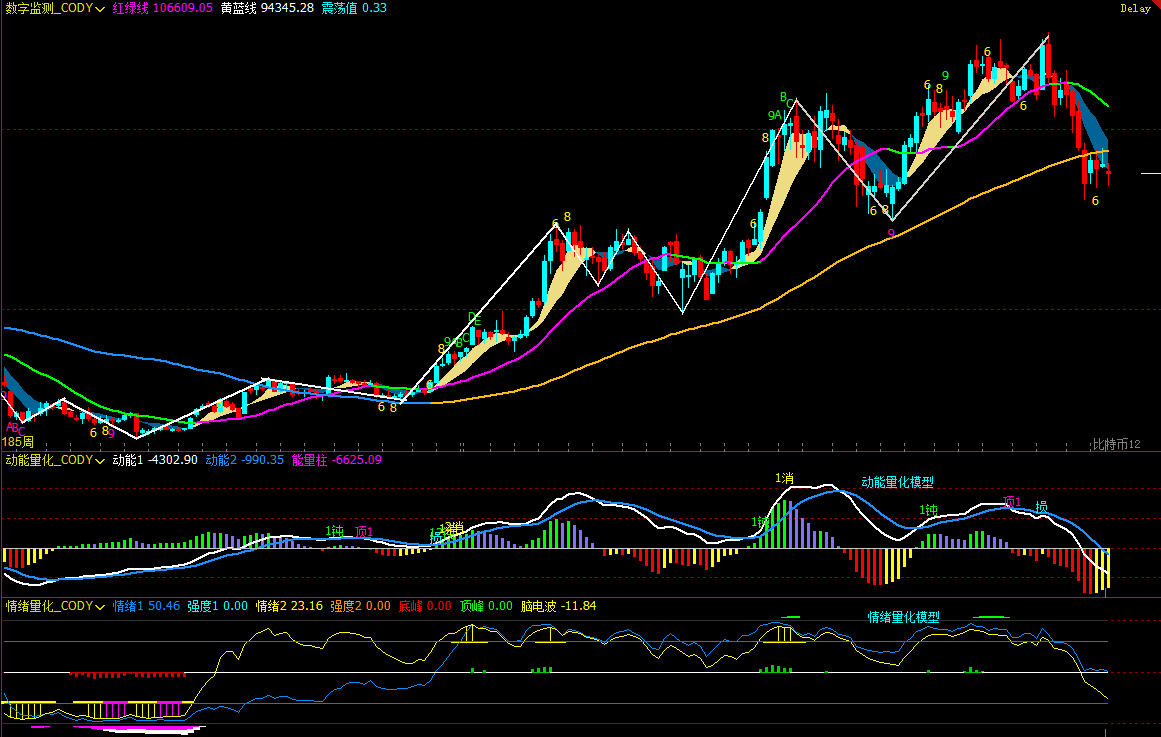
Figure 2

1. As shown in (Figure 2), analysis from the weekly chart:

Momentum Quantitative Model: After last week's adjustment, the two momentum indicator lines are still running below the zero axis, and the negative energy柱 is gradually shortening. This indicates that although the weekly chart has entered a bear market, the bearish momentum has not been fully released.

Momentum Quantitative Model Predicts: Price decline index: High

Sentiment Quantitative Model: Blue sentiment line value 49.74, intensity zero; yellow sentiment line value 19.99 (close to the low threshold), intensity zero, peak value is 0.

Sentiment Quantitative Model Predicts: Price pressure and support index: Neutral

Digital Monitoring Model: The price has broken below the bull-bear (yellow-blue line) dividing line for 6 weeks; short-term bottom digital signal (above 9) has not yet appeared.

The above data预示: Bitcoin's weekly chart has established a bearish trend, be wary of subsequent release of bearish forces.

Bitcoin Daily K-line Chart:
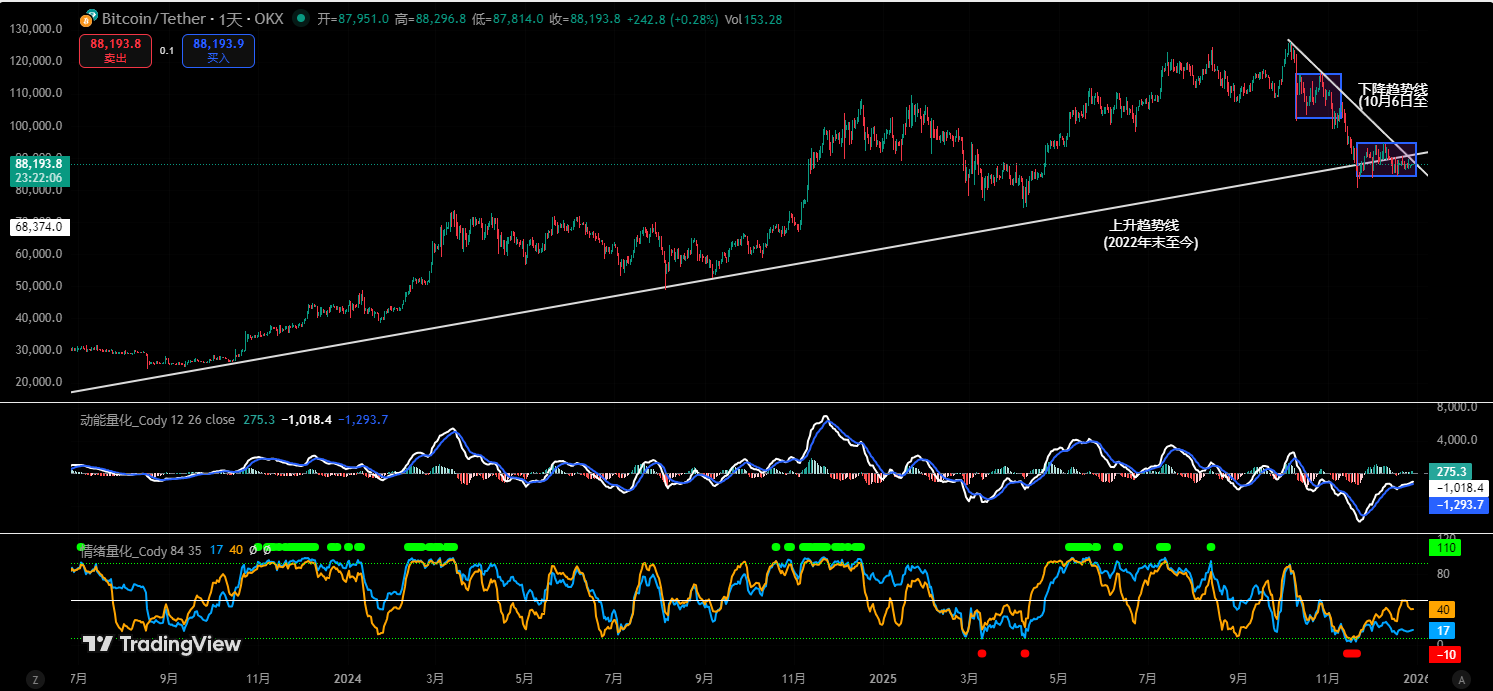
Figure 3

2. As shown in (Figure 3), analysis from the daily chart:

Momentum Quantitative Model: In last week's movement, the two momentum lines were almost粘合 together, slowly rising below the zero axis and gradually approaching the zero axis. Affected by the holiday, daily trading volume continued to萎缩, and the positive energy柱 change was not obvious.

Momentum Quantitative Model Predicts: Buying momentum is weak, the energy柱 has contracted to a "starry" state, indicating a temporary balance between long and short forces.

Sentiment Quantitative Model: After last week's daily close, the blue sentiment line value is 16 (close to the low threshold), intensity zero; yellow sentiment line value is 40, intensity zero.

Sentiment Quantitative Model Predicts: Pressure and support index: Neutral

The above data提示: The daily level is in a bear market, and the short-term market is about to choose a direction.

III. This Week's Bitcoin Market Prediction: (12.29~01.04)

1. It is highly likely that the market will mainly fluctuate and探底 this week, with the core observation range at $86,000~$86,500.

If effectively broken below: The price may continue to探底, testing the support zone below of $83,500~$84,500.

If effectively站稳: The market may延续 the current $86,500~$91,000 range fluctuation pattern.

2. Core Pressure Levels:

• First Pressure Zone: $89,500~$91,000 zone

• Second Pressure Zone: $93,000~$94,500 zone

• Important Pressure Zone: Near $97,000

3. Core Support Levels:

• First Support Level: $86,000~$86,500 zone

• Second Support Level: $83,500~$84,500 zone

• Important Support Level: Near $80,000.

IV. This Week's Bitcoin Operation Strategy (Excluding Sudden News Impact): (12.29~01.04)

1. Medium-term Strategy: Maintain a medium-term position of about 65% (short positions).

2. Short-term Strategy: Use 30% of the position, set stop loss points, and look for "spread" opportunities based on support and pressure levels. (Using 30 minutes as the operation cycle).

3. Focus on observing the struggle between long and short双方 over the $86,000~$86,500 zone. To cope with market evolution, we have drafted A/B two sets of short-term operation plans:

Plan A: If effectively站稳 the $86,000~$86,500 zone:

• Open Position: When the price rebounds to the $89,500~$91,000 zone and shows resistance signals, a 30% short position can be established.

• Risk Control: Short stop loss set above $92,500.

• Close Position: When the price falls to the $86,000~$86,500 zone and shows stabilization signals, close all short positions to take profit.

Plan B: If effectively broken below the $86,000~$86,500 zone:

• Open Position: If the price effectively breaks below, a 30% short position can be established.

• Risk Control: Stop loss set above $88,000.

• Close Position: When the price探 to the $83,500~$84,500 zone shows stabilization signals, gradually close the position to take profit.

V. Special Notes:​​

1. When opening a position: Immediately set the initial stop loss level.

2. When profit reaches 1%: Move the stop loss to the opening cost price (breakeven point), ensuring principal safety.

3. When profit reaches 2%​​: Move the stop loss to the position of 1% profit.

4. Continuous Tracking: Thereafter, for every additional 1% profit the price makes, move the stop loss level同步 by 1%, dynamically protecting and locking in existing profits.

(Note: The above 1% profit trigger threshold can be flexibly adjusted by investors according to their own risk preference and标的 volatility.)

VI. This Week's Key Events前瞻: (12.29~01.04)

1. Fed Meeting Minutes Release "Real Divergence" Signal

Wednesday 03:00, the Fed will release the latest monetary policy meeting minutes. Compared to the interest rate decision itself, the minutes are more critical regarding the degree of divergence among internal members on the "timing, magnitude, and persistence of rate cuts."

If the minutes show increased confidence among officials in the decline of inflation and discuss an earlier or faster easing path, it will strengthen market expectations of "falling real interest rates," constituting a medium-term positive for Bitcoin; conversely, if the minutes emphasize concerns about inflation recurring or financial conditions easing too quickly, it may阶段性 lift the dollar and US bond yields, forming emotional suppression on BTC.

For Bitcoin, this is not a short-term directional signal, but an important node affecting the medium-term fund pricing anchor.

2. Initial Jobless Claims: Thermometer of Liquidity Expectations

Wednesday 21:30, the US will announce the initial jobless claims for the week ending December 27.

The market now pays more attention to "whether the labor market is showing structural cooling" rather than fluctuations in a single data point.

If initial claims持续 above trend levels, it will further verify the economic cooling logic, strengthening market expectations for the continuation of宽松 policies, which is beneficial for the valuation repair of non-yielding assets like Bitcoin; if the data falls again, it may strengthen the judgment that "the economy is still resilient," which is not conducive to the expansion of risk appetite for BTC in the short term.

The impact of this indicator on Bitcoin is mainly reflected in interest rate expectations rather than fundamentals itself.

3. Final Manufacturing PMI Verifies Real Economy Direction

Friday 22:45, the US December S&P Global Manufacturing PMI final value is announced.

As a leading indicator, the PMI will help the market judge whether "soft landing" is still on track.

If the final value confirms that manufacturing is stabilizing or even improving, the overall sentiment of risk assets is expected to be maintained, with limited systematic pressure on BTC; if the PMI is revised down again, it may trigger repricing of economic downturn, short-term bearish for risk assets, but medium to long term may instead strengthen expectations for monetary easing.

Financial markets are changing rapidly, all market analysis and trading strategies need to be dynamically adjusted. All views, analysis models, and operation strategies involved in this article are derived from personal technical analysis, for personal trading log use only, and do not constitute any investment advice or operation basis. The market has risks, investment needs caution, DYOR.


Perguntas relacionadas

QWhat is the analyst's core short-term view on the Bitcoin market as presented in the article?

AThe analyst's core short-term view is that the market is in a state of wide-range consolidation and is about to choose a direction. They emphasize the possibility that major funds might drive a downward break below the $80,000 psychological level to flush out remaining long positions before a potential technical rebound.

QWhat were the key support and resistance levels identified for Bitcoin in the previous week's analysis?

AThe key resistance levels were the first zone at $89,500~$91,000 and the second zone at $93,000~$94,500. The key support levels were the first zone at $86,500~$87,500 and the second zone at $83,500~$84,500.

QAccording to the technical analysis, what is the current state of Bitcoin's medium-term trend based on the weekly chart?

AThe weekly chart analysis confirms that Bitcoin has established a medium-term bearish trend. The momentum量化 model shows indicators below the zero line with negative energy columns shortening, indicating bearish momentum has not been fully released. The sentiment量化 model shows neutral pressure and support indices.

QWhat are the two main short-term trading strategies (Plan A and Plan B) proposed for the upcoming week?

APlan A: If the price holds effectively above the $86,000~$86,500 area, open a 30% short position when the price rebounds to the $89,500~$91,000 resistance zone and shows a rejection signal. Stop loss is set above $92,500. Plan B: If the price effectively breaks below the $86,000~$86,500 area, open a 30% short position. Stop loss is set above $88,000. Take profit when the price falls to the $83,500~$84,500 support zone and shows signs of stabilization.

QWhat key macroeconomic events are highlighted as important for Bitcoin's price movement in the coming week?

AThe key events are: 1. The release of the FOMC Meeting Minutes on Wednesday at 03:00, which could signal internal Fed分歧 on rate cuts. 2. The Weekly Initial Jobless Claims data on Wednesday at 21:30, which acts as a thermometer for liquidity expectations. 3. The S&P Global Manufacturing PMI Final reading on Friday at 22:45, which validates the direction of the real economy.

Leituras Relacionadas

AAOI Defies Trend with Over 10% Surge, 'New Stock God' Serenity Predicts Potential to Double Again

On June 4th, despite a significant sell-off in the broader AI and semiconductor sector triggered by Broadcom's disappointing guidance, Applied Optoelectronics (AAOI) surged over 11%, showcasing a sharp divergence in market sentiment. Broadcom's warning about potential supply chain diversification by key customer Google and a weaker-than-expected outlook punctured the high-flying AI valuation narrative. This led to heavy selling in names like Broadcom (-12.6%) and Micron (-7%), with funds rotating into traditional industrial stocks. AAOI defied this trend. The stock has experienced high volatility recently, driven by bullish analyst coverage, notably from Rosenblatt which raised its price target to $220. Key catalysts include initial 800G optical module revenue from Amazon, potential certification from Oracle, and strong demand across its product portfolio. The company has reported cumulative orders for 800G/1.6T modules exceeding $324 million and is aggressively expanding manufacturing capacity in Texas, targeting an annualized run-rate of $1.4 billion for its module business by Q3 2027. However, AAOI's fundamentals present a mixed picture. Its Q1 2026 results missed expectations, showing a GAAP net loss, and Q2 guidance points to merely breakeven adjusted EPS. Risks include a delayed 800G production ramp to the second half of the year and high dependence on a few key cloud customers. Recent stock sales by company executives near price highs also noted. The article suggests AAOI's rally reflects a market beginning to differentiate within the AI ecosystem. While Broadcom's issues prompted a reassessment of custom ASIC and customer concentration risks, funds flowing into AAOI indicate a belief that the "physical bottleneck" narrative for optical connectivity—where supply remains tight—remains intact and is somewhat decoupled from the current sector weakness. The sustainability of AAOI's premium valuation now hinges on the successful execution of its production plans and upcoming quarterly results.

marsbitHá 6m

AAOI Defies Trend with Over 10% Surge, 'New Stock God' Serenity Predicts Potential to Double Again

marsbitHá 6m

Worried about AI's Self-Evolution, Anthropic Intends to Stop Training?

In early 2026, Anthropic signaled a significant shift in its public narrative regarding AI development timelines and safety. In June, its Anthropic Institute published a detailed article, "When AI builds itself," presenting internal data suggesting accelerating AI self-improvement. Key figures included over 80% of merged code being written by Claude and a 52x speedup in certain optimization tasks. The article outlined three future scenarios, with the most speculative being full recursive self-improvement (RSI), where AI autonomously builds better successors. Anthropic stated RSI is "possible" and may arrive faster than most institutions are prepared for. This narrative pivot followed a series of strategic moves. In January, CEO Dario Amodei wrote about a powerful self-improvement feedback loop. In February, Anthropic revised its Responsible Scaling Policy, removing a core commitment to pause training if capabilities outstripped safety controls, citing the risk of falling behind competitors. This change coincided with reported pressure from the US Department of Defense. By May, Anthropic's valuation had soared to $965 billion. Anthropic's stance was mirrored by other industry leaders. DeepMind CEO Demis Hassabis adjusted his AGI timeline to "by 2029" and admitted to using provocative language like "foothills of the singularity" to create urgency. OpenAI also released a model claiming a key role in its own creation process. The article's carefully calibrated tone—presenting dramatic data alongside qualifying footnotes—exemplifies a balancing act between signaling technological acceleration and managing commercial, regulatory, and safety imperatives. External experts offered contrasting interpretations of the same data, from warnings of catastrophic risk akin to Chernobyl to skepticism that current automation merely handles "grunt work," not genius. The coordinated narrative shift among top labs highlights the complex interplay between perceived technical inflection points and strategic communication aimed at investors, regulators, and the public.

marsbitHá 8m

Worried about AI's Self-Evolution, Anthropic Intends to Stop Training?

marsbitHá 8m

The Macroeconomic Underpinnings of Africa's Payment Market Landscape

The African payments market, characterized by the world's highest mobile money penetration and fastest-growing cryptocurrency adoption, is not a coincidence but a macroeconomic necessity driven by deep structural factors. Two key drivers create this landscape: (1) Africa's heavy reliance on commodity exports, trade, and remittances, generating massive cross-border settlement and remittance demand; and (2) chronically underdeveloped financial infrastructure, exacerbated by international bank de-risking, foreign exchange mismanagement, and persistent inflation. This vacuum has allowed mobile money and crypto to thrive. Mobile money platforms replace banks for domestic payments, while cryptocurrencies serve as a store of value against local currency depreciation and a low-cost medium for cross-border exchange. A crucial division lies along the Sahara Desert. North Africa is integrated into the oil-anchored MENA framework, while Sub-Saharan Africa (SSA), plagued by dollar shortages and fragmented currencies, has become a natural, massive market for mobile money and crypto. Nigeria, Kenya, and South Africa are global leaders in adoption. The SSA economy is deeply dollarized due to currency instability, yet suffers from a severe "dollar shortage" caused by trade deficits and limited export capacity. This creates parallel forex markets and high remittance costs. Cryptocurrencies, particularly stablecoins, fill this gap by providing access to dollar liquidity, cheaper cross-border transfers, and an inflation-resistant store of value, primarily driven by retail users for small-value transactions. While regional initiatives like PAPSS aim to reduce dollar dependence, the fundamental constraints of commodity reliance, trade imbalances, and shallow financial markets persist. Therefore, mobile money and cryptocurrencies are not niche trends but essential financial infrastructure filling a structural void, and they are likely to remain central to Africa's economic landscape for the foreseeable future.

链捕手Há 18m

The Macroeconomic Underpinnings of Africa's Payment Market Landscape

链捕手Há 18m

Trading

Spot
Futuros

Artigos em Destaque

Como comprar BILL

Bem-vindo à HTX.com!Tornámos a compra de Billions Network (BILL) simples e conveniente.Segue o nosso guia passo a passo para iniciar a tua jornada no mundo das criptos.Passo 1: cria a tua conta HTXUtiliza o teu e-mail ou número de telefone para te inscreveres numa conta gratuita na HTX.Desfruta de um processo de inscrição sem complicações e desbloqueia todas as funcionalidades.Obter a minha contaPasso 2: vai para Comprar Cripto e escolhe o teu método de pagamentoCartão de crédito/débito: usa o teu visa ou mastercard para comprar Billions Network (BILL) instantaneamente.Saldo: usa os fundos da tua conta HTX para transacionar sem problemas.Terceiros: adicionamos métodos de pagamento populares, como Google Pay e Apple Pay, para aumentar a conveniência.P2P: transaciona diretamente com outros utilizadores na HTX.Mercado de balcão (OTC): oferecemos serviços personalizados e taxas de câmbio competitivas para os traders.Passo 3: armazena teu Billions Network (BILL)Depois de comprar o teu Billions Network (BILL), armazena-o na tua conta HTX.Alternativamente, podes enviá-lo para outro lugar através de transferência blockchain ou usá-lo para transacionar outras criptomoedas.Passo 4: transaciona Billions Network (BILL)Transaciona facilmente Billions Network (BILL) no mercado à vista da HTX.Acede simplesmente à tua conta, seleciona o teu par de trading, executa as tuas transações e monitoriza em tempo real.Oferecemos uma experiência de fácil utilização tanto para principiantes como para traders experientes.

242 Visualizações TotaisPublicado em {updateTime}Atualizado em 2026.06.02

Como comprar BILL

O que é ATWO

I. Introdução ao ProjetoArena Two é uma plataforma interativa descentralizada que permite aos fãs desempenhar um papel ativo e tokenizado nos resultados de eventos em tempo real. Ao contrário dos modelos tradicionais de transmissão que reduzem os fãs a espectadores passivos, a Arena Two utiliza a tecnologia blockchain para permitir que os fãs votem diretamente em tempo real e influenciem os resultados em campo.II. Informação sobre o TokenNome do token: ATWO(Arena Two)III. Links RelacionadosWebsite:https://arenatwo.com/Exploradores:https://basescan.org/token/0x499D35eBE6cEe9B2Ac35Fd003fcBbeeB9CFc7B32Twitter:https://x.com/arenatwoXNota: A introdução ao projeto provém dos materiais publicados ou fornecidos pela equipa oficial do projeto, que é apenas para referência e não constitui aconselhamento de investimento. A HTX não se responsabiliza por quaisquer perdas diretas ou indiretas resultantes.

210 Visualizações TotaisPublicado em {updateTime}Atualizado em 2026.06.02

O que é ATWO

Como comprar ATWO

Bem-vindo à HTX.com!Tornámos a compra de Arena Two (ATWO) simples e conveniente.Segue o nosso guia passo a passo para iniciar a tua jornada no mundo das criptos.Passo 1: cria a tua conta HTXUtiliza o teu e-mail ou número de telefone para te inscreveres numa conta gratuita na HTX.Desfruta de um processo de inscrição sem complicações e desbloqueia todas as funcionalidades.Obter a minha contaPasso 2: vai para Comprar Cripto e escolhe o teu método de pagamentoCartão de crédito/débito: usa o teu visa ou mastercard para comprar Arena Two (ATWO) instantaneamente.Saldo: usa os fundos da tua conta HTX para transacionar sem problemas.Terceiros: adicionamos métodos de pagamento populares, como Google Pay e Apple Pay, para aumentar a conveniência.P2P: transaciona diretamente com outros utilizadores na HTX.Mercado de balcão (OTC): oferecemos serviços personalizados e taxas de câmbio competitivas para os traders.Passo 3: armazena teu Arena Two (ATWO)Depois de comprar o teu Arena Two (ATWO), armazena-o na tua conta HTX.Alternativamente, podes enviá-lo para outro lugar através de transferência blockchain ou usá-lo para transacionar outras criptomoedas.Passo 4: transaciona Arena Two (ATWO)Transaciona facilmente Arena Two (ATWO) no mercado à vista da HTX.Acede simplesmente à tua conta, seleciona o teu par de trading, executa as tuas transações e monitoriza em tempo real.Oferecemos uma experiência de fácil utilização tanto para principiantes como para traders experientes.

123 Visualizações TotaisPublicado em {updateTime}Atualizado em 2026.06.02

Como comprar ATWO

Discussões

Bem-vindo à Comunidade HTX. Aqui, pode manter-se informado sobre os mais recentes desenvolvimentos da plataforma e obter acesso a análises profissionais de mercado. As opiniões dos utilizadores sobre o preço de A (A) são apresentadas abaixo.

活动图片