Bitcoin Funding Rate Hits Three-Month Low: What Did the Shorts Already Know?

marsbitPublicado em 2026-03-09Última atualização em 2026-03-09

Resumo

Bitcoin's derivatives market signaled significant downside pressure ahead of key macro data, as funding rates turned deeply negative — hitting around -6% on February 28, a three-month low — while open interest (in BTC terms) continued to rise. This combination indicated that traders were aggressively shorting or hedging, using high leverage, even before the U.S. employment report was released. When the jobs data came in softer than expected, it triggered a macro repricing event. The negative funding rates reflected a crowded speculative position favoring shorts, meaning sellers were paying buyers to maintain their bearish bets. Such conditions can persist if hedging demand is genuine or if trend-following behavior continues, rather than simply indicating an imminent reversal. The real signal occurs when negative funding rates coincide with stable or rising open interest — suggesting new short positions are still entering — while price fails to make new lows. Liquidations then act as a scoreboard: cascading long or short squeezes confirm whether volatility has forced positions to unwind. In summary, derivatives metrics — funding rates, open interest, and liquidations — provided a clear, early warning of building risk and leveraged positioning prior to the macro catalyst. The market’s reaction was ultimately a function of crowded positions meeting a macroeconomic trigger.

Author: CryptoSlate

Compiled by: Deep Tide TechFlow

Deep Tide Guide: This article explains an important market mechanism: Before macroeconomic data was announced, the Bitcoin derivatives market had already clearly signaled risks through three dimensions—funding rates, open interest, and liquidations. Understanding this logic allows one to see the real market pressures earlier than chasing any narrative.

Full Text Below:

The Bitcoin derivatives market provides the best explanation for this week's macro pressures.

Funding rates turned sharply negative, open interest remained high, and then the U.S. jobs report landed. These three events together indicate that the market had heavily positioned for downside hedging before the actual macro catalyst arrived.

This sequence is worth understanding because it explains how macro volatility enters the crypto market.

It usually appears first in perpetual contracts—where hedging is fastest and leverage usage is highest.

Funding rates tell you which side is paying to maintain positions, open interest tells you how many positions remain in the system, and liquidation data tells you when these positions start to break.

On February 28, Bitcoin perpetual funding rates fell to approximately -6%, one of the most negative readings in nearly three months. BTC-denominated open interest rose from about 113,380 BTC at the beginning of the year to 120,260 BTC.
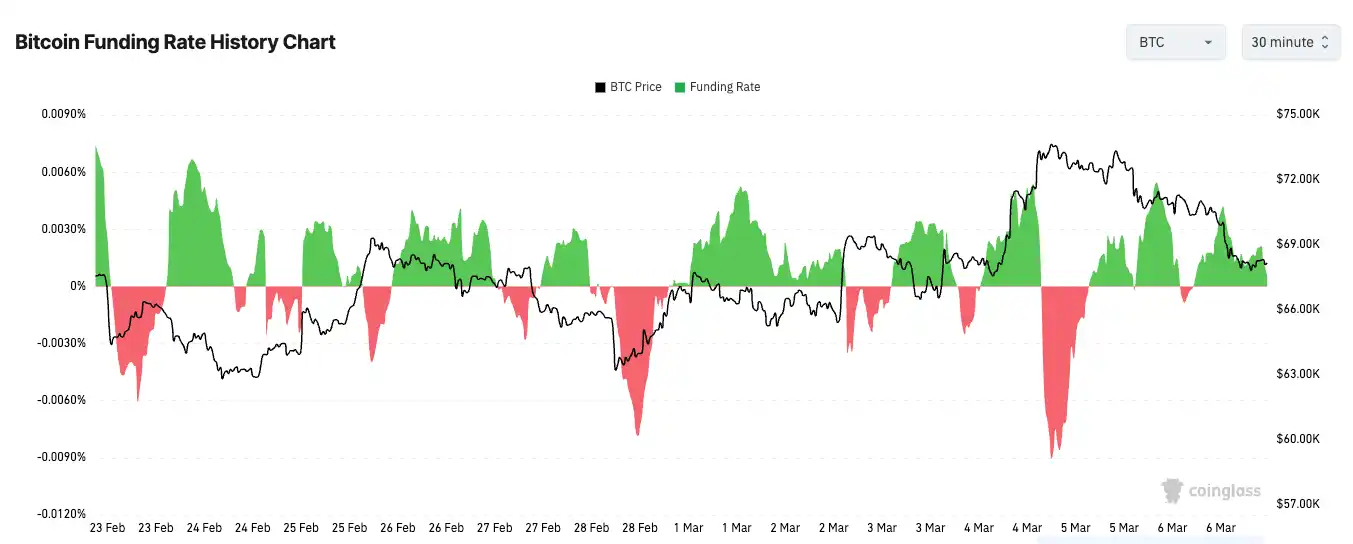
This combination is important because it points to two things simultaneously: Traders are aggressively betting on the downside, and they are doing so with more leverage entering the market. The market is both very tense and very crowded.

This is the simplest way to understand how macro pressure enters the crypto market.

It appears in the derivatives ledger, not as a neatly packaged X narrative or a tidy economist report. Traders act there first because perpetual contracts are liquid, low-cost, and always available.

When they worry about growth, interest rates, or broader risk-off sentiment, they short perpetual contracts; these contracts fall below spot, and funding rates turn negative because shorts must pay longs to maintain their positions.

Why Negative Funding Rates Persist

But negative funding rates alone are not a bottom signal; they only tell you which way the market is leaning.

This distinction is important because traders like to turn every extreme reading into a prediction.

Extremely negative funding rates can signal short covering, and last week's setup clearly created that possibility. But when hedging demand is real, it can also persist longer than expected.

Extreme spikes and drops in funding rates reflect one-sided positioning, which can persist during strong directional moves.

This persistence usually comes from two places.

Some traders are hedging real spot exposure, meaning they are not precisely predicting the next move but simply protecting their portfolios. Others are simple trend followers, willing to pay funding rates as long as the market continues moving in their direction. Both types can keep funding rates negative even after the initial panic has passed.

That's why the real signal isn't whether funding rates are negative. A more interesting pattern emerges when funding rates remain significantly negative while prices stop making new lows. Then, pressure begins to build beneath the surface. Shorts are still paying to maintain positions, but the market is no longer rewarding them in the same way. This is how short-covering conditions form.

The Jobs Report Brought Real Macro Input to the Market

This week's macro catalyst came from the U.S. labor market. On March 6, the Bureau of Labor Statistics reported a loss of 92,000 non-farm jobs in February, with an unemployment rate of 4.4%.

Such reports trigger broad repricing because they touch on multiple market themes. A weaker labor market could lower yields if traders believe the Fed may need a more dovish path. It could also hit risk appetite if traders interpret the data as a sign of real economic weakness.

The crypto market typically feels this debate more intensely because leverage turns macro issues into positioning events.

If traders are heavily short and macro data even briefly eases financial conditions, prices can surge rapidly as shorts are forced to cover.

If the data deepens risk-off sentiment, the same crowded positioning can continue to pressure downward as shorts remain comfortable and longs start to capitulate.

Funding rates are the pressure gauge, open interest is the fuel, and liquidations are the moment pressure starts to break through the system.

Liquidation Data Is the Scoreboard

Liquidation data tells you whether the move is orderly or forced.

Short liquidations usually confirm a covering event, while long liquidations usually confirm a washout to the downside. When both longs and shorts are liquidated in a short time, the market is telling you that volatility has taken over, and neither side has much room to hold positions.

That's why liquidation data is best used as a confirmation layer. Funding rates set the conditions, but liquidations tell you whether those conditions are actually forced into price.

Open interest is equally important here. If participation shrinks synchronously, falling prices and negative funding rates don't say much.

This may only mean traders are stepping back to wait and see. But when open interest rises alongside negative funding rates, it means new positions are being built with a bearish or defensive bias.

Tracking open interest in BTC terms removes some distortions from price fluctuations, so a rise in BTC-denominated open interest during price declines more clearly reflects market participation.

From this perspective, the past week wasn't really about Bitcoin's strength or weakness but about where pressure was building.

The derivatives market showed heavy shorting or hedging before the jobs data landed.

The jobs report then provided a real macro input for global markets to process.

When these two things met, the crypto market did what it usually does: It expressed the same macro uncertainty everyone was facing with larger candles, faster reversals, and more violent position liquidations.

Funding rates don't predict price; they only tell you where leverage is leaning. Open interest doesn't tell you who is right, only how many positions are still on the field. Liquidation data doesn't explain the entire move, only when the move becomes involuntary.

That's why derivatives ultimately became the best macro explainer this week. Before the narrative dust settled, the ledger had already painted the risks clearly. Traders were shorting, leverage was still in the system, and the jobs report gave the market a real object to react to.

What happened afterward was simply price discovering how crowded the room was.

Perguntas relacionadas

QWhat does a negative funding rate in Bitcoin perpetual contracts indicate about market sentiment?

AA negative funding rate indicates that traders are heavily betting on the downside, as shorts are paying longs to maintain their positions, reflecting bearish sentiment and hedging activity.

QHow did the US employment report on March 6 impact the crypto market?

AThe US employment report, which reported a loss of 92,000 non-farm jobs and a 4.4% unemployment rate, served as a macro catalyst that triggered broad repricing, affecting risk appetite and potentially influencing Federal Reserve policy, leading to increased volatility and liquidations in the crypto market.

QWhy is the combination of negative funding rates and high open interest significant?

AThe combination of negative funding rates and high open interest signals that traders are aggressively shorting or hedging while more leverage is entering the market, indicating both high tension and crowded positioning, which can amplify market moves when macro catalysts occur.

QWhat role do liquidation data play in confirming market conditions?

ALiquidation data acts as a scoreboard, confirming whether market moves are orderly or forced. Short liquidations indicate covering, while long liquidations confirm a sell-off; simultaneous liquidations of both sides show volatility has taken control, with little room for either side to hold positions.

QHow do Bitcoin derivatives provide insight into macro pressure before traditional narratives?

ABitcoin derivatives, through funding rates, open interest, and liquidations, reveal risk and hedging activity in real-time, often ahead of macro events. They show where pressure is building in the market, offering a clearer picture of sentiment and leverage dynamics before economic data or narratives are fully absorbed.

Leituras Relacionadas

In-Depth Report on the On-Chain Lending Market: When Off-Chain Credit Meets On-Chain Liquidation

The on-chain lending market has evolved from a peripheral DeFi niche into core financial infrastructure. As of early 2026, total value locked (TVL) in on-chain lending protocols has reached $64.3 billion, accounting for 53.54% of total DeFi TVL, making it the largest and most mature vertical within decentralized finance. Aave dominates the sector with approximately $32.9 billion in TVL, commanding nearly half of the market—a leadership position that is unlikely to be challenged in the foreseeable future. However, the path of on-chain lending forward is not without risk. Liquidation cascades, credit defaults, and cross-chain vulnerabilities remain systemic threats hanging over the industry. At the same time, a deeper structural transformation is underway: on-chain lending is shifting from a “leverage tool for crypto-native users” to a “compliant gateway for institutional capital”. The scale of RWA (Real World Asset) lending has surpassed $18.5 billion, with U.S. Treasuries and government securities increasingly serving as core collateral. Institutional capital inflows are reshaping both the user base and risk appetite of the sector. This report systematically analyzes the evolution of on-chain lending definitions, competitive dynamics, core risks, and future trends, providing a comprehensive industry outlook for investors and trade practitioners. Key findings suggest that the “one dominant player with several strong challengers” structure will persist in the short term, while fixed-rate lending, compliant collateral, and institutional credit underwriting will define the next phase of competition. For investors focused on DeFi infrastructure, three key opportunity tracks stand out, namely, the Aave ecosystem (Morpho, Spark), RWA lending protocols (Ondo, Maple) and fixed-rate innovation (Notional, Pendle).

HTX LearnHá 6m

In-Depth Report on the On-Chain Lending Market: When Off-Chain Credit Meets On-Chain Liquidation

HTX LearnHá 6m

Fu Peng's First Public Speech in 2026: What Exactly Are Crypto Assets? Why Did I Join the Crypto Asset Industry?

Fu Peng, a renowned macroeconomist and now Chief Economist at New火 Group, delivered his first public speech of 2026 at the Hong Kong Web3 Festival. He explained his perspective on crypto assets and why he joined the industry, framing it within the context of macroeconomic trends and financial evolution. Fu emphasized that crypto assets are transitioning from an early, belief-driven phase to a mature, institutionally integrated asset class. He drew parallels to the 1970s-80s, when technological advances (like computing) revolutionized traditional finance, leading to the rise of FICC (Fixed Income, Currencies, and Commodities). Similarly, current advancements in AI, data, and blockchain are reshaping finance, with crypto assets becoming part of a new "FICC + C" (C for Crypto) framework. He noted that institutional capital, including traditional hedge funds, avoided early crypto due to its speculative nature but are now engaging as regulatory clarity emerges (e.g., stablecoin laws, CFTC classifying crypto as a commodity). Fu predicted that 2025-2026 marks a turning point where crypto becomes a standardized, financially viable asset for diversified portfolios, akin to commodities or derivatives in traditional finance. Fu defined Bitcoin not as "digital gold" in a simplistic sense but as a value-preserving, financially tradable asset. He highlighted that crypto's future lies in regulated, institutional adoption, moving away from retail-dominated trading. His entry into crypto signals this maturation, where traditional finance integrates crypto into mainstream asset management.

marsbitHá 1h

Fu Peng's First Public Speech in 2026: What Exactly Are Crypto Assets? Why Did I Join the Crypto Asset Industry?

marsbitHá 1h

Justin Sun Sues Trump Family: What $75 Million Bought Was Only a Blacklist

Justin Sun, founder of Tron, has filed a lawsuit in federal court against World Liberty Financial (WLF), alleging he was made the "primary target of a fraudulent scheme" after investing $75 million. Sun claims the investment secured him an advisor title and WLFI tokens, which were later frozen by WLF, causing "hundreds of millions in losses." The dispute began in late 2024 when Sun's investment helped revive WLF's struggling token sale, which ultimately raised $550 million. Shortly after, the SEC dropped its lawsuit against Sun following Donald Trump's inauguration. However, relations soured when Sun refused WLF's demands for additional funding. In August 2025, WLF added a "blacklist" function to its smart contract, allowing it to unilaterally freeze tokens. Sun's holdings, worth approximately $107 million, were frozen, and he was threatened with token destruction. The lawsuit highlights WLF's structure, which directs 75% of token sale profits to the Trump family, who had earned $1 billion by December 2025. WLF's CEO is Zach Witkoff, son of U.S. Middle East envoy Steve Witkoff. The project faces scrutiny for opaque operations, including a controversial loan arrangement on the Dolomite platform, co-founded by a WLF advisor. Despite Sun's history with the SEC, the case underscores centralization risks within DeFi, as WLF controls governance and holds powers to freeze assets arbitrarily. Sun's tokens remain frozen as legal proceedings begin.

marsbitHá 1h

Justin Sun Sues Trump Family: What $75 Million Bought Was Only a Blacklist

marsbitHá 1h

Trading

Spot
Futuros
活动图片