Bitcoin Following The 2022 Cycle? What To Expect If It Plays Out The Same Way

bitcoinistPublicado em 2026-03-12Última atualização em 2026-03-12

Resumo

The current Bitcoin market structure is showing similarities to the transition into the 2022 bear market, according to technical analysis. Following a cycle peak, Bitcoin has fallen below the 50-week Simple Moving Average (SMA), a key indicator that historically signals a shift from bullish momentum to a broader downtrend. After this breakdown, a brief consolidation and relief rally occurred, but it failed to reclaim the lost level, mirroring the pattern from the previous cycle. Additionally, the Relative Strength Index (RSI) has dropped below the 45 level, indicating weakening underlying market strength and echoing the momentum breakdown that preceded the prolonged 2022 decline. A descending trendline on the RSI has also capped multiple failed breakout attempts. If this pattern continues, Bitcoin could experience another significant downward leg before forming a definitive market bottom.

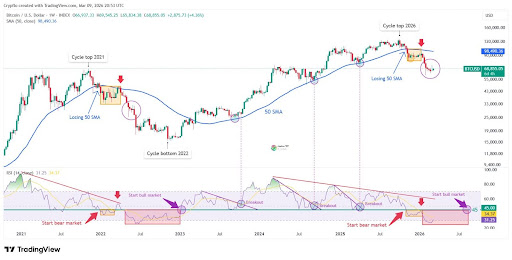
The current structure of Bitcoin may be unfolding in a way that closely resembles the transition that led into the 2022 bear market. A chart shared by an analyst on X highlights several technical signals that appeared during the 2021–2022 shift and are now emerging again in 2026. According to the comparison, the market could still face another downward phase before a definitive bottom forms.

Bitcoin Losing The 50-Week SMA Signals Structural Shift

During the previous cycle, Bitcoin peaked in 2021 before eventually falling below the 50-week simple moving average (SMA). That breakdown marked a turning point in the broader market structure. After losing the level, price entered a short consolidation phase where a relief rally briefly developed, but the recovery failed to reclaim the lost structure. The weakness ultimately extended into the prolonged decline that defined the 2022 bear market.

A similar sequence is now visible following the projected 2026 cycle top. According to @_cryptflow_ on X, Bitcoin recently moved beneath the 50-week SMA after peaking earlier in the cycle. This indicator has historically served as a major dividing line between sustained bullish momentum and broader downtrends, meaning its loss often signals a shift in the market’s underlying strength.
Source: X

The chart also outlines a comparable reaction after the breakdown. In both cycles, price stabilized temporarily after slipping below the moving average and attempted a recovery. However, those rebounds failed to reclaim the lost level, leaving the broader downward structure intact.

This stage is illustrated in the chart with a consolidation box forming after the break below the 50-week SMA. The zone represents a relief rally phase where the price attempts to recover but struggles to regain momentum. In the previous cycle, that temporary stabilization was followed by another significant decline, suggesting the current structure could still evolve in a similar direction.

Relative Strength Index (RSI) Signals Bear Market Shift

Beyond price structure, the chart also highlights the behavior of the RSI. During the previous market transition, the RSI dropping below the 45 level marked the beginning of a sustained bearish phase, separating bullish momentum from a period of prolonged weakness.

The same pattern is emerging again, with the chart showing RSI recently falling below the 45 level, echoing the momentum breakdown that preceded the extended 2022 decline. This shift suggests that underlying market strength may already be weakening as conditions move away from the bullish environment that characterized the earlier stage of the cycle.

The RSI chart also features a descending trendline that has repeatedly capped momentum since the cycle peak. Several breakout attempts occurred during the last bull phase, but each ultimately failed before momentum reversed. Similar failed breakout attempts are now visible in the current cycle.

If the broader structure continues to mirror the earlier template, the chart suggests Bitcoin could still experience another downward leg before a clear bottom forms. While cycles rarely repeat identically, the comparison highlights how similar momentum shifts and structural breaks have historically preceded deeper market corrections.

Bitcoin pushes above $70,000 | Source: BTCUSD on Tradingview.com

Perguntas relacionadas

QAccording to the analyst's chart, what key moving average did Bitcoin break below in both the 2021-2022 cycle and the current 2026 cycle, signaling a structural shift?

AThe 50-week simple moving average (SMA).

QWhat does the article suggest typically happens after Bitcoin loses the 50-week SMA, based on the previous cycle?

AThe price enters a short consolidation phase with a relief rally that fails to reclaim the lost level, which is often followed by a prolonged decline.

QWhat level on the Relative Strength Index (RSI) is identified as a critical signal for the beginning of a sustained bearish phase?

AThe RSI dropping below the 45 level.

QWhat pattern on the RSI chart has repeatedly capped momentum since the cycle peak in both cycles?

AA descending trendline.

QIf the current cycle continues to mirror the 2021-2022 template, what does the analyst suggest could happen before a definitive bottom is formed?

ABitcoin could experience another downward leg or significant decline.

Leituras Relacionadas

If the AI Bubble Is Already Bursting, Who Will Truly Survive?

If the AI Bubble is Bursting, Who Will Remain? The debate over an AI bubble is intensifying, with figures like Ray Dalio warning of high levels and Jensen Huang seeing immense, early-stage opportunity. Both views hold truth: a speculative bubble in capital markets likely exists, mirroring the dot-com era, but the underlying technological shift is real and transformative. History shows that while bubbles burst—wiping out overvalued companies and speculative capital—they often leave behind critical physical and digital infrastructure. The dot-com bust, for instance, eliminated many firms but left the global fiber optic networks and data centers that enabled the rise of Amazon, Netflix, and cloud computing. Today's massive AI infrastructure investments (projected at trillions by 2030) in data centers, power, cooling, and GPUs may follow a similar path, creating the foundation for future applications. A key divergence from past bubbles is the "Jevons Paradox" effect in AI. As the cost of AI inference has plummeted by over 99.7% since 2023, enterprise spending on AI has skyrocketed. Cheap "tokens" have unlocked vast, previously uneconomical use cases, moving AI from simple chatbots into core business workflows—code generation, legal document review, scientific simulation, and financial analysis. The market is now in a phase of self-correction, weeding out superficial "API-wrapper" startups, but this cleansing process strengthens the ecosystem. The long-term trajectory is clear. The value is gradually shifting from capital expenditure (CapEx) on hardware to operational expenditure (OpEx) on transformative applications. As AI becomes a utility, the winners will be firms that deeply integrate it to solve vertical industry problems in law, healthcare, finance, and manufacturing. The泡沫 will recede, but the foundational shift towards an AI-powered era across all sectors is irreversible. The underlying productive force of AI contains no bubble.

marsbitHá 25m

If the AI Bubble Is Already Bursting, Who Will Truly Survive?

marsbitHá 25m

If the AI Bubble Is Already Bursting, Who Will Truly Remain?

**Summary: If the AI Bubble is Bursting, What Will Remain?** The debate around an AI bubble is intensifying, with figures like Ray Dalio warning of high valuations while Jensen Huang sees immense opportunity. This echoes the dot-com bubble, which saw massive wealth destruction but ultimately left behind critical infrastructure like undersea cables and broadband, enabling future giants like Amazon and Netflix. Similarly, today's AI boom involves trillions invested in data centers, power, cooling, and GPUs, while application-layer revenue remains comparatively modest. This investment-disparity signals a bubble. However, the core technological progress is real and accelerating. AI inference costs have plummeted by over 99.7% since 2023, making intelligence increasingly cheap and accessible. This cost collapse is unlocking vast new demand. Instead of reducing spending, enterprises are tripling their AI cloud expenditure. Cheap "tokens" enable AI to move beyond simple chatbots into complex workflows—automating code writing, legal document review, financial analysis, and scientific research. This follows "Jevons's paradox": improved efficiency leads to greater total consumption. The market is now undergoing a necessary purification, weeding out "API-wrapper" startups with no real moat. The deeper evolution involves a shift from capital expenditure (CapEx) on infrastructure to operational expenditure (OpEx) on value-creation in applications. While hardware vendors currently profit most, long-term value will migrate to AI-native firms solving vertical industry problems. Ultimately, a market correction will cleanse speculative excess but will not reverse the AI+ trend. The massive physical and algorithmic infrastructure being built will endure, becoming a cheap, utility-like foundation. Just as the internet became indispensable to all industries post-2000, AI is poised to empower and redefine every sector, moving society irreversibly toward an intelligence-augmented era. The bubble may burst, but the underlying productive momentum is solid.

链捕手Há 31m

If the AI Bubble Is Already Bursting, Who Will Truly Remain?

链捕手Há 31m

Microsoft CEO: In the AI Era, How Do You Define a Company's Moat?

Microsoft CEO Satya Nadella argues that in the AI era, a company's true competitive edge, or "moat," is not determined by choosing the single most powerful model, but by its ability to build a continuous "learning loop." This system integrates and evolves by connecting human workflows, domain expertise, organizational judgment, and employee experience. He posits that future companies will accumulate two types of capital: Human Capital (employee knowledge, judgment, creativity) and "Token Capital" (a firm's own built and owned AI capabilities). Importantly, AI amplifies rather than devalues human capital. Human direction is essential to guide progress, as computational power alone is aimless. The core opportunity lies in creating a closed-loop system where human and token capital reinforce each other in a compound, self-improving cycle. A company must be able to preserve its unique institutional knowledge—its "company veteran" expertise—even if it switches underlying general-purpose AI models. This requires private evaluation benchmarks, reinforcement learning environments based on internal data, and queryable knowledge bases. Nadella warns against a future where economic value is concentrated by a few dominant models that commoditize entire industries' knowledge. Instead, the priority should be building a broad "frontier ecosystem" where every company, industry, and nation can own its learning loop. This allows organizations to retain control of their intellectual property, amplify employee capabilities, and ensure the economic value created by AI is captured within their own businesses and communities. True corporate sovereignty in the AI age comes from turning organizational knowledge into a compounding system that creates enduring, defensible value.

marsbitHá 1h

Microsoft CEO: In the AI Era, How Do You Define a Company's Moat?

marsbitHá 1h

ETFs Are Just the Ticket: The True Institutionalization of Bitcoin Is Happening Where You Can't See It

Beyond the Bitcoin ETF spotlight, a deeper institutionalization is underway, leveraging Bitcoin as a foundational financial primitive. Institutions are using Bitcoin for purposes long reserved for assets like U.S. Treasuries and gold: as collateral for loans, insurance reserves, and the backbone of rated bonds. Examples include a Barbados-based insurer capitalizing with $40M in Bitcoin reserves and Ledn's $188M securitization of Bitcoin-backed loans, which received the first-ever investment-grade rating (BBB-) from S&P for a digital asset-backed security. This structure was stress-tested during a 27% price drop in early 2026, triggering automatic liquidations that functioned as designed but revealed the systemic risk of synchronized selling across leveraged positions. Infrastructure is evolving to support this, with platforms like Anchorage Digital's Atlas network enabling secure, institutional-grade settlement and collateral management. Strategies like basis trades and corporate treasuries (exemplified by companies like MicroStrategy issuing billions in equity and debt to fund Bitcoin acquisitions) further integrate Bitcoin into financial mechanics. While ETFs solved "how to own" Bitcoin, these developments answer "what to do with it," embedding the asset into the working machinery of finance—as collateral upon which loans, derivatives, and structured products are built. The real, enduring institutional shift is happening in these largely invisible plumbing and financing systems.

marsbitHá 1h

ETFs Are Just the Ticket: The True Institutionalization of Bitcoin Is Happening Where You Can't See It

marsbitHá 1h

ZEC Co-Founder Responds to Orchard Vulnerability: No Signs of Theft, Orchard Pool to Be Sealed

ZEC Co-Founder Addresses Orchard Vulnerability: No Signs of Theft, Plans to Sunset Orchard Pool A security vulnerability was recently discovered in Zcash's Orchard shielded pool, raising key concerns. The primary questions are whether the flaw was exploited, if user funds are safe, whether users can verify the total ZEC supply, and if other similar vulnerabilities exist. Analysis suggests the vulnerability was likely not exploited prior to its discovery. It was found proactively by a researcher using specialized tools, not due to an active breach. The development team and mining pools acted quickly to contain the issue. Typical financially-motivated attacks would likely have left visible on-chain evidence, which has not been observed. User funds in Orchard are considered safe and should be recoverable, assuming no prior exploitation. If the flaw was never used, all legitimate funds can be withdrawn. The article outlines risks associated with moving funds to transparent addresses or other pools, but concludes that leaving assets in place is a reasonable option. Currently, users cannot independently verify that the total ZEC supply hasn't been inflated due to this bug. However, the planned Ironwood network upgrade is designed to resolve this. It will permanently close the Orchard pool to new deposits and internal transfers, allowing only withdrawals. This mechanism will cap total withdrawals at the amount of legitimately deposited funds, enabling anyone to cryptographically verify the supply post-upgrade. Multiple teams, including Shielded Labs, have conducted extensive audits focused on counterfeiting vulnerabilities, assisted by advanced AI tools. No additional flaws of this type have been found so far, increasing confidence that no other similar undisclosed vulnerabilities exist. In summary, evidence indicates the Orchard bug was probably not used, user funds are secure, and no other counterfeiting flaws are currently known. The upcoming Ironwood upgrade will restore users' ability to independently verify the total ZEC supply, closing this chapter.

Foresight NewsHá 1h

ZEC Co-Founder Responds to Orchard Vulnerability: No Signs of Theft, Orchard Pool to Be Sealed

Foresight NewsHá 1h

Trading

Spot
Futuros

Artigos em Destaque

O que é BITCOIN

Compreender o HarryPotterObamaSonic10Inu (ERC-20) e a Sua Posição no Espaço Cripto Nos últimos anos, o mercado de criptomoedas assistiu a um aumento na popularidade das moedas meme, cativando não apenas os traders, mas também aqueles que procuram envolvimento comunitário e valor de entretenimento. Entre estes tokens únicos está o HarryPotterObamaSonic10Inu (ERC-20), um projeto intrigante que mistura referências culturais no tecido das criptomoedas. Este artigo explora os principais aspetos do HarryPotterObamaSonic10Inu, examinando os seus mecanismos, a sua ética orientada pela comunidade e o seu envolvimento com o vasto panorama cripto. O que é o HarryPotterObamaSonic10Inu (ERC-20)? Como o nome sugere, o HarryPotterObamaSonic10Inu é uma moeda meme construída na blockchain Ethereum, classificada sob o padrão ERC-20. Ao contrário das criptomoedas tradicionais, que podem enfatizar a utilidade prática ou o potencial de investimento, este token prospera no valor de entretenimento e na força da sua comunidade. O projeto visa promover um ambiente onde utilizadores envolvidos possam reunir-se, partilhar ideias e participar em atividades inspiradas por diversos fenómenos culturais. Uma característica notável do HarryPotterObamaSonic10Inu é a zero taxa sobre transações. Este elemento atraente visa encorajar a negociação e o envolvimento da comunidade, isento de encargos adicionais que podem desencorajar os traders de pequena escala. A oferta total da moeda está fixada em mil milhões de tokens, uma cifra que marca a sua intenção de manter uma circulação substancial dentro da comunidade. Criador do HarryPotterObamaSonic10Inu (ERC-20) As origens do HarryPotterObamaSonic10Inu estão um pouco envoltas em mistério; os detalhes sobre o criador permanecem desconhecidos. O desenvolvimento deste token carece de uma equipa identificável ou de um plano explícito, o que não é raro no setor das moedas meme. Em vez disso, o projeto surgiu de forma orgânica, com o seu progresso a depender fortemente do entusiasmo e da participação da sua comunidade. Investidores do HarryPotterObamaSonic10Inu (ERC-20) No que diz respeito a investimentos externos e apoios, o HarryPotterObamaSonic10Inu também permanece ambíguo. O token não lista quaisquer fundações de investimento conhecidas ou apoio organizacional significativo. Em vez disso, o “sangue vital” do projeto é a sua comunidade de base, que informa o seu crescimento e sustentabilidade através da ação coletiva e do envolvimento no espaço cripto. Como Funciona o HarryPotterObamaSonic10Inu (ERC-20)? Como uma moeda meme, o HarryPotterObamaSonic10Inu opera principalmente fora dos quadros tradicionais que muitas vezes governam o valor dos ativos. Existem vários aspetos distintivos que definem como o projeto funciona: Transações Sem Taxas: Sem taxas sobre transações, os utilizadores podem comprar e vender o token livremente, sem a preocupação de custos ocultos. Envolvimento da Comunidade: O projeto prospera na interação da comunidade, aproveitando plataformas de redes sociais para criar entusiasmo e facilitar a participação. Discussões, partilha de conteúdo e envolvimento são elementos cruciais que ajudam a expandir o seu alcance e a fomentar a lealdade entre os apoiantes. Sem Utilidade Prática: Deve ser notado que o HarryPotterObamaSonic10Inu não oferece utilidade concreta dentro do ecossistema financeiro. Em vez disso, é classificado como um token principalmente para entretenimento e atividades comunitárias. Referência Cultural: O token incorpora de forma inteligente elementos da cultura popular para atrair interesse, conectando-se tanto com entusiastas de memes como com seguidores de criptomoedas. HarryPotterObamaSonic10Inu exemplifica como as moedas meme operam de forma diferente de projetos de criptomoedas mais tradicionais, entrando no mercado como construções sociais inovadoras em vez de ativos utilitários. Linha do Tempo do HarryPotterObamaSonic10Inu (ERC-20) A história do HarryPotterObamaSonic10Inu é marcada por vários marcos notáveis: Criação: O token surgiu de um meme viral, capturando a imaginação de muitos entusiastas de criptomoedas. Datas específicas de criação não estão disponíveis, sublinhando a sua ascensão orgânica. Listagem em Exchanges: O HarryPotterObamaSonic10Inu conseguiu entrar em várias exchanges, permitindo um acesso e negociação mais fáceis pela comunidade. Iniciativas de Envolvimento da Comunidade: Atividades contínuas direcionadas a melhorar a interação comunitária, incluindo concursos, campanhas em redes sociais e geração de conteúdo por fãs e defensores. Planos de Expansão Futura: O roteiro do projeto inclui o lançamento de uma coleção de NFTs, mercadorias e um site de eCommerce relacionado aos seus temas culturais, envolvendo ainda mais a comunidade e tentando adicionar mais dimensões ao seu ecossistema. Pontos-Chave sobre o HarryPotterObamaSonic10Inu (ERC-20) Natureza Orientada pela Comunidade: O projeto prioriza a contribuição coletiva e a criatividade, assegurando que o envolvimento dos utilizadores está na vanguarda do seu desenvolvimento. Classificação como Moeda Meme: Representa o epítome da criptomoeda baseada em entretenimento, destacando-se dos veículos de investimento tradicionais. Sem Afiliação Direta com o Bitcoin: Apesar da semelhança no nome do ticker, o HarryPotterObamaSonic10Inu é distinto e não tem qualquer relação com o Bitcoin ou outras criptomoedas estabelecidas. Foco na Colaboração: O HarryPotterObamaSonic10Inu é projetado para criar um espaço de colaboração e partilha de histórias entre os seus detentores, proporcionando uma via para a criatividade e o fortalecimento da comunidade. Perspectivas Futuras: A ambição de expandir além da sua premissa inicial para NFTs e mercadorias delineia um caminho para o projeto potencialmente entrar em avenidas mais mainstream dentro da cultura digital. À medida que as moedas meme continuam a capturar a imaginação da comunidade cripto, HarryPotterObamaSonic10Inu (ERC-20) destaca-se devido aos seus laços culturais e abordagem centrada na comunidade. Embora possa não se encaixar no molde típico de um token orientado para utilidade, a sua essência reside na alegria e camaradagem fomentadas entre os seus apoiantes, destacando a natureza em evolução das criptomoedas em uma era cada vez mais digital. À medida que o projeto continua a desenvolver-se, será importante observar como as dinâmicas comunitárias influenciam a sua trajetória no panorama em constante mudança da tecnologia blockchain.

1.7k Visualizações TotaisPublicado em {updateTime}Atualizado em 2024.12.03

O que é BITCOIN

Como comprar BTC

Bem-vindo à HTX.com!Tornámos a compra de Bitcoin (BTC) simples e conveniente.Segue o nosso guia passo a passo para iniciar a tua jornada no mundo das criptos.Passo 1: cria a tua conta HTXUtiliza o teu e-mail ou número de telefone para te inscreveres numa conta gratuita na HTX.Desfruta de um processo de inscrição sem complicações e desbloqueia todas as funcionalidades.Obter a minha contaPasso 2: vai para Comprar Cripto e escolhe o teu método de pagamentoCartão de crédito/débito: usa o teu visa ou mastercard para comprar Bitcoin (BTC) instantaneamente.Saldo: usa os fundos da tua conta HTX para transacionar sem problemas.Terceiros: adicionamos métodos de pagamento populares, como Google Pay e Apple Pay, para aumentar a conveniência.P2P: transaciona diretamente com outros utilizadores na HTX.Mercado de balcão (OTC): oferecemos serviços personalizados e taxas de câmbio competitivas para os traders.Passo 3: armazena teu Bitcoin (BTC)Depois de comprar o teu Bitcoin (BTC), armazena-o na tua conta HTX.Alternativamente, podes enviá-lo para outro lugar através de transferência blockchain ou usá-lo para transacionar outras criptomoedas.Passo 4: transaciona Bitcoin (BTC)Transaciona facilmente Bitcoin (BTC) no mercado à vista da HTX.Acede simplesmente à tua conta, seleciona o teu par de trading, executa as tuas transações e monitoriza em tempo real.Oferecemos uma experiência de fácil utilização tanto para principiantes como para traders experientes.

4.2k Visualizações TotaisPublicado em {updateTime}Atualizado em 2026.06.02

Como comprar BTC

O que é $BITCOIN

OURO DIGITAL ($BITCOIN): Uma Análise Abrangente Introdução ao OURO DIGITAL ($BITCOIN) OURO DIGITAL ($BITCOIN) é um projeto baseado em blockchain que opera na rede Solana, com o objetivo de combinar as características dos metais preciosos tradicionais com a inovação das tecnologias descentralizadas. Embora partilhe um nome com o Bitcoin, frequentemente referido como “ouro digital” devido à sua percepção como uma reserva de valor, o OURO DIGITAL é um token separado projetado para criar um ecossistema único dentro da paisagem Web3. O seu objetivo é posicionar-se como um ativo digital alternativo viável, embora os detalhes sobre as suas aplicações e funcionalidades ainda estejam em desenvolvimento. O que é o OURO DIGITAL ($BITCOIN)? OURO DIGITAL ($BITCOIN) é um token de criptomoeda explicitamente projetado para uso na blockchain Solana. Em contraste com o Bitcoin, que fornece um papel amplamente reconhecido como armazenamento de valor, este token parece focar em aplicações e características mais amplas. Aspectos notáveis incluem: Infraestrutura Blockchain: O token é construído na blockchain Solana, conhecida pela sua capacidade de lidar com transações de alta velocidade e baixo custo. Dinâmicas de Oferta: O OURO DIGITAL tem um fornecimento máximo limitado a 100 quatrilhões de tokens (100P $BITCOIN), embora os detalhes sobre o seu fornecimento circulante ainda não tenham sido divulgados. Utilidade: Embora as funcionalidades precisas não estejam explicitamente delineadas, existem indicações de que o token poderia ser utilizado para várias aplicações, potencialmente envolvendo aplicações descentralizadas (dApps) ou estratégias de tokenização de ativos. Quem é o Criador do OURO DIGITAL ($BITCOIN)? Neste momento, a identidade dos criadores e da equipa de desenvolvimento por trás do OURO DIGITAL ($BITCOIN) permanece desconhecida. Esta situação é típica entre muitos projetos inovadores no espaço da blockchain, particularmente aqueles alinhados com finanças descentralizadas e fenómenos de moedas meme. Embora tal anonimato possa fomentar uma cultura orientada pela comunidade, intensifica as preocupações sobre governança e responsabilidade. Quem são os Investidores do OURO DIGITAL ($BITCOIN)? As informações disponíveis indicam que o OURO DIGITAL ($BITCOIN) não tem apoiantes institucionais conhecidos ou investimentos proeminentes de capital de risco. O projeto parece operar num modelo peer-to-peer focado no apoio e adoção da comunidade, em vez de rotas de financiamento tradicionais. A sua atividade e liquidez estão principalmente situadas em exchanges descentralizadas (DEXs), como a PumpSwap, em vez de plataformas de negociação centralizadas estabelecidas, destacando ainda mais a sua abordagem de base. Como Funciona o OURO DIGITAL ($BITCOIN) A mecânica operacional do OURO DIGITAL ($BITCOIN) pode ser elaborada com base no seu design de blockchain e nas características da rede: Mecanismo de Consenso: Ao aproveitar o exclusivo proof-of-history (PoH) da Solana combinado com um modelo de proof-of-stake (PoS), o projeto assegura uma validação eficiente das transações, contribuindo para o alto desempenho da rede. Tokenomics: Embora mecanismos deflacionários específicos não tenham sido extensivamente detalhados, o vasto fornecimento máximo de tokens implica que pode atender a microtransações ou casos de uso de nicho que ainda estão por definir. Interoperabilidade: Existe o potencial para integração com o ecossistema mais amplo da Solana, incluindo várias plataformas de finanças descentralizadas (DeFi). No entanto, os detalhes sobre integrações específicas permanecem não especificados. Cronologia de Eventos Chave Aqui está uma cronologia que destaca marcos significativos relacionados ao OURO DIGITAL ($BITCOIN): 2023: O lançamento inicial do token ocorre na blockchain Solana, marcado pelo seu endereço de contrato. 2024: O OURO DIGITAL ganha visibilidade ao tornar-se disponível para negociação em exchanges descentralizadas como a PumpSwap, permitindo que os utilizadores o negociem contra SOL. 2025: O projeto testemunha atividade de negociação esporádica e potencial interesse em envolvimentos liderados pela comunidade, embora não tenham sido documentadas parcerias ou avanços técnicos notáveis até ao momento. Análise Crítica Forças Escalabilidade: A infraestrutura subjacente da Solana suporta altos volumes de transações, o que pode aumentar a utilidade do $BITCOIN em vários cenários de transação. Acessibilidade: O potencial preço de negociação baixo por token pode atrair investidores de retalho, facilitando uma participação mais ampla devido a oportunidades de propriedade fracionada. Riscos Falta de Transparência: A ausência de apoiantes, desenvolvedores ou um processo de auditoria publicamente conhecidos pode gerar ceticismo em relação à sustentabilidade e confiabilidade do projeto. Volatilidade do Mercado: A atividade de negociação depende fortemente do comportamento especulativo, o que pode resultar em volatilidade significativa dos preços e incerteza para os investidores. Conclusão O OURO DIGITAL ($BITCOIN) surge como um projeto intrigante, mas ambíguo, dentro do ecossistema em rápida evolução da Solana. Embora tente aproveitar a narrativa do “ouro digital”, a sua divergência do papel estabelecido do Bitcoin como reserva de valor sublinha a necessidade de uma diferenciação mais clara da sua utilidade pretendida e estrutura de governança. A aceitação e adoção futuras dependerão provavelmente da abordagem da atual opacidade e da definição mais explícita das suas estratégias operacionais e económicas. Nota: Este relatório abrange informações sintetizadas disponíveis até outubro de 2023, e desenvolvimentos podem ter ocorrido além do período de pesquisa.

92 Visualizações TotaisPublicado em {updateTime}Atualizado em 2025.05.13

O que é $BITCOIN

Discussões

Bem-vindo à Comunidade HTX. Aqui, pode manter-se informado sobre os mais recentes desenvolvimentos da plataforma e obter acesso a análises profissionais de mercado. As opiniões dos utilizadores sobre o preço de BTC (BTC) são apresentadas abaixo.

活动图片














