Bitcoin ETFs Near YTD Flow Recovery Despite 40% Price Drop

bitcoinistPublicado em 2026-03-25Última atualização em 2026-03-25

Resumo

US spot Bitcoin ETFs are nearing a complete recovery of their year-to-date outflows, despite Bitcoin's price declining by approximately 40% over the past six months. According to analyst Eric Balchunas, these ETFs have seen a significant influx of $2.59 billion in the past month alone, reducing the net YTD deficit to around -$140 million. BlackRock’s IBIT has been a major driver, attracting $2.23 billion in the last month and ranking in the top 2% of all ETFs by flows. While funds like Fidelity’s FBTC and Grayscale’s GBTC remain negative YTD, the broader market shows resilience with several mid-tier and smaller ETFs contributing positively. Balchunas highlighted this as unusual compared to historical asset class behavior, noting that Bitcoin ETF investors have displayed higher tolerance for drawdowns than those in gold during a similar stress period. At the time of reporting, Bitcoin traded at $71,322.

US spot Bitcoin ETFs are on the verge of fully reversing their year-to-date outflows, even after Bitcoin endured a roughly 40% drawdown over the past six months, a resilience that is beginning to stand out against historical precedent in other asset classes.

Data shared by Bloomberg ETF analyst Eric Balchunas shows aggregate Bitcoin ETF flows turning sharply positive in recent weeks. While the group still sits at approximately -$140 million year-to-date, the pace of recent inflows suggests that deficit is close to being erased. Over the past month alone, Bitcoin ETFs have attracted roughly $2.59 billion, underscoring a notable shift in investor behavior.

BlackRock’s IBIT Leads Bitcoin ETF Rebound

At the center of the rebound is BlackRock’s IBIT, which has pulled in $1.32 billion in net inflows year-to-date, placing it in the top 2% of all ETFs by flows. Over the past month, IBIT alone has attracted $2.23 billion, with an additional $212 million over the last week, signaling persistent demand despite broader market volatility.

Other funds are contributing to the recovery, albeit at a smaller scale. Fidelity’s FBTC and ARK’s ARKB remain under pressure on a year-to-date basis, posting -$1.13 billion and -$193 million respectively. Grayscale’s GBTC is also in the red with outflows at -$730 million.
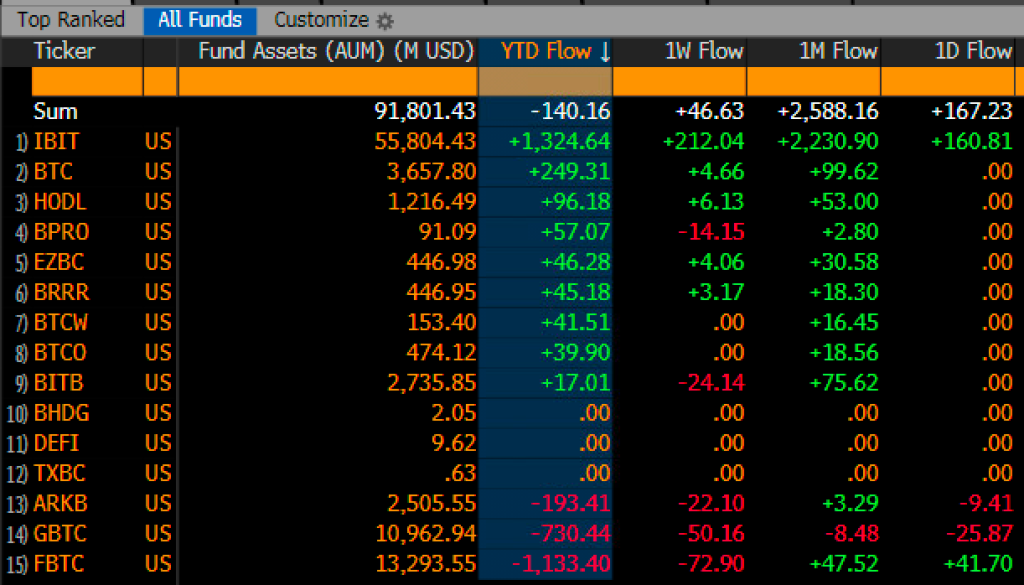
US Bitcoin ETF data | Source: X @EricBalchunas

Still, the broader picture has improved materially. Several mid-tier products, including BITB, BTC, and HODL, are showing positive inflows year-to-date, while smaller funds like EZBC and BRRR have quietly added tens of millions in net demand. The aggregate effect is a market that has absorbed significant selling pressure earlier in the year and is now approaching equilibrium.

Balchunas framed the development as unusual in historical context, particularly given the magnitude of Bitcoin’s recent correction. “Yeah bitcoin ETFs now $2.5b for month and one good day away from completely digging out of their YTD flow hole,” he wrote, adding that IBIT has already crossed that threshold. “Again, incredible fortitude in face of 40% 6mo price drop and widespread media pile on.”

He contrasted this behavior with gold during a comparable period of stress. “For context, when gold fell 40% in short time frame about 10yrs ago, it saw 1/3 of its investors bail (not that that’s bad either, that’s normal, btc is just abnormal).” The implication is not that Bitcoin is inherently more stable, but that its investor base—at least in ETF form—has demonstrated a higher tolerance for drawdowns.

That observation aligns with Balchunas’ broader view on how both assets function within portfolios. In a separate note, he emphasized that neither Bitcoin nor gold should be evaluated through short-term performance alone, particularly given their inconsistent correlation properties. “Bitcoin is similar but with more correlation (0.45) with stocks. Both unpredictable but valid asset classes and shouldn’t be judged based on short time frames.”

At press time BTC traded at $71,322.
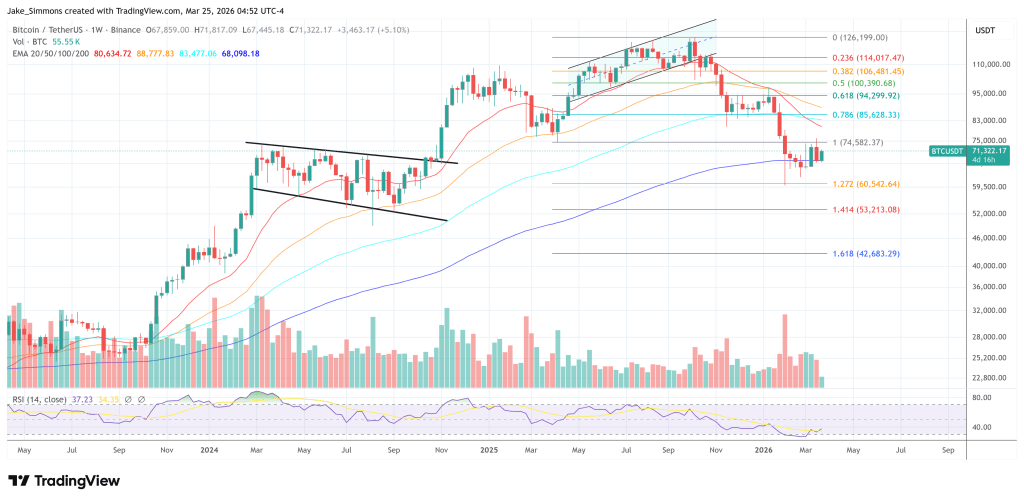
BTC must break above $74,500 1-week chart | Source: BTCUSDT on TradingView.com

Perguntas relacionadas

QDespite a 40% price drop in Bitcoin, what is the current state of US spot Bitcoin ETF year-to-date (YTD) flows?

AUS spot Bitcoin ETFs are on the verge of fully reversing their year-to-date outflows, with the aggregate flow deficit at approximately -$140 million, which is close to being erased due to strong recent inflows.

QWhich specific Bitcoin ETF has led the rebound in inflows and how much has it attracted in the past month?

ABlackRock's IBIT has led the rebound, attracting $2.23 billion in net inflows over the past month alone and $1.32 billion year-to-date, placing it in the top 2% of all ETFs by flows.

QHow does the resilience of Bitcoin ETF investors during this price drop compare to gold investors in a similar historical situation?

ABloomberg analyst Eric Balchunas contrasted the behavior, noting that when gold fell 40% about 10 years ago, it saw one-third of its investors bail. In contrast, Bitcoin ETF investors have shown 'incredible fortitude' and a higher tolerance for drawdowns, with flows turning positive.

QWhat are the year-to-date flow figures for Fidelity's FBTC and Grayscale's GBTC ETFs?

AFidelity's FBTC has year-to-date outflows of -$1.13 billion, and Grayscale's GBTC has outflows of -$730 million.

QWhat key price level does the chart suggest Bitcoin must break above, according to the article?

AThe chart suggests that Bitcoin must break above $74,500 on the 1-week chart.

Leituras Relacionadas

Trading

Spot
Futuros

Artigos em Destaque

Como comprar FLOW

Bem-vindo à HTX.com!Tornámos a compra de Flow (FLOW) simples e conveniente.Segue o nosso guia passo a passo para iniciar a tua jornada no mundo das criptos.Passo 1: cria a tua conta HTXUtiliza o teu e-mail ou número de telefone para te inscreveres numa conta gratuita na HTX.Desfruta de um processo de inscrição sem complicações e desbloqueia todas as funcionalidades.Obter a minha contaPasso 2: vai para Comprar Cripto e escolhe o teu método de pagamentoCartão de crédito/débito: usa o teu visa ou mastercard para comprar Flow (FLOW) instantaneamente.Saldo: usa os fundos da tua conta HTX para transacionar sem problemas.Terceiros: adicionamos métodos de pagamento populares, como Google Pay e Apple Pay, para aumentar a conveniência.P2P: transaciona diretamente com outros utilizadores na HTX.Mercado de balcão (OTC): oferecemos serviços personalizados e taxas de câmbio competitivas para os traders.Passo 3: armazena teu Flow (FLOW)Depois de comprar o teu Flow (FLOW), armazena-o na tua conta HTX.Alternativamente, podes enviá-lo para outro lugar através de transferência blockchain ou usá-lo para transacionar outras criptomoedas.Passo 4: transaciona Flow (FLOW)Transaciona facilmente Flow (FLOW) no mercado à vista da HTX.Acede simplesmente à tua conta, seleciona o teu par de trading, executa as tuas transações e monitoriza em tempo real.Oferecemos uma experiência de fácil utilização tanto para principiantes como para traders experientes.

241 Visualizações TotaisPublicado em {updateTime}Atualizado em 2025.03.21

Como comprar FLOW

Discussões

Bem-vindo à Comunidade HTX. Aqui, pode manter-se informado sobre os mais recentes desenvolvimentos da plataforma e obter acesso a análises profissionais de mercado. As opiniões dos utilizadores sobre o preço de FLOW (FLOW) são apresentadas abaixo.

活动图片













