BIP-110 Could Split Bitcoin In New Soft Fork Fight, Jameson Lopp Warns

bitcoinistPublicado em 2026-02-25Última atualização em 2026-02-25

Jameson Lopp is escalating his criticism of BIP-110, arguing the proposal could trigger a disruptive Bitcoin chain split while failing to stop the behavior it is meant to curb. In a Feb. 23 post, Lopp frames the plan as a consensus-layer response to a policy and cultural dispute around transaction “spam,” with risks that extend well beyond mempool debates.

BIP-110 is pitched as a soft fork led by Luke Dashjr that would temporarily restrict arbitrary data in transactions. Lopp summarizes it as adding seven new transaction-validity restrictions, including limits on where data can be placed and constraints on certain script behavior, but says the tradeoffs are far more severe than supporters admit. He calls the proposal “reckless and doomed to fail,” setting the tone for a post that is less a technical explainer than a warning about governance and coordination risk.

Why Lopp Thinks The Activation Path Is Dangerous For Bitcoin

The core of Lopp’s argument is not just what BIP-110 changes, but how it tries to activate. He points to the proposal’s 55% miner-signaling threshold for a user-activated soft fork and says that low bar materially increases the probability of two competing chains if the ecosystem is not aligned.

He also stresses that BIP-110 nodes would reject non-compliant blocks outright, which raises coordination risk compared with soft forks that old nodes can continue to follow without enforcement conflicts.

Lopp is especially pointed on the mandatory activation posture at block height 961,632. In one of the sharpest passages, he writes: “This is not a neutral, low-drama deployment posture. It’s dogmatic bullying. [...] you cannot pretend it’s low-risk.” He ties that warning to a broader point: even if one views UASF tactics as legitimate, the proposal’s design increases the odds of a messy failure mode if miners, exchanges, wallets, and infrastructure providers do not converge in time.

He also pushes back on comparisons to 2017, noting that the UASF many people cite in the SegWit era never actually had to run to the edge because SegWit activated via miner signaling instead. That distinction matters in Lopp’s framing, because BIP-110 proponents are, in his view, leaning on a historical precedent that did not test the exact scenario they now describe as manageable.

Another major section of Lopp’s post targets the claim that BIP-110 has meaningful grassroots momentum. He argues that raw node counts (roughly 20% run Knots) are a weak proxy for consensus because signaling is cheap, node operation can be low-cost, and Tor addresses are “effectively zero” cost to create at scale. He publishes a breakdown of reachable nodes and highlights the higher Tor-to-IPv4 ratio among Knots and BIP-110 signaling nodes as a reason to treat node-count narratives cautiously.

On mining support, Lopp says the gap is more straightforward. At the time of publication, he writes miner signaling was “precisely [...] zero,” and he cites public opposition from F2Pool while arguing miners have limited incentive to back a proposal that could reduce fee revenue. That point reinforces his broader thesis that BIP-110 supporters are overestimating social signaling and underestimating the role of economically significant actors in Bitcoin upgrade politics.

Lopp’s post ultimately reads as a warning that the immediate issue is not simply whether BIP-110 activates, but what the campaign reveals about where Bitcoin’s internal dispute over neutrality, censorship resistance, and block-space usage is heading. Even a failed fork push, in his framing, can still impose real costs by forcing operators and businesses to plan around low-probability but high-impact coordination failure.

At press time, Bitcoin traded at $62,791.
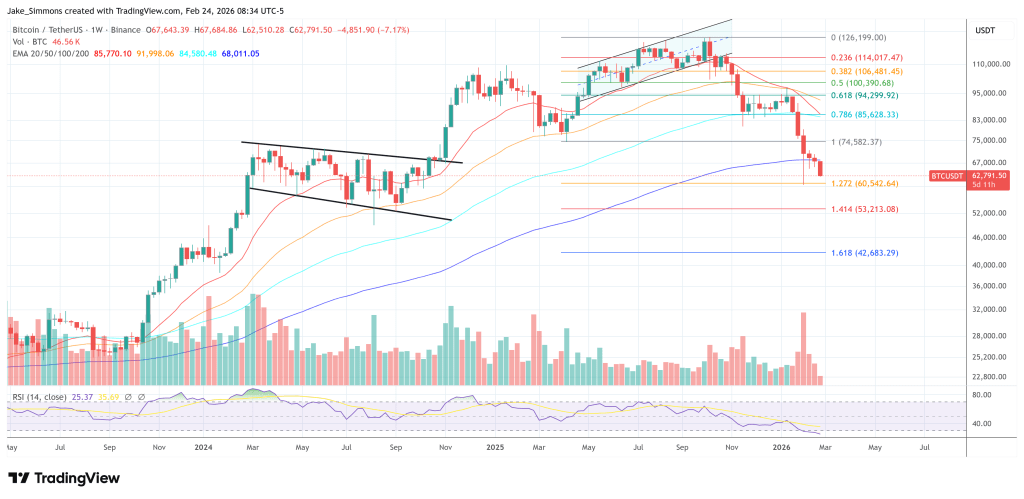
Bitcoin falls below $63,000, 1-week chart | Source: BTCUSDT on TradingView.com

Perguntas relacionadas

QWhat is the main concern Jameson Lopp raises about BIP-110?

AJameson Lopp's main concern is that BIP-110 could trigger a disruptive Bitcoin chain split due to its low 55% miner-signaling threshold for activation and its design that increases coordination risks, while failing to effectively stop the 'spam' behavior it aims to curb.

QHow does BIP-110 propose to activate, and why does Lopp find this dangerous?

ABIP-110 proposes a user-activated soft fork (UASF) with a 55% miner-signaling threshold. Lopp finds this dangerous because the low activation threshold and the node's policy of outright rejecting non-compliant blocks significantly increase the probability of creating two competing chains if the broader Bitcoin ecosystem is not fully aligned.

QWhat does Jameson Lopp say about the grassroots support for BIP-110?

ALopp argues that the raw node count signaling support for BIP-110 is a weak proxy for consensus. He highlights that a high percentage of these nodes are on the Tor network, which are cheap to create at scale, and cautions against overestimating this form of social signaling, especially since miner support was precisely zero at the time of his writing.

QAccording to Lopp, why is the comparison to the 2017 SegWit UASF flawed?

ALopp states the comparison is flawed because the 2017 SegWit UASF never actually had to run to its full extent; SegWit activated via miner signaling before the UASF was triggered. This means the historical precedent did not test the high-risk scenario of a contentious chain split that BIP-110 proponents are now describing as manageable.

QWhat is the broader implication of the BIP-110 debate, beyond the proposal itself?

AThe broader implication is that the debate reveals a deepening internal conflict within Bitcoin over core principles like neutrality, censorship resistance, and block-space usage. Even if BIP-110 fails, the campaign forces operators and businesses to incur real costs by having to plan for a low-probability but high-impact coordination failure.

Leituras Relacionadas

Thanks to Dice Rolls, Bitcoin Keys Are Stored Offline, But Not Everyone Will Do It

The article discusses using dice rolls to generate secure Bitcoin wallet seeds, providing entropy independent of potentially flawed hardware random number generators. It explains that each fair dice roll offers about 2.585 bits of entropy, with around 50 rolls needed for a standard 12-word seed phrase and 99+ recommended for higher security. This method gained attention after a vulnerability was revealed in some Coldcard hardware wallets, where a faulty firmware RNG (dating back to 2021) compromised generated keys. The analysis notes that while a dice-generated main seed was safe from this specific flaw, other Coldcard functions (like creating paper wallets, backup keys, or passwords) could still be vulnerable if they used the defective RNG. The piece argues that while dice-based entropy is technically robust, the manual process is error-prone, tedious, and unrealistic for most new users, who might make mistakes in recording or inputting rolls. It concludes that while manual entropy generation should remain an option for advanced users, the long-term goal is to develop reliable, user-friendly hardware and software that securely generates randomness without requiring specialized knowledge. Coldcard users are advised to check their firmware version and replace any secondary secrets (like paper wallet keys) created with vulnerable devices, while also considering multi-signature setups with devices from different manufacturers for added security.

cryptonews.ruHá 3h

Thanks to Dice Rolls, Bitcoin Keys Are Stored Offline, But Not Everyone Will Do It

cryptonews.ruHá 3h

Trading

Spot
活动图片





