Binance XRP Reserves Fall To 2024 Low — Recovery Soon?

bitcoinistPublicado em 2025-12-15Última atualização em 2025-12-15

Resumo

XRP's exchange reserves on Binance have fallen to approximately 2.6 billion, the lowest level recorded in 2024, according to an on-chain analysis by Arab Chain. This decline suggests a shift in investor behavior, with more tokens being moved from exchanges into personal wallets, indicating reduced selling pressure and potential accumulation. Historically, such outflows can signal easing bearish momentum and lower the risk of large-scale sell-offs. Meanwhile, XRP's price has been trading between $2.000 and $2.123 for most of December. Analysts note that holding above the $2.0 support level is crucial; a break below could lead to a decline toward $1.20. At the time of writing, XRP is trading around $2.02.

While the XRP price displays a clear bearish structure, momentum pushing the price downwards appears to be cooling. A recent analysis into underlying on-chain activity has revealed a shift in investor behavior, providing context to the recently slowed momentum seen.

XRP Holdings Decline To 2024 Low Of 2.6 Billion

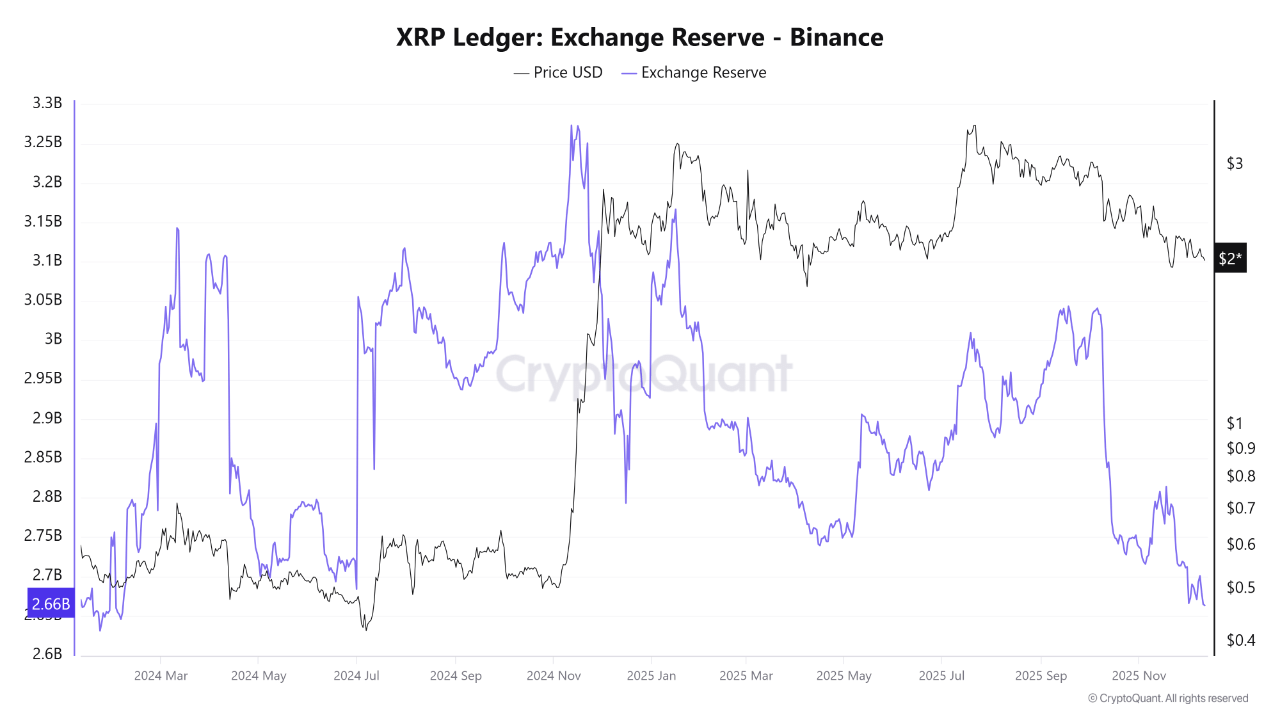
In a QuickTake post on CryptoQuant, the on-chain analytics group Arab Chain explains how the XRP market is experiencing certain shifts in liquidity dynamics. The analysis revolved around data obtained from the XRP Ledger: Exchange Reserve metric, which tracks the total amount of XRP held in wallets associated with centralized cryptocurrency exchanges (in this case, Binance).

According to Arab Chain, XRP’s exchange reserves on the Binance platform have declined, reaching an approximate 2.6 billion reading, the lowest level seen since 2024. Typically, a fall in exchange reserve numbers indicates the tokens’ movement out of centralized platforms into personal wallets for long-term holding or merely transferred out for other on-chain uses.
Source: CryptoQuant

Notably, the steady contraction of Binance’s XRP reserves points out that market participants might be more inclined towards holding, as opposed to having a growing selling appetite. Arab Chain cites historical data, explaining that increased outflows from exchanges can be interpreted as a sign of easing bearish pressure. This is because coins outside exchanges are less prone to rapid liquidation events. Also, such a decline during periods where prices remain stable could signal growing accumulation tendencies among investors.

The analytics group further revealed a unique trait of current data. The present decline in reserves came after previous sharp growths in the XRP exchange reserves. It then becomes clear that the market may simply be “rebalancing its supply structure, with a reduced amount of XRP available for day-to-day trading.”

It’s worth noting that the contraction in reserves puts the market in a delicately bullish position. In this scenario, the re-entry of buyers into the XRP market could translate into a faster and sharper bullish momentum. On the other hand, a sustained absence of growing reserves dampens the chances of any large-scale sell-off in the short term.

XRP Price Overview

For most of December, XRP has traded within the $2.123–$2.000 price levels. Popular market analyst, Ali Martinez, however, recently took to X to report that $XRP has to prevail above $2.0, for any hopes of a price recovery to be realistic. In the scenario where $2.0 fails to hold, the altcoin could spiral downwards to as low as $1.20.

As of this writing, XRP trades at approximately $2.02, with CoinMarketCap data reporting a % 0.64% growth over the last 24 hours.

XRP trading at $2.0153 on the daily chart | Source: Tradingview.com

Leituras Relacionadas

Why Are the Most Believers in AGI Buying NVIDIA Put Options?

The article analyzes the significant, market-moving 13F filing for Q1 2026 by Situational Awareness LP (SALP), a fund managed by former OpenAI researcher Leopold Aschenbrenner. While Aschenbrenner is a prominent believer in the accelerated arrival of AGI and has built the fund as a focused bet on AI infrastructure, the filing revealed large new put option positions (totaling billions in notional value) on key AI/semiconductor names like Nvidia, SMH ETF, Broadcom, and AMD. The article argues this is not a bearish turn on AI but a sophisticated hedging strategy. Given the macro backdrop in late March (rising oil prices, inflation concerns, higher-for-longer interest rates), the fund is managing volatility in its high-beta, high-valuation portfolio of AI infrastructure plays (like Bloom Energy, CoreWeave, Core Scientific). The puts act as "insurance" against a potential systemic pullback in the AI trade. Simultaneously, SALP maintained or added to core long positions in companies tied to power, data centers, compute, and storage—the "bottlenecks" expected to capture AI capital spending. It trimmed or exited some Q1 winners (e.g., Lumentum) and reduced leverage (e.g., selling CoreWeave calls), suggesting a rotation from crowded, high-momentum trades towards assets with clearer long-term fundamental pathways. The key takeaway is an evolution in the AI investment theme: from a broad, linear rally to a more discerning, "show-me-the-money" phase. The focus shifts from simply buying the AI narrative to identifying companies that can convert capex into tangible revenue, while actively managing portfolio risk in a volatile macro environment. The strategy reflects a move from unilateral bullishness to "offense with defense."

marsbitHá 6m

Why Are the Most Believers in AGI Buying NVIDIA Put Options?

marsbitHá 6m

AI Saved a Group of New Energy Investors

The article "AI Saves a Group of New Energy Investors" details a remarkable turnaround in the green energy investment sector, driven by its convergence with artificial intelligence infrastructure. After a prolonged downturn marked by valuation slumps and funding cold spells since 2022, the sector has experienced a dramatic resurgence in 2026. This shift is attributed to new policies, particularly the "AI-Energy Synergy" national strategy, which mandates green power and energy storage systems for new large-scale computing centers. This redefines green electricity and storage from traditional manufacturing into core, indispensable assets for AI's operational backbone, creating a new narrative where "computing power equals electricity, and green power equals assets." This paradigm change is reflected in surging market performance. Power stocks like Datang Power have seen massive gains, and green energy ETFs have recorded significant capital inflows. The IPO market is also active, with companies like Sige New Energy listing successfully. Investment and financing have accelerated sharply, with major expansion projects and large-scale IPOs like China Resources New Energy's record-breaking offering. Notably, some top projects have seen valuations rebound by approximately 60%. The article highlights that the previous industry trough became a prime investment window. With AI-driven demand predicted to create massive power shortfalls (e.g., a projected 55GW gap for data centers), sectors like energy storage, grid upgrades, and green power are seeing explosive growth. Investors are now prioritizing areas like power management, large-scale storage, virtual power plants, and supporting technologies like liquid cooling—the "pick-and-shovel" plays of the AI infrastructure boom. Examples like KKR's highly successful investment in cooling company CoolIT Systems underscore the lucrative opportunities. In conclusion, the integration with AI has sparked a fundamental revaluation of new energy assets. For investors who endured the sector's低谷, a harvest season has arrived, with the broader investment upswing seemingly just beginning.

marsbitHá 35m

AI Saved a Group of New Energy Investors

marsbitHá 35m

Learn Codex with the "Morning Briefing": Six Replicable Levels of Use

This article introduces a "Morning Briefing" as a simple, progressive framework for learning to effectively use Codex (an AI assistant), moving from basic information gathering to a more sophisticated, autonomous work partner. It outlines six actionable levels: **Level 1: Basic Information Query.** Start by simply asking Codex to check your Slack, Gmail, and Calendar to summarize what needs your attention today. **Level 2: Personalization with an Agents File.** Create a persistent file containing your default preferences for the briefing's format and content, so it's consistently useful. **Level 3: Automation.** Set the briefing to run automatically every weekday morning, creating a reliable starting point for your day. **Level 4: Project-Specific Briefings.** Instead of one overwhelming summary, create separate, dedicated threads for different projects (e.g., a launch, recruitment), each with its own focused briefing. **Level 5: Drafting Follow-Up Actions.** Elevate the briefing from a summary to an action starter by having it draft replies, prepare meeting notes, or highlight stalled decisions—ready for your review. **Level 6: Building a Memory System (Vault).** Integrate a knowledge vault (a structured file system) where important recurring information (project statuses, key people, decisions) is stored and updated. The briefing consults this vault to provide richer context and learns over time. The approach's strength is its incremental nature. Each level teaches a core Codex capability (connectors, personalization, automation, project context, assisted work, persistent memory) within a familiar, practical workflow, avoiding overwhelming theoretical concepts. It transforms a simple daily check-in into a personalized, evolving work operating system.

marsbitHá 1h

Learn Codex with the "Morning Briefing": Six Replicable Levels of Use

marsbitHá 1h

Trading

Spot
Futuros

Artigos em Destaque

Como comprar SOON

Bem-vindo à HTX.com!Tornámos a compra de SOON (SOON) simples e conveniente.Segue o nosso guia passo a passo para iniciar a tua jornada no mundo das criptos.Passo 1: cria a tua conta HTXUtiliza o teu e-mail ou número de telefone para te inscreveres numa conta gratuita na HTX.Desfruta de um processo de inscrição sem complicações e desbloqueia todas as funcionalidades.Obter a minha contaPasso 2: vai para Comprar Cripto e escolhe o teu método de pagamentoCartão de crédito/débito: usa o teu visa ou mastercard para comprar SOON (SOON) instantaneamente.Saldo: usa os fundos da tua conta HTX para transacionar sem problemas.Terceiros: adicionamos métodos de pagamento populares, como Google Pay e Apple Pay, para aumentar a conveniência.P2P: transaciona diretamente com outros utilizadores na HTX.Mercado de balcão (OTC): oferecemos serviços personalizados e taxas de câmbio competitivas para os traders.Passo 3: armazena teu SOON (SOON)Depois de comprar o teu SOON (SOON), armazena-o na tua conta HTX.Alternativamente, podes enviá-lo para outro lugar através de transferência blockchain ou usá-lo para transacionar outras criptomoedas.Passo 4: transaciona SOON (SOON)Transaciona facilmente SOON (SOON) no mercado à vista da HTX.Acede simplesmente à tua conta, seleciona o teu par de trading, executa as tuas transações e monitoriza em tempo real.Oferecemos uma experiência de fácil utilização tanto para principiantes como para traders experientes.

164 Visualizações TotaisPublicado em {updateTime}Atualizado em 2025.05.23

Como comprar SOON

Discussões

Bem-vindo à Comunidade HTX. Aqui, pode manter-se informado sobre os mais recentes desenvolvimentos da plataforma e obter acesso a análises profissionais de mercado. As opiniões dos utilizadores sobre o preço de SOON (SOON) são apresentadas abaixo.

活动图片