Binance Alpha Cools Down: User Count Drops 60%, Is No One Claiming 'Eggs' Anymore?

marsbitPublicado em 2026-01-28Última atualização em 2026-01-28

Resumo

Binance Alpha, once hailed as a lucrative platform for earning token airdrops, has seen a significant decline in user engagement and profitability. According to data from Alpha123, the number of users dropped by over 60%, from nearly 500,000 in November 2025 to around 200,000 by January 2026. Monthly earnings per account have also fallen sharply, with the theoretical maximum for January estimated at approximately $715.7—far below the $2,000 monthly profits seen in mid-2025. The platform’s become more challenging due to rising积分门槛 (score thresholds), which recently reached as high as 257 points. In some cases, users cannot meet the threshold through daily activities alone. For example, earning 15 points requires approximately $32,700 in trading volume, which—for retail traders—could mean around 100 trades per day. This results in high transaction costs, including fees and potential slippage, especially when trading volatile tokens. While some early participants earned significant returns from a few high-value airdrops, such opportunities are now rare. Most airdrops now yield below $50, and increased competition—including automated trading by studios—has made it harder for ordinary users to profit. Many are now questioning whether the effort and risk remain worthwhile, especially as platform incentives appear to be shifting away from high-frequency rewards toward more measured engagement.

"Every generation has its eggs to claim, and perhaps for our generation, it's Binance Alpha," said He Yi, Co-CEO of Binance, in late December 2025.

However, over time, according to data statistics from the Alpha123 platform, the number of Binance Alpha users has dropped from nearly 500,000 in November 2025 to about 200,000 today, a decline of over 60%.

At the same time, overall returns have significantly decreased. The "farming" sector, which once generated monthly earnings of over $2,000 per account in mid-2025, is no longer as prosperous.

According to Alpha123 platform statistics, the current daily active users of Binance Alpha are approximately 203,000. As of January 28, a total of 18 airdrops were distributed this month, with claimable shares ranging from 13,000 to 72,000. The average number of claimable shares is about 33,000, accounting for roughly 16.2% of the average daily active users.
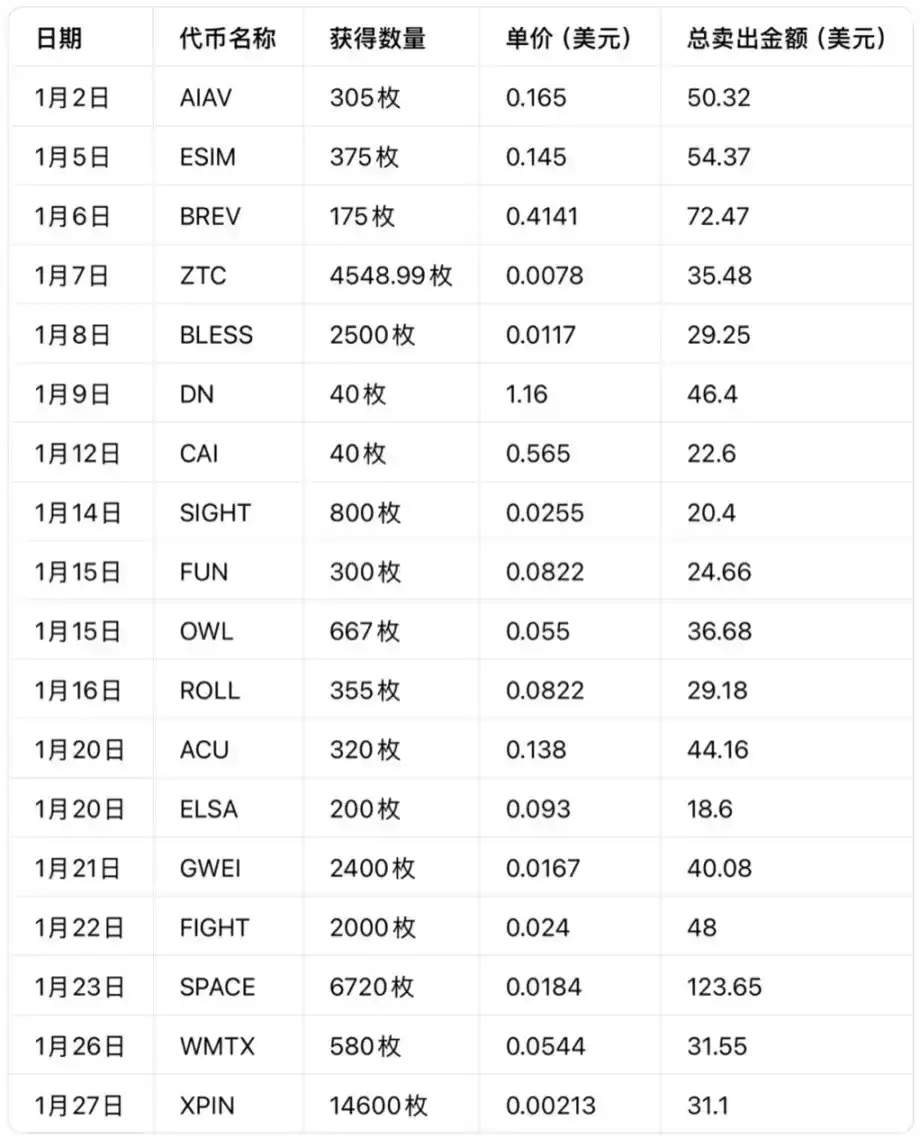
As of January 28, only one of the 18 Alpha rounds this month had a single-round return exceeding $100, which was SPACE at $123.65 (calculated based on the latest opening price 10 minutes after trading began). Meanwhile, 14 rounds had returns below $50, with the lowest round, ELSA, yielding only $18.60.

This month, the minimum Alpha points threshold was 230, while the highest reached 257 points. On January 26, the claim threshold for the Alpha token WMTX was as high as 241 points, but the single-round return was only $31.55. If a user earns 16 points per day, since Alpha points reset every 15 days, theoretically, 240 points can be accumulated in 15 days. Once the threshold exceeds 240 points, it becomes impossible to meet the requirement within a single cycle. For example, the 241 points required for WMTX mean that relying solely on stable daily point accumulation cannot meet the threshold within one cycle.
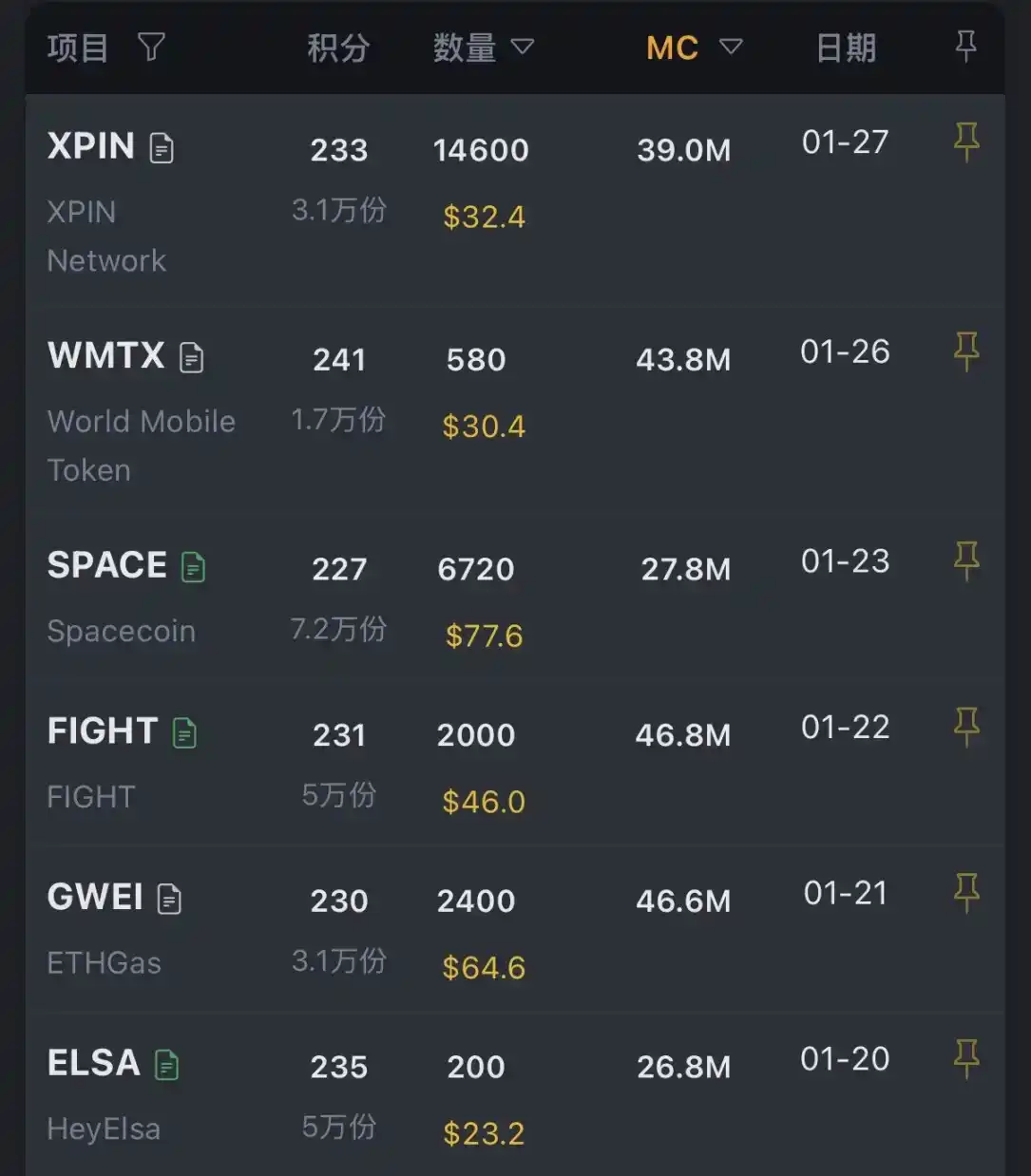
Compared to the period in mid-2025 when single-account monthly income approached $2,000, the theoretical cumulative return for the first 18 rounds this January is approximately $715.70. This figure is based on the premise that "the points threshold is met for every round, and the maximum number of rounds is successfully claimed." However, if a user earns 16 points per day, the maximum number of rounds that can actually be claimed is 5, with returns of about $261.43.

Taking SPACE, which had a return of over $100 in a previous round, as an example, the claim threshold was 227 points, and each claim required 15 points. If a user automatically earns 1 point per day through account balance, the remaining points must be obtained through trading. According to the current relationship between points and trading volume, earning 15 points requires completing approximately $32,700 in trading volume. For mainstream participants with a single trade size of about $330, this equates to completing 100 trades per day.
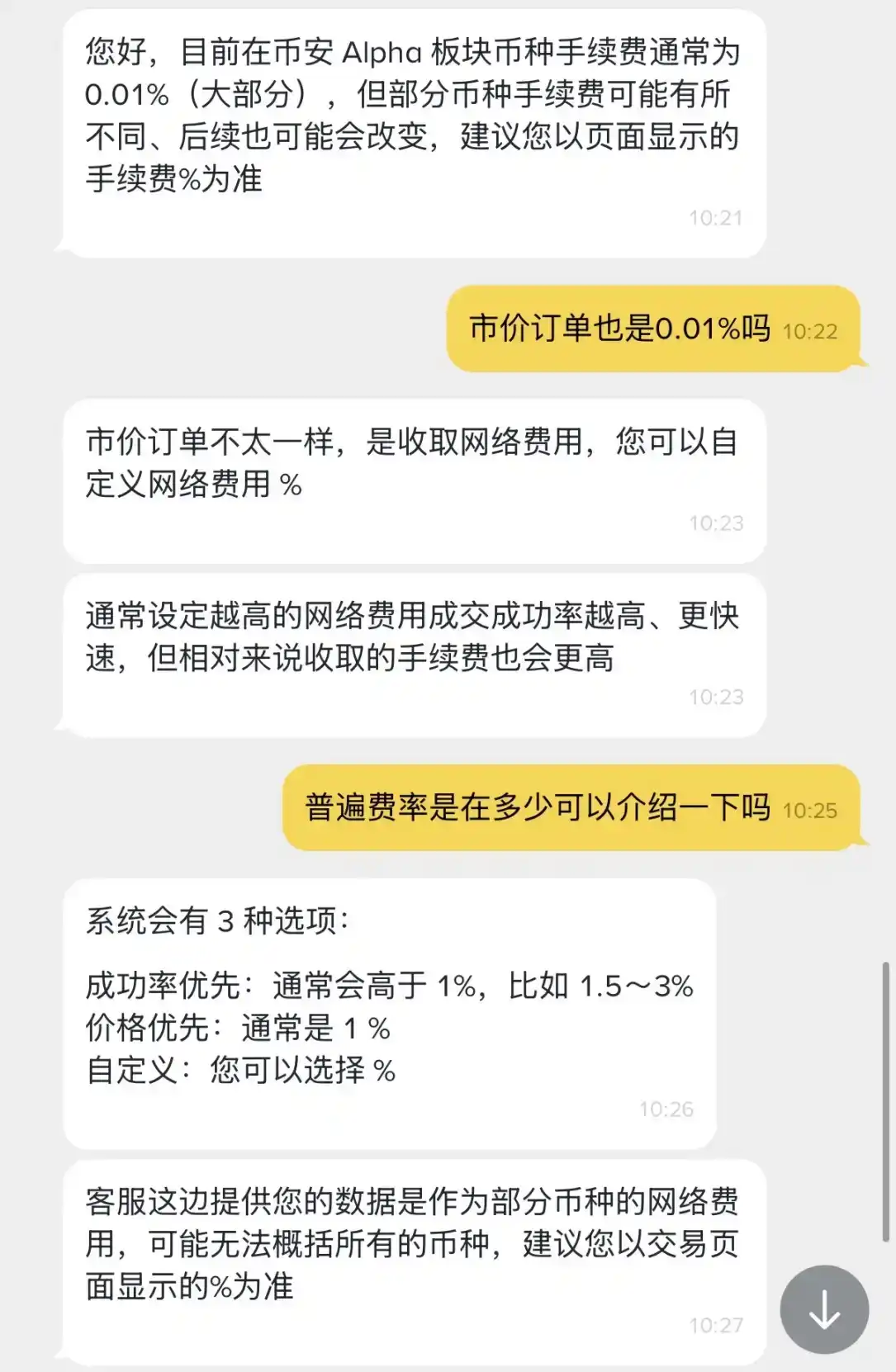
According to the author's investigation, the current limit order fee for the Binance Alpha sector is 0.01%, while the market order fee is typically 1%. If market orders are used to achieve $32,700 in trading volume, at least $327 in fees must be paid daily, excluding price slippage. If trading Alpha sector tokens in the Binance wallet, each transaction incurs a 0.01% service fee and a 0.01% trading fee, with a network fee of about $0.10 per transaction. For a daily trading volume of $32,700, approximately $17 in fees must be paid. If points are accumulated continuously for 15 days to reach 240 points, the minimum cost is $255. Additionally, claiming one Alpha round requires consuming 15 points, which equates to a cost of $17.

To reduce the pressure of the number of trades, the platform occasionally launches multiplier point events, which lower the "number of trades threshold" to some extent but simultaneously amplify price risks. Under a 4x points mechanism, theoretically, only about 25 trades of $330 each are needed daily to earn 15 points. However, such tokens typically experience more剧烈 volatility and have limited liquidity depth, meaning price slippage and short-term fluctuations can quickly erode potential returns.
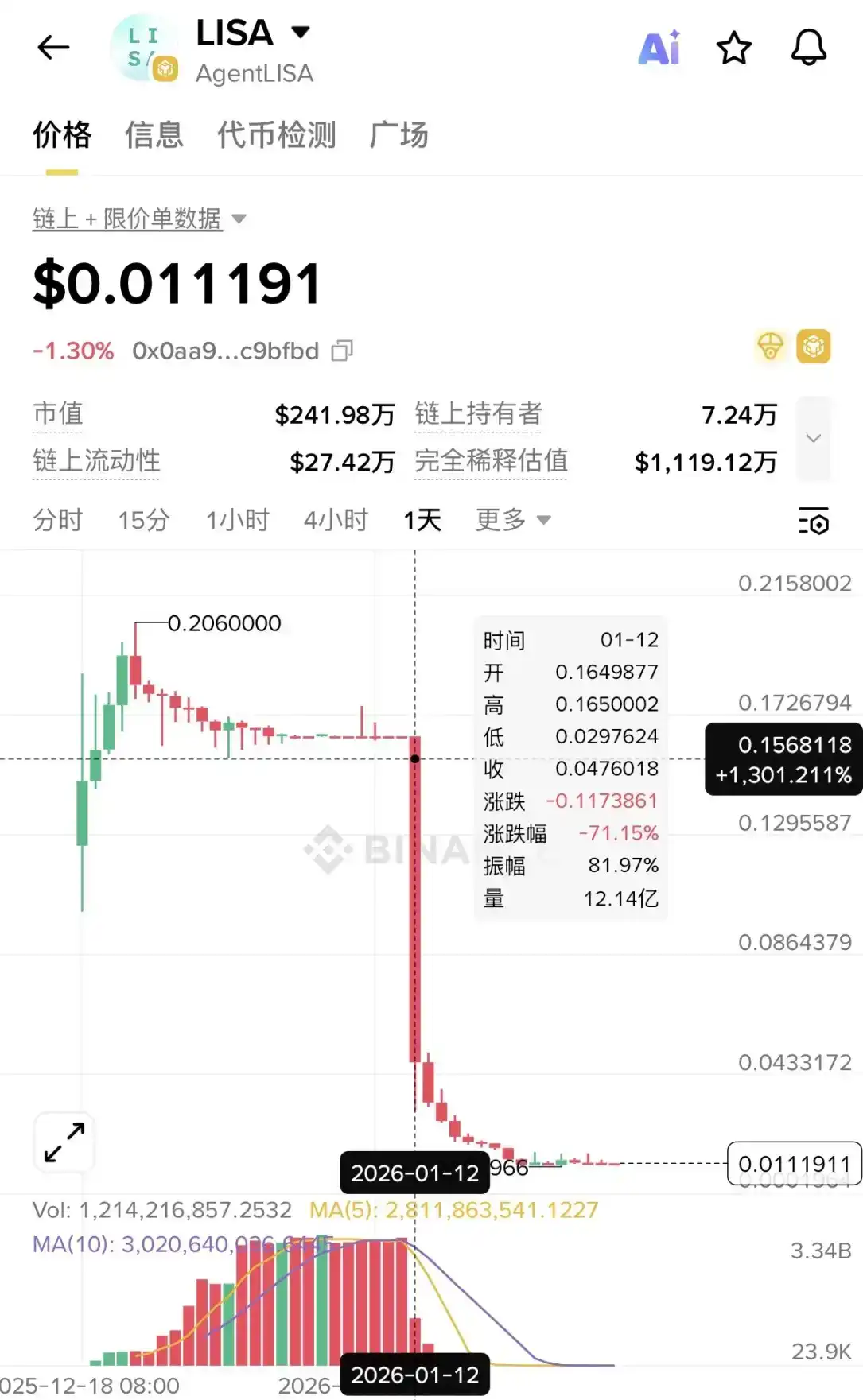
The case of LISA on January 12 became a typical example. The token attracted a large amount of刷量资金 due to its 4x Alpha points incentive, but it experienced concentrated selling within a short period, with a maximum drop of over 80% within 24 hours. The sharp price decline caused some users to incur trading losses far exceeding the airdrop value while earning points.

For users who continue to participate in Alpha, the most direct question is often not "can I still make money" but "is it worth continuing to farm."

Some early participants achieved returns far above the average on certain projects. For example, the 59.82 RIVER tokens obtained on September 19, 2025, if held until now, would be worth about $3,200 at current prices. The 644 MYX tokens obtained on May 6, 2025, are worth about $3,870 at current prices, and if sold at the historical high, the returns would exceed $11,000.

However, such "rare diamond-level big catches" are not consistently replicable. In the current environment of shrinking single-round returns, rising thresholds, and increased volatility, most rounds are closer to small,分散, and uncertain returns. Users are more likely to focus on the overall input-output ratio rather than个别极端收益案例.

The Alpha model本质上 involves exchanging real trading behavior for early token distribution opportunities from projects. Its sustainability relies on the continuous emergence of projects with market performance. When the market enters a stage of存量博弈, the number of high-quality projects is limited, while the number of participants continues to grow, naturally diluting the expected returns for individual users.

At the same time, the core purpose of Alpha in its early stages was to attract traffic for new projects, activate on-chain interactions, and increase user engagement with the Binance wallet ecosystem. During the early high-incentive phase, this goal was clearly achieved, and Alpha一度 became a significant source of user activity and trading volume.
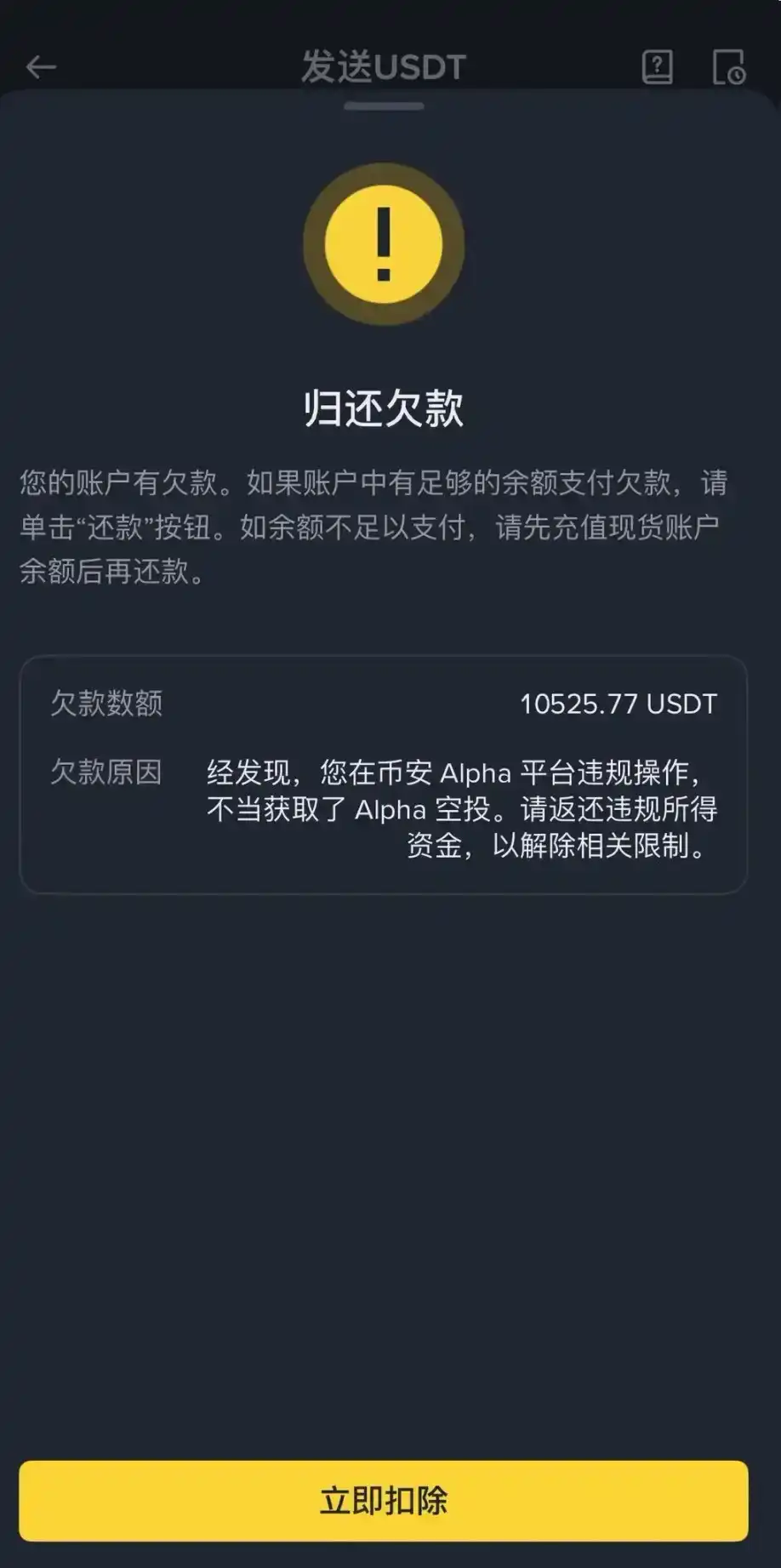
However, as刷量行为, batch operations by studios, and high-frequency gaming intensified, the incentives gradually became套利化. In November 2025, Binance imposed restrictions on some accounts identified as batch-operated by studios and required the return of related earnings. This move showed the platform's effort to压缩异常行为空间, but the community generally believes that automated tools have advantages in efficiency and cost control, putting manual普通用户 at a growing disadvantage in the points competition. Some participants反馈 that in the current environment of high points thresholds and market volatility, continued participation not only yields unstable returns but may also result in net losses due to price fluctuations of the刷量代币, leading them to reduce frequency or even withdraw.

For ordinary users, Alpha is no longer a channel where stable returns can be obtained simply through frequency. Instead, it has become more of a strategic choice requiring careful calculation of costs and risks.


Perguntas relacionadas

QWhat is the main reason for the decline in Binance Alpha's user base according to the article?

AThe decline is attributed to decreased overall returns, higher participation thresholds, increased volatility, and the platform's crackdown on batch operations by studios, making it less profitable and more risky for ordinary users.

QHow much has the user count of Binance Alpha dropped from its peak?

AThe user count has dropped by over 60%, from nearly 500,000 in November 2025 to about 200,000 currently.

QWhat was the highest single-account monthly income during Binance Alpha's peak period in mid-2025?

ADuring the peak period in mid-2025, a single account could earn nearly $2000 per month.

QWhat challenges do users face in earning enough Alpha points to qualify for airdrops?

AUsers face challenges such as high transaction volumes required to earn points (e.g., $32,700 in trading volume for 15 points), high fees, price slippage, and increased volatility, especially during multiplier events.

QHow did Binance address the issue of batch operations by studios on Alpha?

ABinance imposed restrictions on accounts identified as batch operations by studios in November 2025 and required the return of related earnings to combat abusive practices.

Leituras Relacionadas

UBS: The Crowdedness of A-Share Tech Stocks Is Far From Reaching Historical Peaks

UBS: A-share tech stocks still far from peak crowding levels A-shares' technology sector has seen a strong rebound, with trading activity hitting record highs, raising concerns about market crowding. However, UBS Securities argues that a key indicator of institutional positioning suggests the current crowding level remains well below historical peaks. While the large-cap tech sector's share of total A-share trading volume and market capitalization have reached historical highs, the overweight ratio of domestic mutual funds in this sector stood at 9.9% in Q1 2026. This is down from 11.6% in Q3 2025 and significantly lower than the historical peak of 14.1% in Q4 2015. It also pales in comparison to the historical peak overweight of 18.7% for the consumer sector. UBS notes that typical cycles from a low to a peak in fund overweighting last about three years, and the current outperformance of the tech/growth style has lasted less than two years since the policy pivot in September 2024. UBS expects A-share earnings recovery to accelerate, providing fundamental support. It forecasts 2026 A-share profit growth to rise to 11% from 3.9% in 2025. Non-financial A-share profits grew 11.8% YoY in Q1 2026, with gross and net profit margins at their highest since 2023. Persistent fund inflows, the expansion of thematic ETFs, and a recovery in private fund issuance are supporting market liquidity. In tactical allocation, UBS favors growth and cyclical styles under its "slow bull" base case, with overweight ratings on six sectors: Electronics (benefiting from semiconductor inventory recovery and AI innovation), Communications (driven by AI computing demand), Machinery (aided by domestic capex recovery), Non-ferrous Metals (due to rising copper/aluminum prices), Chemicals (supported by anti-involution policies), and Electrical Equipment (driven by policy support and AI data center power demand).

marsbitHá 14m

UBS: The Crowdedness of A-Share Tech Stocks Is Far From Reaching Historical Peaks

marsbitHá 14m

Should You Buy SpaceX Stock at $1.7 Trillion? Here's What the Market Is Worried About

SpaceX is preparing for a massive IPO aiming to raise around $75 billion at a valuation of approximately $1.75 trillion. While its achievements in reusable rockets and the profitable Starlink satellite internet service are clear, the market is concerned about the aggressive valuation. Key issues include: the current $1.75 trillion valuation, which is about 94 times 2025 revenue, seems to price in not just existing businesses but also unproven future ventures like AI infrastructure and orbital data centers. Financially, while Starlink is profitable, the AI division, bolstered by the acquisition of xAI, is incurring massive losses and consuming the majority of capital expenditures. This acquisition also introduced complex related-party financing arrangements and debt onto SpaceX's balance sheet. Furthermore, corporate governance poses a challenge. SpaceX's dual-class share structure ensures founder Elon Musk retains absolute control, limiting ordinary shareholders' influence over high-risk, long-term strategic decisions. The future success of ambitious projects like the Starship rocket—critical for lowering costs and enabling new services—remains a significant variable for the valuation. In summary, the market's apprehension (FUD) centers not on doubting SpaceX's past technological triumphs but on questioning how much premium public investors should pay for a future that combines proven profits with highly speculative and capital-intensive new ventures, all under a governance structure that offers limited shareholder oversight.

marsbitHá 1h

Should You Buy SpaceX Stock at $1.7 Trillion? Here's What the Market Is Worried About

marsbitHá 1h

Breaking the DeFi Cascading Liquidation Curse: Vitalik Proposes a New Solution

Vitalik Buterin has proposed a new DeFi design to eliminate the automatic liquidation mechanism that causes market instability during sharp downturns. The current system, used by protocols like Aave, triggers forced sales when collateral value falls below a threshold, often exacerbating price drops and creating systemic selling pressure. Buterin's alternative model is based on splitting an asset like ETH into two synthetic option-like tokens, P and N, pegged to a price index. Their combined value always equals one ETH. Instead of sudden liquidation, a position's value gradually drifts from its target peg if the market moves. Users must proactively rebalance their holdings to maintain their desired exposure, transferring the management burden from the protocol to the user or automated tools. A key advantage is the reduced reliance on real-time oracles. Pricing decisions are deferred until contract expiry, allowing for more robust, fault-tolerant oracle designs. This removes a clear liquidation threshold that speculators can target for manipulation or MEV extraction. However, significant challenges remain. Frequent rebalancing could incur high slippage and transaction costs, necessitating new liquidity provider models. The design is better suited for hedging instruments than for stablecoins requiring a rigid 1:1 peg. While not an immediate replacement for existing systems, the proposal challenges the foundational assumption that instantaneous forced liquidation is an unavoidable necessity in DeFi, opening the door for fundamentally different risk management architectures.

marsbitHá 1h

Breaking the DeFi Cascading Liquidation Curse: Vitalik Proposes a New Solution

marsbitHá 1h

Trading

Spot
Futuros

Artigos em Destaque

Como comprar ONE

Bem-vindo à HTX.com!Tornámos a compra de Harmony (ONE) simples e conveniente.Segue o nosso guia passo a passo para iniciar a tua jornada no mundo das criptos.Passo 1: cria a tua conta HTXUtiliza o teu e-mail ou número de telefone para te inscreveres numa conta gratuita na HTX.Desfruta de um processo de inscrição sem complicações e desbloqueia todas as funcionalidades.Obter a minha contaPasso 2: vai para Comprar Cripto e escolhe o teu método de pagamentoCartão de crédito/débito: usa o teu visa ou mastercard para comprar Harmony (ONE) instantaneamente.Saldo: usa os fundos da tua conta HTX para transacionar sem problemas.Terceiros: adicionamos métodos de pagamento populares, como Google Pay e Apple Pay, para aumentar a conveniência.P2P: transaciona diretamente com outros utilizadores na HTX.Mercado de balcão (OTC): oferecemos serviços personalizados e taxas de câmbio competitivas para os traders.Passo 3: armazena teu Harmony (ONE)Depois de comprar o teu Harmony (ONE), armazena-o na tua conta HTX.Alternativamente, podes enviá-lo para outro lugar através de transferência blockchain ou usá-lo para transacionar outras criptomoedas.Passo 4: transaciona Harmony (ONE)Transaciona facilmente Harmony (ONE) no mercado à vista da HTX.Acede simplesmente à tua conta, seleciona o teu par de trading, executa as tuas transações e monitoriza em tempo real.Oferecemos uma experiência de fácil utilização tanto para principiantes como para traders experientes.

308 Visualizações TotaisPublicado em {updateTime}Atualizado em 2026.06.02

Como comprar ONE

Discussões

Bem-vindo à Comunidade HTX. Aqui, pode manter-se informado sobre os mais recentes desenvolvimentos da plataforma e obter acesso a análises profissionais de mercado. As opiniões dos utilizadores sobre o preço de ONE (ONE) são apresentadas abaixo.

活动图片












