Better launches Bitcoin-backed mortgages powered by Coinbase

cointelegraphPublicado em 2026-08-26Última atualização em 2026-08-26

Resumo

Better Mortgage and Coinbase have launched a Bitcoin-backed mortgage product for U.S. homebuyers, allowing them to use Bitcoin as collateral for a down payment without selling it. Borrowers must pledge Bitcoin worth at least 250% of the down payment loan, held in a Coinbase Prime custodial account. The mortgage and down payment loan share the same interest rate and are repaid via a single monthly payment. Bitcoin price drops alone do not trigger margin calls, but collateral can be liquidated if payments are 60 days delinquent. This launch follows a 2025 FHFA directive for Fannie Mae and Freddie Mac to consider cryptocurrency in mortgage assessments, reflecting a broader trend of integrating digital assets into the U.S. housing market.

Better Mortgage and Coinbase have made their Bitcoin-backed mortgage product generally available, allowing US homebuyers to pledge Bitcoin as collateral for a down payment without selling it, the companies announced Wednesday.

According to Coinbase’s Help Center, the product pairs a Fannie Mae-backed home loan with a separate down payment loan secured by Bitcoin (BTC). Borrowers must pledge BTC worth at least 250% of the down payment loan, with the pledged BTC transferred to Better’s custodial account on Coinbase Prime.

The two loans carry the same interest rate and amortization term and are repaid through a single monthly payment, Coinbase said. The pledged BTC is returned once the mortgage is fully repaid or refinanced, subject to the loan terms.

Bitcoin price declines alone do not trigger margin calls or changes to the mortgage terms. However, Better can liquidate the pledged BTC if a borrower becomes 60 days delinquent on payments, according to Coinbase.

Borrowers must be US residents with a verified Coinbase account, and remain subject to Better’s credit, income and other underwriting requirements. Coinbase One members are also eligible for a 1% rebate from Better, subject to a $10,000 cap, that can be used toward closing costs and fees.

Better and Coinbase first announced the token-backed mortgage in March, initially opening it through an early-access program.

Related: 77% of Americans see crypto in retirement plans as risky: Survey

Crypto gains ground in US mortgage market

The Better-Coinbase product comes amid broader efforts to incorporate digital assets into US mortgage underwriting.

In June 2025, the Federal Housing Finance Agency directed Fannie Mae and Freddie Mac to develop proposals to consider cryptocurrency held on US-regulated centralized exchanges as an asset in single-family mortgage risk assessments, without requiring conversion to US dollars.
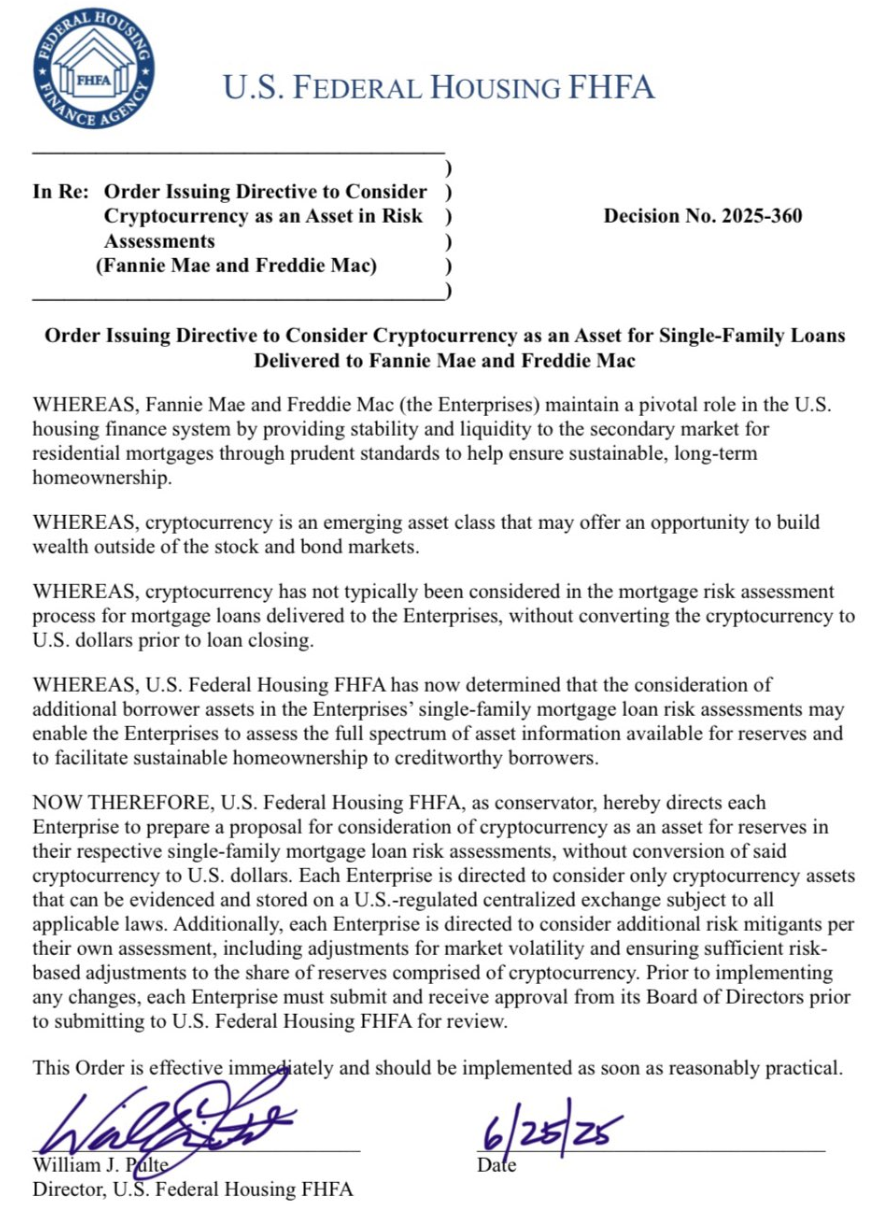
FHFA directive ordering Fannie Mae and Freddie Mac to consider cryptocurrency in mortgage risk assessments. Source: William Pulte

The directive also required the two government-sponsored enterprises to consider risk-mitigation measures for crypto’s volatility and submit any proposed changes to their boards for approval before FHFA review.

Other US lenders have also begun moving in that direction. Mortgage lender and servicer Newrez announced in January that it would recognize certain cryptocurrency holdings when evaluating mortgage applications beginning in February, including for home purchases and refinancing.

The expansion of Bitcoin-backed home financing comes as US housing prices remain near historic highs. The median sales price of a new US home was about $400,000 in 2026, according to data from the US Census Bureau and Department of Housing and Urban Development compiled by the Federal Reserve Bank of St. Louis.
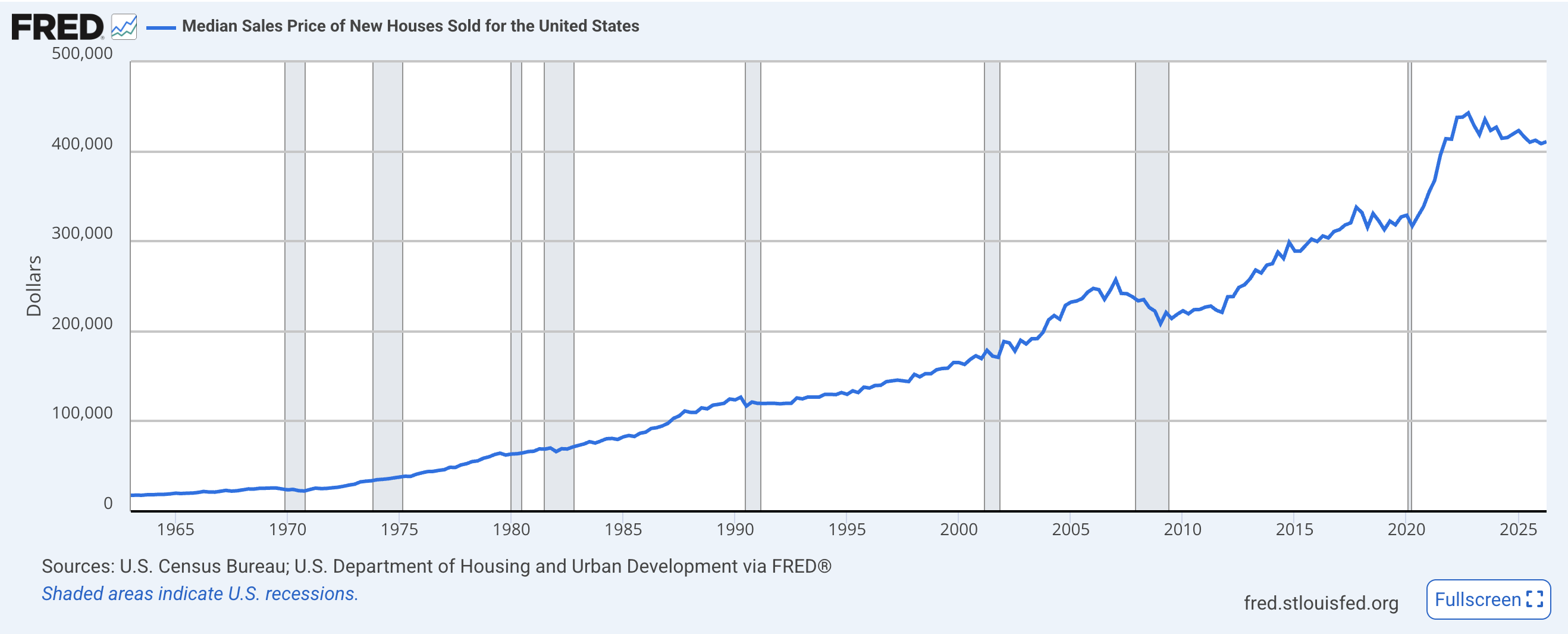
US median new home prices have fallen since 2022, but remain historically elevated. Source: Federal Reserve Bank of St. Louis

Magazine: Hugging Face hack exposes the open-weight AI cybersecurity paradox

Perguntas relacionadas

QWhat is the new product launched by Better Mortgage and Coinbase?

AThey have launched a generally available Bitcoin-backed mortgage product. This allows U.S. homebuyers to pledge Bitcoin as collateral for a down payment without having to sell it.

QHow does the Bitcoin collateral work for the down payment loan?

ABorrowers must pledge Bitcoin worth at least 250% of the down payment loan amount. The pledged BTC is transferred to Better's custodial account on Coinbase Prime and is returned once the mortgage is fully repaid or refinanced.

QWhat triggers the liquidation of the pledged Bitcoin?

ABitcoin price declines alone do not trigger margin calls. However, Better can liquidate the pledged BTC if a borrower becomes 60 days delinquent on their loan payments.

QWhat recent regulatory development supports the consideration of crypto in US mortgages?

AIn June 2025, the Federal Housing Finance Agency (FHFA) directed Fannie Mae and Freddie Mac to develop proposals to consider cryptocurrency held on U.S.-regulated exchanges as an asset in single-family mortgage risk assessments, without requiring conversion to U.S. dollars.

QAside from Better, which other US lender has announced plans to recognize cryptocurrency in mortgage evaluations?

AMortgage lender and servicer Newrez announced in January that it would recognize certain cryptocurrency holdings when evaluating mortgage applications beginning in February, including for home purchases and refinancing.

Leituras Relacionadas

ECB's Schnabel says central bank money 'should move to blockchain'

ECB Executive Board member Isabel Schnabel stated that central bank money "must move onto the blockchain." She argued that stablecoins lack the independent ability to scale liquidity during financial stress—a gap only a central bank can fill. Her proposed solution involves tokenization, which she says can make transactions faster, safer, and more programmable, but only if the safest asset (central bank money) is on the same "rails" as other tokenized assets. This marks a notable shift for the Eurosystem, which had previously viewed Distributed Ledger Technology (DLT) mainly as a tool for regulating stablecoins and crypto, not as infrastructure to adopt directly. The first step is Project Pontes, launching in September. It will initially synchronize the ECB’s existing TARGET services with private DLT platforms. Eventually, it aims to enable settlement finality on a Eurosystem-managed DLT platform with smart contract functionality and 24/7 operation. The long-term strategy is Project Appia, tasked with developing the architecture, standards, and legal framework for a genuine European tokenized asset market by 2028. Trials have already processed around €1.6 billion, and since March 2026, the ECB accepts DLT-based assets as collateral. While not directly impacting Bitcoin's price, these developments signal that a major G7 central bank is preparing to settle transactions on-chain, lending legitimacy to the underlying infrastructure of crypto markets. The ECB's move to avoid "disintermediation" by private tokenization shows that debates in central bank boardrooms are now aligning with discussions long followed in the crypto space.

cryptonews.ruHá 1h

ECB's Schnabel says central bank money 'should move to blockchain'

cryptonews.ruHá 1h

Ripple Labs Warns of a New Challenge for Blockchains

Ripple Labs is preparing the XRP Ledger for quantum threats but now emphasizes a broader challenge: ensuring financial infrastructure can adapt simultaneously to quantum computing and artificial intelligence. Senior Director of Engineering Ayo Akinyele states the goal is not merely anticipating a "Q-Day" but building infrastructure capable of preemptively adopting new security mechanisms without network disruption. The shift to post-quantum cryptography involves more than swapping algorithms; it requires flexible infrastructure, improved key management, and clear upgrade paths. Financial systems were not designed with quantum computers in mind, necessitating a rethink of transaction, identity, asset, and data protection. This is underscored by significant investments, such as the $2 billion U.S.-IBM quantum factory initiative and a 2030 U.S. government mandate for post-quantum cryptography adoption. AI introduces distinct risks by driving automation and autonomous economic activity, increasing demand for an always-on, internet-oriented payment infrastructure. AI agents could soon conduct transactions independently, creating new security requirements. Ripple Labs advocates for proactive, orderly preparation rather than a crisis-driven transition, having outlined a four-phase strategy aiming for a full XRP Ledger transition by 2028, now expanded to address both quantum and AI-driven challenges.

cryptonews.ruHá 1h

Ripple Labs Warns of a New Challenge for Blockchains

cryptonews.ruHá 1h

Trading

Spot
活动图片