Behind the Coinbase Acquisition of USDH: Hyperliquid’s Interest-Driven Choice

Odaily星球日报Publicado em 2026-05-15Última atualização em 2026-05-15

Resumo

The article discusses the transition of the Hyperliquid ecosystem's native stablecoin, USDH, following its acquisition by Coinbase. Last September, USDH, issued by Native Markets, was a focal point in the ecosystem. Recently, Coinbase announced it will become the official USDC treasury deployer on Hyperliquid. Native Markets granted Coinbase the rights to purchase the USDH brand assets, leading to the gradual phase-out of USDH. Users can convert USDH to USDC or fiat without fees during this period. USDC is now Hyperliquid's official stablecoin. The move is framed as a three-way win: * **Coinbase & Circle:** Deepen ties with Hyperliquid's on-chain economy. Both companies are staking HYPE tokens. Circle had already invested in HYPE previously. * **Hyperliquid:** Becomes the primary beneficiary, set to receive the vast majority (estimated ~90%) of the reserve yield income from the ~$5.16 billion in USDC on its platform. This could translate to significant daily HYPE buybacks. The alliance with Coinbase may also offer regulatory advantages in the US. * **Native Markets:** While exiting the stablecoin business, the team reportedly received economic compensation from Coinbase for the USDH brand assets, framing it as a successful conclusion to USDH's role. However, the article notes criticism from some Hyperliquid community members. They view the shift as a step back for decentralization and argue that the original USDH issuer vote was driven by internal interests rather th...

Original|Odaily Planet Daily(@OdailyChina)

Author|Wenser(@wenser 2010)
In September of last year, the battle over the Hyperliquid native stablecoin USDH once became a focal point in the industry; now, this once highly anticipated stablecoin has suddenly welcomed its own "exit moment."

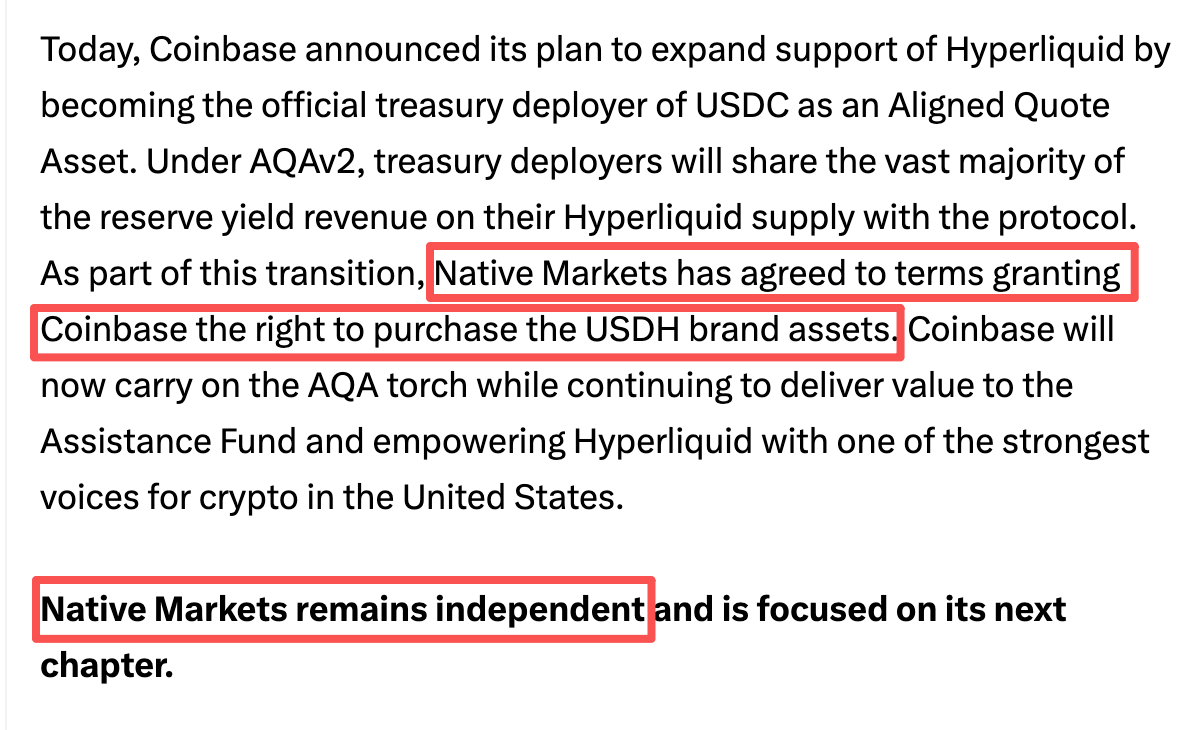
Last night, Coinbase announced it would become the official treasury deployer for USDC on Hyperliquid, while Native Markets, the issuer of the Hyperliquid native stablecoin USDH, granted Coinbase the right to purchase USDH brand assets. Subsequently, the USDH market will be gradually phased out, during which users can still convert USDH to USDC or fiat currency without transaction fees.

From this point on, the once-famous USDH has become an asset absorbed by Coinbase, while USDC is officially established as the official stablecoin and quote asset of Hyperliquid. Odaily Planet Daily will briefly analyze the details and subsequent impacts of this event in this article.

USDH Exits, USDC Rises: The Economic Calculations Behind $50 Billion

This grand play of the "Hyperliquid Ecosystem Stablecoin Battle" ultimately concluded with a win-win-win outcome for the three parties: Coinbase & Circle, Hyperliquid, and Native Markets, the USDH issuer.

Coinbase further deepened its integration with the Hyperliquid ecosystem through this move; Hyperliquid secured the majority of the revenue from USDC stablecoin reserves within its ecosystem; Native Markets, as the ultimate beneficiary of USDH, received its reward in the form of "selling the USDH brand assets."

Coinbase & Circle: Binding to Hyperliquid's On-Chain Economy, Continuously Increasing Investment in HYPE

Currently, the scale of USDC on Hyperliquid is approximately $5.164 billion, a year-on-year increase of 2 times.

As the official partner and revenue-sharing party for USDC, Coinbase's action undoubtedly aims to deeply integrate with the Hyperliquid ecosystem.

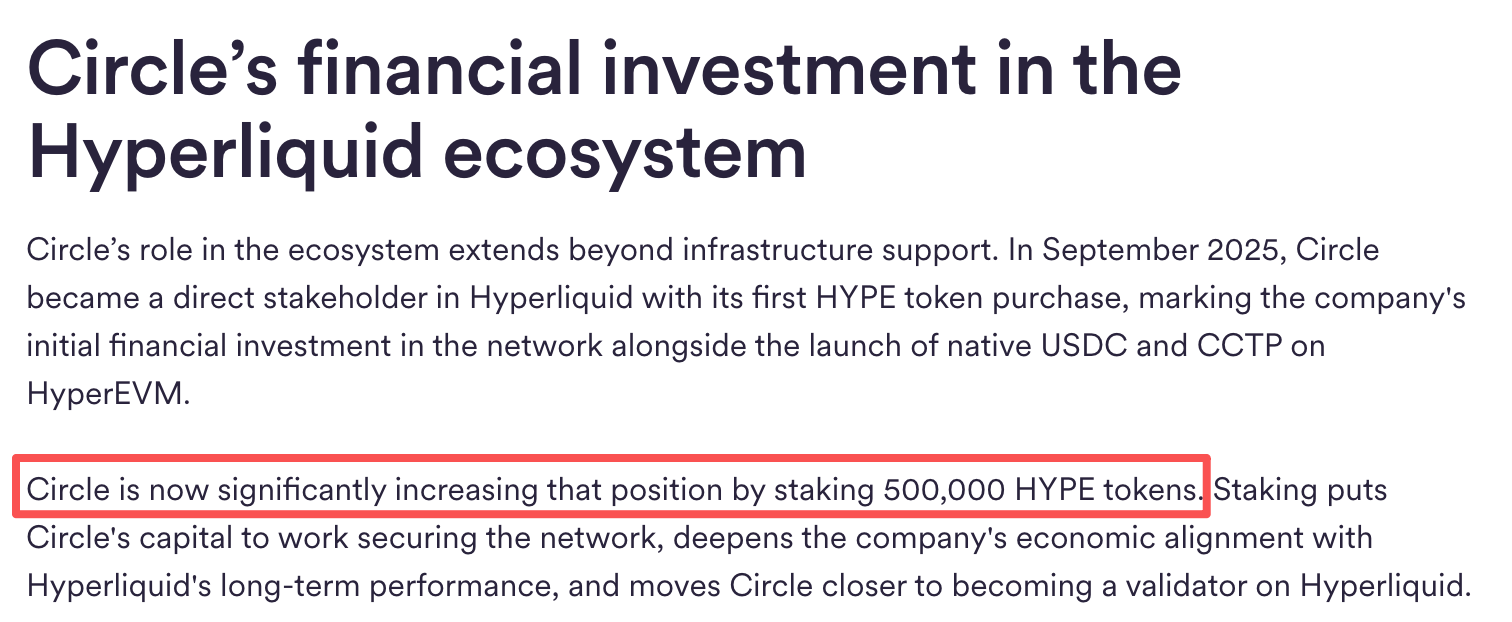
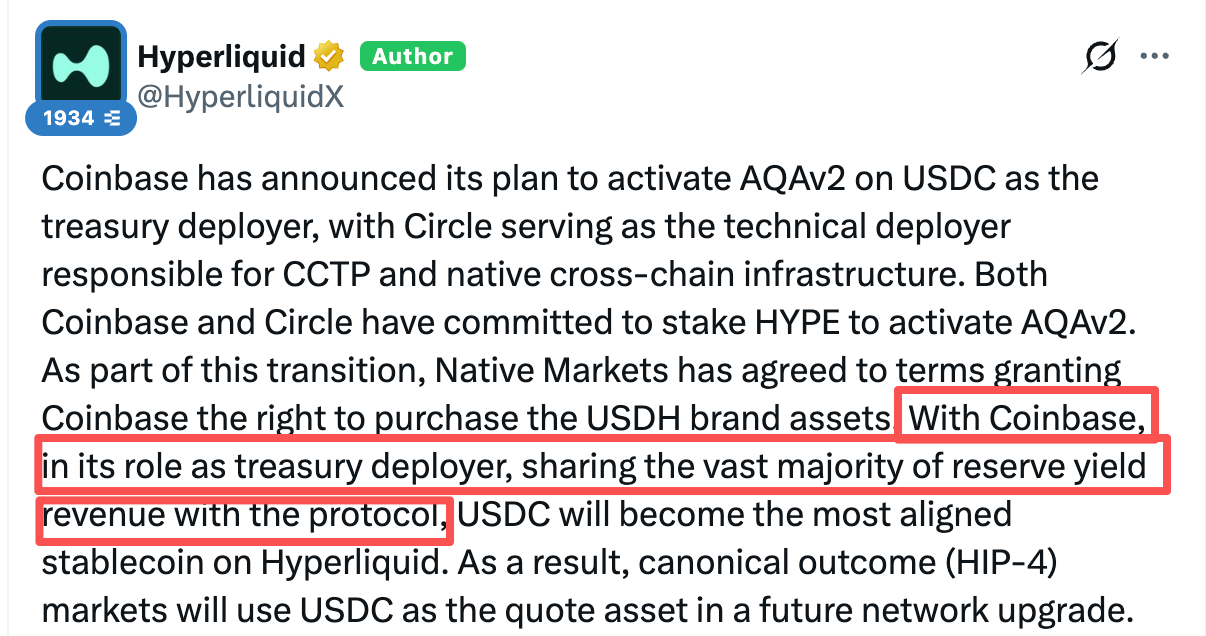
Additionally, according to official Hyperliquid announcement information, both Coinbase (funds deployer) and Circle (responsible for CCTP and native cross-chain infrastructure technical deployment) have committed to staking HYPE to activate AQAv2 (Aligned Quote Asset v2).

It is worth mentioning that in September last year, Circle had already purchased HYPE tokens, and its current HYPE token staking scale has increased to around 500,000.
Hyperliquid: Secures the Lion's Share of USDC Reserve Revenue, Enjoys the Convenience of Being a Coinbase Ally

As for the biggest winner of this cooperation, it is undoubtedly Hyperliquid as the foundational ecosystem.

According to the official announcement, Coinbase will subsequently share the majority (vast majority) of reserve revenue income with the Hyperliquid protocol. Although the specific split ratio has not been disclosed, if based on the previous USDH revenue-sharing mechanism, Hyperliquid will actually receive approximately 90% of the reserve revenue.

According to calculations by Hyperliquid community members, based on a scale of $4.7 billion and a 3.8% interest income rate, this revenue corresponds to approximately $160 million; in other words, it corresponds to a daily HYPE token buyback of about $440,000.

Furthermore, with the CLARITY Act passing the vote in the U.S. Senate Banking Committee, the deep integration between Hyperliquid and Coinbase also means that HYPE and Hyperliquid have gained a certain level of support in terms of U.S. regulation.
Native Markets: USDH's Historical Mission Accomplished

As the issuer of the Hyperliquid native stablecoin USDH, Native Markets might seem like the biggest loser in this "absorption event," but judging from its official statement, its ending can also be considered a "successful retirement."

On one hand, USDH provided a model and template for the revenue sharing of USDC between Coinbase and the Hyperliquid protocol; on the other hand, Coinbase likely directly acquired the USDH-related brand assets. The USDH stablecoin issued by the Native Markets team was essentially "acquired by Coinbase," thus providing the team with a certain economic return.

Subsequently, Native Markets also stated it would remain independent and seek developments in other areas.
After USDH's Exit, In a Win-Win-Win Situation, Only USDH Users Get Hurt

Of course, Native Markets' exit has not been met with universal "praise." Hyperliquid community users have also expressed disapproval of its so-called "sitting at the negotiation table" narrative.

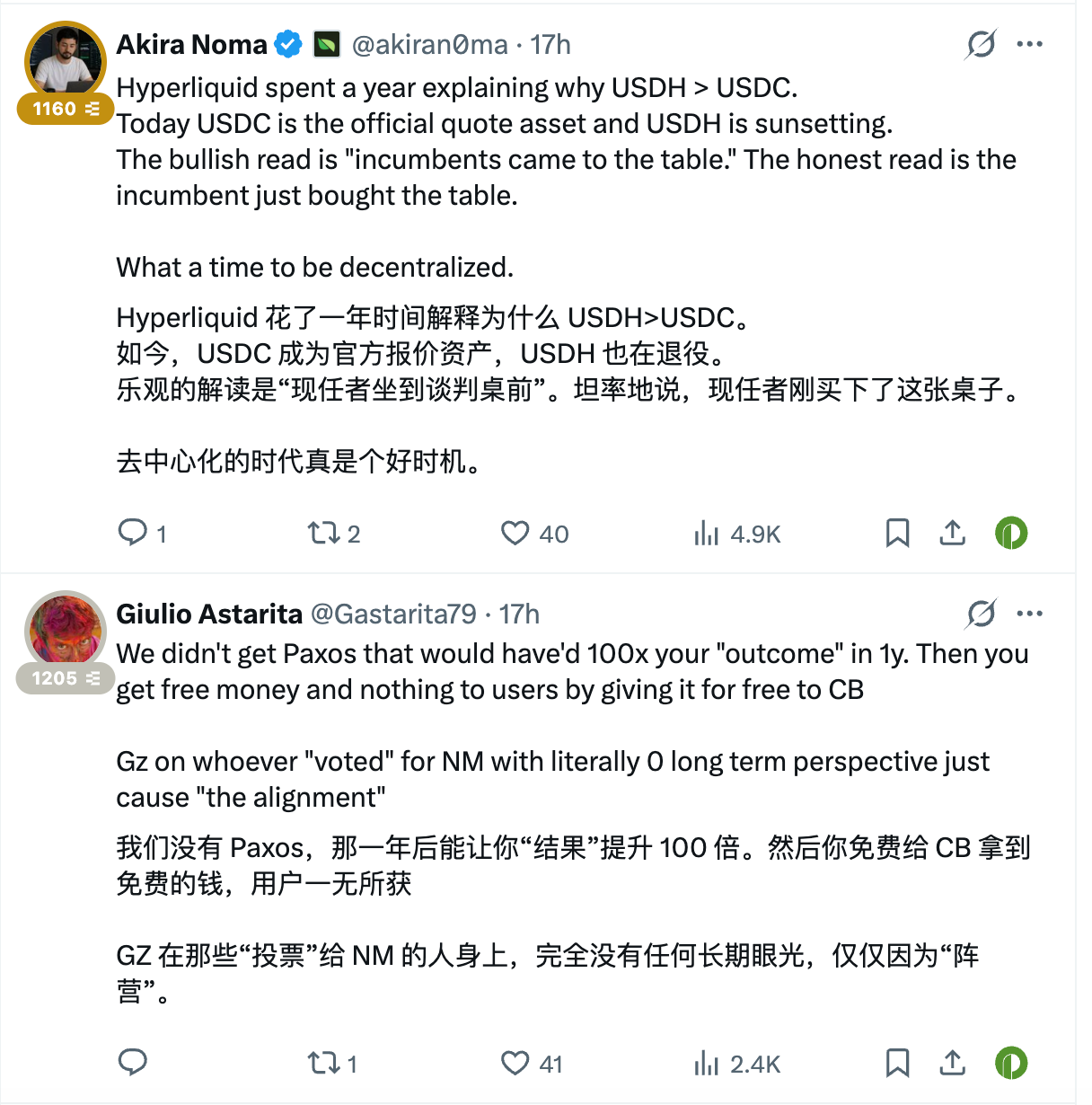
Some believe that the exit of USDH signifies a complete regression of the decentralization era;

Others point out that during the original USDH stablecoin issuer vote, Paxos should have been chosen, as they at least considered users and stablecoin growth. Those who voted for Native Markets were merely aligning with factions and internal interests. Ultimately, users gained nothing. These remarks have garnered considerable agreement and support.
Thus, the drama from a year ago, filled with "dominant pursuit," "resistance against giants," has finally come to an end.

However, looking back now at the scene of Hyperliquid "shaking hands and making peace" with Coinbase and Circle is somewhat poignant and slightly ironic.

In the end, everything was merely about the distribution of interests, not the once-loudly proclaimed slogans of "for the community" or "for Hyperliquid."

Recommended Reading

Hyperliquid Stablecoin USDH Becomes the "Industry's Favorite," Giants Trigger Chaotic Battle for Distribution Rights

USDH Vote in Progress: "Prearranged Script," "Dominant Pursuit," "Stepping Down Bravely" Take Turns on Stage

Perguntas relacionadas

QWhat major announcement did Coinbase make regarding Hyperliquid, and what does it mean for USDH?

ACoinbase announced it will become the official USDC treasury deployer on Hyperliquid. Additionally, USDH issuer Native Markets granted Coinbase the right to purchase the USDH brand assets. This means the USDH market will gradually be shut down, and USDH will effectively be 'acquired' by Coinbase, while USDC is established as Hyperliquid's official stablecoin and quote asset.

QAccording to the article, why is Hyperliquid considered the biggest winner in this arrangement?

AHyperliquid is considered the biggest winner because it will receive the vast majority (estimated around 90%) of the revenue generated from the USDC reserves on its platform. This represents significant, ongoing income. Furthermore, the deep partnership with Coinbase provides regulatory support and convenience for the Hyperliquid ecosystem in the US market.

QWhat benefit does the article state that Coinbase and Circle gain from this partnership with Hyperliquid?

ACoinbase and Circle gain a deeper economic and strategic bond with the Hyperliquid ecosystem. Coinbase strengthens its role as a major stablecoin infrastructure provider. Both companies have also committed to staking HYPE tokens to support the platform's AQAv2 (Aligned Quote Asset) mechanism, with Circle having already increased its HYPE stake significantly.

QHow is the outcome for Native Markets, the issuer of USDH, described in the article?

AThe outcome for Native Markets is described as achieving a 'graceful exit' or 'mission accomplished.' While they are stepping away from USDH, they are reportedly receiving financial compensation from Coinbase for the sale of the USDH brand assets. The team will remain independent to pursue other ventures, having paved the way for the USDC revenue-sharing model.

QWhat is one of the main criticisms from the Hyperliquid community regarding the shutdown of USDH?

AOne major criticism from the community is that the shutdown of USDH represents a step back for decentralization. Some users also expressed disappointment, arguing that the initial vote for the USDH issuer was driven by internal interests and 'bandwagoning' rather than choosing an issuer (like Paxos) that would prioritize users and the stablecoin's growth, leaving end-users with nothing.

Leituras Relacionadas

A Nation Blocks Chips, a Giant Buys a Nuclear Power Plant: Why It's Time to Seriously Consider DeAI

**Title: Great Powers Blockade Chips, Giants Buy Nuclear Plants: Why It's Time to Seriously Consider DeAI** In May 2026, the US closed loopholes for Chinese firms to acquire advanced NVIDIA chips via overseas subsidiaries. That same month, Kenya halted a $1B geothermal data center project involving Microsoft, fearing its immense energy consumption. Meanwhile, Huawei announced mass production of its Ascend AI chip. These disparate events underscore a new reality: the competition for computing power ("compute") has escalated beyond the tech industry, becoming a geopolitical and infrastructural battleground. A new era of oligopoly is forming, with control over the AI stack—from GPU chips (NVIDIA) and cloud platforms (AWS, Azure, Google Cloud) to foundational models (OpenAI, Anthropic)—concentrating in a few Western "AI Octopus" corporations. This centralization creates systemic risks: pricing power and platform lock-in for users, infrastructure fragility, and a widening "compute divide" that threatens to marginalize nations without independent AI capacity. An "AI Iron Curtain" is deepening through export controls. In response, some nations like Saudi Arabia and the UAE are investing heavily to buy compute power, aiming to transition from oil to AI economies. The EU seeks to triple its compute capacity by 2030 to reduce dependency. However, the spending gap is vast, with four US tech giants alone planning ~$750B in AI capex for 2026. The race is increasingly constrained by energy, with AI tasks consuming up to 1000x more power than web searches, pushing firms to even acquire nuclear plants. This landscape is fueling interest in Decentralized AI (DeAI). It proposes a third way: using open protocols to coordinate a global network of idle GPUs, independent developers, and data centers, creating an AI infrastructure without a single controlling entity. Leveraging blockchain and cryptographic verification, DeAI aims to break market concentration, disperse energy demands, reduce geopolitical dependencies, and enhance transparency. While still nascent in performance and stability, DeAI's core promise is not immediate superiority but providing a crucial alternative architecture to resist monopoly, censorship, and centralized power. As specialized AI hardware costs fall and open-source models flourish, the window to build this foundation is open. The very existence of such competition serves as a vital check against the inevitable abuse of concentrated power.

marsbitHá 10m

A Nation Blocks Chips, a Giant Buys a Nuclear Power Plant: Why It's Time to Seriously Consider DeAI

marsbitHá 10m

Outpoll Review: A Prediction Market Platform Built for Active Traders

Outpoll Review: A Prediction Market Platform Built for Active Traders In recent years, prediction markets have grown from a niche sector to a mainstream arena, attracting billions in trading volume and institutional capital. However, the user experience and tools for traders have not kept pace. Outpoll, a new global prediction market platform, aims to fill this gap by providing enhanced trading infrastructure for active and professional traders. Built on standard prediction market principles, Outpoll allows users to trade on the outcome of specific events. It uses fully collateralized contracts with USDC settlement, charges a competitive 0.1% fee per trade, and provides clear settlement rules upfront to minimize disputes. A key focus for Outpoll is its professional-grade trading tools. The platform supports limit and market orders, as well as take-profit and stop-loss orders for open positions—features uncommon in prediction markets. For automated trading, Outpoll offers comprehensive REST and WebSocket APIs, enabling portfolio management, price arbitrage, and integration with existing tools. The platform also features a creator-led market model, where approved experts and community leaders can create and manage markets for niche topics under platform supervision. Its integrated interface combines news feeds directly with trading functions, allowing users to monitor events and manage positions seamlessly. Outpoll launched with a native Android app (available on Google Play) and plans an iOS version later this year. In summary, Outpoll distinguishes itself with trader-focused tools, practical APIs, transparent and collateralized markets, integrated news, and an expanding creator program. For active traders, its advanced order types and API access alone make it a platform worth watching. Outpoll is now globally accessible via outpoll.com and Google Play.

marsbitHá 18m

Outpoll Review: A Prediction Market Platform Built for Active Traders

marsbitHá 18m

Bitwise: Crypto Becomes a Contrarian Investment, Three Logics to Understand the Current Market

**Summary** Matt Hougan, Bitwise's CIO, analyzes the current crypto market through three key lenses, arguing it has shifted from a momentum-driven to a contrarian investment. **1) Crypto Becomes a Contrarian Play:** The market is weak, with major assets like Bitcoin and Ethereum down significantly. Capital has moved to hot sectors like AI, leaving crypto as an "unloved" asset class. This transforms crypto investing from trend-following to a test of patience and fundamental analysis. Investors now favor projects with solid fundamentals (e.g., Hyperliquid) over speculative ones. **2) Regulatory Overhang:** The uncertain fate of the U.S. CLARITY Act, a major crypto regulatory framework, is a key headwind. With its passage in 2024 seen as far from guaranteed (estimates range from 30-55%), institutional capital remains on the sidelines, choosing less risky alternatives like AI stocks. The market needs clarity—whether the bill passes or fails—more than any specific outcome to move decisively. **3) Capital Rotates to New Fundamentals:** This cycle differs from past bear markets where money fled to Bitcoin. Now, capital seeks smaller assets with strong use cases. While major cryptos fell in May 2024, tokens like Hyperliquid (+72%), Zcash (+50%), and XLM (+44%) rallied on their specific fundamentals. This rotation confirms the new contrarian, fundamentals-driven logic and signals the bear market may be in its later stages. **Conclusion:** Short-term pressure persists due to regulatory uncertainty and competition from AI narratives. Investing in crypto now requires a contrarian mindset—acting against the crowd and focusing on fundamental value. Patience and targeting high-quality projects based on their merits are essential for capturing long-term gains.

marsbitHá 1h

Bitwise: Crypto Becomes a Contrarian Investment, Three Logics to Understand the Current Market

marsbitHá 1h

ChatGPT Might Be Disappearing Soon

OpenAI announced at its "Intelligence at Work" event that its coding assistant, Codex, will be fully integrated into the ChatGPT app within weeks. This move marks a strategic shift from a conversational AI (Chat) towards a unified "agentic" platform capable of execution. Codex, originally launched to compete with Anthropic's Claude Code, has grown rapidly to 5 million weekly active users, with 20% being non-developers like analysts and designers. Its enterprise revenue now constitutes 40% of OpenAI's total. The integration is the first step in creating a super-app combining ChatGPT (interface), Codex (execution engine), and the Atlas browser (web access). OpenAI also unveiled new Codex features: specialized Agent plugins for six professional roles, an "Annotations" tool for direct document editing, and a "Sites" function to turn work into shareable web apps. Internally, this reflects a power shift; the Codex team now leads core product strategy. While the ChatGPT brand remains for its vast user base, the platform's future is focused on autonomous agents that perform tasks, not just chat. The article notes that competition with Claude Code pushed OpenAI's development, with Codex competing on cost-effectiveness and accessibility rather than raw coding quality. It concludes that the essence of "ChatGPT" is evolving from a chatbot into an AI agent platform, with the name potentially becoming a legacy symbol of its original function.

marsbitHá 1h

ChatGPT Might Be Disappearing Soon

marsbitHá 1h

Trading

Spot
Futuros
活动图片