Behind the Coinbase Acquisition of USDH: Hyperliquid’s Interest-Driven Choice

Odaily星球日报Publicado em 2026-05-15Última atualização em 2026-05-15

Resumo

The article discusses the transition of the Hyperliquid ecosystem's native stablecoin, USDH, following its acquisition by Coinbase. Last September, USDH, issued by Native Markets, was a focal point in the ecosystem. Recently, Coinbase announced it will become the official USDC treasury deployer on Hyperliquid. Native Markets granted Coinbase the rights to purchase the USDH brand assets, leading to the gradual phase-out of USDH. Users can convert USDH to USDC or fiat without fees during this period. USDC is now Hyperliquid's official stablecoin. The move is framed as a three-way win: * **Coinbase & Circle:** Deepen ties with Hyperliquid's on-chain economy. Both companies are staking HYPE tokens. Circle had already invested in HYPE previously. * **Hyperliquid:** Becomes the primary beneficiary, set to receive the vast majority (estimated ~90%) of the reserve yield income from the ~$5.16 billion in USDC on its platform. This could translate to significant daily HYPE buybacks. The alliance with Coinbase may also offer regulatory advantages in the US. * **Native Markets:** While exiting the stablecoin business, the team reportedly received economic compensation from Coinbase for the USDH brand assets, framing it as a successful conclusion to USDH's role. However, the article notes criticism from some Hyperliquid community members. They view the shift as a step back for decentralization and argue that the original USDH issuer vote was driven by internal interests rather th...

Original|Odaily Planet Daily(@OdailyChina)

Author|Wenser(@wenser 2010)
In September of last year, the battle over the Hyperliquid native stablecoin USDH once became a focal point in the industry; now, this once highly anticipated stablecoin has suddenly welcomed its own "exit moment."

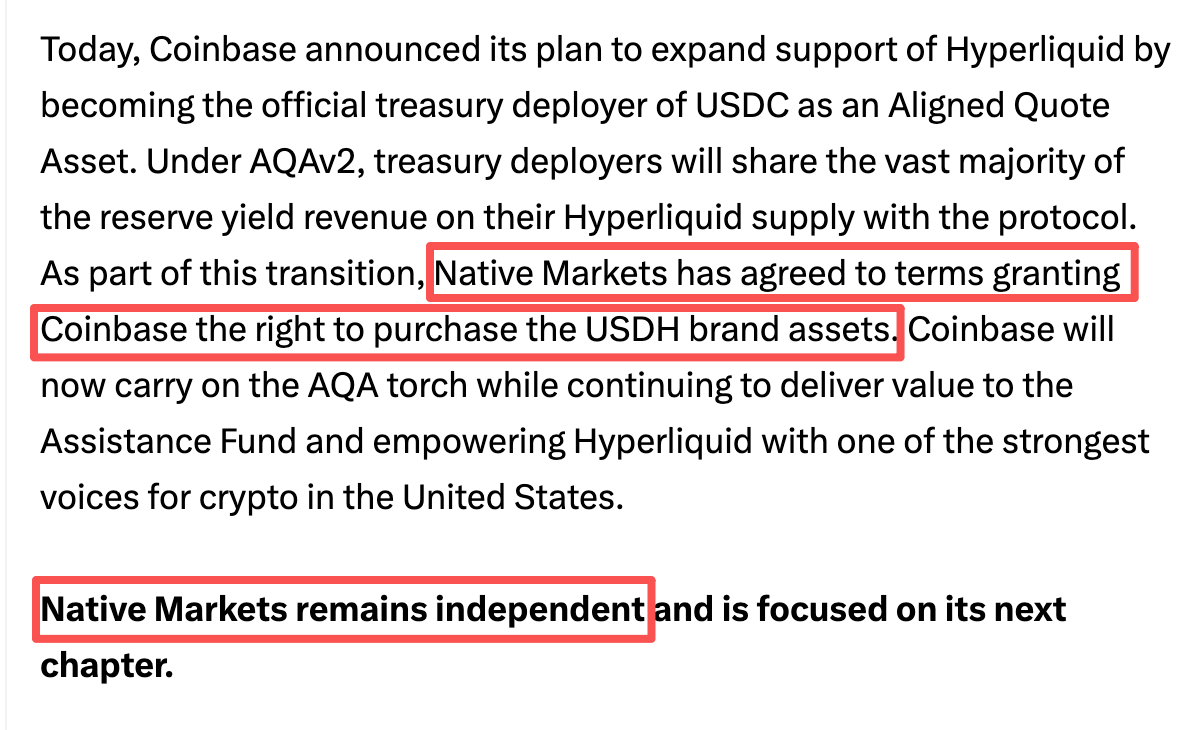
Last night, Coinbase announced it would become the official treasury deployer for USDC on Hyperliquid, while Native Markets, the issuer of the Hyperliquid native stablecoin USDH, granted Coinbase the right to purchase USDH brand assets. Subsequently, the USDH market will be gradually phased out, during which users can still convert USDH to USDC or fiat currency without transaction fees.

From this point on, the once-famous USDH has become an asset absorbed by Coinbase, while USDC is officially established as the official stablecoin and quote asset of Hyperliquid. Odaily Planet Daily will briefly analyze the details and subsequent impacts of this event in this article.

USDH Exits, USDC Rises: The Economic Calculations Behind $50 Billion

This grand play of the "Hyperliquid Ecosystem Stablecoin Battle" ultimately concluded with a win-win-win outcome for the three parties: Coinbase & Circle, Hyperliquid, and Native Markets, the USDH issuer.

Coinbase further deepened its integration with the Hyperliquid ecosystem through this move; Hyperliquid secured the majority of the revenue from USDC stablecoin reserves within its ecosystem; Native Markets, as the ultimate beneficiary of USDH, received its reward in the form of "selling the USDH brand assets."

Coinbase & Circle: Binding to Hyperliquid's On-Chain Economy, Continuously Increasing Investment in HYPE

Currently, the scale of USDC on Hyperliquid is approximately $5.164 billion, a year-on-year increase of 2 times.

As the official partner and revenue-sharing party for USDC, Coinbase's action undoubtedly aims to deeply integrate with the Hyperliquid ecosystem.

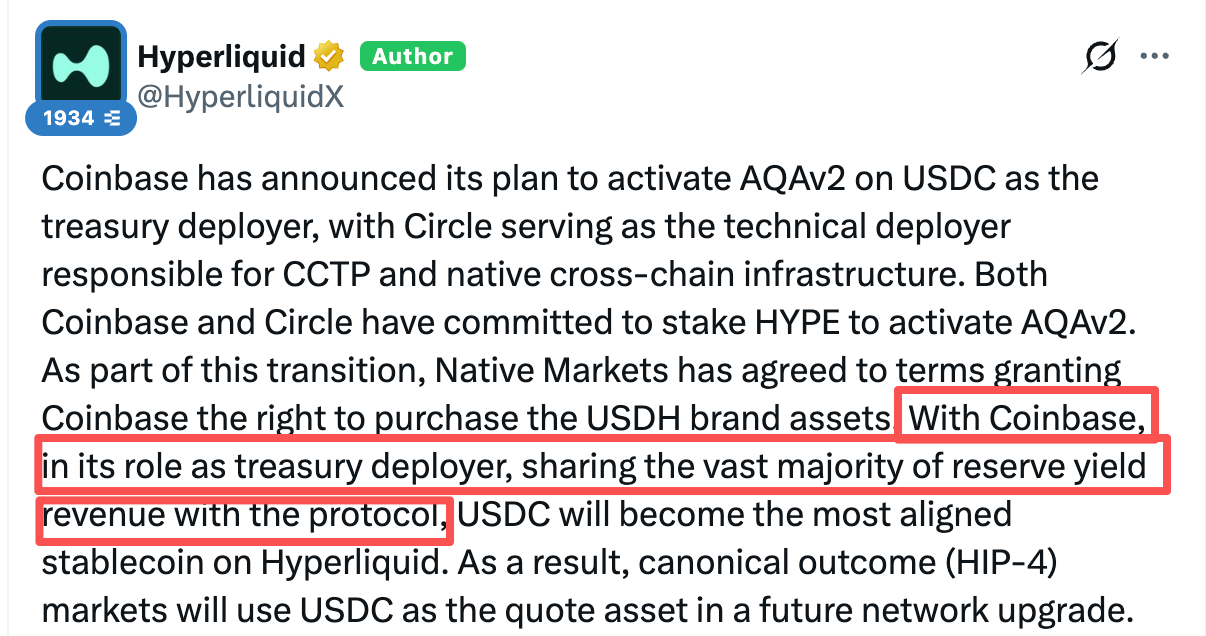
Additionally, according to official Hyperliquid announcement information, both Coinbase (funds deployer) and Circle (responsible for CCTP and native cross-chain infrastructure technical deployment) have committed to staking HYPE to activate AQAv2 (Aligned Quote Asset v2).

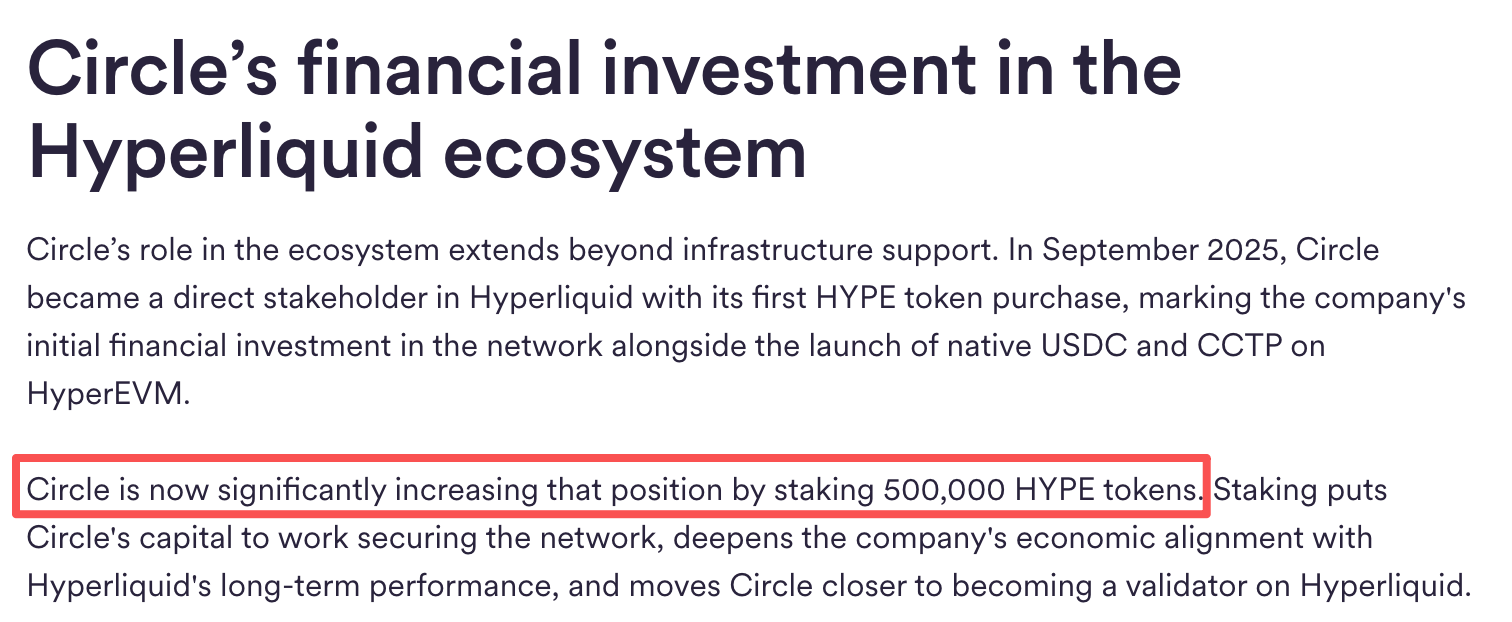
It is worth mentioning that in September last year, Circle had already purchased HYPE tokens, and its current HYPE token staking scale has increased to around 500,000.
Hyperliquid: Secures the Lion's Share of USDC Reserve Revenue, Enjoys the Convenience of Being a Coinbase Ally

As for the biggest winner of this cooperation, it is undoubtedly Hyperliquid as the foundational ecosystem.

According to the official announcement, Coinbase will subsequently share the majority (vast majority) of reserve revenue income with the Hyperliquid protocol. Although the specific split ratio has not been disclosed, if based on the previous USDH revenue-sharing mechanism, Hyperliquid will actually receive approximately 90% of the reserve revenue.

According to calculations by Hyperliquid community members, based on a scale of $4.7 billion and a 3.8% interest income rate, this revenue corresponds to approximately $160 million; in other words, it corresponds to a daily HYPE token buyback of about $440,000.

Furthermore, with the CLARITY Act passing the vote in the U.S. Senate Banking Committee, the deep integration between Hyperliquid and Coinbase also means that HYPE and Hyperliquid have gained a certain level of support in terms of U.S. regulation.
Native Markets: USDH's Historical Mission Accomplished

As the issuer of the Hyperliquid native stablecoin USDH, Native Markets might seem like the biggest loser in this "absorption event," but judging from its official statement, its ending can also be considered a "successful retirement."

On one hand, USDH provided a model and template for the revenue sharing of USDC between Coinbase and the Hyperliquid protocol; on the other hand, Coinbase likely directly acquired the USDH-related brand assets. The USDH stablecoin issued by the Native Markets team was essentially "acquired by Coinbase," thus providing the team with a certain economic return.

Subsequently, Native Markets also stated it would remain independent and seek developments in other areas.
After USDH's Exit, In a Win-Win-Win Situation, Only USDH Users Get Hurt

Of course, Native Markets' exit has not been met with universal "praise." Hyperliquid community users have also expressed disapproval of its so-called "sitting at the negotiation table" narrative.

Some believe that the exit of USDH signifies a complete regression of the decentralization era;

Others point out that during the original USDH stablecoin issuer vote, Paxos should have been chosen, as they at least considered users and stablecoin growth. Those who voted for Native Markets were merely aligning with factions and internal interests. Ultimately, users gained nothing. These remarks have garnered considerable agreement and support.

Thus, the drama from a year ago, filled with "dominant pursuit," "resistance against giants," has finally come to an end.

However, looking back now at the scene of Hyperliquid "shaking hands and making peace" with Coinbase and Circle is somewhat poignant and slightly ironic.

In the end, everything was merely about the distribution of interests, not the once-loudly proclaimed slogans of "for the community" or "for Hyperliquid."

Recommended Reading

Hyperliquid Stablecoin USDH Becomes the "Industry's Favorite," Giants Trigger Chaotic Battle for Distribution Rights

USDH Vote in Progress: "Prearranged Script," "Dominant Pursuit," "Stepping Down Bravely" Take Turns on Stage


Perguntas relacionadas

QWhat major announcement did Coinbase make regarding Hyperliquid, and what does it mean for USDH?

ACoinbase announced it will become the official USDC treasury deployer on Hyperliquid. Additionally, USDH issuer Native Markets granted Coinbase the right to purchase the USDH brand assets. This means the USDH market will gradually be shut down, and USDH will effectively be 'acquired' by Coinbase, while USDC is established as Hyperliquid's official stablecoin and quote asset.

QAccording to the article, why is Hyperliquid considered the biggest winner in this arrangement?

AHyperliquid is considered the biggest winner because it will receive the vast majority (estimated around 90%) of the revenue generated from the USDC reserves on its platform. This represents significant, ongoing income. Furthermore, the deep partnership with Coinbase provides regulatory support and convenience for the Hyperliquid ecosystem in the US market.

QWhat benefit does the article state that Coinbase and Circle gain from this partnership with Hyperliquid?

ACoinbase and Circle gain a deeper economic and strategic bond with the Hyperliquid ecosystem. Coinbase strengthens its role as a major stablecoin infrastructure provider. Both companies have also committed to staking HYPE tokens to support the platform's AQAv2 (Aligned Quote Asset) mechanism, with Circle having already increased its HYPE stake significantly.

QHow is the outcome for Native Markets, the issuer of USDH, described in the article?

AThe outcome for Native Markets is described as achieving a 'graceful exit' or 'mission accomplished.' While they are stepping away from USDH, they are reportedly receiving financial compensation from Coinbase for the sale of the USDH brand assets. The team will remain independent to pursue other ventures, having paved the way for the USDC revenue-sharing model.

QWhat is one of the main criticisms from the Hyperliquid community regarding the shutdown of USDH?

AOne major criticism from the community is that the shutdown of USDH represents a step back for decentralization. Some users also expressed disappointment, arguing that the initial vote for the USDH issuer was driven by internal interests and 'bandwagoning' rather than choosing an issuer (like Paxos) that would prioritize users and the stablecoin's growth, leaving end-users with nothing.

Leituras Relacionadas

It Took Me a Year to See the Bitter Truth About Agent Payments

After a year building infrastructure for the Agent economy, engaging with major players like Stripe, Visa, and Coinbase, the author shares a sobering analysis of the current state of Agent payments. The core finding is a stark lack of genuine, immediate demand across most envisioned use cases. The article breaks down four key market segments: 1. **Agent-to-Merchant (Consumer Shopping):** For most product categories (e.g., clothing, electronics), conversational AI shopping is a step backwards from visual e-commerce interfaces. While agents excel at understanding needs, they can't replace side-by-side product comparison. Real merchant interest is defensive "Agent Engine Optimization," not driven by current customer demand. Potential exists for high-frequency, low-decision purchases (like food delivery) or navigating complex store UIs, but these require massive B2C distribution channels dominated by giants like Amazon. 2. **Agent-to-API (Developer Services):** Developers already have subscriptions and billing relationships for APIs (compute, data). Prepaid balances solve micro-payment issues for low transaction volumes. A deeper structural problem is that major SaaS vendors' business models rely on enterprise contracts, resisting granular pay-per-call pricing. While protocols like MPP and x402 serve the long tail of niche services, this market is small and developers are historically low-willingness-to-pay. 3. **Agent-to-Agent:** This remains largely theoretical with minimal transaction volume. While it represents a long-term bet on a fundamentally new transaction infrastructure (sub-second, micro-penny to million-dollar, multi-party settlements), it does not constitute a present market. 4. **Agent-to-Finance:** This is the only category with existing, paying demand. Integrating AI into financial workflows (trading, portfolio management) is a natural evolution and enables new capabilities like autonomous rebalancing. However, competition favors established, regulated institutions. The "real problem" is not moving money between agents, but the broader challenge of **coordination**—orchestrating work between agents and humans, verifying outcomes, and settling results. Payment is just one component of settlement, which is itself part of coordination. Companies that solve the coordination layer will subsume payment, not the other way around. While well-funded incumbents build defensively for a long-term future, startups must find where the market is today—which, for the author's team, lies outside these four categories in an area of real, growing, and underserved activity.

marsbitHá 2m

It Took Me a Year to See the Bitter Truth About Agent Payments

marsbitHá 2m

It Took Me a Year to See the Hard Truth About Agent Payments

**Title: It Took Me a Year to See the Hard Truth About Agent Payments** Over the past year, I've worked on infrastructure for the Agent economy, engaging with major players like Stripe, Visa, Coinbase, and numerous startups. The findings reveal a stark reality: genuine, widespread demand for Agent-based payments does not yet exist. **Key Observations:** * **Agent-to-Merchant (Shopping):** The user experience for AI shopping often falls short, especially for visual product discovery. While AI excels at understanding needs, conversational interfaces can't yet replace browsing and comparing multiple products visually. Current merchant interest is largely defensive ("Agent Engine Optimization") for a future that hasn't arrived. High-frequency, low-friction purchases (like food delivery) are potential fits, but lack open APIs and face high AI inference costs. Simpler, more affordable, or cross-language interactions for complex UIs are a niche opportunity but require massive consumer distribution to scale. * **Agent-to-API (Developer Tools):** Developer payment needs for APIs (computing, data, models) are already met through subscriptions and prepaid credits. The core challenge is not payment friction but supplier economics: most large SaaS providers prefer enterprise contracts over micropayments for API calls. Protocols like MPP and x402 suit the long-tail of smaller services but cater to a developer market historically reluctant to pay for these tools. Major infrastructure needs at the top of the stack are already being addressed. * **Agent-to-Agent (Machine Commerce):** This is a long-term vision with almost no current transaction volume. While a future with high-speed, high-frequency, multi-party machine-to-machine transactions would require novel infrastructure, it remains theoretical. The market is not here yet. * **Agent-to-Finance:** This is the only category with clear, present demand. Financial professionals and DeFi users already pay for tools, and AI augmentation is a natural evolution. Autonomous AI agents can enable entirely new financial strategies. However, competition is fierce from established, regulated incumbents who can more easily layer AI onto their existing products. **The Core Insight:** Companies, especially giants with long time horizons, are building defensively for a potential future of mass machine commerce. For them, early investment is a low-cost hedge. For startups, the current market reality is different. The primary challenge isn't just moving money between agents (payments). The larger, unsolved problem is **orchestration** – coordinating work between agents and humans, verifying outcomes, and then settling. Payment is just a part of settlement, which is just a part of orchestration. Companies that solve the orchestration problem will subsume payments, not the other way around. After a year of building, we see the real, growing, and underserved market opportunity lies in this broader domain of orchestration.

链捕手Há 25m

It Took Me a Year to See the Hard Truth About Agent Payments

链捕手Há 25m

Claude Opus 4.8 Finds a $4.5 Billion Bug: The AI Era is Mass-Producing Hackers

A researcher discovered a critical "infinite mint" vulnerability in the Zcash cryptocurrency's Orchard protocol using Claude Opus 4.8, leading to a swift fix but also a 50% market drop, erasing billions in value. This incident highlights a new era where powerful, accessible AI models are dramatically lowering the barrier to finding software vulnerabilities. Previously, the security community feared specialized models like Claude Mythos Preview, capable of finding decades-old zero-day exploits. The Zcash case, however, involved a publicly available, general-purpose model. This shift makes advanced security auditing—and attack capabilities—accessible to far more people, not just experts. The mass democratization of vulnerability discovery brings a dual challenge: a flood of low-quality, AI-generated false reports that overwhelm maintainers, and the real, rapid uncovering of deep, dangerous bugs. Open-source projects, often understaffed and unfunded, are particularly vulnerable to this "attention DDoS." The article cites examples like curl shutting down its bug bounty program due to the unsustainable workload. Our perceived digital safety has often been luck, relying on the high cost and effort required to find deeply hidden flaws in complex systems, as seen with historical vulnerabilities like Heartbleed or Baron Samedit. AI changes this cost structure, effectively "mass-producing flashlights" to illuminate every corner of our codebase. While large companies operate extensive security chains involving external white-hat hackers and massive defensive operations, the global cybersecurity workforce faces a severe shortage, especially of experienced personnel capable of analyzing complex threats and coordinating fixes. The core dilemma emerges: AI makes *finding* bugs cheap and scalable, but *fixing* them remains a slow, expensive, and human-intensive process. The article concludes that AI won't destroy the internet but acts as a bright light, revealing that our digital existence is not inherently secure but is precariously maintained by ongoing human effort. The true cost in the AI era may not be discovery, but whether there will be enough people left willing and able to do the hard work of repair.

marsbitHá 58m

Claude Opus 4.8 Finds a $4.5 Billion Bug: The AI Era is Mass-Producing Hackers

marsbitHá 58m

Codex Goal Mode Usage Guide: How to Make AI Continuously Pursue a Specific Objective

"Codex Goal Mode: How to Make AI Work Continuously Toward a Specific Goal" OpenAI's Codex "goal mode" (/goal) transforms the AI from a reactive code assistant into a proactive execution agent capable of working autonomously for hours or even days to achieve a defined objective. To maximize its effectiveness, follow these key principles: 1. **Define Clear, Verifiable Exit Criteria:** The goal prompt should be a concise, measurable success condition, not a lengthy specification. Use quantifiable metrics like "reduce build time by 30%" or "achieve 100% test parity." 2. **Provide Initial Guidance and Tools:** Direct Codex toward likely problem areas and specify available tools (e.g., browsers, testing environments) to prevent it from exploring unproductive paths. 3. **Enable Progress Measurement:** Equip Codex with ways to track advancement, such as creating comparison tools for visual tasks or evaluation sets, ensuring it can gauge its own progress. 4. **Use a Realistic Execution Environment:** For tasks like performance optimization, provide access to environments that closely mimic production (e.g., similar configs, databases) to yield valid results. 5. **Be Cautious with Visual Goals:** Avoid vague "pixel-perfect" instructions. Instead, supplement visual references with functional checklists or design system specifications to prevent Codex from obsessing over minor details. 6. **Implement Progress Tracking:** For long-running tasks, have Codex commit code to draft PRs, update progress documents, or send Slack updates to maintain visibility into its work. 7. **Review and Consolidate Results:** Once the goal is met, instruct Codex to review its work, clean up ineffective experimental code, and reflect on what strategies succeeded or failed. Ultimately, using goal mode shifts the developer's role from writing prompts to managing a persistent engineering agent—defining objectives, establishing metrics, configuring environments, and conducting final reviews.

marsbitHá 2h

Codex Goal Mode Usage Guide: How to Make AI Continuously Pursue a Specific Objective

marsbitHá 2h

Trading

Spot
Futuros
活动图片




