Behind Changxin Technology, Stands a Group of A-Share Companies

marsbitPublicado em 2026-05-28Última atualização em 2026-05-28

Resumo

Changxin Technology, a leading Chinese DRAM (Dynamic Random Access Memory) manufacturer, has passed the review by the STAR Market listing committee, moving closer to an IPO. The company, seeking to raise 29.5 billion yuan, is the first to utilize the new "pre-review mechanism" on the STAR Market, expediting its approval process within five months. As China's largest and most technologically advanced integrated DRAM company, Changxin has achieved mass production of mainstream DDR5 and LPDDR5X products. It holds the fourth-largest global market share and ranks first in China, though it still trails behind industry leaders Samsung, SK Hynix, and Micron in areas like HBM technology. The company reported its first annual profit in 2025, with net profit surging to 24.762 billion yuan in Q1 2026, driven by booming AI-related demand. The IPO has drawn significant market attention due to Changxin's extensive and prestigious shareholder base. This includes state-backed funds like the National Integrated Circuit Industry Investment Fund II, industrial partner GigaDevice, internet giants (Xiaomi, Alibaba, Tencent), and several securities firms and A-share listed companies such as InfoMotion, Shangfeng Cement, and Hefei Urban Construction, which stand to benefit from the listing. The company's founder, Zhu Yiming, a pivotal figure in China's semiconductor industry who also founded GigaDevice, has committed to an unprecedented long-term lock-up of his shares and a massive personal equit...

Source: Cailian Press

Today (May 27), the domestic DRAM (Dynamic Random-Access Memory) leader—Changxin Technology Group Co., Ltd. (hereinafter referred to as "Changxin Technology")—successfully passed the review by the STAR Market listing committee and is about to enter the capital market.
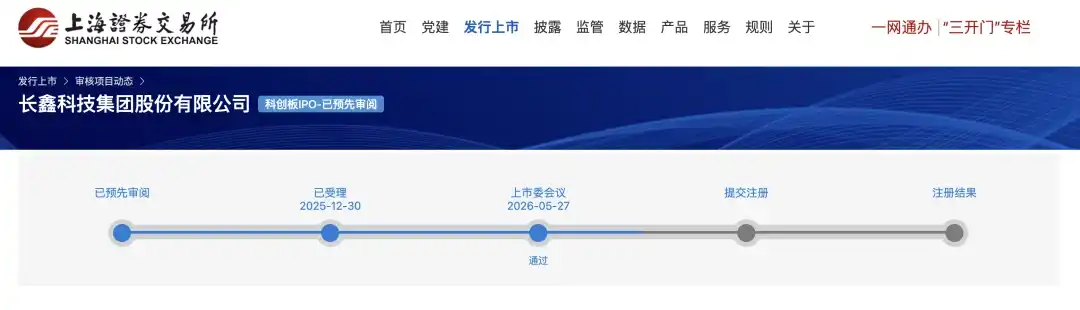
As the first "pre-review" project on the STAR Market and a hard-tech behemoth aiming to raise 29.5 billion yuan, Changxin Technology's passage of the review coincides with its tenth anniversary. This is not only a milestone for the company's own development but also marks a crucial step for China's memory chip industry in breaking the long-term overseas monopoly and moving towards self-reliance and controllability.

From Acceptance to Passing Review: Less Than 5 Months

It took Changxin Technology less than five months from IPO acceptance on the STAR Market to passing the review.

As the first company to apply for listing using the IPO "Pre-Review Mechanism" after the STAR Market reform policy in July 2025, Changxin Technology's listing review process was special and high-priority, significantly shortening the listing cycle while avoiding targeted competition from peers due to early disclosure of business and technical information.

Judging from previous rounds of inquiries by the exchange, concerns primarily focused on three core issues: the industry cycle, technological gap, and sustainability of profitability, all directly addressing the pain points of the DRAM industry and key aspects of the company's development.

In response, Changxin Technology stated in its inquiry replies that the DRAM industry is significantly influenced by market supply-demand fluctuations and exhibits pronounced cyclical characteristics. Furthermore, as the supply side of the DRAM market is highly concentrated, with Samsung Electronics, SK Hynix, and Micron Technology holding the vast majority of market share, their capital expenditures are relatively concentrated. Decisions to add or reduce capacity are often released simultaneously, thereby intensifying the industry's cyclical nature and causing significant volatility in DRAM market prices. DRAM products have a high degree of standardization, and the company sets product prices with reference to market prices. Fluctuations in market prices directly affect the company's product unit prices and revenue, thereby impacting its profits.

Samsung Electronics, SK Hynix, and Micron Technology have developed over several decades, possessing first-mover technological advantages and cost advantages, making them more resilient to risks and market shocks. In contrast, Changxin Technology started its development relatively late and is still in the capacity construction and ramp-up phase. Ramping up production capacity for new production lines typically takes multiple quarters, and building a new wafer fab from capital expenditure to capacity release can take several years. Consequently, at this stage, the company still lags behind international leading manufacturers in terms of revenue scale, production capacity scale, and product portfolio. Not only are its production costs relatively higher, but it is also more prone to negative product gross margins or increased inventory write-downs when market competition intensifies and product prices fall compared to leading manufacturers.

In the 2024 global DRAM market, Samsung Electronics, SK Hynix, and Micron Technology held market shares of 40.35%, 33.19%, and 20.73% respectively. Changxin Technology ranked fourth globally and first in China in terms of global market share.

In its inquiries, the exchange also focused on the technological gap between Changxin Technology and the aforementioned overseas leaders, as well as the progress of industry localization.

Changxin Technology has achieved mass production of DDR5/LPDDR5X, filling the domestic gap for general-purpose DRAM. However, a gap still exists in HBM (High Bandwidth Memory) compared to Samsung and SK Hynix.

Changxin Technology stated that after years of development, it has become China's largest, most technologically advanced, and most comprehensively positioned DRAM research, design, and manufacturing integrated enterprise. It has established product portfolios covering the two major mainstream product series: DDR and LPDDR. Moreover, each series can provide the most advanced DDR5, LPDDR5/5X products currently on the market. Its products are widely used in markets such as servers, mobile devices, personal computers, and smart vehicles. The performance of its main products has reached internationally advanced levels, demonstrating strong product competitiveness.

Starting from the second half of 2025, the AI computing power explosion drove a surge in memory prices, allowing Changxin Technology to achieve its first annual profit turnaround. For the full year 2025, the company achieved a net profit attributable to shareholders of 1.875 billion yuan. By the first quarter of 2026, its net profit attributable to shareholders reached 24.762 billion yuan, with a daily profit exceeding 275 million yuan.

In the SSE's inquiry, Changxin was required to disclose its future profit prospects and uncertainties regarding its future development.

Changxin Technology stated that DRAM, as the core hub of artificial intelligence computing power systems, has seen explosive growth in market demand driven by the rapid development of AI and high-speed growth in related infrastructure investment. This was one of the main reasons for the company's performance growth since the second half of 2025.

However, the performance of companies in the DRAM industry is susceptible to cyclical fluctuations. Represented by Samsung Electronics, SK Hynix, and Micron Technology, these companies started relatively early and, after years of development and accumulation, have built strong scale, product, and technological advantages, equipping them with a certain degree of resilience against cyclical fluctuations.

Nevertheless, Changxin Technology also stated, "As production capacity continues to be released, the company's production capacity scale is rapidly catching up with the top three international manufacturers, and its competitiveness continues to strengthen. Meanwhile, with product sales achieving rapid growth, the company has developed strong resilience against cyclical fluctuations. Therefore, under the current favorable market expectations, the company expects to achieve profitability in 2026 or 2027, which is reasonable and prudent."

Luxurious Shareholder List, Many A-Share Companies May Benefit

Due to the extremely high upfront production and R&D investments required for storage chip manufacturers using the IDM model, Changxin Technology's development has undergone multiple rounds of financing, ultimately forming a large-scale and diverse shareholder base.

Changxin Technology has no controlling shareholder or actual controller. Its largest shareholder is Hefei Qinghui Jidian Enterprise Management Partnership (Limited Partnership), directly holding 21.67% of the company's shares.

Among Changxin Technology's shareholders are state-backed investors such as the National Integrated Circuit Industry Investment Fund Phase II (Big Fund II), Anhui Provincial Investment Group, and Guotiao Fund.

Simultaneously, industrial capital like Gigadevice is deeply bound with it, and internet and consumer electronics giants such as Midea Capital, Xiaomi, Alibaba, and Tencent also appear on the shareholder list.

Furthermore, Changxin Technology's early-stage investors include a host of well-known market-oriented investment institutions such as China Merchants Capital, Legend Capital, An Yuan Fund, Cornerstone Capital, Yanchuang Capital, Lanpu Investment, Yunfeng Capital, Yan Yuan Venture Capital, Mingsheng Capital, Qianhai Fund of Funds, and Huafu Jiaye.

On the eve of Changxin Technology's listing, as several listed companies' affiliated funds had previously invested in Changxin, the market derived a related concept sector for Changxin Technology. Every time its listing progress was updated, from its tutoring filing to the review meeting, it attracted high market attention.

In Changxin Technology's latest prospectus, five brokerages—China Merchants Securities, Huaan Securities, China Securities Co., Ltd., Founder Securities, and China International Capital Corporation Limited—appeared, having invested in Changxin Technology through their subsidiaries or participating funds respectively. Considering that Changxin Technology's market capitalization may reach trillions of yuan upon listing, the book value of these brokerages' equity holdings is expected to significantly boost their net profit figures. Brokerage stocks have also been sought after by market funds due to the progress of Changxin's IPO.

Additionally, since the beginning of this year, several listed companies have disclosed their equity investment ties with Changxin Technology through channels such as investor interaction platforms.

Apart from Gigadevice, multiple A-share companies including Infusion, Shangfeng Cement, Hefei Urban Construction, Hefei Department Store Group, and Zhongshan Public Utilities have successively revealed that they had invested in Changxin Technology through their affiliated private equity funds.

According to an announcement disclosed by Gigadevice in 2024, after participating in Changxin Technology's financing with 1.5 billion yuan of its own funds, its shareholding increased to approximately 1.88% post-investment. Infusion indicated on an interactive platform as early as July 2025 that it had made early-stage investments in Changxin Storage. Infusion is a long-term partner and important supplier of Changxin Storage, cooperating with Changxin's Hefei, Beijing, and Shanghai plants. Shangfeng Cement also stated on an interactive platform in October 2025 that the company invested 200 million yuan in Changxin Technology through the private equity investment fund Shanghai Junzhipu Venture Capital Partnership (Limited Partnership), indirectly holding about 0.15% of the shares.

Zhu Yiming's Hardcore Chip Making and Breakthrough Path

In the wave of domestic DRAM breaking through from being "strangled" to achieving breakthroughs, Zhu Yiming is an unavoidable core figure. He single-handedly founded Gigadevice, turning it into the "first domestic storage design stock," and on the other hand, established Changxin Technology, breaking the nearly four-decade DRAM monopoly of Samsung, SK Hynix, and Micron, making it the world's fourth-largest memory manufacturer.

Born in 1972 into an ordinary family in Funing, Yancheng, Jiangsu, Zhu Yiming came from a modest background but possessed exceptional talent. At 17, he entered the Physics Department of Tsinghua University with the second-highest college entrance examination score in the county, earning his bachelor's and master's degrees within five years, showcasing his technical aptitude.

In 1997, Zhu Yiming went to the United States for further studies, pursuing a master's degree in Electrical Engineering at Stony Brook University, State University of New York. After graduation, he successively worked at ipolicy Networks Inc. and Monolithic System Technologies Inc., rising from a senior engineer to project leader in the industry, with an annual salary of millions and settled in California. However, a comfortable life never eroded his original aspiration. After years of research and experience in the industry, Zhu witnessed firsthand the transfer of the storage industry from the US to Japan, South Korea, and Taiwan, China. He also deeply understood the "stranglehold" situation of China's annual hundred-billion-level chip imports, profoundly realizing that China cannot be "chip-less." "Being chip-less means being soul-less. Without mastering core technologies, the nation's prosperity is built on sand."

In 2004, after accumulating rich experience, Zhu Yiming decided to return to China to start a business, embarking on the path of chip making.

A widely circulated assertion by Zhu Yiming about the storage industry is: If a computer is likened to a crown, the CPU is the jewel on the crown, and the memory is the base of the crown. Naturally, the base requires more gold and jewels. The memory market is the largest in the IC industry; whenever a new process is born, the first thing it makes is memory. As semiconductor processes move into the deep sub-micron era, the proportion of various memory types in integrated circuits gradually increases. Whoever leads memory technology can dominate the entire integrated circuit industry.

In 2005, in a roughcast room at Tsinghua Science Park in Beijing, Zhu Yiming founded "Xin Ji Jia Yi," the predecessor of Gigadevice, with a startup capital of only $920,000. The initial stage of entrepreneurship could be described as a "hellish start." Therefore, in strategic choice, Zhu avoided the crowded DRAM track and chose the relatively niche NOR Flash memory field. Until 2016, Gigadevice was listed on the main board of the Shanghai Stock Exchange, becoming the first domestic memory stock. Today, Gigadevice has grown into the world's second-largest NOR Flash supplier and a leading domestic MCU chip enterprise, with a latest market capitalization of 360 billion yuan.

After what the world saw as "success and fame," Zhu Yiming resolutely turned around, choosing to partner with the Hefei Municipal Government to establish Changxin Technology in May 2016, targeting the DRAM track monopolized overseas, with a total project investment exceeding 50 billion yuan.

In July 2018, Zhu Yiming resigned as General Manager of Gigadevice and took up the positions of Chairman and CEO of Changxin Technology full-time, vowing: "Before Changxin turns a profit, I will not receive a single cent in salary or bonus." For eight years until Changxin Technology achieved its first annual profit in 2025, Changxin continued to incur losses and faced external skepticism that "China cannot make DRAM," but Zhu gritted his teeth and persevered.

In May 2026, as Changxin Technology's STAR Market listing review approached, Zhu Yiming released the largest personal equity incentive plan in A-share history.

The updated prospectus of Changxin Technology shows that Zhu Yiming voluntarily pledged to allocate 50% of his partnership interest in Hefei Jixin Sishiyihao Enterprise Management Partnership (Limited Partnership)—amounting to approximately 768 million shares—to the employees of Changxin Technology and its consolidated subsidiaries over the 10 natural years following the 36th month after Changxin Technology's listing, for employee incentive purposes.

It is noteworthy that the incentive recipients do not include Zhu Yiming himself.

Based on a conservative market estimate of a 2 trillion yuan market capitalization, the incentive value may exceed 20 billion yuan, setting an A-share record for personal equity incentives.

Simultaneously, Zhu Yiming also pledged an ultra-long share lock-up period, promising not to transfer his held shares for the first ten years after Changxin Technology's listing. In the second ten years after the tenth anniversary of the listing, he would sell no more than 20% of the remaining locked shares from the end of the previous year annually. This arrangement of an ultra-long share lock-up period is also relatively rare in A-share history.

An investor familiar with Changxin Technology told the STAR Market Daily reporter that the high-end development of domestic memory has entered a critical stage from breakthrough to volume production, with very broad prospects. Domestic memory enterprises represented by Changxin Technology have already transitioned from followers to runners alongside, and potentially future leaders.

At the technological level, represented by domestically mass-produced DDR5 memory chips entering mainstream server supply chains, domestic DRAM has achieved alignment with international mainstream product generations. At the industrial level, from storage media and chips to systems, China has achieved breakthroughs across the entire chain, with continuously enhancing industrial chain synergy and self-reliance and controllability capabilities. At the market level, AI computing power, data center construction, and the proliferation of smart terminals have created strong and sustained demand pull for high-end memory products such as HBM and DDR5.


Perguntas relacionadas

QWhat is the significance of ChangXin Technology's recent approval for listing on the STAR Market?

AChangXin Technology's approval marks a milestone as the first company to use the IPO 'pre-review mechanism' on the STAR Market, signifying a major step in China's semiconductor industry towards breaking long-term foreign monopolies and achieving self-sufficiency in DRAM production.

QWho are the major shareholders of ChangXin Technology?

AChangXin Technology's shareholders include state-backed funds like the National Integrated Circuit Industry Investment Fund II, Anhui Investment Group, and Guotiao Fund; industrial capital such as GigaDevice; internet and consumer electronics giants like Midea Capital, Xiaomi, Alibaba, and Tencent; and notable market investment institutions.

QWhat challenges does ChangXin Technology face compared to international DRAM leaders like Samsung and SK Hynix?

AChangXin Technology faces challenges including a later market entry, smaller production scale, higher relative costs, and technological gaps, particularly in HBM (High Bandwidth Memory) compared to leaders like Samsung and SK Hynix. It is also more vulnerable to market cyclical fluctuations and price competition.

QWhat personal commitment did Zhu Yiming make regarding his shares in ChangXin Technology?

AZhu Yiming committed to allocating 50% of his shares in Hefei Jixin Sishiyihao (approximately 768 million shares) to employees of ChangXin Technology and its subsidiaries over ten years after the company has been listed for 36 months. He also pledged an unusually long lock-up period for his remaining shares.

QWhich A-listed companies are expected to benefit from ChangXin Technology's IPO?

AA-listed companies expected to benefit include GigaDevice, Zhenfan Technology, Shangfeng Cement, Hefei Urban Construction, Hefei Department Store Group, and Zhongshan Public Utilities, which have invested in ChangXin Technology through private equity funds. Several securities firms like China Merchants Securities are also shareholders.

Leituras Relacionadas

Justin Sun’s Interview with Hurun Report: A New Order and Certainty for Value Flow in the Era of Transformation

In an interview with *Hurun Report*, Justin Sun, founder of TRON, discussed the evolution of the Web3 industry as it moves from initial exploration to large-scale adoption. He emphasized that the core value of blockchain lies in building an open and inclusive internet of value, enabling anyone globally to transfer and use funds efficiently and at low cost, regardless of location or access to banking. Sun highlighted that projects with lasting impact are those built on genuine demand and real-world usage. He pointed to the stablecoin payment ecosystem as the most mature and scalable application currently, noting that TRON has rapidly become one of the world's largest stablecoin networks. The circulation of USDT on TRON has surpassed $86.3 billion, driven by actual use cases such as cross-border transfers and daily payments, demonstrating strong network effects. Regarding strategy, Sun outlined a methodology combining data-driven iteration, rapid execution, and user-centric focus. He cited the decision to partner with Tether to launch TRC-20 USDT as a key strategic move, based on an assessment of market trends and long-term potential, which has become a significant growth engine for the TRON ecosystem. On globalization, Sun stressed the importance of local compliance and cultural adaptation, noting that success in different markets depends on deep understanding and local partnerships. He also addressed the convergence of AI and blockchain, describing it as a transformative direction where blockchain provides decentralized infrastructure for AI, while AI enhances the intelligence and user experience of blockchain systems. For industry participants and young entrepreneurs, Sun advised continuous learning and adaptability in a fast-changing environment, focusing on building irreplaceable core strengths rather than spreading resources too thinly. Through infrastructure development, global strategy, and technological foresight, TRON aims to advance the practical implementation and evolution of the value internet.

marsbitHá 18m

Justin Sun’s Interview with Hurun Report: A New Order and Certainty for Value Flow in the Era of Transformation

marsbitHá 18m

Samsung Leverages Technology Cycles, SK Hynix Relies on HBM, What Enabled Micron to Win a Trillion-Dollar Market Cap?

Micron Technology, the Idaho-based memory chip maker, recently saw its market cap surpass $1 trillion, securing its position as one of the top three DRAM manufacturers alongside Samsung and SK Hynix. Its survival and growth story is marked by a unique combination of political maneuvering and hard-won manufacturing efficiency, but also strategic missteps that now challenge its future. Founded in 1978 in Boise without significant government or capital backing, Micron repeatedly turned to Washington for survival during critical junctures. In the 1980s, it filed anti-dumping complaints against Japanese firms, leading to the U.S.-Japan Semiconductor Agreement. Ironically, this created an opening for Samsung, which Micron had earlier licensed its 64K DRAM technology to. In 2002, Micron avoided heavy fines in a price-fixing investigation by acting as a whistleblower against its competitors, cementing its reputation as a "political opportunist." A major strategic error occurred in 2013 with its $2.5 billion acquisition of bankrupt Japanese firm Elpida. This deal burdened Micron with integrating incompatible manufacturing processes just as the industry was pivoting toward HBM (High Bandwidth Memory), a critical technology for AI. SK Hynix had launched its first HBM chip that same year. By the time AI demand exploded with ChatGPT in 2022, SK Hynix commanded about 85% of the HBM3 market, while Micron, playing catch-up, held only around 3%. In 2017, Micron employed similar tactics against a new competitor, Chinese startup Fujian Jinhua, by alleging intellectual property theft, which led to U.S. sanctions effectively crippling the firm. However, this strategy backfired in 2023 when China banned Micron's products from its critical infrastructure, causing its revenue share from China to plummet from 14% in FY2023 to just 7.1% by FY2025. Today, Micron faces a triple squeeze: it lags in the high-margin HBM race, faces pricing pressure in low-end DRAM from Chinese manufacturers like CXMT, and has lost crucial access to the booming Chinese AI server market. Despite its political strategies, Micron's core strength is its exceptional manufacturing cost control, achieved through decades of engineering. Its DRAM chips have a smaller cell area than its rivals, yielding more chips per wafer. This efficiency has been vital for weathering industry downturns. However, this advantage cannot compensate for the decade lost in HBM development. Micron is now racing to ramp up production of its HBM3E, certified by NVIDIA, and develop HBM4. Its future hinges on whether it can close this technological "time debt" through relentless R&D and execution, in a marathon where its competitors, having started earlier, are not slowing down.

marsbitHá 36m

Samsung Leverages Technology Cycles, SK Hynix Relies on HBM, What Enabled Micron to Win a Trillion-Dollar Market Cap?

marsbitHá 36m

Deconstructing Mysterious Researcher Serenity's Chokepoint Algorithm and the Global Revaluation of Equity Assets

Unmasking Serenity's "Chokepoint Theory": A Framework for AI-Era Investment This article deconstructs the investment methodology of the pseudonymous online researcher Serenity (formerly AleaBito on Reddit), who claims extraordinary returns by identifying critical bottlenecks in AI and robotics supply chains. Rejecting Wall Street's typical top-down analysis, Serenity employs a bottom-up, reverse-engineering approach. Starting with an end product like an Nvidia GPU cluster, he meticulously maps the global supply chain down to its most essential, irreplaceable physical components—the "choke points." These are low-profile, often monopolized sub-sectors where a disruption could paralyze entire downstream industries, analogous to a strategic strait controlling global oil flow. His primary focus is the physical evolution of AI data centers, specifically the shift from copper interconnects to silicon photonics and Co-Packaged Optics (CPO). He identifies five critical, monopolized technical barriers within CPO: high-precision fiber alignment components (e.g., FOCI), external light sources and high-power lasers (e.g., SIVE), molecular beam epitaxy equipment (ALRIB/Riber), ultra-high-purity red phosphorus raw materials, and Silicon-on-Insulator (SOI) wafers (Soitec). Serenity extends this framework to humanoid robotics, arguing that while the AI "brain" resides in the US, the physical "body" hardware (actuators, gears, motors) is dominated by Asian manufacturers. He highlights a looming "demand tsunami" for specific rare earth elements essential for robot motors, presenting a severe future supply chain and geopolitical challenge. The article cites several of his investment targets (RPI, SIVE, Soitec, VLN, NBIS) where identifying such choke points, coupled with correcting market mispricings (e.g., ticker code confusion for VLN), allegedly led to significant re-ratings. Ultimately, the article posits that Serenity's core value is not in providing stock picks, but in demonstrating a paradigm: using deep technical analysis to find the silent, indispensable "physical switches" within complex systems, thereby exploiting institutional research blind spots. However, it warns of major risks, including illiquidity in micro-cap stocks, potential "pump-and-dump" accusations, and the foundational gamble that his identified technological paths (like CPO) are the correct and inevitable ones.

marsbitHá 38m

Deconstructing Mysterious Researcher Serenity's Chokepoint Algorithm and the Global Revaluation of Equity Assets

marsbitHá 38m

Cross-strait Regulators Jointly Block Hong Kong Stock Account Openings: Where Can Your Money Go Now?

**Summary:** On May 22, 2026, financial regulators in mainland China and Hong Kong launched a synchronized crackdown targeting informal channels used by mainland investors to trade in Hong Kong and US stocks via Hong Kong-based securities firms. The Hong Kong Securities and Futures Commission (SFC) issued a stringent circular to licensed brokers, mandating stricter onboarding procedures for mainland clients. New requirements include a mandatory written declaration stating that all investment funds originate from *outside* mainland China and are from legal sources. The SFC also demanded the closure of accounts opened with suspicious documents and dormant accounts. Simultaneously, China's securities regulator, along with seven other ministries, initiated a two-year rectification plan, penalizing firms like Futu and Tiger Brokers for illegal cross-border operations. This effectively ends the previously common grey-area practice for mainlanders. Immediate impacts are evident. Social media reports show mainland investors traveling to Hong Kong for in-person account openings are now frequently denied after signing the new declaration, even at firms like uSMART that still accept applications. The declaration acts as both a compliance shield for brokers and a filter for clients. While major internet brokers have halted new mainland accounts, limited options remain. A few Hong Kong-licensed firms like uSMART, Fosun Wealth, and Cheerful still offer avenues, but approval is not guaranteed and hinges on proving offshore fund sources. Crucially, funding accounts must now be in the investor's own name at qualified Hong Kong or international banks, blocking previous informal methods like third-party transfers. For compliant access, official channels like Stock Connect, QDII, and the Cross-boundary Wealth Management Connect remain open. Individuals with verifiable overseas residency or status have better prospects. The crackdown signals the definitive end of the loosely regulated expansion period, forcing mainland investors toward stricter, fully compliant pathways for overseas asset allocation.

marsbitHá 43m

Cross-strait Regulators Jointly Block Hong Kong Stock Account Openings: Where Can Your Money Go Now?

marsbitHá 43m

Iran and the Fed -- Three Scenarios That Will Impact Global Markets Next

"Three Scenarios for Iran and the Fed Shaping Global Markets" Iranian geopolitics and the Fed's monetary policy path are two dominant themes for markets. Deutsche Bank Research outlines three scenarios linking Iran ceasefire outcomes to Fed policy, with oil prices as the key transmission channel. **Scenario 1: Peace Deal.** A breakthrough leading to the Strait of Hormuz reopening would ease near-term Fed tightening pressure. Recent inflation would be viewed as a temporary energy shock. However, medium-term risks remain; rate hikes could resurface in 2027 if inflation persists. **Scenario 2: Stalemate.** A breakdown in talks and a prolonged Strait closure, but no major escalation, is deemed the scenario with the *highest* Fed hike risk. Sustained high oil prices would feed into core inflation and threaten inflation expectations, while not severely damaging demand enough to give the Fed a reason to pause. This environment could necessitate multiple Fed rate hikes in 2026. **Scenario 3: Conflict Escalation.** Renewed conflict and sharply higher oil prices create a two-way risk for Fed policy. On one hand, it would risk severe inflation expectations de-anchoring, forcing a hawkish response. On the other, extreme oil prices could severely damage demand and the labor market, potentially shifting the Fed's focus toward easing. The ultimate policy decision would depend on which risk materializes first. Overall, Deutsche Bank's framework emphasizes that the path for oil prices, dictated by Iran, will define the nature of inflation pressures and ultimately determine the Fed's policy space. Key signals to watch include ceasefire progress, whether Brent crude stabilizes below $100, and any shift in Fed officials' rhetoric from discussing cuts to potential hikes.

marsbitHá 52m

Iran and the Fed -- Three Scenarios That Will Impact Global Markets Next

marsbitHá 52m

Trading

Spot
Futuros

Artigos em Destaque

O que é DOGE M

Doge Matrix ($doge m): A Nova Raça de Criptomoeda Orientada pela Comunidade Introdução No panorama em constante evolução das criptomoedas, novos projetos surgem constantemente, cada um visando captar o interesse de investidores e entusiastas. Um dos mais recentes entrantes neste domínio é o Doge Matrix, representado pelo símbolo de ticker $doge m. Este projeto atraiu atenção graças às suas raízes na popular cultura de memes em torno do Dogecoin, estabelecendo o seu lugar dentro do espaço web3. Este artigo visa fornecer uma análise abrangente do Doge Matrix, cobrindo a sua visão geral, criador, investidores, funcionalidade, cronologia e aspetos notáveis. O que é o Doge Matrix ($doge m)? O Doge Matrix é um projeto de criptomoeda orientado pela comunidade que aparentemente se baseia no apelo generalizado do Dogecoin, uma moeda digital conhecida pelo seu mascote Shiba Inu e pelas suas origens em memes. Embora os objetivos gerais do Doge Matrix não estejam extensivamente definidos, caracteriza-se por um compromisso em aproveitar o envolvimento e o apoio da comunidade. Ao contrário das criptomoedas tradicionais que muitas vezes enfatizam a utilidade ou o valor intrínseco através de tecnologias subjacentes, o Doge Matrix posiciona-se dentro de um espaço que abraça o fenómeno cultural das criptomoedas, apelando particularmente àqueles que se identificam com a ética dos ativos baseados em memes. Aproveitando as forças da comunidade Dogecoin, o Doge Matrix opera como parte de um ecossistema mais amplo, convidando à participação e ao envolvimento de utilizadores que partilham um interesse pela criptomoeda e pelo espaço digital. Quem é o Criador do Doge Matrix ($doge m)? A identidade do criador do Doge Matrix permanece desconhecida. Esta falta de transparência não é uma ocorrência incomum no espaço das criptomoedas, onde alguns projetos são lançados sem revelar as identidades dos seus fundadores. A ausência de informação sobre a equipa fundadora pode levantar questões entre potenciais investidores sobre a responsabilidade e a direção do projeto. Quem são os Investidores do Doge Matrix ($doge m)? Atualmente, não há informações disponíveis publicamente que detalhem os investidores ou as fundações de investimento que apoiam o Doge Matrix. O projeto parece depender principalmente do apoio da comunidade em vez de investimento institucional. Este modelo alinha-se com a natureza orientada pela comunidade da iniciativa, promovendo um ambiente onde a direção do projeto é moldada pelos seus participantes em vez de ser ditada por um pequeno grupo de financiadores. Como Funciona o Doge Matrix ($doge m)? Os detalhes sobre os mecanismos operacionais do Doge Matrix são um tanto vagos, refletindo uma tendência mais ampla de projetos no espaço das moedas meme, onde funcionalidades inovadoras nem sempre são claramente articuladas. No entanto, o Doge Matrix parece ser projetado para aproveitar o ecossistema existente de criptomoedas, incentivando a participação dos utilizadores enquanto se liga às referências culturais familiares associadas ao Dogecoin. As suas características potencialmente únicas derivam das interações da comunidade em vez de avanços tecnológicos, enfatizando experiências partilhadas e colaboração entre os detentores de tokens. Embora as inovações exatas não tenham sido explicitamente delineadas, o projeto parece criar um espaço onde os membros da comunidade podem interagir, partilhar ideias e impulsionar o potencial do projeto para a frente. Cronologia do Doge Matrix ($doge m) Refletir sobre a cronologia do projeto revela eventos notáveis que definiram a sua jornada até agora: 25 de Novembro de 2024: O Doge Matrix alcançou o seu valor máximo histórico, marcando um marco significativo na sua história inicial. 1 de Janeiro de 2025: Por outro lado, o Doge Matrix atingiu o seu valor mínimo histórico, ilustrando a volatilidade frequentemente associada às criptomoedas, especialmente nas fases iniciais do ciclo de vida de um projeto. Em Curso: O projeto continua a ser ativamente negociado e apoiado pela sua comunidade, embora marcos ou objetivos futuros específicos ainda não tenham sido divulgados. Pontos Chave Sobre o Doge Matrix ($doge m) Foco na Comunidade No coração do Doge Matrix está um compromisso com o envolvimento da comunidade. O projeto prospera na premissa de colaboração e objetivos partilhados entre os seus membros, enfatizando a importância do esforço coletivo. Ao contrário de projetos centralizados que muitas vezes têm uma estrutura de liderança definida, o Doge Matrix apresenta atualmente uma abordagem mais fluida à governança, onde a voz de cada membro da comunidade importa. Volatilidade O mercado de criptomoedas é notório pela sua volatilidade, e o Doge Matrix não é exceção. A sua história de preços reflete flutuações significativas entre valores altos e baixos, o que é típico de muitas novas criptomoedas, mas sublinha os riscos associados ao investimento em tokens emergentes. Falta de Informação Detalhada Uma das características mais marcantes do Doge Matrix é a escassez de informação detalhada sobre os seus fundamentos tecnológicos e mecanismos operacionais. Esta ambiguidade exige que potenciais investidores realizem uma diligência prévia minuciosa antes de se envolverem com o projeto. Conclusão Em resumo, o Doge Matrix ($doge m) ilustra uma nova onda de projetos de criptomoeda que dependem fortemente do envolvimento da comunidade e da relevância cultural. Embora falte em certos pormenores—como liderança clara, objetivos definidos e funcionalidade detalhada—o projeto conseguiu gerar interesse dentro da comunidade cripto, aproveitando o apelo estabelecido da cultura de memes. Como em qualquer investimento no espaço das criptomoedas, compreender os riscos inerentes e realizar uma pesquisa abrangente é essencial para potenciais participantes. O Doge Matrix serve como um lembrete da natureza dinâmica, por vezes imprevisível, da indústria cripto, marcada por uma evolução constante e entusiasmo por iniciativas orientadas pela comunidade.

448 Visualizações TotaisPublicado em {updateTime}Atualizado em 2025.02.03

O que é DOGE M

O que é $M

Compreender o Mantis ($M): Uma Nova Era na Interoperabilidade entre Cadeias No panorama em constante evolução do Web3 e das criptomoedas, novos projetos esforçam-se por oferecer soluções inovadoras destinadas a melhorar a experiência do utilizador e expandir as possibilidades funcionais dentro do ecossistema financeiro descentralizado. Um desses projetos que está a ganhar atenção é o Mantis ($M), um protocolo pioneiro fundado nos princípios da interoperabilidade entre cadeias e liquidações baseadas em intenções. Este artigo explora os aspetos essenciais do Mantis, incluindo a sua funcionalidade central, criadores, apoio ao investimento, características inovadoras e marcos críticos. O que é o Mantis ($M)? O Mantis é descrito como um protocolo de liquidação de intenções multi-domínio que simplifica as interações entre cadeias, permitindo que os utilizadores executem transações financeiras complexas em várias plataformas de blockchain de forma contínua. O protocolo opera através de três camadas principais: Expressão de Intenção: Os utilizadores podem articular os seus objetivos de transação utilizando linguagem natural facilitada pelo DISE LLM, um modelo avançado de linguagem de IA. Por exemplo, um utilizador pode expressar o desejo de trocar Ethereum (ETH) por Solana (SOL) com uma tolerância de slippage específica de 1%. Execução: Esta camada utiliza uma rede de solucionadores que competem para satisfazer as intenções dos utilizadores. As transações são executadas utilizando mecanismos como Coincidência de Vontades (CoWs) e Leilões de Fluxo de Ordens (OFAs), que garantem que as exigências dos utilizadores sejam atendidas de forma otimizada. Liquidação: Aproveitando o protocolo de Comunicação Inter-Blockchain (IBC), o Mantis permite transações atómicas entre cadeias, permitindo que os utilizadores operem em várias cadeias suportadas, incluindo Ethereum, Solana e Cosmos. O Mantis é projetado para introduzir geração de rendimento nativa para ativos inativos, utilizando provas criptográficas para manter a integridade das transações ao longo de todo o processo. Criadores e Equipa de Desenvolvimento O Mantis foi concebido pela Composable Foundation, uma organização orientada para a pesquisa notável pela sua ênfase em soluções de interoperabilidade de blockchain. Esta fundação colabora com instituições académicas de prestígio, incluindo a Universidade de Harvard e a Universidade de Lisboa, contribuindo para extensos esforços de pesquisa e desenvolvimento que informam a arquitetura e funcionalidade do Mantis. O compromisso da Composable Foundation em fomentar a inovação no espaço da blockchain posiciona o Mantis como uma solução robusta para a crescente demanda por interoperabilidade entre várias redes de blockchain. Investidores e Apoio Embora detalhes específicos sobre investidores individuais não tenham sido divulgados publicamente, o Mantis conta com um apoio substancial de várias entidades, incluindo: Subsídios de ecossistemas de cadeias habilitadas para IBC, que apoiam o crescimento e integração do protocolo dentro dos ecossistemas de finanças descentralizadas. Parcerias estratégicas com fornecedores de infraestrutura que melhoram as capacidades de rede do Mantis e as estratégias de implementação. Financiamento através do tesouro da Composable Foundation, garantindo apoio financeiro sustentado para o desenvolvimento contínuo e custos operacionais. Esses esforços colaborativos refletem um consenso entre as partes interessadas sobre a importância de melhorar a funcionalidade entre cadeias e o potencial utilitário das inovações infraestruturais do Mantis. Inovações Chave O Mantis distingue-se através de várias inovações pioneiras que melhoram a sua funcionalidade e utilidade: Intenções Agnósticas em Relação à Cadeia: Os utilizadores podem iniciar transações a partir de qualquer cadeia suportada enquanto liquidam em outra. Esta flexibilidade empodera os utilizadores, promovendo uma maior interação entre diferentes plataformas. Interface Potenciada por IA: A integração do DISE LLM permite que os utilizadores realizem operações DeFi complexas utilizando linguagem natural, simplificando assim as interações e tornando a tecnologia blockchain acessível a um público mais amplo. Captura de MEV Inter-Domínio: O Mantis cria um mercado interno para valor máximo extraível (MEV) através de competições entre solucionadores. Esta abordagem inovadora permite uma maior eficiência e extração de valor em transações complexas. Camada de Liquidação Modular: O protocolo suporta vários métodos de verificação, incluindo provas de conhecimento nulo e rollups otimistas, proporcionando uma estrutura versátil que pode adaptar-se a tecnologias de blockchain emergentes. Cronologia Histórica O desenvolvimento do Mantis é marcado por vários marcos críticos que traçam a sua trajetória e crescimento: | Ano | Marco | |————|————————————————————————| | 2022 | Desenvolvimento do conceito inicial dentro da divisão de pesquisa da Composable Foundation. | | Q3 2024 | Lançamento da testnet com capacidades de ponte entre Solana e Ethereum. | | Q1 2025 | Evento de Geração de Token (TGE) antecipado juntamente com o lançamento da mainnet. | | Q2 2025 | Integração esperada do DISE LLM e expansão das capacidades entre cadeias. | | 2025 H2 | Apoio planeado para mais de 15 cadeias através de mais atualizações do IBC. | Esta cronologia delineia a evolução do Mantis, desde discussões conceituais até à implementação ativa e fases de crescimento futuro. Estratégia de Crescimento do Ecossistema A estratégia do Mantis para o crescimento do ecossistema inclui várias iniciativas destinadas a incentivar a participação dos utilizadores e o envolvimento dos desenvolvedores: Sistema de Créditos: Os utilizadores podem ganhar créditos do protocolo ao fornecer liquidez e participar em programas de referência. Esses créditos são resgatáveis por incentivos no futuro, promovendo uma comunidade de utilizadores robusta. Kit de Desenvolvimento de Software Modular (SDK): Este kit de ferramentas capacita os desenvolvedores a criar aplicações baseadas em modelos orientados por intenções utilizando a infraestrutura do Mantis, promovendo assim a inovação dentro do seu ecossistema. Modelo de Governança: À medida que o protocolo amadurece, os detentores de tokens $M terão voz na governança do protocolo, permitindo-lhes votar em atualizações e alterações propostas, aumentando assim o envolvimento da comunidade e a descentralização. O Mantis representa um avanço significativo no domínio da arquitetura entre cadeias. Ao integrar de forma contínua algoritmos avançados de IA com uma estrutura de liquidação robusta, o Mantis procura abordar os problemas de fragmentação dentro de ecossistemas multi-cadeia. A sua abordagem inovadora prioriza a melhoria das experiências dos utilizadores, enquanto adere aos princípios fundamentais de descentralização e segurança, estabelecendo um novo padrão para a futura interoperabilidade das tecnologias blockchain. À medida que o Mantis continua a sua jornada de crescimento e implementação, promete ser um projeto a observar de perto no competitivo panorama do Web3 e das finanças descentralizadas. Com o seu foco em ultrapassar fronteiras e elevar o envolvimento dos utilizadores, o Mantis está posicionado para ser uma parte integral dos desenvolvimentos futuros no espaço das criptomoedas.

78 Visualizações TotaisPublicado em {updateTime}Atualizado em 2025.03.18

O que é $M

Como comprar M

Bem-vindo à HTX.com!Tornámos a compra de MemeCore (M) simples e conveniente.Segue o nosso guia passo a passo para iniciar a tua jornada no mundo das criptos.Passo 1: cria a tua conta HTXUtiliza o teu e-mail ou número de telefone para te inscreveres numa conta gratuita na HTX.Desfruta de um processo de inscrição sem complicações e desbloqueia todas as funcionalidades.Obter a minha contaPasso 2: vai para Comprar Cripto e escolhe o teu método de pagamentoCartão de crédito/débito: usa o teu visa ou mastercard para comprar MemeCore (M) instantaneamente.Saldo: usa os fundos da tua conta HTX para transacionar sem problemas.Terceiros: adicionamos métodos de pagamento populares, como Google Pay e Apple Pay, para aumentar a conveniência.P2P: transaciona diretamente com outros utilizadores na HTX.Mercado de balcão (OTC): oferecemos serviços personalizados e taxas de câmbio competitivas para os traders.Passo 3: armazena teu MemeCore (M)Depois de comprar o teu MemeCore (M), armazena-o na tua conta HTX.Alternativamente, podes enviá-lo para outro lugar através de transferência blockchain ou usá-lo para transacionar outras criptomoedas.Passo 4: transaciona MemeCore (M)Transaciona facilmente MemeCore (M) no mercado à vista da HTX.Acede simplesmente à tua conta, seleciona o teu par de trading, executa as tuas transações e monitoriza em tempo real.Oferecemos uma experiência de fácil utilização tanto para principiantes como para traders experientes.

594 Visualizações TotaisPublicado em {updateTime}Atualizado em 2025.07.02

Como comprar M

Discussões

Bem-vindo à Comunidade HTX. Aqui, pode manter-se informado sobre os mais recentes desenvolvimentos da plataforma e obter acesso a análises profissionais de mercado. As opiniões dos utilizadores sobre o preço de M (M) são apresentadas abaixo.

活动图片