Bear Market Script: Which Act Is Your 'Faith' Experiencing?

marsbitPublicado em 2026-03-05Última atualização em 2026-03-05

Resumo

The article "Bear Market Script: Which Act Is Your 'Faith' Experiencing?" by TVBee analyzes the typical stages of a cryptocurrency bear market, using Bitcoin (BTC) and Tether (USDT) market capitalization as key indicators. It identifies 3-4 phases: 1. **Reaction Phase (Faith Intact)**: BTC declines while USDT rises, indicating some investors still hold hope. 2. **Confirmation Phase (Faith Collapses)**: BTC may fall or stagnate, and USDT decreases, confirming the bear market as capital exits. 3. **Accumulation Phase (Faith Consolidates)**: BTC may drop or trade sideways, but USDT rises again, suggesting stronger believers are preparing to re-enter. 4. **Final Panic Phase (Black Swan)**: A optional phase where both BTC and USDT fall sharply due to extreme events (e.g., 2022’s Luna collapse). The author suggests the current market (early 2026) is likely in Phase 2, driven by geopolitical tensions like the Iran conflict. The duration of this phase depends on external factors such as Trump administration policies, monetary changes, and potential black swan events. Ideal entry points for investors are during Phase 3 (USDT rising) or in the recovery phase (right-side entry), where USDT growth and BTC stabilization signal a market rebound. The analysis notes that bear markets are evolving—Phase 1 is shortening, but Phase 2 remains unpredictable due to external shocks. Caution and patience are advised.

Author: TVBee

The 3-4 Stages of a Bear Market Experience

Bear Market Stage 1: Reaction Phase (Faith Remains)

⬩Approx. Dec 16, 2017 ~ Oct 08, 2018

⬩Approx. Nov 07, 2021 ~ May 12, 2022

⬩Suspected Oct 06, 2025 ~ Jan 06, 2026

In this stage, BTC is falling, but the market cap of USDT is rising.

Funds flowing out of crypto are still accumulating partly in USDT; some people likely hold illusions about the market trend. This is the market's reaction phase to the bear market, the stage where faith still remains.
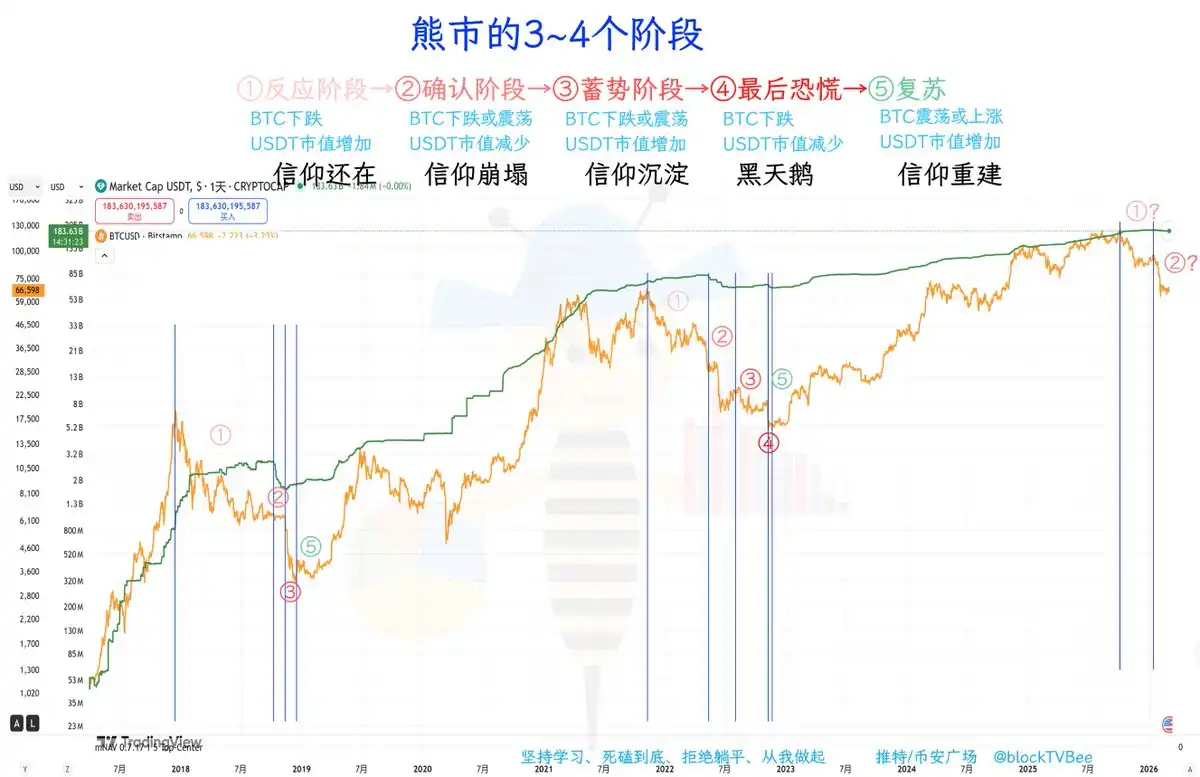
It is suspected that Oct 06, 2025 ~ Jan 06, 2026 completed this stage.

Bear Market Stage 2: Confirmation Phase (Faith Collapses)

⬩Approx. Oct 08, 2018 ~ Nov 14, 2018

⬩Approx. May 12, 2022 ~ Aug 04, 2022

⬩Suspected Jan 06, 2026 ~ ?

In this stage, BTC may be falling or moving sideways, but the market cap of USDT is decreasing.

Funds flowing out of crypto are now exiting USDT; the market confirms the bear market, and capital begins to exit as the main trend. This is also the stage where faith collapses.

2018 had no major negative events, so BTC moved mainly sideways, while 2022 had Luna + Three Arrows, so BTC fell primarily.

It is suspected that Jan 06, 2026 began entering this stage, with the USDT market cap starting to decrease, and the market beginning to question BTC, its digital gold properties, believing BTC will fall to the 30k range......

However, there are currently no signs that Stage 2 has ended.

Bear Market Stage 3: Accumulation Phase (Faith Sediments)

⬩Approx. Nov 14, 2018 ~ Dec 15, 2018

⬩Approx. Aug 04, 2022 ~ Nov 09, 2022

In this stage, BTC may be falling or moving sideways, but the market cap of USDT is increasing.

In 2018, because the previous phase was sideways, this phase was a decline. In 2022, the previous phase was primarily a decline, so this phase first fell and then moved mainly sideways.

Either funds from selling BTC are no longer primarily exiting, or capital is entering, causing the USDT market cap to increase. The weakest believers have already left, while the steadfast believers begin holding U or injecting capital, accumulating and waiting. Market faith also enters a sedimentation stage.

Bear Market Stage 4: Final Panic (Black Swan)

⬩Approx. Nov 09, 2022 ~ Nov 22, 2022

In this stage, BTC is falling, and the USDT market cap is also decreasing.

This is the final panic stage, mainly influenced by a black swan event. 2018 did not have this stage.

Recovery

After BTC bottoms out, it may gradually move upward or oscillate at the bottom. However, the USDT market cap increases. This is a stage of market recovery and faith rebuilding.

When to Buy the Dip

The earliest should be in Stage 3, when the USDT market cap is rising, using partial positions to buy the dip in batches.

The best buying opportunity, the phase where BTC crashes and the USDT market cap falls, may not necessarily occur; 2018 did not have this phase.

For retail investors, a more ideal buying range might be on the right side, i.e., the recovery stage. This stage features sustained growth in the USDT market cap, and BTC has experienced a bottom and shows signs of stabilization or even upward movement.

Final Thoughts

By comparison, it can be seen that each cycle's Stage 1 is getting shorter, because the market is reacting to the bear market faster and faster.

However, Stage 2 has not gotten shorter. Stage 2 may be related to the impact of negative events. The first half of 2018 had no negative events; it even had the mainnet launches of EOS and Tron. In 2022, the Luna crash followed by Three Arrows bankruptcy made this cycle's Stage 2 longer and the decline greater.

We are most likely already in Stage 2 now; the USDT market cap is decreasing, and the current negative is the Iran conflict. It is still uncertain when this negative will end.

Price-wise, Brother Bee believes the impact of the conflict on liquidity is relatively weak, but US stocks have a correction demand, so the current situation might be between the 2018 and 2022 Stage 2, possibly a downward. Of course, the certainty of this guess is not high; the uncertainties around Trump and Iran are quite significant.

In terms of cycles, Brother Bee's speculation is that around the time of Trump's visit to China, the geopolitical negatives might end. Because Trump's visit to China would mean that regarding countries like Iran, Trump already holds sufficient negotiation chips.

However, whether black swans will appear during the process of communication and coordination between the two sides is unknown. Furthermore, there are subsequent key events like Wash's inauguration and Japan's interest rate hike.

Therefore, when Stage 2 will end still requires continued observation. The first opportunity to buy the dip still requires patience, waiting for the USDT market cap to resume its rise after experiencing a decline. Since USDT's current use is not limited to crypto trading, the changes in its market cap this cycle might be less obvious. Thus, it's also necessary to consider factors like geopolitics and monetary policy.


Perguntas relacionadas

QWhat are the main stages of a bear market according to the article, and what characterizes each stage?

AThe article outlines 3-4 stages: 1. Reaction Stage (Faith Remains): BTC falls, but USDT market cap rises as some funds remain hopeful. 2. Confirmation Stage (Faith Collapses): BTC may fall or stagnate, USDT market cap decreases as funds exit, confirming the bear market. 3. Accumulation Stage (Faith Sediments): BTC may fall or stagnate, but USDT market cap increases as weak holders leave and strong holders accumulate. 4. Final Panic Stage (Black Swan, not present in 2018): BTC falls sharply with USDT market cap decreasing due to a black swan event.

QBased on the historical patterns described, when did the author suggest the 'Reaction Stage' of the current bear market (circa 2025-2026) likely began and ended?

AThe author suggested the Reaction Stage for the current cycle疑似 (suspectedly) began around October 6, 2025, and ended around January 6, 2026.

QWhat is the key on-chain metric the author uses to identify the transition between bear market stages, particularly between Stage 1 and Stage 2?

AThe key on-chain metric is the market capitalization of USDT. A rising USDT market cap characterizes Stage 1, while a decreasing USDT market cap signals the transition into Stage 2.

QAccording to the author, what is the earliest recommended time for investors to consider buying the dip (accumulating assets) in a bear market?

AThe earliest recommended time to start accumulating is during Stage 3 (the Accumulation Stage), when the USDT market cap is increasing. The author advises using a portion of capital to buy in batches at this stage.

QWhat are some of the specific geopolitical and economic events mentioned as potential factors prolonging the current 'Confirmation Stage' (Stage 2)?

AThe events mentioned are the Iran conflict, potential U.S. stock market correction, uncertainty surrounding former President Trump's actions (including a potential visit to China), the upcoming term of Fed Chair Waller, and a potential interest rate hike by Japan.

Leituras Relacionadas

How Much Debt Does Strategy Really Have? Is There a Risk of Implosion?

MicroStrategy's Debt Risk: A Turning Point in the "Never Sell" Strategy As of June 3, 2026, MicroStrategy holds 843,706 bitcoins (valued at ~$53.1B) but faces significant financial obligations. Its capital structure includes $6.75B in convertible notes and $15.48B in perpetual preferred stock (led by the $8.5B STRC series), creating an annual payout burden of ~$1.71B. With software revenue at only ~$500M, interest and dividend obligations far exceed operating income. A critical shift occurred in late May 2026 when the company sold 32 bitcoins for ~$2.5M to cover dividends, breaking CEO Michael Saylor's long-standing "never sell" pledge. This symbolic move triggered a sharp decline in both Bitcoin's price and MSTR stock, reflecting market fears about cash flow sustainability. The core of the strain is the STRC perpetual preferred stock, designed as a "permanent loan" with no maturity date but requiring high monthly dividends (currently 11.5%). Its business model relies on a three-part cycle: issuing new STRC shares, using proceeds to buy more Bitcoin and fund a USD reserve, and using that reserve to pay dividends. This cycle depends on continuous investor demand for STRC and Bitcoin's price appreciation. Analysis shows Bitcoin needs to appreciate at least 2.3% annually to cover the $1.71B in yearly obligations at current holdings. With Bitcoin price down ~22% from March 2026 highs, this pressure has intensified. The company's $900M USD reserve can only cover about 7 months of payments if STRC issuance stalls. Key risks are not immediate bankruptcy or forced Bitcoin liquidation (as BTC is not collateral), but rather: 1) The erosion of MSTR's premium to its Bitcoin holdings (mNAV), which would cripple its ability to raise cheap capital; 2) A vicious cycle where stagnant Bitcoin prices reduce STRC demand, draining the USD reserve and forcing BTC sales, further depressing prices. The period from February 2027 to September 2028 is a crucial test, with over $5.9B in convertible notes facing put options or maturity. In essence, MicroStrategy has evolved from a simple Bitcoin holder into a complex financial entity acting like a "private Bitcoin bank," leveraging its BTC holdings to create layered financial products. Its survival depends on maintaining Bitcoin's price trend, its stock premium, and market appetite for its preferred shares. The recent token sale marks not a betrayal of its Bitcoin thesis, but an admission that the leveraged strategy must eventually be paid for.

marsbitHá 10m

How Much Debt Does Strategy Really Have? Is There a Risk of Implosion?

marsbitHá 10m

Anthropic Cries Wolf: Is the AGI Threat Real, or Just an IPO Story?

Anthropic has published an article titled "When AI builds itself," discussing the emerging concept of "recursive self-improvement," where AI begins to actively participate in designing, training, testing, and optimizing its own subsequent versions. The company presents internal data showing that by May 2026, over 80% of code merged into its codebase was written by Claude, its AI model. Claude's capabilities have expanded to handling complex, open-ended engineering tasks, achieving a 76% success rate in such areas, and even contributing to research processes, such as optimizing code performance and conducting AI safety experiments. Anthropic outlines an evolution from human-driven development to AI-assisted workflows, culminating in the current stage where AI agents can autonomously write, run, and delegate code. The company cautions that the path toward a "closed loop," where AI continuously improves itself, is becoming visible. It calls for coordinated global mechanisms to potentially slow or pause frontier AI development to allow safety research and societal structures to catch up. However, the timing of this warning coincides with Anthropic's preparations for an IPO, framing the narrative not just as a safety concern but also as a demonstration of Claude's advanced capabilities and its integral role in accelerating Anthropic's own R&D—creating a potential "flywheel" effect for competitive advantage. This contrasts with OpenAI's recent, more policy-oriented discussion of the same risks, highlighting the competitive dynamics in the AI industry as companies position themselves in both the technological and regulatory landscape.

marsbitHá 1h

Anthropic Cries Wolf: Is the AGI Threat Real, or Just an IPO Story?

marsbitHá 1h

BIT Research: ETF Purchases Have Slowed, Strategy (MicroStrategy) Has Slowed, What Else Can Drive Bitcoin's Rise?

Market Refocus on Inflation and Rate Expectations Weighs on Bitcoin Currently, the market is in a phase of macro-repricing dominated by inflation and interest rate expectations. Bitcoin, which previously benefited from easy liquidity and low inflation, is seeing its core bullish drivers weaken. These drivers were market expectations for interest rate cuts and strong inflows from Bitcoin ETFs and institutions like MicroStrategy (referred to as "Strategy" in the text). The logic has shifted. Recent high inflation data (e.g., CPI hitting 3.8% in a May 2026 report) has caused the market to sharply reduce its rate cut expectations for 2025 and even price in potential hikes. This is a key constraint for Bitcoin, as it lacks cash flows and is highly sensitive to rate expectations. Concurrently, institutional capital flows have slowed significantly. Following the hot CPI data, Bitcoin ETFs saw accelerated outflows, with around $4.3 billion leaving over a period. MicroStrategy's ability to keep adding substantial Bitcoin to its balance sheet is also diminishing. Together, ETF and MicroStrategy holdings total roughly $110 billion, but their momentum as growth engines is cooling. In summary, Bitcoin's current pressure stems not from its own fundamentals but from a changing macro environment. As long as inflation stays elevated, Bitcoin is likely to remain in a consolidating phase. However, historically, inflation eventually peaks. Once it recedes and rate cut expectations rebuild, institutional capital could return, potentially fueling a new and more robust recovery phase for Bitcoin.

marsbitHá 1h

BIT Research: ETF Purchases Have Slowed, Strategy (MicroStrategy) Has Slowed, What Else Can Drive Bitcoin's Rise?

marsbitHá 1h

Trading

Spot
Futuros

Artigos em Destaque

Como comprar 4

Bem-vindo à HTX.com!Tornámos a compra de 4 (4) simples e conveniente.Segue o nosso guia passo a passo para iniciar a tua jornada no mundo das criptos.Passo 1: cria a tua conta HTXUtiliza o teu e-mail ou número de telefone para te inscreveres numa conta gratuita na HTX.Desfruta de um processo de inscrição sem complicações e desbloqueia todas as funcionalidades.Obter a minha contaPasso 2: vai para Comprar Cripto e escolhe o teu método de pagamentoCartão de crédito/débito: usa o teu visa ou mastercard para comprar 4 (4) instantaneamente.Saldo: usa os fundos da tua conta HTX para transacionar sem problemas.Terceiros: adicionamos métodos de pagamento populares, como Google Pay e Apple Pay, para aumentar a conveniência.P2P: transaciona diretamente com outros utilizadores na HTX.Mercado de balcão (OTC): oferecemos serviços personalizados e taxas de câmbio competitivas para os traders.Passo 3: armazena teu 4 (4)Depois de comprar o teu 4 (4), armazena-o na tua conta HTX.Alternativamente, podes enviá-lo para outro lugar através de transferência blockchain ou usá-lo para transacionar outras criptomoedas.Passo 4: transaciona 4 (4)Transaciona facilmente 4 (4) no mercado à vista da HTX.Acede simplesmente à tua conta, seleciona o teu par de trading, executa as tuas transações e monitoriza em tempo real.Oferecemos uma experiência de fácil utilização tanto para principiantes como para traders experientes.

616 Visualizações TotaisPublicado em {updateTime}Atualizado em 2026.06.02

Como comprar 4

Discussões

Bem-vindo à Comunidade HTX. Aqui, pode manter-se informado sobre os mais recentes desenvolvimentos da plataforma e obter acesso a análises profissionais de mercado. As opiniões dos utilizadores sobre o preço de 4 (4) são apresentadas abaixo.

活动图片