Banks Prepare To Spend $100 Million+ To Stop Crypto Bills, Expert Warns

bitcoinistPublicado em 2026-03-11Última atualização em 2026-03-11

Resumo

The fight over US crypto legislation is intensifying into a direct clash between the digital asset industry and the established banking sector. According to Dennis Porter, CEO of the Satoshi Action Fund, the banking industry is preparing a massive lobbying push, potentially exceeding $100 million, to counteract efforts to advance crypto market structure and stablecoin legislation. Porter warns that this creates a significant counterbalance to crypto lobbying groups and could lead lawmakers to withdraw support. He states that crypto industry faces political challenges, including low public trust and ethical concerns linked to Trump family involvement. Furthermore, market structure legislation is politically difficult as it covers a wide range of complex issues. The banking industry holds an advantage due to its entrenched local influence, including physical branches and jobs in lawmakers' districts. Porter cautions that if the dispute escalates into an open lobbying war, it could jeopardize the already tight Senate vote. He also notes that the legislative window is narrowing as midterm elections approach, with electoral incentives increasingly shaping the calendar.

The fight over US crypto legislation is turning into a direct clash between digital-asset firms and one of Washington’s oldest power centers. In an interview with Pete Rizzo, Satoshi Action Fund founder and CEO Dennis Porter said the banking industry is preparing a nine-figure lobbying push that could complicate efforts to advance both market structure legislation and stablecoin rules.

Crypto’s D.C. Outlook Just Got Darker

Porter said the core dispute is no longer just about whether Congress wants to regulate crypto, but on whose terms. President Donald Trump has publicly backed keeping the GENIUS Act intact, Porter noted, which he described as a positive sign for crypto firms. But he argued that support from the White House does not resolve the deeper standoff with banks, especially around stablecoins and the issue of rewards programs that banks view as a threat to deposits.

“The bank lobby has come out and said that they do plan to spend to counteract the crypto industry,” Porter said. “They said they’re raising nine figures, which is right up there with the Fairshake number. So that does create that counterbalance where they can essentially assert themselves into the ecosystem and start to peel some of these lawmakers off.”

That matters because, in Porter’s telling, crypto is entering the fight without a clean political backdrop. He said Democrats have grown more cautious around digital-asset legislation as Trump family involvement in the sector has raised ethics concerns among both lawmakers and voters.

At the same time, he described market structure as a far more expansive and politically difficult package than stablecoin legislation, since it touches not only securities-versus-commodities questions but also DeFi, illicit finance, ethics provisions and the makeup of the CFTC.

Porter argued that this leaves the legislation exposed to a wider set of objections and delays. He said there is still a path forward if key Democrats become comfortable with revisions, but added that the bill currently lacks a decisive forcing mechanism and has been pushed aside while lawmakers focus on a housing package.

The bank-crypto standoff, he suggested, could become especially dangerous if it turns into an open lobbying war. “If we end up in a situation where they’re directly lobbying against each other, you could see a lot of not just Democrats peel off this bill, but even possibly Republicans peel off this bill as well,” Porter said. “The vote is already tight in the Senate, very tight.”

His reasoning was straightforward: banks bring not just money, but entrenched local influence. Unlike much of crypto, Porter said, banks can point to branches, jobs and long-standing relationships in lawmakers’ districts. That advantage becomes even more important at a time when, by his own account, the industry is struggling politically.

“And also, crypto really is not popular right now,” Porter said. “Public trust in the crypto space is at an all-time low. Something that we’re deeply concerned about at Satoshi Action. Something that definitely needs some work.”

Porter framed that weakness as both a political problem and a policy argument. In his view, one purpose of market structure legislation is precisely to clean out the “crap” and scams that have damaged the sector’s reputation. But until lawmakers see a clearer consumer and political upside, he suggested, crypto firms may have trouble overcoming resistance from incumbents that view stablecoins as an existential threat to their business model.

He was notably cautious on timing. While some analysts have argued the window effectively closes by summer, Porter said the odds decline as the midterms approach but do not disappear entirely. His broader point was that the legislative calendar is being shaped as much by electoral incentives as by the text of the bills themselves.

At press time, the total crypto market cap stood at $2.34 trillion.
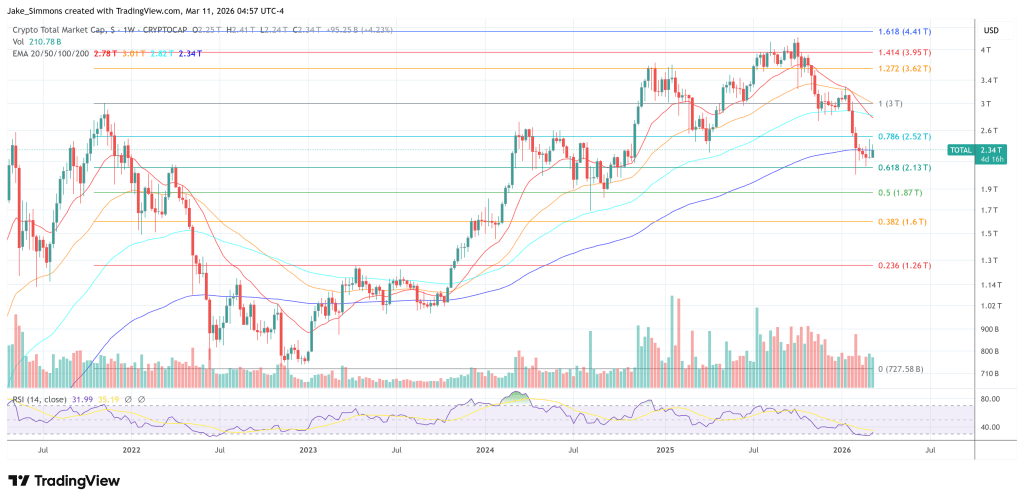
Total crypto market cap, 1-week chart | Source: TOTAL on TradingView.com

Perguntas relacionadas

QAccording to Dennis Porter, how much money is the banking industry preparing to spend to counteract crypto legislation efforts?

AThe banking industry is preparing to spend a nine-figure sum, which is over $100 million, to lobby against crypto bills.

QWhat are the two main types of US crypto legislation mentioned that are being complicated by this banking push?

AThe two main types of US crypto legislation mentioned are market structure legislation and stablecoin rules.

QWhat reason does Porter give for why banks have a significant advantage in a lobbying war against crypto?

APorter states that banks have an advantage because they bring not just money, but entrenched local influence, including physical branches, jobs, and long-standing relationships in lawmakers' districts.

QWhat does Dennis Porter cite as a major political weakness for the crypto industry in this fight?

AHe cites that 'crypto is not popular right now' and that 'public trust in the crypto space is at an all-time low.'

QBeyond the bank opposition, what other reason is given for why the market structure bill is politically difficult to pass?

AThe market structure bill is described as politically difficult because it is a far more expansive package that touches on securities-vs-commodities questions, DeFi, illicit finance, ethics provisions, and the makeup of the CFTC, leaving it exposed to a wider set of objections.

Leituras Relacionadas

Huang Renxun Dramatically 'Saves' South Korean Stock Market

In early June, South Korea's stock market experienced a sharp decline, with the KOSPI index dropping over 5% and triggering a trading halt. Amid this volatility, NVIDIA CEO Jensen Huang's visit to Seoul provided a dramatic boost to market sentiment. During his trip, Huang held a dinner meeting with SK Group Chairman Chey Tae-won and SK Hynix CEO Kwak Noh-Jung. He announced that NVIDIA's new Vera CPU would utilize SK Hynix DRAM and confirmed a multi-year technical collaboration between the two companies. This partnership aims to co-develop next-generation memory for NVIDIA's AI infrastructure roadmap, covering products from data center supercomputers to personal AI devices. Huang also publicly commented that AI company stocks were attractively priced. A key announcement was that NVIDIA's upcoming Vera Rubin AI supercomputer systems will use HBM4 memory, with supply qualifications granted to all three major suppliers: SK Hynix, Samsung Electronics, and Micron Technology. Despite this multi-sourcing strategy, Huang warned that the industry-wide chip shortage, affecting everything from wafers to packaging, is expected to persist for several years due to relentless demand from global AI factory construction. The collaboration extends beyond memory supply. SK Hynix will employ NVIDIA's AI platforms and Omniverse digital twin technology to enhance its own semiconductor design, simulation, and manufacturing processes, aiming for more autonomous factory operations. This visit builds upon a prior October 2025 agreement for SK Group to build a large-scale AI data center using over 50,000 NVIDIA GPUs. Huang's itinerary also included meetings with other Korean giants like Hyundai, LG, and Samsung, indicating NVIDIA's broader strategy to deepen ties with South Korea's tech industry.

链捕手Há 58m

Huang Renxun Dramatically 'Saves' South Korean Stock Market

链捕手Há 58m

When Inference Becomes a Scarce Resource, Who Captures the Value?

When Inference Becomes the Scarce Resource, Who Captures the Value? The core AI bottleneck has shifted from model training to inference (runtime execution). While concerns persisted about an "AI compute gap"—initially a $200B, now a $600B problem—the market is now recognizing that the solution and value lie in the inference layer. Nvidia's financial restructuring around "serving tokens" and Cerebras's successful IPO highlight this shift. Inference is a recurring, usage-based cost, estimated to be 10-50x larger than the one-time training market, especially with the rise of agentic AI. The inference stack spans six layers: silicon (e.g., Nvidia), bare metal (e.g., CoreWeave), GPU rental/aggregation, deployment/optimization, model APIs, and end applications. Most companies operate in one layer. However, Hyperbolic uniquely spans three layers (GPU rental, deployment, and model APIs) without owning any hardware. It aggregates fragmented GPU supply from multiple cloud providers into a standardized pool, offering developers the cheapest available compute through intelligent routing. Its multi-cloud aggregation creates a data moat and a flywheel: more supply leads to better pricing data and liquidity, attracting more developers and providers. In contrast, applications like Venice operate at the top of the stack, reselling privacy-wrapped inference but remaining dependent on and constrained by the underlying compute costs they purchase. As inference demand explodes, value accrues not just to consumer applications but increasingly to the aggregation and routing layer that captures their cost of revenue. The coming potential GPU oversupply reinforces this dynamic. While hardware owners may suffer from depreciation, asset-light aggregators like Hyperbolic benefit from price arbitrage, routing workloads to the cheapest available capacity. The ultimate winner in the inference economy may not be the entity with the most GPUs, but the one that can most efficiently discover, aggregate, and route the world's fragmented compute.

链捕手Há 1h

When Inference Becomes a Scarce Resource, Who Captures the Value?

链捕手Há 1h

Trading

Spot
Futuros
活动图片





