Banking Lobby Digs In Against Landmark Crypto Bill as $SUBBD Gains Ground

bitcoinistPublicado em 2026-02-11Última atualização em 2026-02-11

Resumo

A powerful banking coalition, including the ABA and BPI, is lobbying against the landmark FIT21 crypto bill, claiming it creates regulatory gaps and risks, despite its aim to provide clearer rules. This resistance highlights a power struggle, as traditional finance sees crypto and DeFi as threats to its dominance. The resulting regulatory uncertainty is pushing users toward decentralized alternatives. This centralization problem extends beyond finance to the $191B content creation industry, where high fees and platform control are common. SUBBD Token ($SUBBD) emerges as a Web3 solution, offering creators decentralized earnings through subscriptions, NFTs, and AI tools, while giving fans participation via token-gated content and staking. The project's presale has raised over $1.4 million, signaling strong interest in a decentralized model for creators. With a fixed 20% APY for staking, it incentivizes early adoption. Regulatory gridlock may ironically fuel SUBBD's growth, as users seek transparent, fair platforms outside traditional control.

As Washington grapples with regulating digital assets, a powerful banking coalition just drew a line in the sand against the landmark Financial Innovation and Technology for the 21st Century Act (FIT21). It’s a move that highlights the growing schism between traditional finance and crypto, a conflict that’s inadvertently pushing users toward projects operating completely outside the old guard’s control.

The banking groups involved did release a statement after the meeting, despite not moving forward, but it didn’t outline the next steps.

In a recent letter to Senate leadership, the American Bankers Association (ABA) and the Bank Policy Institute (BPI), among others, urged lawmakers to kill the bill, even after it passed the House with surprising bipartisan support. Why the pushback? They claim FIT21 would create regulatory gaps, undermine existing securities laws, and expose consumers to undue risk. The bill itself is designed to do the opposite: establish a clearer framework for digital assets by finally delineating the jurisdictions of the SEC and CFTC.

Let’s be clear: this resistance isn’t just about policy. It’s about power. The banking sector sees the burgeoning crypto ecosystem, especially stablecoins and DeFi, as a direct threat to its long-held dominance over finance.

By lobbying against regulatory clarity, they perpetuate the very uncertainty that stifles mainstream adoption. And the second-order effect? It pushes innovation and user interest right into the arms of decentralized platforms that promise to bypass the gatekeepers altogether. While titans debate, builders build.

SUBBD Emerges as an Answer to Centralized Control

This battle in Washington underscores a problem that goes way beyond finance: the pitfalls of centralization. Sound familiar? The same dynamics, exorbitant fees, censorship, and arbitrary rule changes, plaguing traditional banking, are just as rampant in the $191B content creation industry. Platforms like YouTube, Twitch, and OnlyFans can slash creator earnings with fees as high as 70%, all while holding the power of sudden de-platforming over their heads.

This is the exact friction point that SUBBD Token ($SUBBD) was built to solve. It’s a Web3-native alternative that merges a decentralized ethos with powerful AI tools, aiming to become the ultimate hub for the modern creator.

The platform tackles the industry’s biggest pain points head-on, offering creators multiple ways to earn, from subscriptions and tipping to NFT sales, all within a transparent ecosystem on Ethereum.

What most coverage misses is the parallel here. The banking lobby fears disintermediation, and frankly, the creator economy is more than ready for it. SUBBD’s entire architecture is designed to hand power back to the user. It integrates an AI Personal Assistant for automating fan interactions, AI voice cloning, and even the ability to launch fully AI-driven influencers.
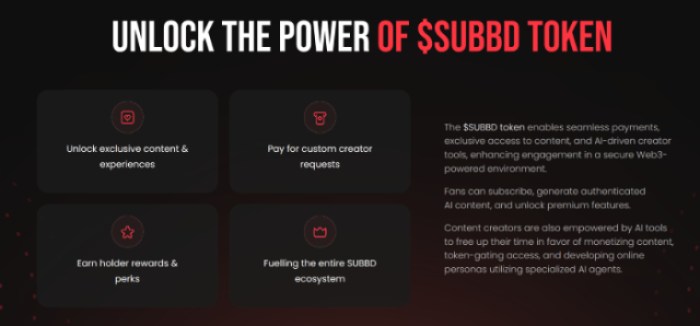
For fans, the platform isn’t just about consumption; it’s about participation through token-gated content and staking rewards. It creates a symbiotic economy where both sides win, without a middleman taking an outrageous cut.

CHECK OUT THE $SUBBD TOKEN ON ITS PRESALE PAGE

Presale Momentum Signals a Shift in Creator and Fan Sentiment

The market’s appetite for a decentralized fix is becoming undeniable. The ongoing SUBBD Token presale has already pulled in over $1.4 mwith tokens priced at just $0.057495. That kind of early-stage funding isn’t just noise; it’s a clear signal that people believe the creator economy is ripe for a shakeup.

Investors aren’t just buying a token; they’re buying into a whole new model for content ownership. The project’s staking mechanism, which offers a fixed 20% APY for the first year, gives an immediate incentive to get involved.

Stakers get access to exclusive content, livestreams, and other perks, transforming them from passive consumers into active participants. The risk? Well, like any new platform, it all comes down to achieving critical mass, attracting enough great creators and dedicated fans to make the ecosystem thrive.

Ironically, the regulatory gridlock in the U.S. might just be SUBBD’s biggest catalyst. As legacy institutions fight tooth and nail to preserve the status quo, they’re inadvertently making the best possible case for platforms that are transparent and fair by design.

The traction in SUBBD’s presale says it all: creators and users aren’t waiting for permission from Washington or Wall Street anymore. They’re just building a better system themselves. Join the SUBBD Token presale here.

BUY YOUR $SUBBD HERE

This article is for informational purposes only and should not be considered financial advice. All investments in cryptocurrency carry inherent risks, and you should conduct your own research.


Perguntas relacionadas

QWhat is the main argument made by the banking lobby (ABA and BPI) against the FIT21 Act?

AThe banking lobby argues that the FIT21 Act would create regulatory gaps, undermine existing securities laws, and expose consumers to undue risk.

QAccording to the article, what is the core problem that SUBBD Token ($SUBBD) aims to solve in the content creation industry?

ASUBBD Token aims to solve the problems of exorbitant fees (as high as 70%), censorship, and the risk of sudden de-platforming that creators face on centralized platforms like YouTube and OnlyFans.

QWhat are some of the key AI tools integrated into the SUBBD platform for creators?

AThe SUBBD platform integrates an AI Personal Assistant for automating fan interactions, AI voice cloning, and the ability to launch fully AI-driven influencers.

QHow does the SUBBD platform's staking mechanism work to incentivize users?

AThe staking mechanism offers a fixed 20% APY for the first year, and stakers gain access to exclusive content, livestreams, and other perks, turning them into active participants.

QWhat does the article suggest is the 'second-order effect' of the lobbying efforts against crypto regulation?

AThe second-order effect is that it pushes innovation and user interest toward decentralized platforms that operate outside of traditional financial control, as these platforms promise to bypass the gatekeepers altogether.

Leituras Relacionadas

Qualcomm: AI Hype Subsides, When Will Smartphones Emerge from the Gloom?

Qualcomm reported its Q3 FY2026 results (ending June 2026), with revenue of $9.95B, down 4% YoY but above expectations. Gross margin declined to 53.1%, pressured by rising costs across manufacturing and memory. Key business segments showed mixed performance: Handset revenue fell 19.6% YoY to $5.09B, dragged by an 11% decline in non-Apple Android shipments and weaker high-end mix. Conversely, Automotive revenue surged 61% to $1.59B, and IoT grew 9% to $1.83B. Core operating profit dropped 41% YoY due to margin compression and higher expenses. Management's Q4 FY2026 guidance projects revenue of $9.7B-$10.5B, in line with consensus, but Non-GAAP EPS guidance of $2.05-$2.25 fell short of expectations. Amidst persistent weakness in its core handset market, Qualcomm is pursuing growth in AI, focusing on Edge AI (smartphones, PCs, automotive) and Data Center AI. Its data center strategy includes four pillars: AI accelerators (e.g., AI200), commercial CPUs (Dragonfly C1000), custom silicon, and connectivity solutions. While these initiatives initially boosted its stock, concerns over AI capital expenditure sustainability have since erased those gains. The company targets $5B in data center revenue for FY2027 and $15B for FY2029. The report concludes that with the traditional handset business still under pressure, the data center opportunity is currently viewed as a longer-term option, and a more conservative valuation based on core operations may be warranted until AI contributions materialize.

marsbitHá 3m

Qualcomm: AI Hype Subsides, When Will Smartphones Emerge from the Gloom?

marsbitHá 3m

From TPU to Self-Evolving Agents: How Jeff Dean Predicts the Next Step in AI

At the 2026 YC Startup School, Jeff Dean outlined his vision for AI's next phase, shifting focus from simply scaling models to building intelligent, autonomous systems. He believes AI's progress is no longer just about creating smarter models, but about integrating them into systems capable of long-term, iterative work, automated experimentation, and continuous learning. This evolution moves the competition from "who has the bigger model" to "who can best organize intelligence." Dean suggests AI capabilities are now comparable to a junior engineer, enabling the automation of complex workflows. However, the true challenge and opportunity lie in managing these AI "workers" at scale. He emphasizes the importance of **context engineering**—structuring tools, memory, and feedback loops—over raw model power. For startups, this means building deep expertise in niche domains where general models currently fail (near 0-1% success rates), leveraging proprietary data, specialized tools, and domain-specific evaluators. A recurring theme is re-examining fundamental constraints. Dean's past work, like moving Google's search index to memory or creating the TPU, stemmed from questioning outdated assumptions about hardware and cost. He sees similar inflection points today, particularly in **specialized inference hardware** to drastically reduce latency and energy consumption for real-time Agent operation. Notably, he points out that in modern AI systems, the dominant cost is often not computation but **data movement**. Reliable, long-running Agents require robust system design, borrowing concepts from distributed computing like checkpointing, state management, and parallel exploration to handle failures and maintain progress over days or weeks. As AI automates execution, the scarcest human skills will shift to **defining clear specifications**, **judging what problems are worth solving** (taste), and designing effective feedback loops. Ultimately, Dean's framework prioritizes understanding the problem deeply, identifying the true bottlenecks, and systematically building closed-loop systems where AI can not only perform tasks but also improve AI itself.

marsbitHá 3m

From TPU to Self-Evolving Agents: How Jeff Dean Predicts the Next Step in AI

marsbitHá 3m

Trading

Spot
活动图片




