Audiera price prediction: Can BEAT break above $3 without fresh buying?

ambcryptoPublicado em 2026-07-14Última atualização em 2026-07-14

Resumo

Escalating U.S.-Iran tensions impacted markets, with the S&P 500 and Dow Jones declining. Bitcoin faced selling pressure, while Audiera (BEAT) gained 0.74% despite a nearly halved daily trading volume. BEAT had previously rallied 18% despite a token release, but now faces a key resistance zone between $3.0 and $3.20. Technical indicators on the 1-day chart show bearish momentum. For BEAT to break above $3.20, it requires sustained organic buying pressure and higher lows. While recent token burns on July 13 may boost confidence, the token remains under scrutiny due to past allegations of similarities to other projects and an 87% price crash from June 12-18. Investor caution is advised due to lingering concerns over price manipulation and inflated valuation.

The U.S.-Iran ceasefire has ended, and hostilities have resumed. President Donald Trump stated the U.S. would be reinstating the blockade on Iranian ports, driving crude oil prices up on Monday, the 13th of July, and hurting stock markets.

The S&P 500 was down 49 points, and the Dow Jones Index was down 33 points, or 0.64% and 0.63% respectively, from their highs of the day.

A wave of Bitcoin [BTC] selling was spotted, and long positions were closed in the derivatives market. This leverage unwind has fueled the recent price reset and helped explain why crypto was down for the day.

Audiera [BEAT] was up 0.74% in the past 24 hours, but its daily trading volume has nearly halved from the previous day.

Recently, AMBCrypto reported that the $824 million market capitalization altcoin was able to rally 18% on high trading volume, even after a release of 21.25 million BEAT tokens. This represented 7.3% of the circulating supply.

Can organic demand drive BEAT prices higher?
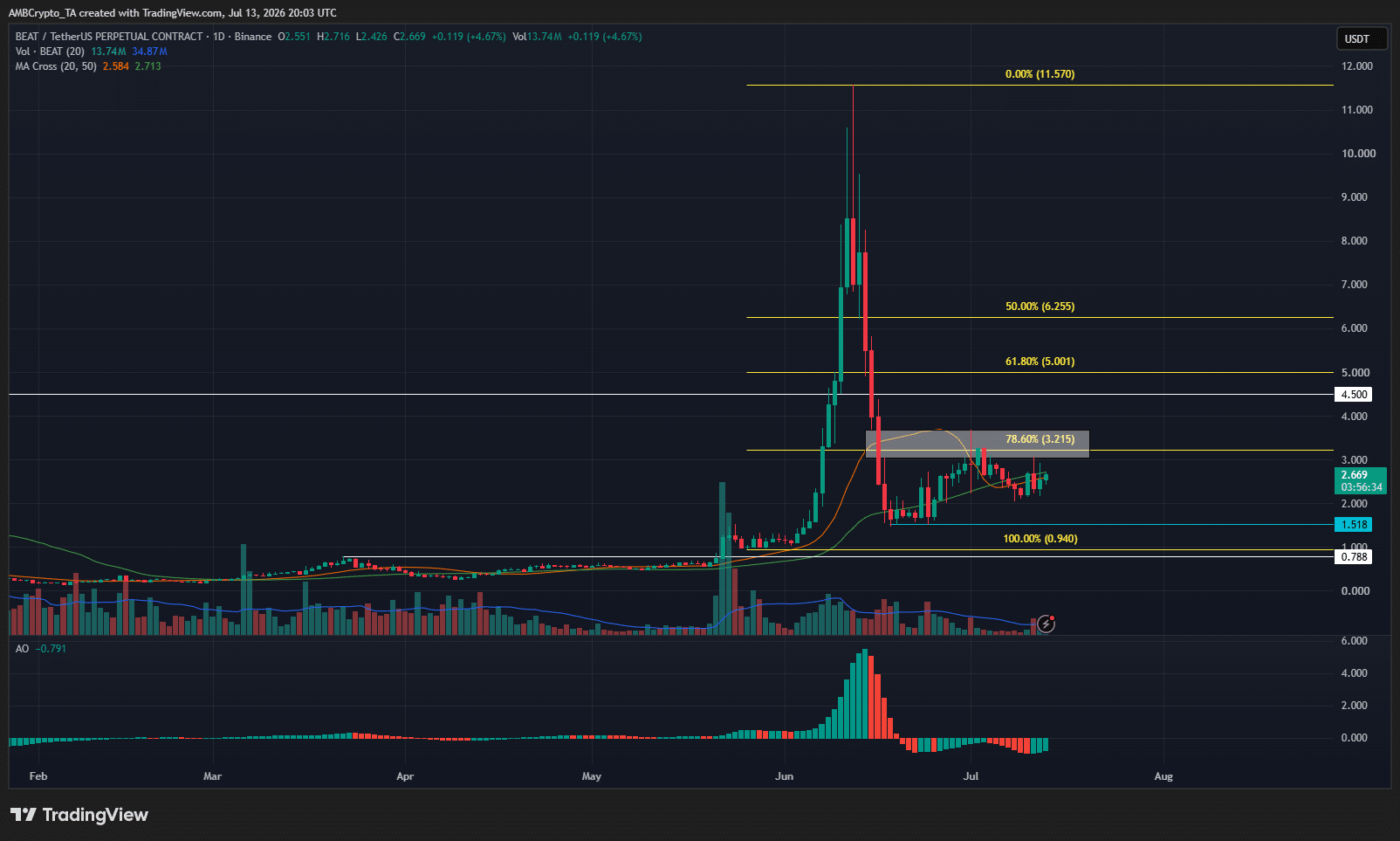
Source: BEAT on TradingView

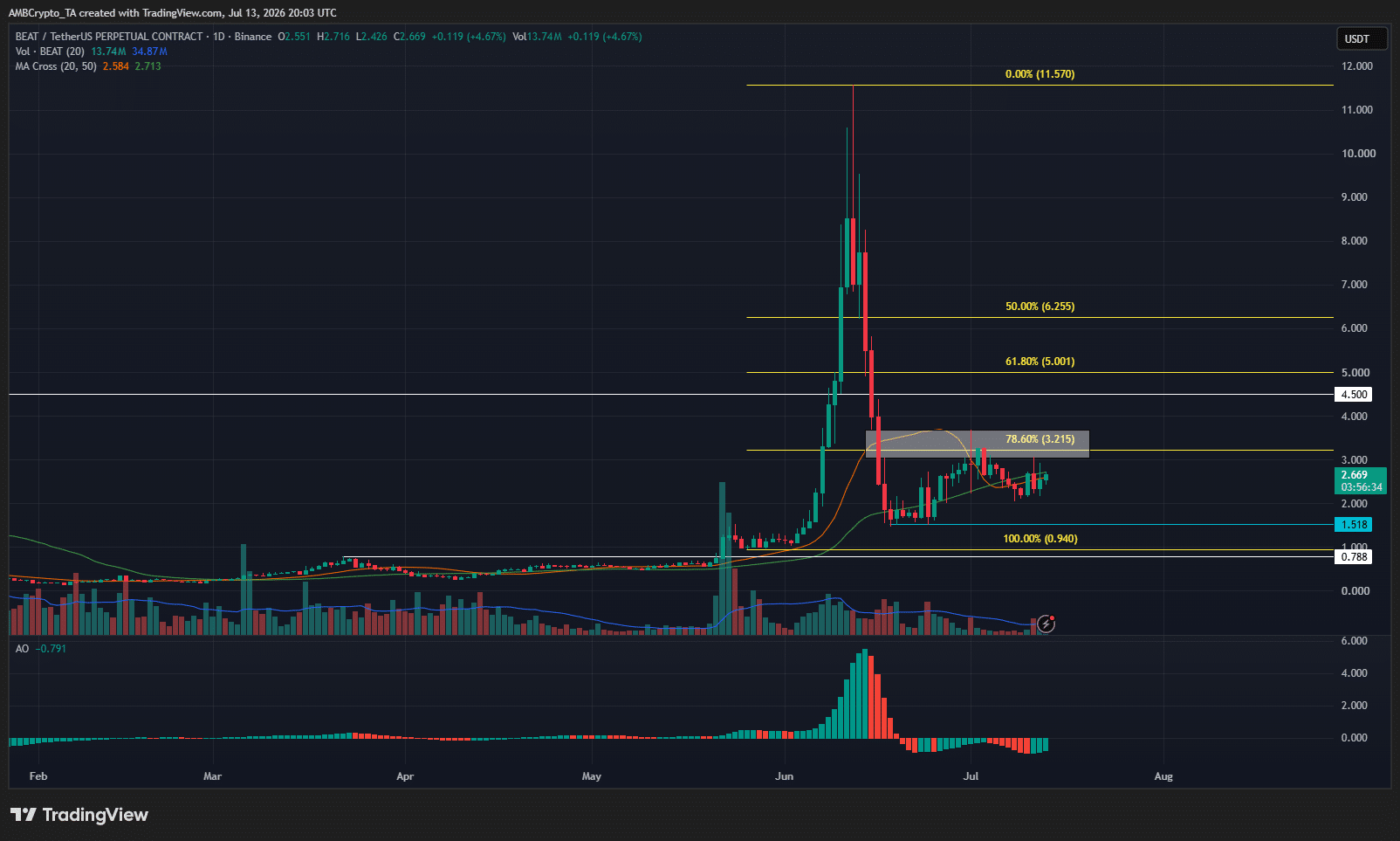
The swing structure remained bullish, but the $3.0-$3.20 area has become a local supply zone. The momentum was bearish on the 1-day timeframe, the Awesome Oscillator warned.

If BEAT can make higher lows in the coming days, it would signal that buyers were convinced of further gains. Such demand might be able to push prices past $3.20.

However, for this scenario to play out, BEAT needs to attract more capital towards itself.

Traders’ call to action- Caution
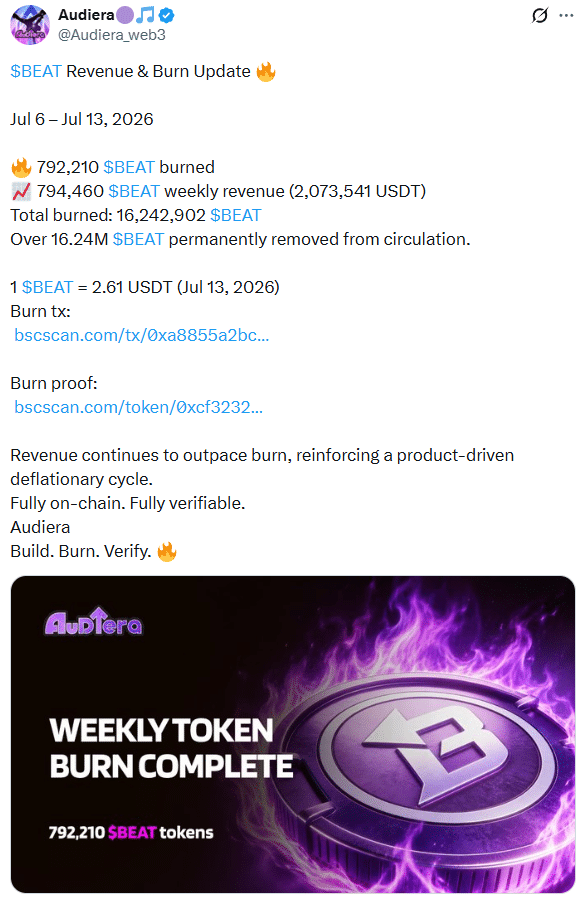
Source: Audiera on X

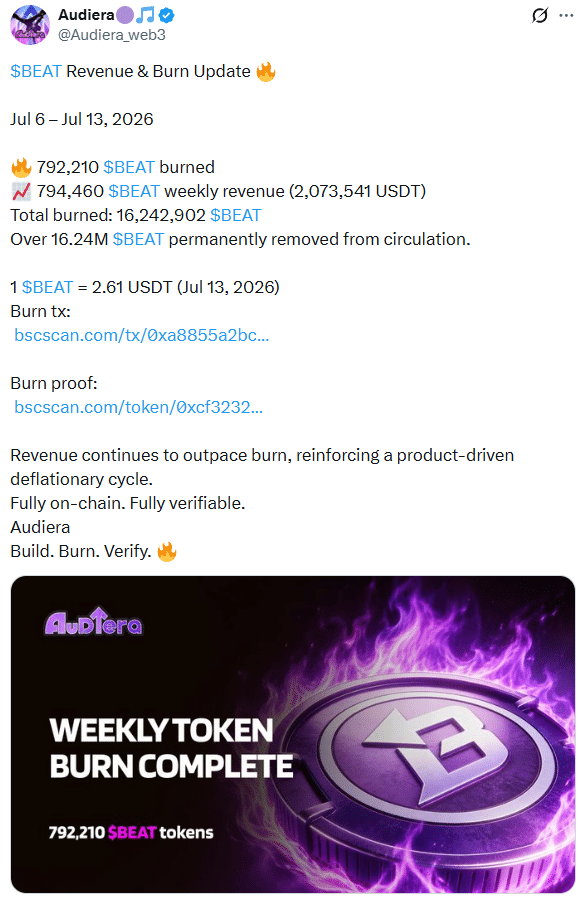
The news of the 792,210 BEAT burn on July 13 can buoy market participant confidence. Yet, the rally to $11.5 also coincided with public allegations that the Dance to Earn token showed onchain similarities to LAB and RIVER.
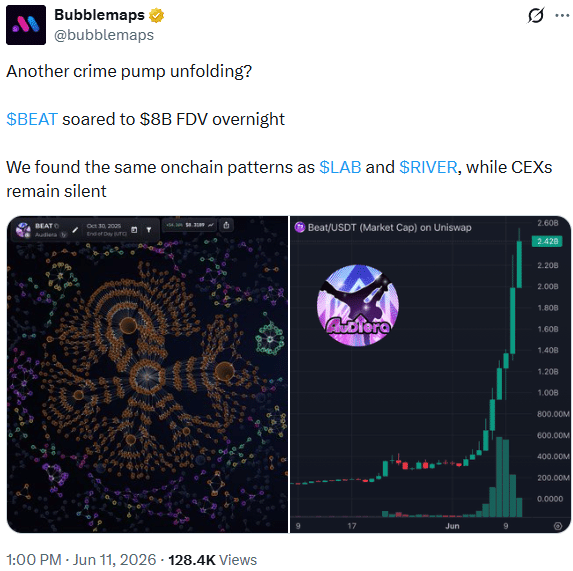
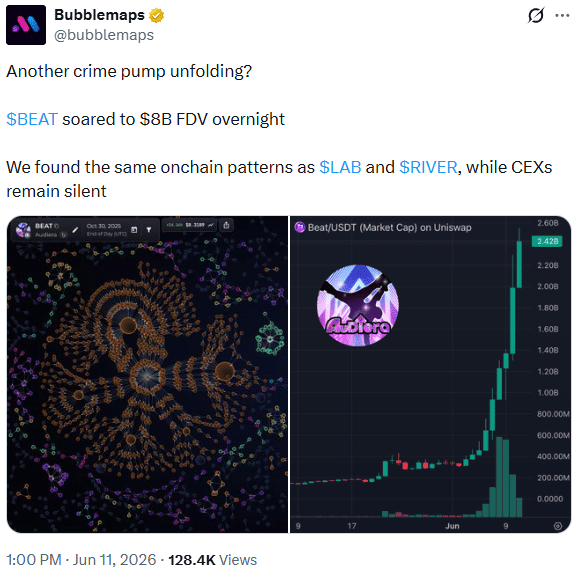
Source: Bubblemaps on X

From June 12 to 18, BEAT underwent an 87% correction, falling from $11.57 to $1.459. The visual analytics platform posted that they had no conclusive evidence tying BEAT to LAB and RIVER. Still, investor caution is warranted.


Final Summary

  • BEAT saw short-term upward momentum, and the weekly BEAT burns can help fuel a recovery.
  • Allegations of price manipulation and overinflated fully diluted value, or FDV, have not gone away.


Perguntas relacionadas

QWhat recent global event led to a decline in stock markets and Bitcoin, according to the article?

AThe resumption of hostilities between the U.S. and Iran, specifically the U.S. reinstating a blockade on Iranian ports, drove up crude oil prices and contributed to the decline in stock markets and Bitcoin.

QDespite the broader crypto market being down, what was BEAT's 24-hour price performance?

ABEAT was up 0.74% in the past 24 hours, although its daily trading volume had nearly halved from the previous day.

QWhat are the key price levels mentioned in the article that form a local supply zone for BEAT?

AThe article identifies the $3.0-$3.20 area as a local supply zone that BEAT needs to break through for further gains.

QWhat positive action taken by the Audiera project on July 13th might boost investor confidence?

AThe project executed a burn of 792,210 BEAT tokens on July 13th, which can buoy market participant confidence.

QWhat major concern regarding BEAT's fundamentals is highlighted in the article's final summary?

AThe final summary highlights that allegations of price manipulation and an overinflated fully diluted value (FDV) for BEAT have not gone away.

Leituras Relacionadas

In Jinjiang, Fujian, a Storage Super Unicorn Lies Quiet

In Fujian's Jinjiang, a city known for sportswear, lies a quiet semiconductor giant: Fujian Jinhua Integrated Circuit Co. (JHICC). Once a promising domestic DRAM manufacturer alongside Yangtze Memory and ChangXin Memory Technologies (CXMT), its journey was derailed in 2018 when the U.S. placed it on an Entity List and filed criminal charges for alleged trade secret theft. This halted production for years. A turning point came in February 2024 when a U.S. federal court found JHICC not guilty. However, it had lost crucial time. While CXMT soared to become a top-valued A-share company in 2024, JHICC, with an estimated valuation of 80 billion RMB, was just restarting. Its current output is primarily customized DDR4 chips, not the advanced DDR5/HBM demanded for AI, but it still benefits from the broader memory chip upcycle. JHICC's story is tied to Chen Zhengkun, a veteran engineer who left Micron to lead the venture. Founded in 2016 with state-backed funding, JHICC partnered with Taiwan's UMC to develop DRAM technology. Rapid progress was cut short by the U.S. actions, which Micron initiated, partly due to its heavy reliance on the Chinese market. Post-sanctions, Chen's team worked to rebuild the production line with reduced reliance on U.S. technology. According to its records, JHICC achieved small-scale production and revenue growth under immense pressure. It now focuses on the stable "niche" DRAM market (e.g., TVs, routers) with a monthly capacity of ~40,000 wafers, aiming for 60,000 by 2026. It holds over 1,000 patents but remains on the Entity List. For Jinjiang, investing in JHICC was a bold industrial leap. The local government provided unwavering financial and logistical support during the crisis, helping the company survive. JHICC has become the anchor for a growing local semiconductor cluster. Though its scale lags behind domestic peers, JHICC's persistence symbolizes a hard-won foothold in a global market long dominated by Samsung, SK Hynix, and Micron. Having missed one boom, it seeks a place in the new AI-driven memory supercycle.

marsbitHá 1h

In Jinjiang, Fujian, a Storage Super Unicorn Lies Quiet

marsbitHá 1h

Trading

Spot
活动图片