At What Oil Price Would Systemic Market Risk Be Triggered?

marsbitPublicado em 2026-04-03Última atualização em 2026-04-03

Resumo

Based on a UBS analysis, the key threshold for systemic risk in global markets is identified as $150 per barrel of oil. The report warns that breaching this level would trigger a dangerous negative feedback loop: soaring oil prices → resurgent inflation → tighter monetary policy → deteriorating financial conditions → collapsing demand → market panic. The impact of an oil shock is not linear but highly dependent on the initial economic vulnerability. In the current environment of high interest rates and weak growth, the damage from rising oil prices is significantly amplified. For instance, with a 40% baseline US recession probability, oil at $150 per barrel could cause an economic downturn nearly five times more severe than under milder conditions. UBS outlines two scenarios: in an ideal steady state, the US economy might withstand oil prices up to $200 per barrel. However, in a realistic risk scenario where financial markets react negatively, the critical threshold drops sharply to $150. At this level, three systemic pressures emerge: macroeconomic stagflation risks as central banks halt or reverse rate cuts; market-wide sell-offs due to compressed valuations and wider credit spreads; and a simultaneous slump in corporate profits and household consumption. The report cautions that markets are currently underestimating this nonlinear, cliff-like risk. While prices between $100-$130 may cause sector-specific stress, $150 represents a breaking point where localized damage tr...

Author: Bu Shuqing

Source: Wall Street News

As geopolitical conflicts in the Middle East continue to escalate, every rise in international oil prices is testing the limits of the global market's endurance. UBS has drawn a clear red line in its latest research report: $150 per barrel.

According to the Wind Trading Desk, a recent global macro research report from UBS analysts pointed out that once international oil prices break through $150 per barrel and sustain at that level, the US and global markets will face significant systemic risks, with the probability of recession and severe market adjustments greatly increasing.

The bank emphasized that the danger of this critical point lies in its potential to trigger a complete negative cycle: "high oil prices → rebounding inflation → tightening policies → deteriorating financial conditions → collapsing demand → market panic."

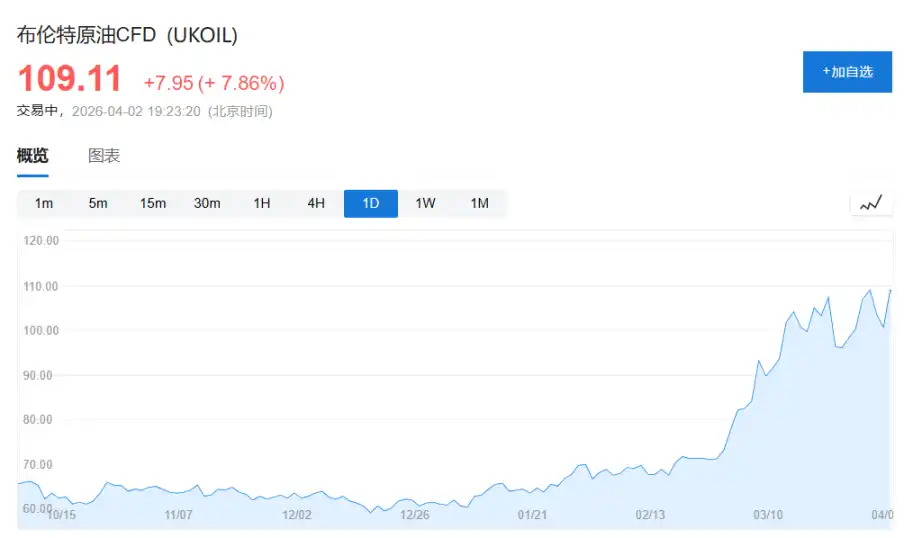
At the time of writing, the international benchmark Brent crude surged nearly 8%, once again approaching the $110 mark. UBS warned that the current market's pricing of oil price risks remains biased towards linear extrapolation, severely underestimating the cliff-like risks near $150 per barrel. Under the shadow of high oil prices, the market has little safety margin left. Protecting against risk and avoiding highly sensitive assets is more important than chasing returns.
Impact Depends on Initial Vulnerability

The UBS report challenges the market's long-held linear perception that "every $10 increase in oil prices drags the economy by a fixed proportion," pointing out that the destructive power of an energy shock highly depends on the initial economic state.

The current global economy is in an environment of high interest rates, weak recovery, and tight credit conditions, with an already elevated baseline probability of recession. This significantly amplifies the transmission effects of an oil price shock.

UBS constructed a three-dimensional analytical framework, using the US composite recession probability, the magnitude of the oil price increase, and the degree of cyclical economic downturn as the three dimensions. The calculation results clearly reveal the nonlinear nature of the risk:

  • When the recession probability is 20% and oil prices are at $100 per barrel, the cyclical economic downturn is only 0.28 standard deviations, indicating a mild impact;
  • If the recession probability rises to 40% while oil prices remain at $100 per barrel, the downturn magnitude expands to 0.81 standard deviations, nearly three times the baseline;
  • And when the recession probability is 40% and oil prices break through $150 per barrel, the downturn magnitude soars to 1.4 standard deviations, with an impact intensity nearly five times the baseline.

This means that the more fragile the economy, the more致命 (fatal) the blow from high oil prices. In the current environment, oil prices rising from $100 to $150 does not mean a 50% increase in pressure, but an accumulation of risk several times over.

$150: The Critical Divide Under Two Scenarios

Based on a pre-Middle East conflict US recession probability of around 30%, UBS provided critical values under two key scenarios. The gap between them reveals the core role of financial market reactions.

In an ideal steady-state scenario, if financial markets are stable with no additional risk发酵 (fermenting), the US economy could theoretically withstand oil prices rising to about $200 per barrel before substantially entering a recession. However, in a realistic risk scenario, once the stock market experiences a significant correction due to high oil prices and risk appetite deteriorates rapidly, the recession临界点 (critical point) would directly drop to $150 per barrel.

UBS pointed out that once $150 per barrel is reached, the world will face三重 (three layers) of systemic pressure:

  • Macro level: Inflation surges for the second time, forcing central banks to interrupt or even reverse interest rate cut cycles, quickly sliding the economy towards stagflation;
  • Market level: Stock market earnings expectations are revised downward, valuations contract, high-yield bond credit spreads widen, and liquidity tightening triggers cross-asset sell-offs;
  • Entity level: Soaring corporate costs squeeze profits, household purchasing power declines, consumption and investment cool down simultaneously, forming a共振下跌 (resonant decline) of the economy and markets.

The report also cited historical comparisons, noting that larger oil price shocks before 2000 had less impact due to stronger initial economic resilience,反而小于 (instead less than) the impact during the 1990 Gulf War period. Today, with the global high-interest-rate environment still present, the financial system is more sensitive to cost increases, and the intensity of a $150 per barrel shock would only be more severe.

Nonlinear Risk: The Blind Spot in Market Pricing

The UBS report specifically warned that the current market's pricing of oil price risks is systematically underestimated, particularly neglecting the threshold effect near $150 per barrel.

According to UBS research, the $100 to $130 per barrel range mostly involves shocks to局部行业 (local industries), pressuring sectors like aviation, logistics, and chemicals, but the overall market remains controllable. Once oil prices stabilize above $150 per barrel, the risk will spread from局部 (local) to全局 (global), escalating from an industry-level issue to a systemic financial risk.

This nonlinear risk manifests on three levels:

  • First, risk transmission accelerates, as high oil prices quickly penetrate the buffers of corporate profits, household consumption, and government finances;
  • Second, policy space compresses, as rising inflation traps central banks in the dilemma of "fighting inflation vs. stabilizing growth," preventing them from promptly supporting the market;
  • Third, confidence collapses rapidly, with significant market corrections and暴露 (exposure) of credit risks叠加 (overlapping), forming a negative feedback loop of "decline → deleveraging → further decline."


Perguntas relacionadas

QAccording to UBS, at what oil price level would the US and global markets face significant systemic risk?

A150 dollars per barrel.

QWhat negative feedback loop would be triggered if oil prices exceed 150 dollars per barrel?

AThe loop is: High oil prices → rebounding inflation → tightening of monetary policy → deteriorating financial conditions → collapsing demand → market panic.

QWhat is the key factor that determines the destructive power of an oil price shock, as stated in the UBS report?

AThe initial state of the economy, with the impact being highly dependent on the initial economic vulnerability.

QUnder the realistic risk scenario, what is the critical oil price point that would push the US economy into a recession, considering financial market reactions?

A150 dollars per barrel.

QWhat are the three systemic pressures the global economy would face once oil prices hit 150 dollars per barrel?

A1. Macro level: Inflation surges again, forcing central banks to halt or reverse rate cuts, pushing the economy towards stagflation. 2. Market level: Downward revisions to corporate earnings, valuation contractions, widening credit spreads for high-yield bonds, and cross-asset sell-offs due to tightening liquidity. 3. Entity level: Soaring corporate costs, squeezed profits, reduced household purchasing power, and a cooling of consumption and investment, leading to a共振下跌 (resonant decline) of the economy and markets.

Leituras Relacionadas

The Verdict in Choi Tae-won's Divorce Case: Revealing the Inheritance Undercurrent Behind SK Hynix's Trillion-Won Empire

SK Group Chairman Chey Tae-won's high-profile divorce case, involving a record 1.38 trillion won settlement, has drawn attention to the succession plans for Korea's second-largest conglomerate, especially its crown jewel, SK hynix. Unlike traditional chaebol scripts centered on the eldest son, Chey's three children from his marriage to former President Roh Tae-woo's daughter, Roh Soh-yeong, are carving distinct, non-traditional paths. Eldest daughter Chey Yun-jung (b. 1989) is seen as the most evident successor. With a scientific and consulting background, she holds executive roles at SK bioscience and SK Inc.'s growth support department, focusing on future strategy and biopharma. Her marriage is to an AI infrastructure entrepreneur, not a traditional business alliance. Second daughter Chey Min-jung (b. 1991) took a unique route, voluntarily serving as a South Korean naval officer, including an anti-piracy deployment. She later worked on policy and strategy for SK hynix in Washington D.C. before co-founding an AI-driven healthcare startup. She married a former U.S. Marine Corps officer, connecting her to U.S. defense and policy circles—networks crucial for a global semiconductor giant. The only son, Chey In-geun (b. 1995), who studied physics like his father, worked briefly at SK E&S before joining McKinsey. Despite fitting the traditional "heir" profile as the eldest son, he remains silent and holds no public position or shares in SK, suggesting the old succession playbook is obsolete. As SK hynix's valuation soars, becoming a geopolitical asset in the AI era, the heirs' legitimacy is no longer automatic. They must prove themselves in fields like AI biotech, global policy, and strategic consulting. Their marriages also reflect new elite networks in tech and defense, not old political alliances. Their inheritance is the complex challenge of navigating a globalized, tech-driven world, not just a corporate throne.

marsbitHá 11h

The Verdict in Choi Tae-won's Divorce Case: Revealing the Inheritance Undercurrent Behind SK Hynix's Trillion-Won Empire

marsbitHá 11h

From OpenSea to OpenRouter: Is Alex Atallah Repeating His 'Exit at the Peak' Playbook?

From OpenSea to OpenRouter: Is Alex Atallah Repeating His "Exit at the Peak" Playbook? According to the Wall Street Journal, payments giant Stripe is in talks to acquire the AI model aggregation platform OpenRouter in a potential deal valuing the company near $100 billion. This would mark founder Alex Atallah's second creation of a company reaching a $100 billion valuation, following his co-founding of NFT marketplace OpenSea. OpenRouter, founded just over three years ago, has grown rapidly by acting as a unified gateway for developers to access over 400 AI models. It currently has about 10 million users and processes over 200 trillion tokens monthly. While the platform's annualized revenue is around $50 million, its valuation has skyrocketed from $1.3 billion in March 2026. The potential acquisition by Stripe, a company OpenRouter's founder once likened it to, represents a major expansion into AI infrastructure for the payments leader. This move echoes Atallah's previous timing with OpenSea, where he departed before the NFT market's significant downturn. For OpenRouter, selling now may be strategic. Despite its scale, its business model—charging a 5-5.5% fee on AI inference calls—faces pressure from competition, open-source models, and potential price wars among model providers, limiting its profitability narrative for an IPO. A key asset for potential acquirers like Stripe is OpenRouter's vast repository of real-world AI usage data, which offers unique insights into model performance and developer preferences that are difficult to replicate. Whether this potential deal signifies a new valuation benchmark for AI infrastructure or another market peak signal remains to be seen.

链捕手Há 11h

From OpenSea to OpenRouter: Is Alex Atallah Repeating His 'Exit at the Peak' Playbook?

链捕手Há 11h

Trading

Spot
活动图片




