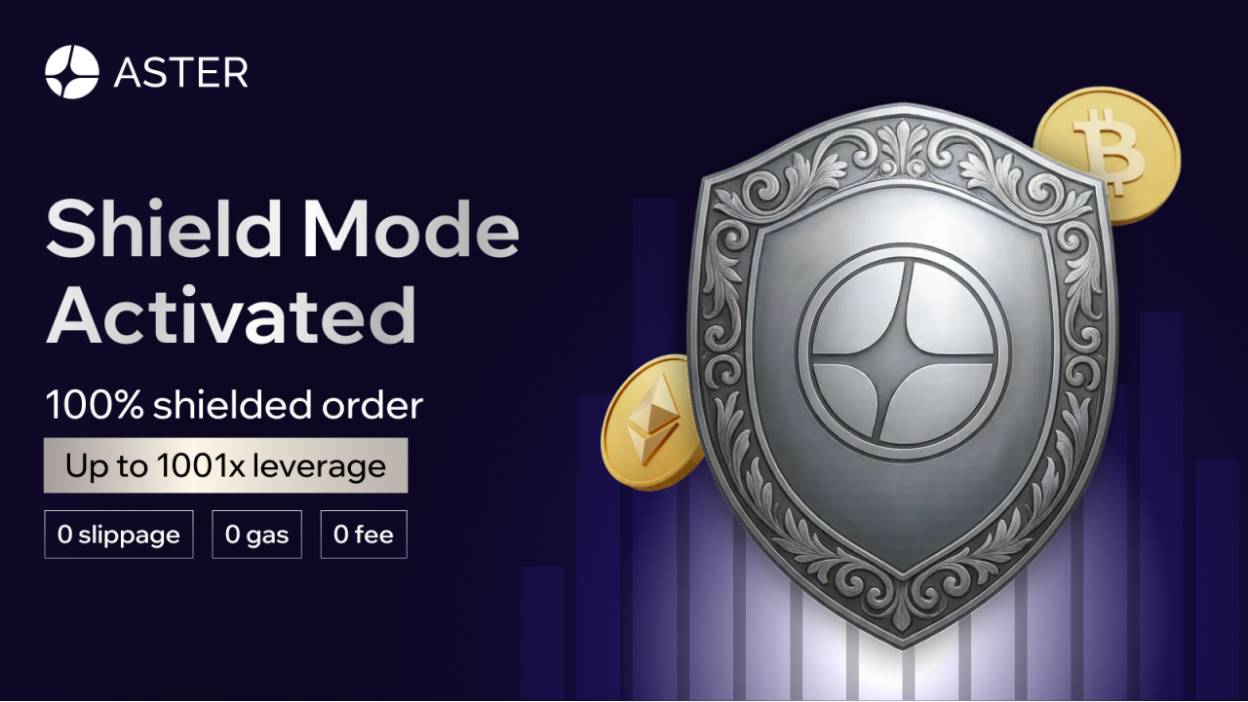
Aster Launches Shield Mode: A High-Performance Trading Protection Mode for On-Chain Traders

深潮Publicado em 2025-12-15Última atualização em 2025-12-15

Resumo

Aster, a high-performance on-chain trading platform supported by YZi Labs, has launched Shield Mode, a new protected trading feature integrated directly into Aster Perpetual. This mode is designed for advanced traders, offering up to 1001x leverage, zero slippage, no opening fees, and fully on-chain settlement. It enhances privacy by allowing users to open and manage positions without interacting directly with the public order book, protecting trading strategies from exposure. Shield Mode also eliminates gas costs, accelerates execution, and will soon support flexible fee models: a commission-based structure or a profit-and-loss based fee. All Shield Mode trades are fee-free until the end of the year. This release marks a key step in Aster's vision to become a next-generation platform for professional on-chain trading.

Aster, a high-performance, privacy-focused on-chain trading platform supported by YZi Labs, today announced the official launch of Shield Mode. This trading feature, as a new protection mode, is directly integrated into Aster Perpetual, aiming to incorporate the complete 1001x leverage trading experience into a faster, more secure, and flexible on-chain trading environment.

Shield Mode is a significant milestone in Aster's vision to advance the next generation of on-chain trading platforms. This mode is designed for advanced traders while providing solutions to the core challenges exchanges face in fully transparent on-chain markets.

Regarding the official launch of Shield Mode, Aster CEO Leonard stated:

Shield Mode is our understanding and interpretation of the future of on-chain trading. The future of on-chain trading is not just about leverage and speed, but also about the emphasis on control, privacy, and protection mechanisms. We are building a platform where traders can perform at their highest level without being forced to expose their trading strategies to the entire market.

Evolution of On-Chain Trading: From 1001x Leverage to Shield Mode

Aster's 1001x leverage product is renowned for pushing the boundaries of on-chain perpetual trading, offering up to 1001x leverage, zero slippage, zero opening fees, and fully on-chain settlement. As on-chain trading infrastructure matures, traders are increasingly aware of the dual nature of fully transparent trading, particularly the risks associated with exposing strategies and intentions in on-chain markets.

In mid-2025, Aster introduced the Hidden Orders feature on its perpetual contract platform, allowing traders to hide order prices and quantities from the public order book while maintaining deep liquidity. This was a crucial step in giving traders greater operational privacy and freedom on-chain.

Shield Mode builds on this foundation with further upgrades, combining high-performance leveraged trading with enhanced trade intent protection to create a smoother and more controllable trading experience.

Shield Mode: The Next-Generation Trading Mode on Aster

Shield Mode is a new trading mode built directly on Aster Perpetual, integrating the 1001x leverage trading experience into a single interface and account system. In this mode, traders can more easily open and manage long or short positions without directly interacting with the public order book, while seamlessly accessing high-leverage trading without cross-chain switches, fragmented operations, or frequent on-chain signatures.

The advantages of Aster's 1001x trading model continue in Shield Mode, including up to 1001x leverage for BTC and ETH, zero slippage, and zero opening fees. Shield Mode further eliminates closing fees, completely removes Gas costs, and accelerates trade execution.

These improvements collectively set a new benchmark for on-chain perpetual contract trading: a high-level on-chain trading experience that combines cost efficiency with extreme performance.

Flexible Fee Structure to Adapt to Diverse Trading Strategies

Shield Mode is designed to support a flexible fee model, allowing traders to choose their payment method based on strategic preferences. In subsequent updates, traders will be able to choose between two modes:

  • Commission Mode: Charges a fixed percentage fee based on trading volume, suitable for high-frequency, stable trading.
  • PnL Mode: Charges fees only on profitable trades, suitable for performance-oriented strategies.

To celebrate the launch of Shield Mode, all trades in this mode will be fee-free from now until the end of the year. This flexibility gives traders greater autonomy over cost control, allowing users with different risk preferences and trading behaviors to find a suitable fee structure.

Laying the Foundation for Aster's Next Phase of Development

Shield Mode embodies Aster's macro vision beyond a single trading function. By introducing a protected trading mode for on-chain markets, Aster provides traders with greater decision-making autonomy and strategic protection capabilities.

Simultaneously, fully integrating the 1001x experience into Aster Perpetual lays the groundwork for unifying Aster's core products under a seamless system in the future, simplifying the path for traders to access high leverage and manage positions.

Combined with zero Gas costs and zero fee characteristics, this mode redefines the efficiency and performance standards of on-chain perpetual trading. This release marks Aster's evolution not only as a decentralized exchange but also as a platform specifically designed for professional and high-performance trading in the next generation of on-chain finance.

About Aster

As an on-chain trading platform, Aster supports high-performance perpetual contracts and spot trading, featuring MEV-aware trading mechanisms, advanced order types like Hidden Orders, and the protected trading mode Shield Mode across multiple blockchains.

Beyond trading features, Aster enhances capital efficiency through Trade & Earn and connects real traders with early liquidity opportunities via Rocket Launch to drive ecosystem growth.

Supported by YZi Labs, Aster is building its own Aster Chain and launching multi-phase airdrop and incentive programs for the global community.

To learn more, visit the Aster Official Website or the Official X Account.


Perguntas relacionadas

QWhat is Aster Shield Mode and what are its main benefits for on-chain traders?

AAster Shield Mode is a new trading protection mode integrated into Aster Perpetual, designed to provide a high-performance trading environment with enhanced privacy and control. Its main benefits include combining 1001x leverage trading with protection of trading intent, eliminating gas costs and closing fees, accelerating trade execution, and offering a flexible fee structure.

QHow does Shield Mode address the challenges of fully transparent on-chain markets?

AShield Mode addresses the challenges of on-chain market transparency by allowing traders to open and manage positions without directly interacting with the public order book. This protects their trading strategies and intentions from being exposed to the entire market, providing greater operational privacy and freedom.

QWhat trading advantages does Shield Mode inherit from Aster's 1001x leverage model?

AShield Mode inherits key advantages from Aster's 1001x leverage model, including up to 1001x leverage on BTC and ETH, zero slippage, zero opening fees, and fully on-chain settlement. It further enhances this by removing closing fees and gas costs entirely.

QWhat flexible fee structures will be available in Shield Mode for different trading strategies?

AShield Mode will offer two flexible fee structures: Commission Mode, which charges a fixed percentage fee based on trading volume (suitable for high-frequency, stable trading), and PnL Mode, which only charges fees on profitable trades (suitable for performance-oriented strategies).

QHow does the launch of Shield Mode contribute to Aster's broader vision for on-chain trading?

AThe launch of Shield Mode is a key milestone in Aster's vision for next-generation on-chain trading platforms. It provides traders with greater decision-making autonomy and strategy protection, integrates the 1001x experience into a seamless system, and sets new standards for cost efficiency and performance in on-chain perpetual trading.

Leituras Relacionadas

Google TPU Shipments Revised Up by 50%

Recent industry research indicates a significant upward revision in the shipments of Google's TPU (Tensor Processing Unit) chips. Previous expectations for 2027 were set at around 10 million units, but new estimates now point to 15 million units, a 50% increase. This substantial boost directly translates to higher demand across the entire supporting supply chain. Google's TPU clusters utilize a standardized all-optical interconnect architecture. Consequently, key hardware components are deeply integrated and scaled in fixed ratios with the chips. The 15 million TPU target will drive corresponding demand increases for NPO optical engines (roughly a 1:1 match), 1.6T optical modules, OCS optical switches, high-end server power supplies, fiber optics & MPO connectors, and liquid cooling solutions. Among these, liquid cooling is highlighted as the sector experiencing the most significant transformation and offering the most stable potential for excess returns. As next-generation TPU chips reach power levels where traditional air cooling is insufficient, liquid cooling becomes essential. 2026 is forecasted as the first year of substantial adoption for Google's liquid cooling solutions. This shift, coupled with delivery and capacity bottlenecks faced by incumbent overseas manufacturers, is creating a prime window for domestic Chinese suppliers to enter and secure Google's core supply chain. The market size for Google-specific liquid cooling is projected to potentially triple from a baseline of hundreds of billions to around 300 billion units by 2028. The logic for the fiber optic sector is also being rewritten. Once considered a cyclical commodity tied to telecom operator procurement, fiber is now a strategic and scarce resource for AI Data Centers (AIDC). A severe supply-demand imbalance, driven by the long lead time for preform production (18-24 months) and surging demand from cloud giants, is supporting strong performance. Chinese fiber manufacturers are well-positioned to capture a significant share of global AIDC demand, with exports potentially reaching 200-300 million core kilometers in 2026. Overall, the investment focus within the AI computing industry is shifting from pure "chip performance speculation" towards the more certain incremental growth in computing infrastructure and its supporting ecosystem. The upward revision in Google TPU shipments, along with the potential for further doubling by 2028, is seen as solidifying performance visibility for the entire supporting supply chain over the next two years.

marsbitHá 1h

Google TPU Shipments Revised Up by 50%

marsbitHá 1h

What Wall Street Really Wants After the Crypto Story Recedes

The tide of speculative crypto narratives has receded, revealing Wall Street's true objective: building a controlled, yield-generating, and compliant financial pipeline on distributed ledgers. They are migrating core functions onto blockchains, not for decentralization, but for efficiency and new revenue streams. Key developments include BlackRock's BUIDL fund, a tokenized treasury fund acting as a foundational reserve asset, and the rise of Securitize, which is going public and partnering with the NYSE to build a 24/7 digital securities trading and settlement system. This signals a major shift of securities clearing to blockchain technology. To make volatile assets like Bitcoin palatable for institutional investors, firms like BlackRock and Goldman Sachs are creating "covered call" ETFs (e.g., BITA). These products systematically sell options on Bitcoin holdings, transforming price volatility into stable monthly income, effectively repackaging crypto as a yield-bearing asset. Stablecoins are being positioned not as speculative tools but as efficient payment rails. Companies like Stripe and Mastercard are integrating them for instant, low-cost merchant settlements and cross-border card payments, respectively. Critically, new legislation like the GENIUS Act shapes them as non-interest-bearing, heavily regulated extensions of the US dollar system. In summary, Wall Street is quietly constructing a parallel, blockchain-based financial infrastructure featuring tokenized traditional assets, structured crypto yields, and programmable dollar pipelines—all under its control and fully integrated with existing regulatory and credit frameworks.

marsbitHá 1h

What Wall Street Really Wants After the Crypto Story Recedes

marsbitHá 1h

Tying Itself to SpaceX: Cursor's $60 Billion Rise

This article recounts the rapid rise of AI-powered coding startup Cursor and its 25-year-old MIT graduate CEO, Michael Truell. Launched in 2023, Cursor achieved explosive growth, reaching over 10 billion USD in revenue by late 2025. However, its journey highlights a central dilemma for AI application companies: dependence on foundational model providers. Cursor initially relied heavily on Anthropic's models but faced an existential threat when Anthropic launched its own competing coding tool, Claude Code. In response, Cursor declared an internal emergency in early 2026 and accelerated development of its own model, Composer. To secure the immense computing power needed, Truell struck a pivotal deal with Elon Musk's SpaceX in April 2026. The collaboration grants Cursor access to SpaceX's supercomputing resources for Composer, while SpaceX's Grok model benefits from Cursor's programming data. The agreement includes a potential 600 billion USD acquisition of Cursor by SpaceX later in the year, though a substantial termination fee is in place if the deal falls through. The story explores Cursor's intense, sometimes controversial hiring practices involving lengthy unpaid "work trials," its complex partnership-turned-rivalry with Anthropic, and its high-stakes gamble to ensure independence through the SpaceX alliance. The core question remains: will Cursor evolve into a defining, independent "generational" software company, or become a key piece in a tech giant's AI arsenal?

marsbitHá 1h

Tying Itself to SpaceX: Cursor's $60 Billion Rise

marsbitHá 1h

Trading

Spot
Futuros

Artigos em Destaque

O que é ATWO

I. Introdução ao ProjetoArena Two é uma plataforma interativa descentralizada que permite aos fãs desempenhar um papel ativo e tokenizado nos resultados de eventos em tempo real. Ao contrário dos modelos tradicionais de transmissão que reduzem os fãs a espectadores passivos, a Arena Two utiliza a tecnologia blockchain para permitir que os fãs votem diretamente em tempo real e influenciem os resultados em campo.II. Informação sobre o TokenNome do token: ATWO(Arena Two)III. Links RelacionadosWebsite:https://arenatwo.com/Exploradores:https://basescan.org/token/0x499D35eBE6cEe9B2Ac35Fd003fcBbeeB9CFc7B32Twitter:https://x.com/arenatwoXNota: A introdução ao projeto provém dos materiais publicados ou fornecidos pela equipa oficial do projeto, que é apenas para referência e não constitui aconselhamento de investimento. A HTX não se responsabiliza por quaisquer perdas diretas ou indiretas resultantes.

258 Visualizações TotaisPublicado em {updateTime}Atualizado em 2026.06.02

O que é ATWO

Como comprar ATWO

Bem-vindo à HTX.com!Tornámos a compra de Arena Two (ATWO) simples e conveniente.Segue o nosso guia passo a passo para iniciar a tua jornada no mundo das criptos.Passo 1: cria a tua conta HTXUtiliza o teu e-mail ou número de telefone para te inscreveres numa conta gratuita na HTX.Desfruta de um processo de inscrição sem complicações e desbloqueia todas as funcionalidades.Obter a minha contaPasso 2: vai para Comprar Cripto e escolhe o teu método de pagamentoCartão de crédito/débito: usa o teu visa ou mastercard para comprar Arena Two (ATWO) instantaneamente.Saldo: usa os fundos da tua conta HTX para transacionar sem problemas.Terceiros: adicionamos métodos de pagamento populares, como Google Pay e Apple Pay, para aumentar a conveniência.P2P: transaciona diretamente com outros utilizadores na HTX.Mercado de balcão (OTC): oferecemos serviços personalizados e taxas de câmbio competitivas para os traders.Passo 3: armazena teu Arena Two (ATWO)Depois de comprar o teu Arena Two (ATWO), armazena-o na tua conta HTX.Alternativamente, podes enviá-lo para outro lugar através de transferência blockchain ou usá-lo para transacionar outras criptomoedas.Passo 4: transaciona Arena Two (ATWO)Transaciona facilmente Arena Two (ATWO) no mercado à vista da HTX.Acede simplesmente à tua conta, seleciona o teu par de trading, executa as tuas transações e monitoriza em tempo real.Oferecemos uma experiência de fácil utilização tanto para principiantes como para traders experientes.

141 Visualizações TotaisPublicado em {updateTime}Atualizado em 2026.06.02

Como comprar ATWO

O que é ZEST

I. Introdução ao Projeto1. O que é o Zest Protocol?O Zest Protocol é um protocolo de empréstimos nativo do Bitcoin construído na camada 2 do Stacks que permite aos utilizadores ganhar rendimento com BTC ou emprestar ativos colateralizando BTC. Os contratos inteligentes do protocolo são escritos na linguagem Clarity, operam totalmente em cadeia e são de código aberto, com um design inspirado no Aave v3. O Zest é atualmente o maior protocolo DeFi no Stacks, com mais de 800 BTC depositados e um pico de TVL superior a 100 milhões de dólares. Em maio de 2026, o protocolo introduziu ainda os Cofres de Colateral em Bitcoin, estendendo as capacidades de empréstimo do Stacks para a rede principal do Bitcoin. Isso permite que os utilizadores emprestem stablecoins sem mover BTC da rede Bitcoin, possibilitando empréstimos com custódia própria.2. Como funciona o Zest Protocol?O Zest Protocol consiste em dois mercados. O mercado do Stacks é construído sobre o Aave v3, permitindo que os utilizadores depositem ativos como sBTC, STX e USDC para ganhar rendimento ou contrair empréstimos sobre-colateralizados. O LTV máximo padrão é de 50% (70% para sBTC). O mercado do Bitcoin opera através dos recém-lançados Cofres de Colateral em Bitcoin. Os utilizadores emprestam stablecoins ao bloquear BTC em cofres de custódia própria na cadeia do Bitcoin. O colateral permanece na rede principal do Bitcoin durante todo o processo, e os utilizadores mantêm a custódia, a menos que a posição seja liquidada.3. Quem fundou o Zest Protocol?Tycho Onnasch (Co-Fundador): Formado na Universidade de Oxford. Envolvido em pesquisa e subsídios para a Stacks Open Internet Foundation. Antigo Gestor na Trust Machines e Fundador da Deedmob. Perfil do LinkedIn: https://www.linkedin.com/in/tychokoonnasch/.Fernando Foy (Co-Fundador): Trabalhou anteriormente em consultoria de TI na Objectif Emploi. Perfil do LinkedIn: https://www.linkedin.com/in/fernando-foy/.Emil E. (Co-Fundador): Possui um Mestrado em Física pela Universidade de Warwick. Antigo Partner de Engenharia na Trust Machines, Desenvolvedor Full-Stack para projetos Web3 e Cientista de Dados no HSBC. Perfil do LinkedIn: https://www.linkedin.com/in/emil-e-49771a145/.Detalhes de Financiamento: Em maio de 2024, o Zest Protocol anunciou a conclusão de uma ronda de financiamento inicial de 3,5 milhões de dólares liderada por Tim Draper, com a participação da Binance Labs, Flow Traders, Trust Machines, entre outros.4. Tokenomics do $ZEST$ZEST é o token nativo do Zest Protocol com um fornecimento total fixo de 1 mil milhões de tokens e sem mecanismo inflacionário.Comunidade (27,83%): Usado para airdrops e incentivos aos utilizadores;Desenvolvimento do Ecossistema (24,82%): Usado para liquidez, parcerias, marketing, listagens em bolsas, etc.;Investidores (22,35%): Apoio às partes investidoras que apoiaram o desenvolvimento inicial do Zest Protocol;Equipa (25%): Alocado para colaboradores principais.Calendário de Vesting: Os tokens da Equipa e dos Investidores estão sujeitos a um período de bloqueio de 1 ano, seguido de 3 anos de desbloqueio linear.5. Cronologia dos Principais Marcos2022: O Zest Protocol é oficialmente fundado.Março de 2024: Concluída a auditoria de segurança e lançado o mercado de empréstimos do Stacks na rede principal.Em fevereiro de 2026, é lançado o Stacks Market V2, introduzindo Grupos de Risco.Em maio de 2026, foram introduzidos os Cofres de Colateral em Bitcoin, e um protótipo operacional da rede principal está agora disponível. Isso permite que os utilizadores utilizem BTC com custódia própria na L1 do Bitcoin como colateral para emprestar stablecoins em cadeias EVM, encerrando a necessidade de bridging, wrapping e custódia de terceiros. Este lançamento é dividido em duas fases. Fase 1: Utiliza transações pré-assinadas para restringir o movimento de BTC; Fase 2: Utiliza BitVM para verificação. II. Informações sobre o TokenNome do token: ZEST (Zest Protocol)III. Links RelacionadosWebsite: https://www.zestprotocol.com/Exploradores: https://bscscan.com/token/0x5506599c722389a60580b5213ea1da60d64754a1Twitter: https://twitter.com/ZestProtocolNota: A introdução ao projeto provém dos materiais publicados ou fornecidos pela equipa oficial do projeto, que é apenas para referência e não constitui aconselhamento de investimento. A HTX não se responsabiliza por quaisquer perdas diretas ou indiretas resultantes.

207 Visualizações TotaisPublicado em {updateTime}Atualizado em 2026.06.02

O que é ZEST

Discussões

Bem-vindo à Comunidade HTX. Aqui, pode manter-se informado sobre os mais recentes desenvolvimentos da plataforma e obter acesso a análises profissionais de mercado. As opiniões dos utilizadores sobre o preço de A (A) são apresentadas abaixo.

活动图片