Aster Chain mainnet debuts: Can it slow the DEX’s falling market share?

ambcryptoPublicado em 2026-03-18Última atualização em 2026-03-18

Resumo

Aster Chain, a perpetual DEX backed by YZi Labs, has launched its mainnet. The new Layer 1 blockchain incorporates zero-knowledge proofs and stealth addresses to prevent "position hunting" and improve privacy for high-frequency traders, while maintaining a CEX-like user experience. Despite a strong initial debut in late 2025, Aster's trading volume and market share have significantly declined. Weekly volume dropped from a peak of $74 billion to under $10 billion, and its market share fell from 40% to 20%. Competitor Hyperliquid, which initially lost dominance to Aster, has since regained much of its market share. The native token, ASTER, fell 86% from its high but recovered 80% during a broader market bounce. The mainnet announcement caused a brief 10% price surge, but gains were not sustained. The token remains range-bound between $0.70 and $0.80, with a potential move to $0.95 if key resistance is broken. Future demand may depend on the success of planned staking features.

YZi Labs-backed perpetual DEX platform Aster has finally unveiled its Aster Chain mainnet. The new chain will adopt zero-knowledge proofs and stealth addresses in a bid to curb ‘position hunting,’ common on transparent public chains and platforms like Hyperliquid.

Initially, the DEX debuted on BNB Chain via a bridge and later extended to Ethereum [ETH], Solana [SOL], and Arbitrum [ARB] as a multi-chain dApp. While it will still support trading across these chains, it will transition into a sovereign Layer 1 ecosystem.

The move is aimed at achieving the privacy and other optimal features for high-frequency traders while maintaining a CEX-like user experience.

Aster’s market share falls

Although the DEX became an instant hit after its launch last September, the traction has waned significantly in 2026.

During its peak activity in October 2025, it handled nearly $74 billion in weekly trading volume. But its trading activity shrank to less than $10 billion as of mid-March 2026, following the broader crypto rout in the past few months.

Its overall market share in perps trading volume declined by half, from 40% to 20%, over the same period.
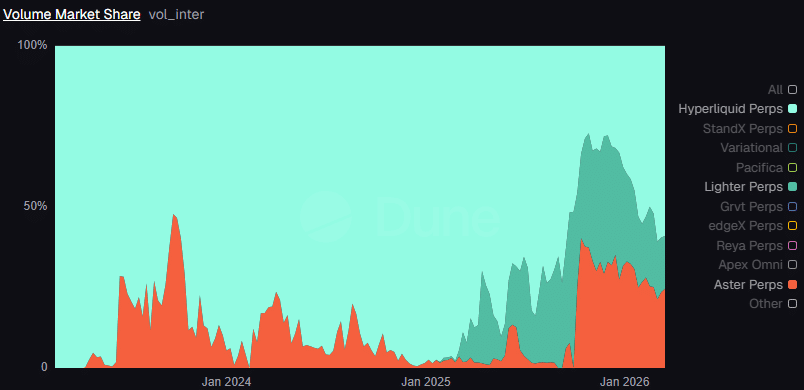
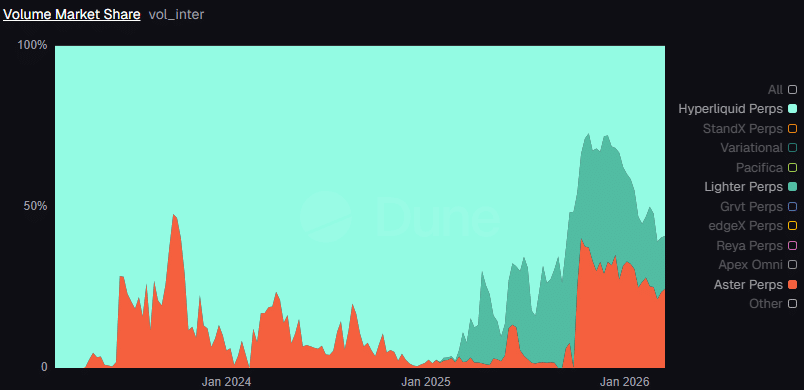
Source: Dune

Interestingly, Aster’s wild FOMO after launch clawed down Hyperliquid’s [HYPE] market share. Hyperliquid had over 60% dominance before Aster went live. Afterward, its dominance fell to 27% but began reclaiming it only after unveiling trading support for oil, gold, silver, and other commodities via HIP-3.

As of writing, Hyperliquid has regained most of its trading volume, while Aster’s steep decline has not abated.

ASTER price reaction

Likewise, its native token ASTER slumped 86% after a free fall from $3 to a low of $0.4. However, the broader market relief bounce from early February has boosted the altcoin’s recovery by 80%.

But the mainnet debut didn’t help bulls that much. After the update, ASTER swiftly rallied by nearly 10%, hitting $0.790, but had erased most of the gains at the time of writing.

When zoomed out, the altcoin was still stuck at its February tight price range of $0.70 and $0.80. The sideways structure may extend if there is no meaningful catalyst for a broader market extended recovery.

However, should the $0.80 price level be flipped to support, then retesting $0.950 could be feasible. It’s unclear whether the planned staking feature will induce demand for ASTER.
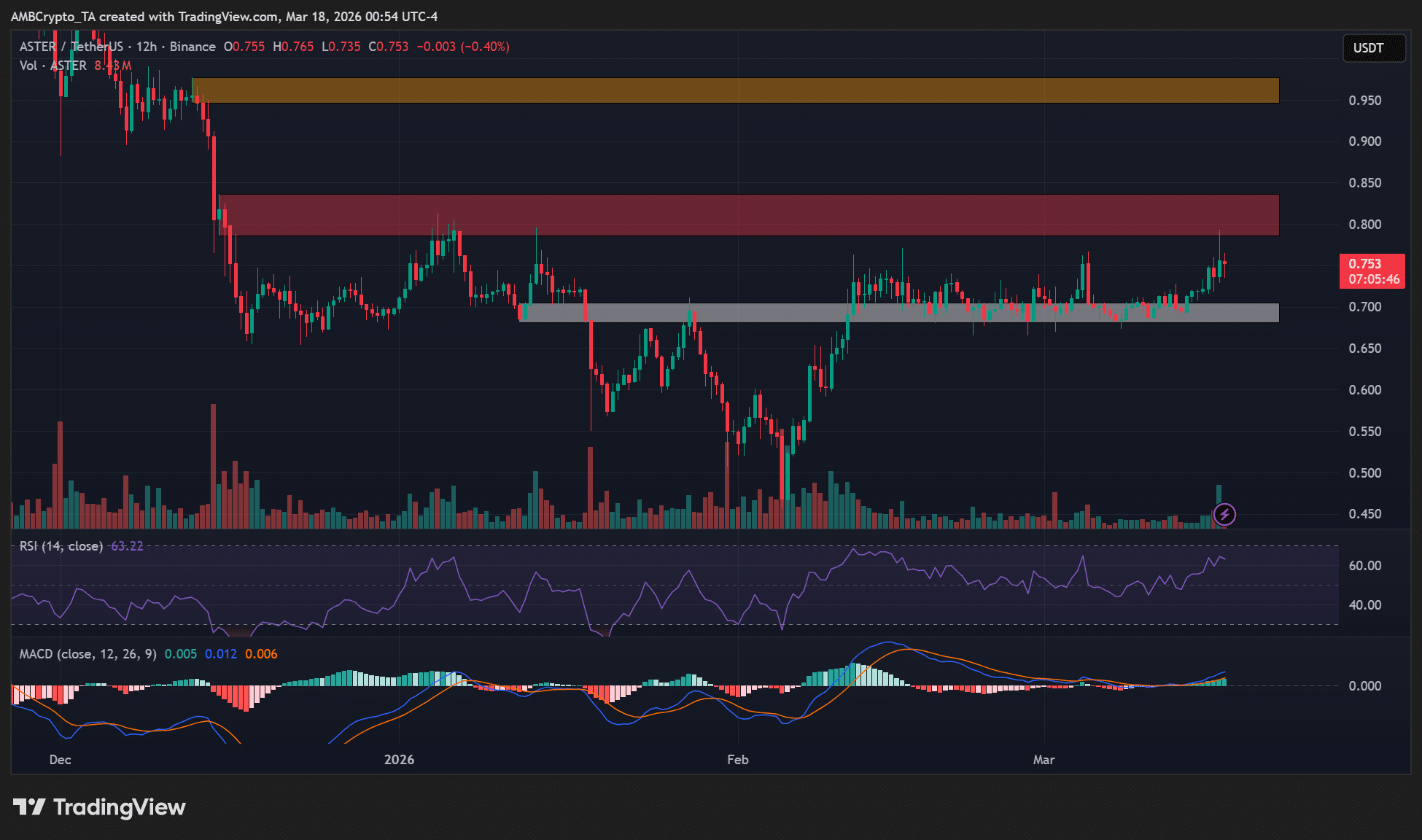
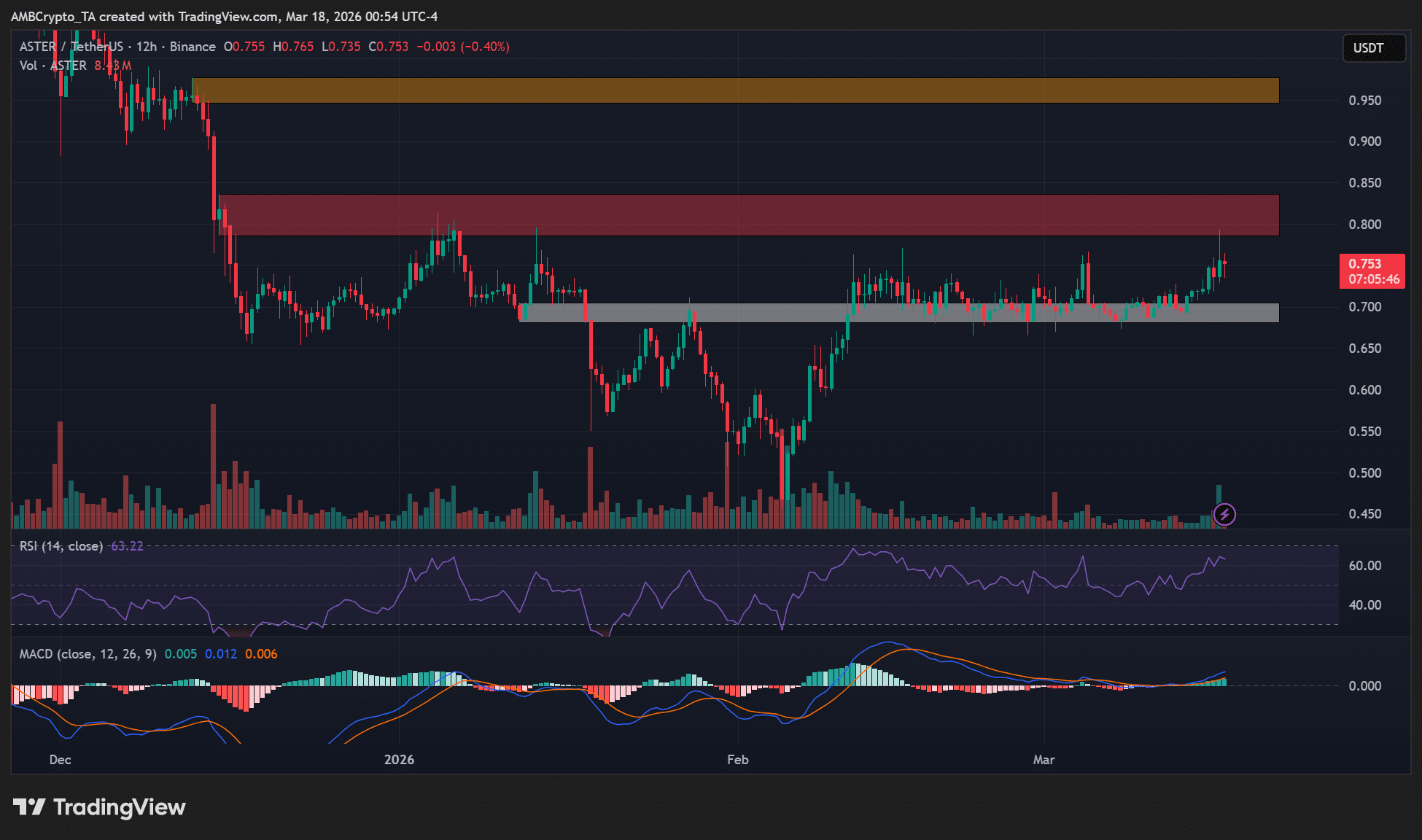
Source: ASTER/USDT, TradingView

Final Summary

  • Aster has unveiled its Aster Chain mainnet to double down on privacy and trading efficiency.
  • Still, the DEX’s traction remains in a downtrend while the ASTER price has been stuck in a tight range.


Criptomoedas em alta

Perguntas relacionadas

QWhat is the main purpose of the newly launched Aster Chain mainnet?

AThe Aster Chain mainnet aims to provide enhanced privacy and optimal features for high-frequency traders by adopting zero-knowledge proofs and stealth addresses to curb position hunting, while maintaining a CEX-like user experience.

QHow did Aster's market share in perpetual trading volume change from its peak to mid-March 2026?

AAster's market share in perpetual trading volume declined by half, from 40% at its peak to 20% by mid-March 2026.

QWhat was the impact of Aster's launch on Hyperliquid's market dominance?

AAster's launch reduced Hyperliquid's market dominance from over 60% to 27%, though Hyperliquid later regained most of its trading volume after introducing support for commodities like oil, gold, and silver via HIP-3.

QHow did the ASTER token price react to the mainnet debut?

AThe ASTER token initially rallied nearly 10% to $0.790 after the mainnet debut but erased most of those gains shortly after, remaining stuck in the $0.70 to $0.80 range.

QWhat chains did Aster initially support before transitioning to a sovereign Layer 1 ecosystem?

AAster initially debuted on BNB Chain via a bridge and later extended to Ethereum, Solana, and Arbitrum as a multi-chain dApp before transitioning to a sovereign Layer 1 ecosystem.

Leituras Relacionadas

Who Decides Bitcoin's Rules? BIP-110 Ignites Governance Debate

Title: Who Decides Bitcoin's Rules? BIP-110 Ignites Governance Debate A new technical proposal, BIP-110 (Reduced Data Temporary Softfork), has sparked a fundamental governance debate within the Bitcoin community. It aims to impose new consensus rules for one year to limit non-financial data (like inscriptions and Runes) on-chain, moving beyond simple node and miner policy filters to invalidate currently valid transactions. Supporters argue that default policies have failed due to workarounds, necessitating consensus-layer changes to protect Bitcoin's core monetary function from data spam. Critics, including Michael Saylor and Adam Back, contend this dangerously centralizes judgment, undermines permissionlessness, and sets a risky governance precedent. They advocate for market-based solutions like fees or Layer 2s instead. The debate exposes deeper tensions: miners are divided on activation; node operators assert their sovereignty; Bitcoin Core developers influence defaults without direct accountability; and large corporate holders like MicroStrategy now wield narrative influence. Technically, BIP-110 may not fully block data and carries a disclosed consensus bug risk. Ultimately, BIP-110 acts as a stress test, forcing the community to confront the unresolved question: who legitimately decides what Bitcoin is and how it evolves, amidst competing claims from miners, nodes, developers, and capital holders.

链捕手Há 12m

Who Decides Bitcoin's Rules? BIP-110 Ignites Governance Debate

链捕手Há 12m

Zcash's New Node Zakura Goes Live: Privacy Payments Can Reach 50,000 TPS, Aiming to Rival Visa and Mastercard

Zcash, a privacy-focused cryptocurrency, has launched a new full node software called Zakura version 1.0.0. Developed by Zcash co-founder Sean Bowe and Dev Ojha, with private ZEC donations, its goal is to enable Zcash to process over 50,000 transactions per second (TPS)—matching the scale of Visa and Mastercard—while maintaining full transaction privacy and verifiability. This addresses a key bottleneck, as Zcash currently handles only about 1 private transaction per second. Zakura is a fork of the Zcash Foundation's Zebra node. It features chain pruning and snapshots, reducing disk usage and allowing new nodes to sync in under two minutes. It also offers compatibility with the legacy `zcashd` client interface. The scalability challenge stems from the large data size of privacy proofs. Bowe's Tachyon project aims to use recursive proofs to reduce consensus-layer data needs from ~500 MB/s to ~100 MB/s. For wallet scalability, Valar Group is researching Private Information Retrieval (PIR) tech to allow wallets to fetch their data privately. Zakura supports fast block propagation and the upcoming "Ironwood" network upgrade (NU6.3), scheduled for activation around July 28th. Ironwood was created to contain a critical inflation bug discovered in the Orchard shielded pool in May 2024. The fix uses "turnstiles" to trap any counterfeit ZEC created during the vulnerability period within the shielded pool, preventing it from entering circulation and restoring supply integrity.

marsbitHá 27m

Zcash's New Node Zakura Goes Live: Privacy Payments Can Reach 50,000 TPS, Aiming to Rival Visa and Mastercard

marsbitHá 27m

Replicating the "DeepSeek Moment"? Wall Street Unanimously Says: Kimi K3 Instead Strengthens Computing Power Demand

Title: Wall Street Sees Kimi K3 as a Catalyst for Compute Demand, Not a "DeepSeek Moment 2.0" Summary: Following the release of Moonshot AI's powerful open-source model Kimi K3, initial market reaction mirrored the "DeepSeek moment" that sparked a sell-off in compute stocks earlier in 2025, fearing reduced demand for AI infrastructure. However, major Wall Street banks including UBS, Nomura, BofA, and Citi argue the opposite: K3 will accelerate, not weaken, demand for compute, memory, storage, and networking. Their analysis centers on K3's specifications—2.8 trillion parameters, 1M token context, and MoE architecture—which represent a "scale" story rather than a pure "efficiency" one like DeepSeek R1. These features increase pressure on inference, memory (especially KV cache), and storage. Analysts invoke Jevons Paradox: as high-quality models become more affordable (K3 is cheaper than top closed models but not the cheapest), usage and token volumes expand, ultimately increasing total compute consumption. The reports highlight that competition will force leading US AI labs (OpenAI, Anthropic, Google) to invest more in training and iteration to maintain their edge. Furthermore, the rise of capable open-source models like K3 is expanding the global AI developer ecosystem, with Chinese models now accounting for over 45% of developer traffic. Key beneficiaries identified across the AI infrastructure chain include memory/storage players (e.g., Micron, Samsung), compute leaders (Nvidia, TSMC), networking suppliers (due to "super-node" cluster needs for deploying K3), and cloud platforms (e.g., Alibaba) that host diverse model ecosystems. The consensus is that stronger open-source models are an entry point for the next wave of infrastructure demand diffusion, provided workload growth outpaces efficiency gains.

链捕手Há 30m

Replicating the "DeepSeek Moment"? Wall Street Unanimously Says: Kimi K3 Instead Strengthens Computing Power Demand

链捕手Há 30m

Prediction Markets Witness $200 Million in Suspicious Insider Trading Over Six Months, Who's Reaping the Profits?

Prediction markets are booming, with monthly trading volume exceeding $210 billion as of 2026. However, a Bloomberg investigation analyzing data from August 2025 to June 2026 reveals a parallel surge in suspicious trading, totaling roughly $200 million in the first half of 2026 on Polymarket alone. These potentially illicit trades are concentrated in geopolitical and military events, with 57% of the highest-earning wallets created less than 24 hours before trading. The analysis, using AI-driven platform Polysights, found profits are highly concentrated: the top 1% of wallets captured over half the gains. A significant portion (71%) of funds for marked trades originated from U.S.-regulated crypto exchanges, despite Polymarket's ban on U.S. users. Traders are increasingly using coordinated clusters of wallets and focusing on smaller markets to avoid detection. Two major criminal cases highlight the risks: a U.S. Army sergeant was charged for using classified information on a Venezuela operation to profit nearly $410,000, and an Israeli reservist allegedly leaked details of an Iran strike for a $128,400 gain. Regulatory scrutiny is intensifying. The CFTC is investigating Polymarket, congressional bills aim to ban insiders from trading, and major firms like Goldman Sachs have restricted employee participation. In response, Polymarket has updated its rules against insider trading and provided wallet data to authorities. The core challenge remains distinguishing between skilled research and trading on non-public information in a market designed to price such knowledge.

Foresight NewsHá 40m

Prediction Markets Witness $200 Million in Suspicious Insider Trading Over Six Months, Who's Reaping the Profits?

Foresight NewsHá 40m

Trading

Spot

Artigos em Destaque

Como comprar ASTER

Bem-vindo à HTX.com!Tornámos a compra de Aster (ASTER) simples e conveniente.Segue o nosso guia passo a passo para iniciar a tua jornada no mundo das criptos.Passo 1: cria a tua conta HTXUtiliza o teu e-mail ou número de telefone para te inscreveres numa conta gratuita na HTX.Desfruta de um processo de inscrição sem complicações e desbloqueia todas as funcionalidades.Obter a minha contaPasso 2: vai para Comprar Cripto e escolhe o teu método de pagamentoCartão de crédito/débito: usa o teu visa ou mastercard para comprar Aster (ASTER) instantaneamente.Saldo: usa os fundos da tua conta HTX para transacionar sem problemas.Terceiros: adicionamos métodos de pagamento populares, como Google Pay e Apple Pay, para aumentar a conveniência.P2P: transaciona diretamente com outros utilizadores na HTX.Mercado de balcão (OTC): oferecemos serviços personalizados e taxas de câmbio competitivas para os traders.Passo 3: armazena teu Aster (ASTER)Depois de comprar o teu Aster (ASTER), armazena-o na tua conta HTX.Alternativamente, podes enviá-lo para outro lugar através de transferência blockchain ou usá-lo para transacionar outras criptomoedas.Passo 4: transaciona Aster (ASTER)Transaciona facilmente Aster (ASTER) no mercado à vista da HTX.Acede simplesmente à tua conta, seleciona o teu par de trading, executa as tuas transações e monitoriza em tempo real.Oferecemos uma experiência de fácil utilização tanto para principiantes como para traders experientes.

605 Visualizações TotaisPublicado em {updateTime}Atualizado em 2026.06.02

Como comprar ASTER

Discussões

Bem-vindo à Comunidade HTX. Aqui, pode manter-se informado sobre os mais recentes desenvolvimentos da plataforma e obter acesso a análises profissionais de mercado. As opiniões dos utilizadores sobre o preço de ASTER (ASTER) são apresentadas abaixo.

活动图片