Asia-Pacific Stocks Under Pressure, South Korean Shares Lead Declines with SK Hynix Down 6% at One Point, Bitcoin Breaches $80,000, U.S. Treasuries Volatile at High Levels

华尔街日报Publicado em 2026-08-25Última atualização em 2026-08-25

Resumo

Asia-Pacific stock markets faced pressure, with South Korean equities leading the decline. Shares of Samsung Electronics and SK Hynix fell sharply, dragging down the KOSPI index by over 4% at one point. The drop in tech stocks mirrored a sell-off in U.S. semiconductors, with investors adopting a cautious stance ahead of Nvidia's earnings report, seen as a key signal for the AI trade outlook. Samsung's recent shareholder return plan, while large, fell short of some market expectations. Meanwhile, SK Hynix faces internal pressure as its union rejected a provisional wage agreement. Japanese stocks initially fell but later recovered, with the Nikkei 225 turning positive. Former Bank of Japan board member Seiji Adachi suggested a rate hike is likely next month, warning that inaction could trigger renewed yen weakness. In other markets, U.S. Treasury yields remained elevated near 4.71%. Bitcoin broke above $80,000 for the first time since mid-May, while gold eased slightly after recent gains. Analysts note the simultaneous strength in gold and crypto points to market concerns about long-term dollar weakness. The focus this week is dual: Nvidia's earnings are critical for stabilizing the AI-driven tech sector, while Fed Chair Kevin Warsh's speech at the Jackson Hole symposium is expected to provide clarity on the interest rate path.

South Korean memory chip giants Samsung Electronics and SK Hynix fell sharply on Monday, dragging the benchmark KOSPI index down by more than 4% at one point and putting pressure on technology stocks across the Asia-Pacific region. Market sentiment turned cautious as investors trimmed their exposure to tech shares, awaiting Nvidia's earnings report this week for a key signal on the outlook for artificial intelligence-related trading.

On August 25, Samsung Electronics saw its intraday drop exceed 4%, while SK Hynix's decline at one point exceeded 6%. Together, they contributed the most to a 0.5% decline in the MSCI Asia Pacific Index, though their losses have since narrowed. Pressure on Samsung's stock price partly stemmed from a shareholder return plan announced last Friday that fell short of market expectations—despite the company announcing it would return between 90 trillion and 110 trillion won (approximately $65 billion to $80 billion) to shareholders this year, about five times the record set in 2020, analysts noted the scale still fell short of market estimates and lacked direct stock price-boosting measures like treasury stock cancellation.
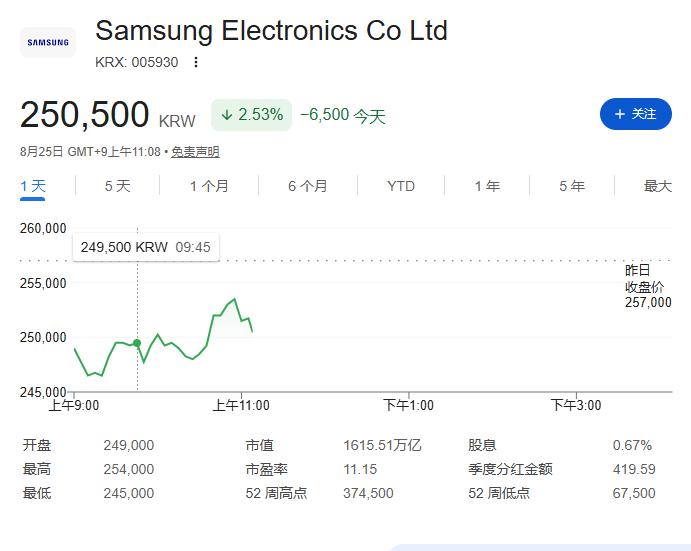
SK Hynix also faces internal pressure. The company's union members on Tuesday rejected a tentative wage agreement, with 50.08% of the 15,045 employees who voted casting 'no' ballots. The agreement included a 6.3% pay raise and revisions to a profit-sharing bonus scheme—40% to be paid in cash and 60% in company stock. The union is expected to restart wage negotiations with management.
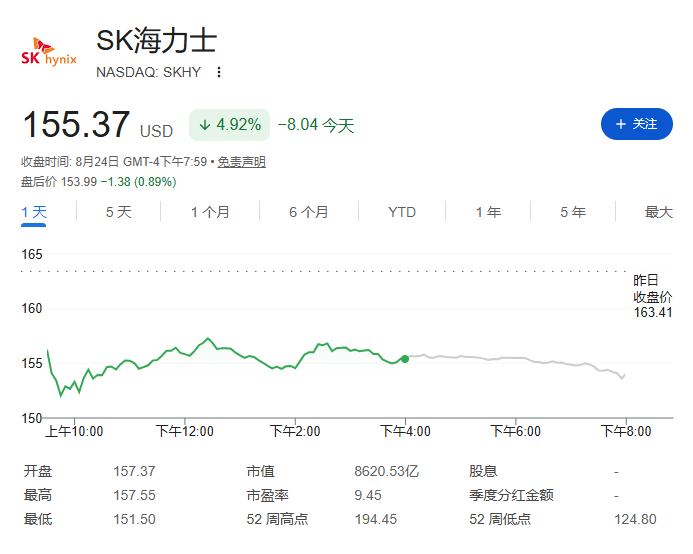
The decline in Asia-Pacific tech stocks extended losses from Wall Street's previous session. On Monday, major U.S. semiconductor stocks faced selling pressure, with the Nasdaq 100 index falling nearly 1%, and Nvidia recording its longest losing streak since 2022. Nvidia is scheduled to report earnings this Wednesday, and the market will closely watch whether its results can halt the recent weakness in chip stocks.

South Korean Stocks Rebound After Plunge, Japanese Stocks Recover and Turn Positive

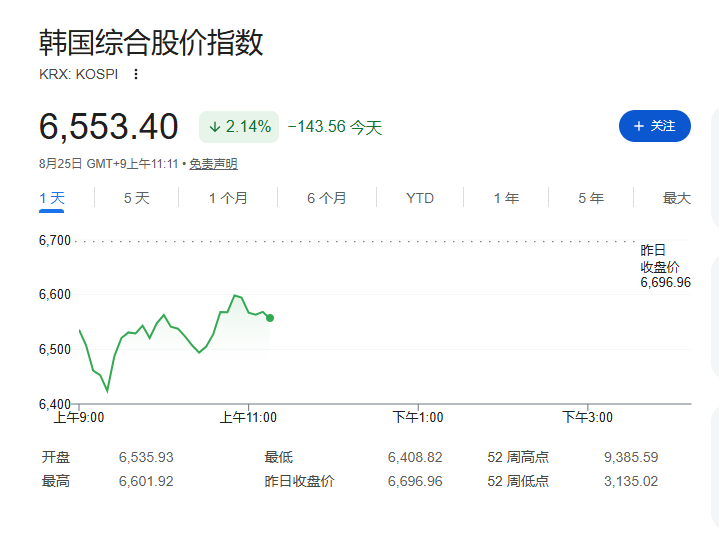
The KOSPI index showed a pronounced 'deep V' pattern intraday, plunging 4.3% to 6,408.82 points before recovering somewhat. At the time of writing, the KOSPI was trading at 6,531.74 points, down 2.14%; Samsung Electronics fell about 3%, while SK Hynix dropped about 5%.
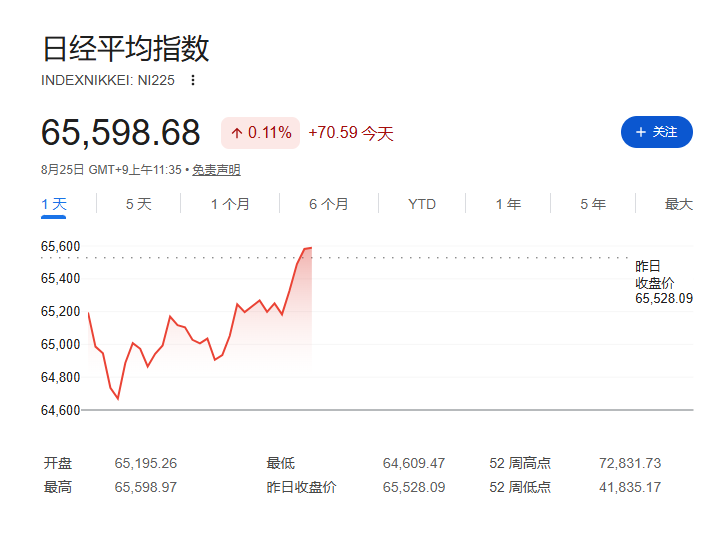
Japanese stocks also opened lower and fell, with the Nikkei 225 Index declining 0.9%, but it recovered and turned positive during the session. Among individual stocks, Kioxia Holdings fell nearly 3%, while Advantest and Panasonic Holdings both fell more than 3%. On the news front, former Bank of Japan Policy Board member Makoto Ando said the BOJ is likely to raise interest rates next month and could hike again as early as January next year. He warned that if the central bank maintains its current policy, it could trigger another round of yen selling, pushing up import costs and accelerating inflation. "The BOJ is essentially backed into a corner, and the market has almost fully priced in a rate hike. If the BOJ doesn't hike, the yen could weaken significantly again."
U.S. Treasury Yields Volatile at High Levels, Bitcoin Rises Above $80,000

U.S. Treasury yields remained elevated, with the 10-year yield at 4.71%. Earlier reports suggested the U.S. Treasury might use its cash reserves to buy back older, high-yielding debt to lower borrowing costs, but Treasury Secretary Scott Bessent later gave no clear signals about changes in debt management in his remarks. "We haven't bought a single bond yet," Bessent said in response to a question at a press conference.

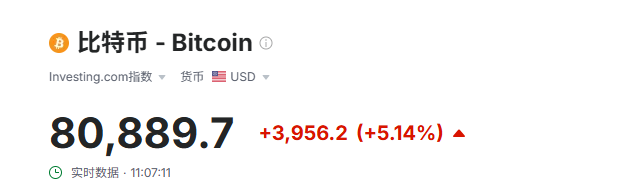
Gold edged lower, with spot gold down 0.2% to around $4,640 per ounce. Gold had earlier climbed to its highest level since May, supported by dollar weakness concerns stemming from Federal Reserve intervention in the bond market. Bitcoin rose for a third consecutive day, breaking above $80,000 for the first time since mid-May. According to Bloomberg strategist Mark Cranfield, the simultaneous strength in gold and cryptocurrencies both point to shared market concerns about the long-term weakening outlook for the U.S. dollar.
Nvidia Earnings and Jackson Hole Conference Form Dual Focus This Week

According to Bloomberg, investors are weighing geopolitical risks against a busy week of economic data and corporate earnings, with the outlook for technology stocks becoming a key variable testing overall risk sentiment. Nvidia's earnings are seen as a crucial barometer for confidence in AI-related trading, which has faced pressure in recent months as investor doubts deepen over whether massive AI spending will translate into corresponding profits.

Chris Larkin of Morgan Stanley's E*Trade said: "Details of U.S. economic sanctions on Iran, the Treasury's efforts to lower long-term yields, and economic data will largely shape the market's sentiment backdrop. But earnings from Nvidia and other tech stocks will be a significant weight influencing market momentum."

Richard Reyle, Chief Investment Officer at Questar Capital Partners, noted that Nvidia's earnings and Federal Reserve Chair Kevin Warsh's scheduled speech on Friday at the Jackson Hole symposium form the two pillars for markets this week. "These two things are usually unrelated, but Nvidia needs to deliver strong results to steady one leg of the stock market, while Warsh needs to provide clear guidance on the direction of interest rates to steady the other leg."


Criptomoedas em alta

Perguntas relacionadas

QWhat were the main factors causing the decline in South Korean semiconductor stocks, specifically Samsung Electronics and SK Hynix, as mentioned in the article?

ASamsung Electronics faced pressure because its announced shareholder return plan fell short of market expectations in terms of scale and lacked direct stock-boosting measures like share buybacks. SK Hynix was impacted as its labor union members voted to reject a proposed wage agreement, which would lead to renewed negotiations with management.

QHow did the performance of major Asian stock indexes like South Korea's KOSPI and Japan's Nikkei 225 evolve during the trading session described?

ASouth Korea's KOSPI index plunged over 4.3% at one point, forming a deep 'V' shape, before paring losses to trade down 2.14%. Japan's Nikkei 225 index initially fell 0.9% but later recovered to trade in positive territory.

QAccording to the article, what significant milestone did Bitcoin achieve, and what market concern does its rise alongside gold reportedly indicate?

ABitcoin broke above the $80,000 level for the first time since mid-May. The simultaneous strength in gold and cryptocurrencies, according to a Bloomberg strategist, points to a shared market concern about the long-term weakening prospects for the US dollar.

QWhat two key events are highlighted in the article as the dual focus for the market this week, and why are they important?

AThe two key events are Nvidia's upcoming earnings report and Federal Reserve Chairman Kevin Warsh's scheduled speech at the Jackson Hole conference. They are important because Nvidia's earnings are seen as a crucial test for confidence in the AI trade, while Warsh's speech is expected to provide critical guidance on the future direction of interest rates, both being vital for stabilizing market sentiment.

QWhat reason did a former Bank of Japan board member give for the likelihood of a Japanese rate hike, and what potential consequence did he warn about if the BOJ did not act?

AFormer Bank of Japan board member Seiji Adachi stated that the central bank is likely to raise rates next month, partly because market expectations are already fully priced in. He warned that if the BOJ keeps policy unchanged, it could trigger another round of yen selling, which would push up import costs and accelerate inflation.

Leituras Relacionadas

Wall Street Morning Report: Nvidia Falls for 7 Consecutive Days, AI Stocks Continue to Bleed Out; U.S. Treasury Buybacks Criticized as Temporary Fix, Inflation and Deficit Are the Real Big Problems

Wall Street Morning Report: Tech and Treasury Tensions U.S. stocks were mixed. The Dow gained 0.26%, supported by defensive and consumer staples stocks, while the S&P 500 fell 0.28% and the Nasdaq dropped 0.76% amid a sell-off in AI hardware. The U.S. announced new sanctions targeting Iran's key economic sectors, temporarily easing oil prices (Brent -2.35%). However, concerns over potential disruption to the Strait of Hormuz could pressure European natural gas prices. Meanwhile, the Treasury's upcoming bond buyback plan faced criticism from major banks (Goldman Sachs, Deutsche Bank, Citadel), who argue it doesn't address the root causes of high long-term yields: persistent inflation and the massive fiscal deficit. The 10-year Treasury yield dipped slightly to around 4.70%. Gold rose, with Citi raising its short-term target to $4,800/oz. The AI hardware and semiconductor sector saw intense selling. The Philadelphia Semiconductor Index fell nearly 3%. NVIDIA dropped 2.91%, marking its seventh consecutive daily decline—its longest losing streak since 2022—due to pre-earnings caution despite strong analyst estimates. Memory chip stocks (Micron -6%, others down 5-6%) fell after Samsung's shareholder returns disappointed, raising cycle peak fears. Optical communications was also a big loser, led by Applied Optoelectronics (-14%) on equity dilution concerns. Wall Street is growing wary of off-balance-sheet credit risks in AI infrastructure financing. In other moves, Tesla fell 3.83% on a major China recall. Meta rose 1.66% on news of its upcoming "Hatch" AI platform. Defensive stocks like Visa and Walmart supported the Dow. Key upcoming events include the Jefferies Semiconductor Conference (Aug 25-26), Gamescom (Aug 26-30), and NVIDIA's earnings report (Aug 28).

marsbitHá 9m

Wall Street Morning Report: Nvidia Falls for 7 Consecutive Days, AI Stocks Continue to Bleed Out; U.S. Treasury Buybacks Criticized as Temporary Fix, Inflation and Deficit Are the Real Big Problems

marsbitHá 9m

Analog Chip Giants TI and ADI Are Stepping Up

Analog chip giants Texas Instruments (TI) and Analog Devices (ADI) have both reported strong quarterly results, signaling an industry recovery. TI's Q2 2026 revenue reached $5.463 billion, a 23% year-over-year (YoY) increase. ADI's Q3 FY2026 revenue hit $4.022 billion, up 40% YoY, marking a new quarterly record. Both companies benefited from rising demand in industrial and data center markets, though their growth paths differed. TI experienced broad-based strength across its segments. Industrial revenue (33% of total) grew approximately 30% YoY, while data center revenue (9%) doubled. The automotive segment (33%) also showed a strong rebound, attributed to demand from China's EV/hybrid market and low inventory levels at automakers. ADI's growth was led by its industrial (49% of revenue, +53% YoY) and communications (16%, +84% YoY) segments, with data center products constituting 80% of the latter. Management highlighted a significant "AI exposure," with data center and ATE-related businesses now accounting for 20% of total revenue. Key differences emerged in their strategies and supply chain dynamics. ADI attributed a larger portion of its growth to AI infrastructure demand and has built "strategic inventory" to a record high of ~$1.93 billion to support future growth, despite channel inventory being below target levels. Its product lead times have extended to up to six months, and price increases are contributing to margin expansion. TI's inventory remained high at $4.6 billion but saw improved turnover. The company emphasized that its growth is primarily volume-driven, with minimal contribution from recent price hikes. TI maintains a competitive lead time below 13 weeks and expressed confidence in its capacity sufficiency for the next three years. In summary, both companies are riding a recovery wave fueled by industrial and AI/data center demand. TI's approach leverages its broad market presence and prepared capacity, while ADI is more focused on AI-driven growth and strategic inventory buildup. Their differing paths highlight the evolving structure of demand within the analog semiconductor market's rebound.

marsbitHá 34m

Analog Chip Giants TI and ADI Are Stepping Up

marsbitHá 34m

Trading

Spot

Artigos em Destaque

Como comprar ONE

Bem-vindo à HTX.com!Tornámos a compra de Harmony (ONE) simples e conveniente.Segue o nosso guia passo a passo para iniciar a tua jornada no mundo das criptos.Passo 1: cria a tua conta HTXUtiliza o teu e-mail ou número de telefone para te inscreveres numa conta gratuita na HTX.Desfruta de um processo de inscrição sem complicações e desbloqueia todas as funcionalidades.Obter a minha contaPasso 2: vai para Comprar Cripto e escolhe o teu método de pagamentoCartão de crédito/débito: usa o teu visa ou mastercard para comprar Harmony (ONE) instantaneamente.Saldo: usa os fundos da tua conta HTX para transacionar sem problemas.Terceiros: adicionamos métodos de pagamento populares, como Google Pay e Apple Pay, para aumentar a conveniência.P2P: transaciona diretamente com outros utilizadores na HTX.Mercado de balcão (OTC): oferecemos serviços personalizados e taxas de câmbio competitivas para os traders.Passo 3: armazena teu Harmony (ONE)Depois de comprar o teu Harmony (ONE), armazena-o na tua conta HTX.Alternativamente, podes enviá-lo para outro lugar através de transferência blockchain ou usá-lo para transacionar outras criptomoedas.Passo 4: transaciona Harmony (ONE)Transaciona facilmente Harmony (ONE) no mercado à vista da HTX.Acede simplesmente à tua conta, seleciona o teu par de trading, executa as tuas transações e monitoriza em tempo real.Oferecemos uma experiência de fácil utilização tanto para principiantes como para traders experientes.

610 Visualizações TotaisPublicado em {updateTime}Atualizado em 2026.06.02

Como comprar ONE

Discussões

Bem-vindo à Comunidade HTX. Aqui, pode manter-se informado sobre os mais recentes desenvolvimentos da plataforma e obter acesso a análises profissionais de mercado. As opiniões dos utilizadores sobre o preço de ONE (ONE) são apresentadas abaixo.

活动图片