Arthur Hayes Puts $100K On Hyperliquid (HYPE) Outrunning Every $1B+ Altcoin

bitcoinistPublicado em 2026-02-09Última atualização em 2026-02-09

Resumo

Arthur Hayes, co-founder of BitMEX, has placed a $100,000 bet that the Hyperliquid (HYPE) token will outperform every altcoin with a market cap over $1 billion during a specific period in 2026. This wager, made against Multicoin Capital's Kyle Samani, who criticized Hyperliquid for being "everything wrong with crypto," reframes the debate into a performance-based challenge. The bet comes amid analysis of Hyperliquid's new HIP-3 product, which offers non-crypto derivatives like equity and commodity perpetuals. Early data suggests these traditional finance instruments are gaining traction, accounting for 31% of the platform's volume. However, a stress test during a silver selloff revealed liquidity gaps compared to established venues like COMEX. Hayes's bet ultimately tests whether Hyperliquid's growth narrative and 24/7 access to non-crypto markets will translate into superior token performance.

Arthur Hayes is turning a long-running debate about Hyperliquid into a price-denominated wager, staking $100,000 that HYPE will beat every altcoin with a $1 billion-plus market cap over a defined window.

“Since HYPE is bad Kyle Samani let’s make a bet,” Hayes wrote on X. “I bet that from 00:00 UTC 10 Feb 2026 to 00:00 UTC 31 July 2026 $HYPE will out perform any shitcoin >$1bn mcap on coingecko in USD terms. You choose your champion. Loser donates $100k to a charity of the winner’s choice.”

Hayes’ post landed in the wake of a pointed takedown from Multicoin Capital co-founder Kyle Samani, who called Hyperliquid “in most respects everything wrong with crypto,” while listing objections “Founder literally fled his home country to build, openly facilitates crime and terror, closed source, permissioned.”

Why Hyperliquid Could Be Superior

The sparring unfolded alongside a separate thread of bullish commentary on Hyperliquid’s push into non-crypto derivatives via HIP-3, a product line that has begun listing equity and commodity perpetuals. Blockworks analyst Shaunda Devens, whose research was shared by Jon Charbonneau, argued that HIP-3 is already pulling meaningful activity outside pure crypto flow.

In devens’ analysis of HIP-3 silver perpetuals versus CME/COMEX Micro Silver futures, Hyperliquid is framed less as a meme-driven venue and more as an attempt to build an always-on, order-driven derivatives market for traditional underlyings. The report notes that “TradFi instruments now [account for] 31% of venue volume” with “daily notional above $5B,” positioning the silver contract as a stress test of whether those markets can hold up when the underlying is moving fast.

“Pre-crash, Hyperliquid was competitive at top-of-book for the sizes that dominate perp flow,” the report said, citing a 2.4 bps median spread versus 3 bps on COMEX, and “median slippage was 0.5 bps from the benchmark.” But it also emphasized the capacity gap: roughly “~$230k within ±5 bps on Hyperliquid vs. ~$13M on COMEX,” a difference that matters as clip sizes rise.

That trade-off sharpened during a violent silver selloff, when the report says both venues degraded but Hyperliquid developed a heavier execution tail. It cites a brief dislocation of more than 400 bps versus the benchmark before mean reversion via funding, and notes that “1% of Hyperliquid trades printed >50 bps from mid, vs. none on COMEX.”

Hayes’ wager effectively reframes the dispute: not whether Hyperliquid is philosophically “good” or “bad,” but whether its growth narrative, especially around 24/7 access to non-crypto risk, translates into token outperformance relative to large-cap peers.

If the next six months validate the thesis embedded in HIP-3: tight execution for retail-weighted flow, continuous trading when legacy venues are closed, and a path to less cycle-sensitive revenue, HYPE’s relative performance becomes a simple scoreboard. If not, the bet offers a high-visibility way for critics to test whether the market is pricing substance or momentum.

At press time, HYPE traded at $32.275.
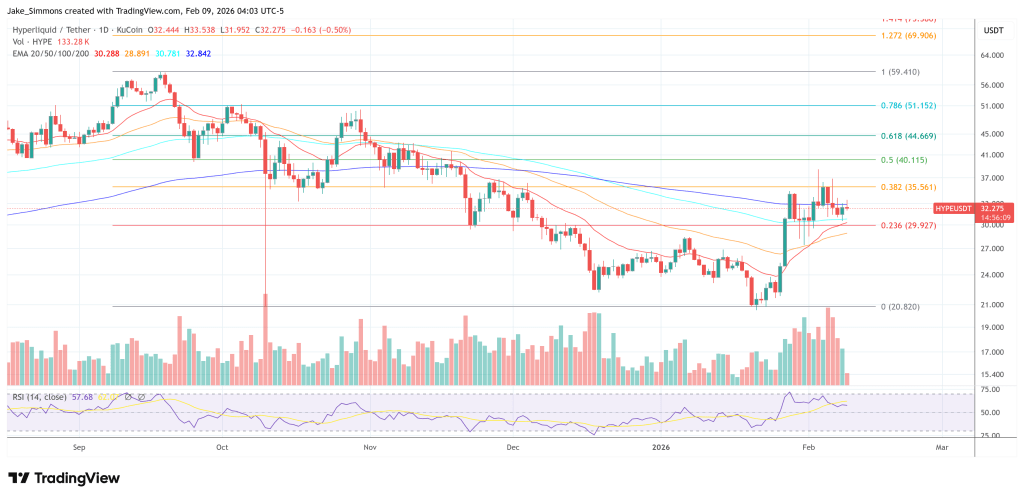
HYPE must break the 0.382 Fib, 1-week chart | Source: HYPEUSDT on TradingView.com

Perguntas relacionadas

QWhat is the specific bet that Arthur Hayes made regarding Hyperliquid (HYPE)?

AArthur Hayes bet $100,000 that from February 10, 2026, to July 31, 2026, the price of HYPE will outperform any other cryptocurrency with a market cap over $1 billion in USD terms. The loser will donate the money to a charity of the winner's choice.

QWho is the target of Arthur Hayes's bet and what was their criticism of Hyperliquid?

AThe bet is directed at Kyle Samani, co-founder of Multicoin Capital. Samani criticized Hyperliquid, calling it 'in most respects everything wrong with crypto,' citing that its founder fled his home country, it openly facilitates crime and terror, and that it is closed source and permissioned.

QWhat is HIP-3 and why is it significant for Hyperliquid's growth narrative?

AHIP-3 is Hyperliquid's product line for non-crypto derivatives, specifically listing equity and commodity perpetuals. It is significant because it represents the platform's push into traditional finance (TradFi) instruments, aiming to provide 24/7, order-driven derivatives markets and attract activity outside of pure cryptocurrency flow.

QAccording to the analysis cited, how did Hyperliquid's silver perpetuals compare to CME/COMEX futures in terms of market performance?

AThe analysis found that pre-crash, Hyperliquid was competitive with a median spread of 2.4 basis points (bps) versus 3 bps on COMEX, and had median slippage of 0.5 bps. However, it had a significant capacity gap, with ~$230k within ±5 bps on Hyperliquid versus ~$13M on COMEX, which became more apparent during a violent selloff.

QWhat is the ultimate question that Arthur Hayes's bet reframes the debate into?

AThe bet reframes the debate from whether Hyperliquid is philosophically 'good' or 'bad' to whether its growth narrative—particularly its 24/7 access to non-crypto derivatives—will translate into its token (HYPE) outperforming other large-cap altcoins.

Leituras Relacionadas

Has the 'Digital Gold' Narrative for BTC Failed?

**Title: Has the "Digital Gold" Narrative for Bitcoin Failed?** The article argues that Bitcoin's "digital gold" narrative remains valid despite a recent sharp price decline (from a peak near $126k in Oct 2025 to briefly under $61k in Feb 2026). It presents a long-term investment framework based on three core points: **1. Viewing Bitcoin as an Asset:** Bitcoin is presented as a superior potential store of value compared to gold. Key arguments are its absolute scarcity (21 million cap), superior portability, and transparent auditability via its public ledger. While acknowledging its current use in early, volatile stages (~3-4% global adoption), the author draws parallels to the early, disruptive phases of the internet and e-commerce. **2. Understanding the Recent Downturn:** The current ~50% correction is framed as a predictable, consensus-driven cycle following its post-halving peak (the 2024 halving preceded the Oct 2025 high). A crucial factor is a historic "changing of hands": the influx of new institutional buyers via ETFs allowed early, low-cost holders (miners, OG believers) to take profits. The author notes that while severe, Bitcoin's historical drawdowns (e.g., 93% in 2011, 77% in 2021-22) have been progressively smaller, suggesting maturing holder structure and decreasing volatility over time. **3. The Long-Term Perspective:** The long-term thesis hinges on Bitcoin capturing a portion of gold's market value. With Bitcoin's market cap at ~$1.4 trillion (at $70k) versus gold's ~$20 trillion, significant upside potential exists if the "digital gold" narrative is partially realized. However, the author strongly cautions that short-term risks remain, the bottom is unpredictable, and high volatility is inherent. The real risk is not Bitcoin failing but poor personal position management (over-leverage, wrong capital) and a lack of deep understanding, which can force investors out during severe downturns. The conclusion uses Amazon's 95% crash post-2000 dot-com bubble and subsequent 42x recovery as an analogy. The ultimate question is not if Bitcoin's price will rise, but if an investor's strategy and conviction can withstand the volatility to see the long-term play out. The recent divergence (gold up, Bitcoin down) is posed not as a narrative failure, but as potential evidence of this ongoing, painful transition from a speculative asset to a mainstream allocation.

marsbitHá 5h

Has the 'Digital Gold' Narrative for BTC Failed?

marsbitHá 5h

Has BTC's 'Digital Gold' Narrative Failed?

The article discusses Bitcoin's "digital gold" narrative, its recent price drop, and long-term outlook through the perspective of "Jason". It argues the narrative is not a failure but that Bitcoin represents a superior, new asset class due to its fixed supply (21 million), portability, and auditability. The piece compares its current ~3-4% global adoption rate to early internet/e-commerce, suggesting significant growth potential. Regarding the 2025-2026 price decline (from ~$126k to briefly under $61k), the author views it as a predictable, consensus-driven sell-off within Bitcoin's ~4-year cycle post-halving, exacerbated by a major "handover" from early, low-cost holders to new institutional buyers via ETFs. A key observation is that historical peak-to-trough drawdowns have lessened over time (e.g., 93% in 2011 to ~50% in 2026), indicating maturing volatility as holder structure changes. For the long term, the author uses a simple framework: Bitcoin's total market cap (~$1.4T at $70k) is only about 7% of gold's (~$20T). Even capturing 30-50% of gold's value would imply substantial upside. However, the article strongly cautions against viewing this as investment advice, emphasizing extreme volatility and the critical importance of risk management, position sizing, and deep fundamental understanding to survive severe drawdowns. It concludes by drawing a parallel to Amazon's 95% crash in 2000 and subsequent 42x recovery, stressing that the key is surviving market cycles to realize long-term potential.

链捕手Há 5h

Has BTC's 'Digital Gold' Narrative Failed?

链捕手Há 5h

From Code to Cognition: A Ten-Thousand-Word Guide to the Evolution of the Robot Brain

"From Code to Cognition: The Evolution of Robot Brains" The journey of robotic intelligence has shifted dramatically from manually coded systems to AI-driven brains. For decades, robots relied on layered software stacks—perception, state estimation, planning, control—each handcrafted. While predictable, they lacked adaptability. The 2010s saw deep learning revolutionize perception (e.g., object detection) and control (via reinforcement learning), but learned skills remained narrow. The arrival of Large Language Models (LLMs) marked a turning point. LLMs acted as high-level planners, interpreting natural language instructions and generating sequences of actions for traditional robotic systems to execute. However, true integration came with Visual-Language-Action (VLA) models, which fused vision, language, and motion prediction into a single network. Pioneered by models like RT-2 and open-source projects like OpenVLA, VLAs enable robots to reason and act directly from visual input and commands. The most advanced humanoid robots now employ a "dual-brain" architecture: a slow-thinking, large VLA (System 2) for reasoning and planning, and a fast-reacting, small network (System 1) for high-frequency motion control, sometimes with an even lower-level System 0 for balance. This split balances cognition with the physics of real-time movement. Computation is split between onboard hardware (e.g., NVIDIA Jetson) for safety-critical control loops and cloud/edge servers for non-critical tasks like learning and interfaces. A crucial driver is the open-source ecosystem—models like GR00T and OpenVLA allow startups to build upon pre-trained brains and fine-tune them with their own data, accelerating development. Despite progress, current systems struggle with recovery from errors, sample inefficiency, and long-horizon tasks. This has spurred the rise of **World Models**—neural networks that predict the consequences of actions. By simulating possible futures before acting (like NVIDIA Cosmos or Meta V-JEPA), robots can plan, recover, and generalize better. This represents the next frontier: shifting intelligence from learned reactions to an internal model of physics and cause-and-effect. The field is rapidly evolving. While not yet at its "ChatGPT moment," the convergence of cheaper hardware, scalable simulation, and world models points toward robots that are increasingly capable, adaptive, and useful. The question is shifting from "what can robots do?" to "what *should* they do?"

marsbitHá 6h

From Code to Cognition: A Ten-Thousand-Word Guide to the Evolution of the Robot Brain

marsbitHá 6h

Trading

Spot
Futuros
活动图片





