Arthur Hayes Puts $100K On Hyperliquid (HYPE) Outrunning Every $1B+ Altcoin

bitcoinistPublicado em 2026-02-09Última atualização em 2026-02-09

Resumo

Arthur Hayes, co-founder of BitMEX, has placed a $100,000 bet that the Hyperliquid (HYPE) token will outperform every altcoin with a market cap over $1 billion during a specific period in 2026. This wager, made against Multicoin Capital's Kyle Samani, who criticized Hyperliquid for being "everything wrong with crypto," reframes the debate into a performance-based challenge. The bet comes amid analysis of Hyperliquid's new HIP-3 product, which offers non-crypto derivatives like equity and commodity perpetuals. Early data suggests these traditional finance instruments are gaining traction, accounting for 31% of the platform's volume. However, a stress test during a silver selloff revealed liquidity gaps compared to established venues like COMEX. Hayes's bet ultimately tests whether Hyperliquid's growth narrative and 24/7 access to non-crypto markets will translate into superior token performance.

Arthur Hayes is turning a long-running debate about Hyperliquid into a price-denominated wager, staking $100,000 that HYPE will beat every altcoin with a $1 billion-plus market cap over a defined window.

“Since HYPE is bad Kyle Samani let’s make a bet,” Hayes wrote on X. “I bet that from 00:00 UTC 10 Feb 2026 to 00:00 UTC 31 July 2026 $HYPE will out perform any shitcoin >$1bn mcap on coingecko in USD terms. You choose your champion. Loser donates $100k to a charity of the winner’s choice.”

Hayes’ post landed in the wake of a pointed takedown from Multicoin Capital co-founder Kyle Samani, who called Hyperliquid “in most respects everything wrong with crypto,” while listing objections “Founder literally fled his home country to build, openly facilitates crime and terror, closed source, permissioned.”

Why Hyperliquid Could Be Superior

The sparring unfolded alongside a separate thread of bullish commentary on Hyperliquid’s push into non-crypto derivatives via HIP-3, a product line that has begun listing equity and commodity perpetuals. Blockworks analyst Shaunda Devens, whose research was shared by Jon Charbonneau, argued that HIP-3 is already pulling meaningful activity outside pure crypto flow.

In devens’ analysis of HIP-3 silver perpetuals versus CME/COMEX Micro Silver futures, Hyperliquid is framed less as a meme-driven venue and more as an attempt to build an always-on, order-driven derivatives market for traditional underlyings. The report notes that “TradFi instruments now [account for] 31% of venue volume” with “daily notional above $5B,” positioning the silver contract as a stress test of whether those markets can hold up when the underlying is moving fast.

“Pre-crash, Hyperliquid was competitive at top-of-book for the sizes that dominate perp flow,” the report said, citing a 2.4 bps median spread versus 3 bps on COMEX, and “median slippage was 0.5 bps from the benchmark.” But it also emphasized the capacity gap: roughly “~$230k within ±5 bps on Hyperliquid vs. ~$13M on COMEX,” a difference that matters as clip sizes rise.

That trade-off sharpened during a violent silver selloff, when the report says both venues degraded but Hyperliquid developed a heavier execution tail. It cites a brief dislocation of more than 400 bps versus the benchmark before mean reversion via funding, and notes that “1% of Hyperliquid trades printed >50 bps from mid, vs. none on COMEX.”

Hayes’ wager effectively reframes the dispute: not whether Hyperliquid is philosophically “good” or “bad,” but whether its growth narrative, especially around 24/7 access to non-crypto risk, translates into token outperformance relative to large-cap peers.

If the next six months validate the thesis embedded in HIP-3: tight execution for retail-weighted flow, continuous trading when legacy venues are closed, and a path to less cycle-sensitive revenue, HYPE’s relative performance becomes a simple scoreboard. If not, the bet offers a high-visibility way for critics to test whether the market is pricing substance or momentum.

At press time, HYPE traded at $32.275.
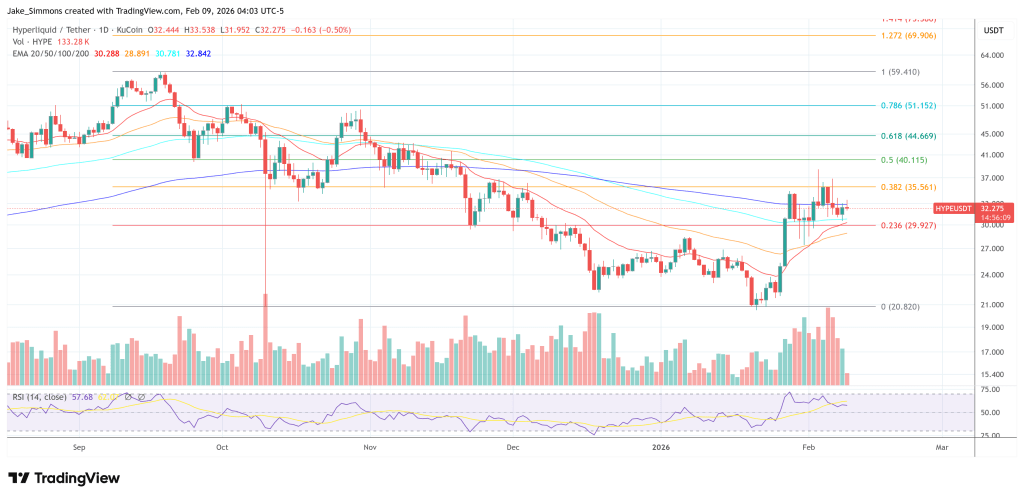
HYPE must break the 0.382 Fib, 1-week chart | Source: HYPEUSDT on TradingView.com

Perguntas relacionadas

QWhat is the specific bet that Arthur Hayes made regarding Hyperliquid (HYPE)?

AArthur Hayes bet $100,000 that from February 10, 2026, to July 31, 2026, the price of HYPE will outperform any other cryptocurrency with a market cap over $1 billion in USD terms. The loser will donate the money to a charity of the winner's choice.

QWho is the target of Arthur Hayes's bet and what was their criticism of Hyperliquid?

AThe bet is directed at Kyle Samani, co-founder of Multicoin Capital. Samani criticized Hyperliquid, calling it 'in most respects everything wrong with crypto,' citing that its founder fled his home country, it openly facilitates crime and terror, and that it is closed source and permissioned.

QWhat is HIP-3 and why is it significant for Hyperliquid's growth narrative?

AHIP-3 is Hyperliquid's product line for non-crypto derivatives, specifically listing equity and commodity perpetuals. It is significant because it represents the platform's push into traditional finance (TradFi) instruments, aiming to provide 24/7, order-driven derivatives markets and attract activity outside of pure cryptocurrency flow.

QAccording to the analysis cited, how did Hyperliquid's silver perpetuals compare to CME/COMEX futures in terms of market performance?

AThe analysis found that pre-crash, Hyperliquid was competitive with a median spread of 2.4 basis points (bps) versus 3 bps on COMEX, and had median slippage of 0.5 bps. However, it had a significant capacity gap, with ~$230k within ±5 bps on Hyperliquid versus ~$13M on COMEX, which became more apparent during a violent selloff.

QWhat is the ultimate question that Arthur Hayes's bet reframes the debate into?

AThe bet reframes the debate from whether Hyperliquid is philosophically 'good' or 'bad' to whether its growth narrative—particularly its 24/7 access to non-crypto derivatives—will translate into its token (HYPE) outperforming other large-cap altcoins.

Leituras Relacionadas

Dalio Warns: AI Boom Shows Signs of a Bubble, Day of Reckoning Will Be the Time of Burst

Ray Dalio, founder of Bridgewater Associates, warns that the current artificial intelligence investment boom shows classic signs of a bubble, which he expects will eventually burst. In a Bloomberg Television interview, he noted that great technological revolutions often lead to capital inflows that create bubbles, making it difficult for investors and companies to calibrate their spending accurately—either overspending to capture market share or underspending and losing their competitive position. This caution comes amid significant rallies in AI-related assets, particularly chipmakers, driven by soaring demand for data centers and high-bandwidth chips, raising debates about overheating valuations. In contrast, Nvidia CEO Jensen Huang recently asserted that investors embracing the AI wave would see "crazy" returns and dismissed concerns over return on investment for data center spending as outdated. Dalio, however, focuses on the risks in the profit realization phase. He argues that bubbles tend to show signs of破裂 when markets transition from investment to the need for tangible returns, describing the burst as a process of converting paper wealth into cash. While acknowledging AI's intrinsic value, he expressed concern over the future profitability of some AI companies, suggesting the market is repeating a familiar pattern. The 76-year-old billionaire, who fully exited Bridgewater in 2025, has a net worth estimated at $21.5 billion according to the Bloomberg Billionaires Index.

marsbitHá 13m

Dalio Warns: AI Boom Shows Signs of a Bubble, Day of Reckoning Will Be the Time of Burst

marsbitHá 13m

Privacy Coin Crisis of Confidence! ZEC Plunges Over 56% in a Single Day

Zcash (ZEC), a leading privacy-focused cryptocurrency, experienced a severe crash on June 5th, plummeting over 56% in a single day and erasing nearly two months of gains. The flash crash was triggered by the disclosure of a critical zero-knowledge proof vulnerability within Zcash's Orchard privacy pool, which had existed since the pool's launch in May 2022. The flaw theoretically allowed an attacker to forge unlimited ZEC undetectably due to the pool's privacy features. The vulnerability was discovered on May 29th by independent security researcher Taylor Hornby during a proactive audit commissioned by Shielded Labs, utilizing AI-assisted analysis. The Zcash development team responded swiftly, implementing an emergency soft fork to disable Orchard transactions on June 2nd and executing a permanent hard fork fix (NU6.2) on June 3rd. Despite the technical fix, a major crisis of confidence emerged. The core issue is that Orchard's privacy design makes it cryptographically impossible to prove whether the vulnerability was exploited over the past four years, casting permanent doubt on the historical supply integrity of ZEC. While Shielded Labs argues exploitation was unlikely, the inability to provide definitive proof has severely damaged market trust. This sentiment was exacerbated when BitMEX co-founder Arthur Hayes, a prominent ZEC supporter, announced he was selling his entire position. He stated that privacy assets require "perfect security" rather than "probable safety." The combined effect of the disclosure and Hayes's exit ignited widespread panic selling, leading to massive liquidations and significant price decline. Analysts note the event highlights a fundamental tension within privacy coins: the conflict between verifiable supply and cryptographic privacy.

链捕手Há 16m

Privacy Coin Crisis of Confidence! ZEC Plunges Over 56% in a Single Day

链捕手Há 16m

Trading

Spot
Futuros
活动图片





