Arizona AG Alerts Seniors on ATM Scams: How LiquidChain ($LIQUID) Solves Security

bitcoinistPublicado em 2026-02-03Última atualização em 2026-02-03

Resumo

Arizona Attorney General Kris Mayes has issued a warning about a rise in cryptocurrency ATM scams targeting seniors, where fraudsters pose as officials and trick victims into depositing cash into Bitcoin kiosks. These scams exploit the irreversible nature of blockchain transactions and the complexity of current crypto infrastructure. LiquidChain ($LIQUID) is presented as a solution through its Layer 3 protocol, which unifies liquidity across Bitcoin, Ethereum, and Solana into a single execution environment. By eliminating the need for complex bridging and wrapped assets, it reduces transaction steps and potential points of failure. The platform aims to enhance security and usability, offering simplified cross-chain interactions and verifiable settlement. Its architecture is designed to lower fraud risks by streamlining user experience and providing a more transparent, secure DeFi environment.

The warnings from Arizona are becoming increasingly urgent.

Attorney General Kris Mayes issued a stark alert regarding a surge in cryptocurrency ATM scams targeting older adults, a predatory trend that exploits the irreversible nature of blockchain transactions.

According to the AG’s Office, scammers are posing as government officials or tech support agents. They then direct victims to deposit cash into physical Bitcoin kiosks under the guise of ‘protecting’ their savings.

It exposes a critical vulnerability in the current crypto on-ramp infrastructure: the lack of safety guardrails for non-technical users. Once cash is fed into a kiosk and converted to crypto in a scammer’s wallet, the funds are effectively gone.

The technological barrier to entry, combined with high-pressure social engineering, creates a perfect storm for fraud. While state regulators launch reporting tools and public awareness campaigns, the deeper issue lies in the complexity of the current blockchain landscape.

When users are forced to navigate confusing interfaces and fragmented networks, security risks compound. The solution might not just be better education, but better underlying infrastructure that simplifies execution.

That’s the precise operational gap LiquidChain ($LIQUID) aims to fill by rethinking how liquidity moves across the blockchain ecosystem.

Fragmented Liquidity Creates Vectors For Exploitation

The scams plaguing Arizona seniors often rely on the opacity of moving funds between different silos. Frankly, the current DeFi landscape is a mess. Liquidity is fragmented across Bitcoin, Ethereum, and Solana. Jumping between these chains usually requires complex bridging, wrapped assets, and multiple transaction steps.

Each step introduces friction and a potential point of failure where malicious actors can confuse users.

LiquidChain ($LIQUID) tackles this fundamental flaw by functioning as a Layer 3 (L3) infrastructure that fuses Bitcoin, Ethereum, and Solana liquidity into a single execution environment. By creating a Unified Liquidity Layer, the protocol eliminates the need for risky wrapped assets or convoluted bridge transfers.
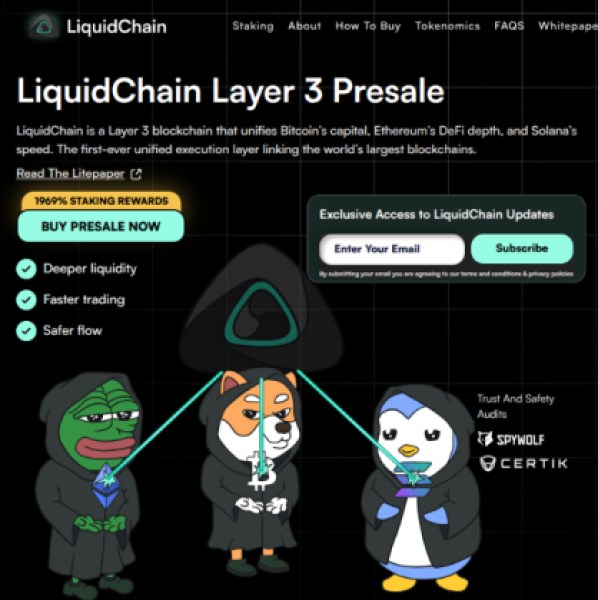
Source: LiquidChain

For a user or developer, this means Single-Step Execution. The data suggests that reducing the number of ‘hops’ a transaction must take drastically lowers the surface area for errors.

The project’s ‘Deploy-Once Architecture’ allows developers to build applications accessing users and liquidity from all three major chains simultaneously. Instead of a disjointed system where funds can easily disappear into the ether of a complex bridge, LiquidChain offers a cohesive environment.

This consolidation is critical. By streamlining the user flow, the protocol removes the technical obfuscation that scammers often hide behind.

EXPLORE THE LIQUIDCHAIN ECOSYSTEM.

LiquidChain L3 Protocol Enhances Verifiable Settlement

Beyond simplification, the core security proposition of LiquidChain lies in its status as a Layer 3 protocol. Layer 1s (like Bitcoin) provide security, and Layer 2s handle scaling. But L3s? That’s where the magic happens, application-specific layers where custom logic and verifiable settlement occur.

The project utilizes a Cross-Chain VM (Virtual Machine) designed to handle the intricacies of multi-chain settlement without forcing the user to manage distinct wallets for every network.

This infrastructure is powered by the $LIQUID token, which serves as the primary transaction fuel for the network. Unlike legacy systems, where value transfer is opaque, the LiquidChain model emphasizes verifiable settlement.

For institutional participants (and savvy retail traders), this transparency is non-negotiable. The protocol also introduces Liquidity Staking, incentivizing users to secure the network while earning rewards, creating a deeper economic alignment between network security and user participation.

We’re seeing a clear shift in the market away from ‘wild west’ infrastructure toward compliant, transparent execution layers.

With Developer Grants available to encourage secure application building, the ecosystem is positioning itself as a hub for the next generation of safe, cross-chain DeFi. If you’re watching the infrastructure thesis, $LIQUID represents a bet on the convergence of major chains into a safer, more usable whole.

VISIT THE OFFICIAL LIQUIDCHAIN ($LIQUID) PRESALE SITE.

This article is for informational purposes only and does not constitute financial advice. Cryptocurrency investments, including presales and new protocols like LiquidChain, carry significant market risk and volatility. Always conduct independent research.


Perguntas relacionadas

QWhat is the main warning issued by Arizona Attorney General Kris Mayes regarding cryptocurrency?

AArizona Attorney General Kris Mayes issued a warning about a surge in cryptocurrency ATM scams targeting older adults, where scammers pose as government officials or tech support to trick victims into depositing cash into Bitcoin kiosks.

QHow does LiquidChain ($LIQUID) aim to address security vulnerabilities in the current crypto infrastructure?

ALiquidChain ($LIQUID) addresses security vulnerabilities by functioning as a Layer 3 infrastructure that unifies liquidity from Bitcoin, Ethereum, and Solana into a single execution environment, eliminating the need for risky wrapped assets or complex bridge transfers and reducing points of failure.

QWhat is the 'Deploy-Once Architecture' mentioned in the context of LiquidChain?

AThe 'Deploy-Once Architecture' allows developers to build applications that can access users and liquidity from Bitcoin, Ethereum, and Solana simultaneously, creating a cohesive environment instead of a fragmented system.

QWhat role does the $LIQUID token play in the LiquidChain ecosystem?

AThe $LIQUID token serves as the primary transaction fuel for the LiquidChain network, powering its cross-chain virtual machine and enabling verifiable settlement, while also supporting liquidity staking to incentivize network security.

QHow does LiquidChain's approach reduce the risk of scams like those targeting seniors in Arizona?

ALiquidChain reduces scam risks by streamlining user flow through single-step execution and a unified liquidity layer, which removes technical obfuscation and complex transaction steps that scammers often exploit to confuse users.

Leituras Relacionadas

The Verdict in Choi Tae-won's Divorce Case: Revealing the Inheritance Undercurrent Behind SK Hynix's Trillion-Won Empire

SK Group Chairman Chey Tae-won's high-profile divorce case, involving a record 1.38 trillion won settlement, has drawn attention to the succession plans for Korea's second-largest conglomerate, especially its crown jewel, SK hynix. Unlike traditional chaebol scripts centered on the eldest son, Chey's three children from his marriage to former President Roh Tae-woo's daughter, Roh Soh-yeong, are carving distinct, non-traditional paths. Eldest daughter Chey Yun-jung (b. 1989) is seen as the most evident successor. With a scientific and consulting background, she holds executive roles at SK bioscience and SK Inc.'s growth support department, focusing on future strategy and biopharma. Her marriage is to an AI infrastructure entrepreneur, not a traditional business alliance. Second daughter Chey Min-jung (b. 1991) took a unique route, voluntarily serving as a South Korean naval officer, including an anti-piracy deployment. She later worked on policy and strategy for SK hynix in Washington D.C. before co-founding an AI-driven healthcare startup. She married a former U.S. Marine Corps officer, connecting her to U.S. defense and policy circles—networks crucial for a global semiconductor giant. The only son, Chey In-geun (b. 1995), who studied physics like his father, worked briefly at SK E&S before joining McKinsey. Despite fitting the traditional "heir" profile as the eldest son, he remains silent and holds no public position or shares in SK, suggesting the old succession playbook is obsolete. As SK hynix's valuation soars, becoming a geopolitical asset in the AI era, the heirs' legitimacy is no longer automatic. They must prove themselves in fields like AI biotech, global policy, and strategic consulting. Their marriages also reflect new elite networks in tech and defense, not old political alliances. Their inheritance is the complex challenge of navigating a globalized, tech-driven world, not just a corporate throne.

marsbitHá 10h

The Verdict in Choi Tae-won's Divorce Case: Revealing the Inheritance Undercurrent Behind SK Hynix's Trillion-Won Empire

marsbitHá 10h

From OpenSea to OpenRouter: Is Alex Atallah Repeating His 'Exit at the Peak' Playbook?

From OpenSea to OpenRouter: Is Alex Atallah Repeating His "Exit at the Peak" Playbook? According to the Wall Street Journal, payments giant Stripe is in talks to acquire the AI model aggregation platform OpenRouter in a potential deal valuing the company near $100 billion. This would mark founder Alex Atallah's second creation of a company reaching a $100 billion valuation, following his co-founding of NFT marketplace OpenSea. OpenRouter, founded just over three years ago, has grown rapidly by acting as a unified gateway for developers to access over 400 AI models. It currently has about 10 million users and processes over 200 trillion tokens monthly. While the platform's annualized revenue is around $50 million, its valuation has skyrocketed from $1.3 billion in March 2026. The potential acquisition by Stripe, a company OpenRouter's founder once likened it to, represents a major expansion into AI infrastructure for the payments leader. This move echoes Atallah's previous timing with OpenSea, where he departed before the NFT market's significant downturn. For OpenRouter, selling now may be strategic. Despite its scale, its business model—charging a 5-5.5% fee on AI inference calls—faces pressure from competition, open-source models, and potential price wars among model providers, limiting its profitability narrative for an IPO. A key asset for potential acquirers like Stripe is OpenRouter's vast repository of real-world AI usage data, which offers unique insights into model performance and developer preferences that are difficult to replicate. Whether this potential deal signifies a new valuation benchmark for AI infrastructure or another market peak signal remains to be seen.

链捕手Há 10h

From OpenSea to OpenRouter: Is Alex Atallah Repeating His 'Exit at the Peak' Playbook?

链捕手Há 10h

Trading

Spot
活动图片




