Arizona AG Alerts Seniors on ATM Scams: How LiquidChain ($LIQUID) Solves Security

bitcoinistPublicado em 2026-02-03Última atualização em 2026-02-03

Resumo

Arizona Attorney General Kris Mayes has issued a warning about a rise in cryptocurrency ATM scams targeting seniors, where fraudsters pose as officials and trick victims into depositing cash into Bitcoin kiosks. These scams exploit the irreversible nature of blockchain transactions and the complexity of current crypto infrastructure. LiquidChain ($LIQUID) is presented as a solution through its Layer 3 protocol, which unifies liquidity across Bitcoin, Ethereum, and Solana into a single execution environment. By eliminating the need for complex bridging and wrapped assets, it reduces transaction steps and potential points of failure. The platform aims to enhance security and usability, offering simplified cross-chain interactions and verifiable settlement. Its architecture is designed to lower fraud risks by streamlining user experience and providing a more transparent, secure DeFi environment.

The warnings from Arizona are becoming increasingly urgent.

Attorney General Kris Mayes issued a stark alert regarding a surge in cryptocurrency ATM scams targeting older adults, a predatory trend that exploits the irreversible nature of blockchain transactions.

According to the AG’s Office, scammers are posing as government officials or tech support agents. They then direct victims to deposit cash into physical Bitcoin kiosks under the guise of ‘protecting’ their savings.

It exposes a critical vulnerability in the current crypto on-ramp infrastructure: the lack of safety guardrails for non-technical users. Once cash is fed into a kiosk and converted to crypto in a scammer’s wallet, the funds are effectively gone.

The technological barrier to entry, combined with high-pressure social engineering, creates a perfect storm for fraud. While state regulators launch reporting tools and public awareness campaigns, the deeper issue lies in the complexity of the current blockchain landscape.

When users are forced to navigate confusing interfaces and fragmented networks, security risks compound. The solution might not just be better education, but better underlying infrastructure that simplifies execution.

That’s the precise operational gap LiquidChain ($LIQUID) aims to fill by rethinking how liquidity moves across the blockchain ecosystem.

Fragmented Liquidity Creates Vectors For Exploitation

The scams plaguing Arizona seniors often rely on the opacity of moving funds between different silos. Frankly, the current DeFi landscape is a mess. Liquidity is fragmented across Bitcoin, Ethereum, and Solana. Jumping between these chains usually requires complex bridging, wrapped assets, and multiple transaction steps.

Each step introduces friction and a potential point of failure where malicious actors can confuse users.

LiquidChain ($LIQUID) tackles this fundamental flaw by functioning as a Layer 3 (L3) infrastructure that fuses Bitcoin, Ethereum, and Solana liquidity into a single execution environment. By creating a Unified Liquidity Layer, the protocol eliminates the need for risky wrapped assets or convoluted bridge transfers.
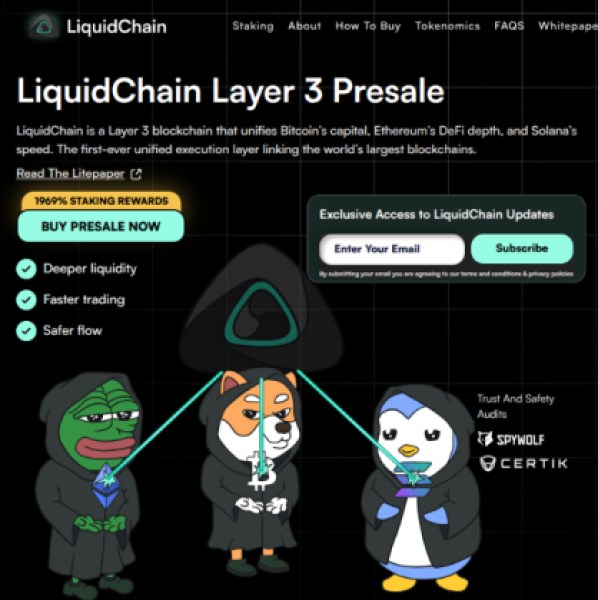
Source: LiquidChain

For a user or developer, this means Single-Step Execution. The data suggests that reducing the number of ‘hops’ a transaction must take drastically lowers the surface area for errors.

The project’s ‘Deploy-Once Architecture’ allows developers to build applications accessing users and liquidity from all three major chains simultaneously. Instead of a disjointed system where funds can easily disappear into the ether of a complex bridge, LiquidChain offers a cohesive environment.

This consolidation is critical. By streamlining the user flow, the protocol removes the technical obfuscation that scammers often hide behind.

EXPLORE THE LIQUIDCHAIN ECOSYSTEM.

LiquidChain L3 Protocol Enhances Verifiable Settlement

Beyond simplification, the core security proposition of LiquidChain lies in its status as a Layer 3 protocol. Layer 1s (like Bitcoin) provide security, and Layer 2s handle scaling. But L3s? That’s where the magic happens, application-specific layers where custom logic and verifiable settlement occur.

The project utilizes a Cross-Chain VM (Virtual Machine) designed to handle the intricacies of multi-chain settlement without forcing the user to manage distinct wallets for every network.

This infrastructure is powered by the $LIQUID token, which serves as the primary transaction fuel for the network. Unlike legacy systems, where value transfer is opaque, the LiquidChain model emphasizes verifiable settlement.

For institutional participants (and savvy retail traders), this transparency is non-negotiable. The protocol also introduces Liquidity Staking, incentivizing users to secure the network while earning rewards, creating a deeper economic alignment between network security and user participation.

We’re seeing a clear shift in the market away from ‘wild west’ infrastructure toward compliant, transparent execution layers.

With Developer Grants available to encourage secure application building, the ecosystem is positioning itself as a hub for the next generation of safe, cross-chain DeFi. If you’re watching the infrastructure thesis, $LIQUID represents a bet on the convergence of major chains into a safer, more usable whole.

VISIT THE OFFICIAL LIQUIDCHAIN ($LIQUID) PRESALE SITE.

This article is for informational purposes only and does not constitute financial advice. Cryptocurrency investments, including presales and new protocols like LiquidChain, carry significant market risk and volatility. Always conduct independent research.


Perguntas relacionadas

QWhat is the main warning issued by Arizona Attorney General Kris Mayes regarding cryptocurrency?

AArizona Attorney General Kris Mayes issued a warning about a surge in cryptocurrency ATM scams targeting older adults, where scammers pose as government officials or tech support to trick victims into depositing cash into Bitcoin kiosks.

QHow does LiquidChain ($LIQUID) aim to address security vulnerabilities in the current crypto infrastructure?

ALiquidChain ($LIQUID) addresses security vulnerabilities by functioning as a Layer 3 infrastructure that unifies liquidity from Bitcoin, Ethereum, and Solana into a single execution environment, eliminating the need for risky wrapped assets or complex bridge transfers and reducing points of failure.

QWhat is the 'Deploy-Once Architecture' mentioned in the context of LiquidChain?

AThe 'Deploy-Once Architecture' allows developers to build applications that can access users and liquidity from Bitcoin, Ethereum, and Solana simultaneously, creating a cohesive environment instead of a fragmented system.

QWhat role does the $LIQUID token play in the LiquidChain ecosystem?

AThe $LIQUID token serves as the primary transaction fuel for the LiquidChain network, powering its cross-chain virtual machine and enabling verifiable settlement, while also supporting liquidity staking to incentivize network security.

QHow does LiquidChain's approach reduce the risk of scams like those targeting seniors in Arizona?

ALiquidChain reduces scam risks by streamlining user flow through single-step execution and a unified liquidity layer, which removes technical obfuscation and complex transaction steps that scammers often exploit to confuse users.

Leituras Relacionadas

What Happens to Ethereum Developer Tools After the Grants Run Out?

On February 27th, the Ethereum Foundation (EF) announced Project Odin, a structured sustainability support program designed for a select group of strategic, previously grant-funded teams. Unlike a standard grant, Odin offers a long-term advisory mechanism focused on helping these teams establish credible, sustainable paths within a two-year framework, thereby reducing long-term dependence on single funding sources. The program addresses a critical post-grant challenge: how essential public goods, especially major developer tools, can achieve financial sustainability beyond initial funding. While grants from EF and programs like Gitcoin or RetroPGF remain vital for startups and research, they often fall short for mature, widely-used infrastructure. Tools like compilers, languages, and network stacks are deeply embedded but struggle with monetization, trapped between being too foundational to lose and too public to generate natural revenue. Project Odin provides teams with a dedicated Strategic Advisor to guide them through a three-phase process: 1) analyzing current funding and realistic options, 2) validating potential paths with stakeholders, and 3) executing plans, which may include crafting support contracts, service agreements, or other recurring revenue models. The first pilot participant is Vyper, a critical smart contract language for the EVM, highlighting the need for sustainable models for core infrastructure. The initiative reframes the public goods conversation from "who should be funded" to "how do already-proven teams avoid perpetual funding crises?" It encourages ecosystem participants—protocols and projects that depend on these tools—to view sustainable support not just as charity, but as essential risk management for their own operational supply chains.

marsbitHá 20m

What Happens to Ethereum Developer Tools After the Grants Run Out?

marsbitHá 20m

MARA Reports Q1 Revenue Below Expectations, Net Loss of $1.3 Billion, Stock Plunges After Hours

Bitcoin mining firm MARA Holdings reported disappointing Q1 2024 results, causing its stock to erase all daily gains and fall 3.44% in after-hours trading. Revenue dropped 18% year-over-year to $174.6 million, missing Wall Street estimates of $192.7 million. The company posted a net loss of $1.3 billion, a significant increase from a $533.4 million loss a year ago, primarily driven by unrealized losses on its holdings of 38,689 Bitcoin, which depreciated in value during the quarter. MARA also sold over 15,100 BTC in late March to repurchase debt at a discount. The broader mining environment remains challenging due to a 35% decline in Bitcoin's price from its all-time high and a nearly 30% increase in mining difficulty over the past year. MARA's market cap ranking among U.S. miners has slipped to seventh. Critically, the company announced a strategic pivot away from Bitcoin mining expansion. It stated it has no plans to purchase new mining equipment and is fully transitioning toward AI data centers. Its strategy involves retrofitting existing mining sites for AI and high-performance computing (HPC) and leveraging its recent $1.5 billion acquisition of Long Ridge Energy & Power, a gas-fired power plant and data center. This infrastructure could eventually support 600 MW of AI compute capacity, allowing MARA to redeploy up to 90% of its non-custodial mining power for AI and IT workloads.

marsbitHá 20m

MARA Reports Q1 Revenue Below Expectations, Net Loss of $1.3 Billion, Stock Plunges After Hours

marsbitHá 20m

The AI Investment Landscape Is Being Reshaped: Beyond the 'Magnificent Seven', What Opportunities Lie in the Semiconductor Supply Chain?

AI Investment Map is Reshaping: Opportunities Beyond the 'Magnificent Seven' Since ChatGPT ignited the AI wave, investment initially focused on the "Magnificent Seven" tech giants dominating cloud infrastructure. However, the rise of DeepSeek and debates on AI capital expenditure effectiveness are shifting this dynamic. Investors now recognize opportunities deeper in the supply chain—the companies providing the essential "picks and shovels." Early concerns about an AI investment "arms race" and potential low returns were partly alleviated by strong Q1 earnings from cloud providers, validating robust compute demand. This has highlighted a more certain investment thesis: regardless of which AI applications ultimately win, massive capital expenditure will first fuel demand for semiconductors and related components. This "pick-and-shovel" logic has driven semiconductor ETFs to record highs. Key beneficiaries include: * **Memory Chipmakers (e.g., SK Hynix, Samsung, Micron)**: High Bandwidth Memory (HBM) is a critical bottleneck for AI training. * **Photonics Companies**: Crucial for high-speed data transfer within AI data centers. * **The Broader "AI-11" Semiconductor Ecosystem**: This encompasses foundries & lithography (TSMC, ASML), logic & custom chips (AMD, Broadcom, Intel, Marvell), and enterprise storage (SanDisk, Western Digital). Every dollar of AI infrastructure spending flows through this chain. While the "Magnificent Seven" remain dominant in market size, their earnings growth premium over the rest of the S&P 500 ("S&P 493") is narrowing. Market attention and marginal investment are shifting towards the expanding semiconductor supply chain. The investment narrative is evolving from "betting on the ultimate AI winner" to "investing in the certainty of the infrastructure build-out." Understanding this shift from the demand side to the supply side is key to identifying future AI investment opportunities.

marsbitHá 49m

The AI Investment Landscape Is Being Reshaped: Beyond the 'Magnificent Seven', What Opportunities Lie in the Semiconductor Supply Chain?

marsbitHá 49m

Trading

Spot
Futuros
活动图片




