Argentina court orders nationwide block of Polymarket over gambling

cointelegraphPublicado em 2026-03-17Última atualização em 2026-03-17

Resumo

An Argentine court has ordered a nationwide block of the crypto-based prediction market platform Polymarket, citing unauthorized gambling operations. The ruling, issued by a Buenos Aires court on March 11, instructed the national communications regulator ENACOM to restrict access to the platform and its variants across the country. The investigation was initiated following a complaint by the Buenos Aires City Lottery (LOTBA), which raised concerns over insufficient identity and age verification, potentially allowing minors to gamble. The court also directed Apple and Google to remove Polymarket’s mobile apps in Argentina. This action follows earlier scrutiny of the platform, particularly regarding its inflation prediction markets, which closely mirrored official data and sparked insider trading concerns. Similar restrictions have been implemented in other countries, including Colombia in Latin America.

A court in Argentina has ordered a nationwide block of major crypto-based prediction market platform Polymarket over unauthorized gambling.

Argentina’s national communications and media regulator, Ente Nacional de Comunicaciones (ENACOM), received a court order to block access to Polymarket website and its variants across the country, according to a ruling dated March 11.

The order was issued by the Buenos Aires Court of First Instance in Criminal, Contravention and Minor Offenses No. 31, which is investigating Polymarket under Argentina’s Criminal Code for allegedly offering gambling services without authorization.

The judge asked ENACOM to carry out the measure either directly or through internet service providers (ISPs) and to promptly inform the court or the specialized gambling prosecutor’s office if technical or other obstacles prevent full compliance.

Buenos Aires regulator initiated the case

According to local media reports, the case was brought by the Buenos Aires City Lottery (LOTBA), the state-owned company that regulates gambling activities in the city.

After receiving a complaint from LOTBA about Polymarket’s alleged operation without authorization, prosecutor Juan Rozas, in charge of the City’s Specialized Gaming Prosecutor’s Office (FEJA), opened the investigation that led to the court order.

Authorities argued that Polymarket allowed users to place bets without sufficient identity and age verification, raising concerns that minors could access the platform.

“In practice, this meant that anyone — including children and adolescents — could access and start betting without any control,” the authorities reportedly said.

Inflation bets deepen scrutiny

In addition to instructing ENACOM to block access to Polymarket, the court reportedly ordered Google and Apple to remove and restrict the platform’s mobile applications on Android and iOS throughout Argentina, including for existing users.

Social media reports indicate users are discussing workarounds such as VPNs, while observers note that the order comes from a Buenos Aires city court rather than the national government.
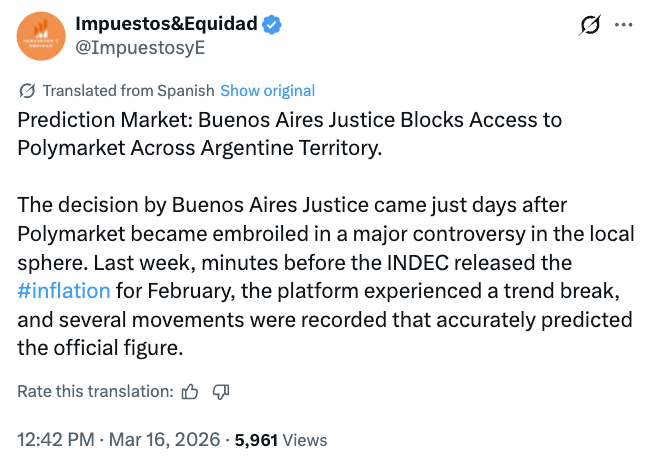
Source: ImpuestosyE (translated by Grok)

The action adds to earlier Polymarket’s scrutiny after its inflation-related prediction markets closely mirrored official data from Argentina’s statistics agency, reigniting controversy over potential insider trading, according to local reports.

Polymarket did not immediately respond to a request for comment from Cointelegraph.

Related: CFTC chair backs blockchain-based prediction markets as ‘truth machines’

Argentina’s action is the latest example of moves against prediction markets globally, with countries including the Netherlands, Hungary, Portugal and Ukraine taking similar steps to restrict access.

In Latin America, Colombia was among the first to take action, with its gambling regulator reportedly warning about Polymarket’s unauthorized operations in September 2025.

Magazine: How crypto laws changed in 2025 — and how they’ll change in 2026

Perguntas relacionadas

QWhy did the Argentina court order a nationwide block of Polymarket?

AThe court ordered the block because Polymarket was allegedly offering unauthorized gambling services, violating Argentina's Criminal Code.

QWhich regulatory body in Argentina is responsible for implementing the block on Polymarket?

AEnte Nacional de Comunicaciones (ENACOM), the national communications and media regulator, is responsible for implementing the block.

QWhat concerns did authorities raise about Polymarket's operations that led to the investigation?

AAuthorities were concerned that Polymarket allowed users to bet without proper identity and age verification, potentially enabling minors to access the platform.

QBesides blocking the website, what additional actions did the court order against Polymarket?

AThe court also ordered Google and Apple to remove and restrict Polymarket's mobile applications on Android and iOS throughout Argentina.

QWhich other countries have taken similar actions to restrict prediction markets like Polymarket?

ACountries including the Netherlands, Hungary, Portugal, Ukraine, and Colombia have taken similar steps to restrict access to such prediction markets.

Leituras Relacionadas

72-Hour Countdown: Can the CLARITY Act Pass 'Miracleously' Before the Senate Recess?

"CLARITY Act Faces 72-Hour Deadline as Senate Recess Looms The U.S. Senate has released its schedule for the week, omitting the crucial CLARITY Act and instead prioritizing another resolution for a procedural vote. With the Senate set to recess on August 7th, the bill now has only about 72 hours to advance. Senate procedural hurdles are steep. First, a cloture petition requires signatures from 16 Senators. Second, a vote requires 60 votes, meaning the Republican's 53 votes need at least 7 Democratic supporters—a key sticking point that has stalled the bill for two months. If passed, a further 30 hours of debate is required before a vote to proceed to consideration. If 16 signatures are not secured by Wednesday, the bill won't even face a vote. Even if filed Wednesday, the earliest vote would be Friday, leaving no time for actual consideration before recess. The major divide remains ethical provisions. The draft bans certain senior officials from issuing or sponsoring digital assets until 2029, but Democrats argue enforcement loopholes are too large, failing to constrain existing holdings and family arrangements. The White House has not formally responded to the revised draft. The Trump family's substantial crypto profits have further eroded Democratic trust. Stablecoin rewards remain contentious. Banks liken them to deposit interest, fearing capital flight, while crypto firms see them as anti-competitive protection for banks. A current compromise bans passive interest but allows rewards for trading, staking, and platform activity. Polymarket data shows the bill's probability of passing by 2026 has fallen to 31%, down 7 points in a week. Betting volume is around $3.7 million. Analyst Bernstein warns failure to advance the bill could trigger a 'bad news' sell-off, pressuring Bitcoin and crypto valuations. Industry advocates, including Grayscale and Treasury Secretary (presumably Yellen, though 'Besant' appears in text), have urged swift action with thousands of contacts to Congress, but progress remains slow. If missed this week, the bill delays until September, where a busier schedule and approaching midterms complicate passage. Democrats suggest a procedural vote this week could keep hope alive for September, but that hope is fading hourly. Market sentiment appears resigned to delay, though a surprise passage could trigger a significant positive reaction. The bill's arduous journey underscores its potential impact on the industry."

marsbitMesmo agora

72-Hour Countdown: Can the CLARITY Act Pass 'Miracleously' Before the Senate Recess?

marsbitMesmo agora

George Santos Settles Dispute with Commodity Futures Trading Commission (CFTC) Over Trading on His Own Kalshi Market

Former U.S. Representative George Santos has settled with the Commodity Futures Trading Commission (CFTC) over allegations he manipulated a futures contract on the Kalshi prediction market related to his potential attendance at a presidential State of the Union address. According to a July 31 order, Santos must repay $17,569.98, pay a $17,500 civil penalty, and is barred from trading on any CFTC-registered exchange for three years. The CFTC found that Santos made misleading public statements about his plans to attend the event while trading on the outcome. He first built a profitable position betting he would attend, then reversed course and profited by betting against his own attendance after travel disruptions. Santos earned profits totaling over $17,000 from these trades. Santos agreed to the settlement without admitting to the findings. His attorney stated Santos initially intended to attend but changed plans due to winter weather, denying any intent to mislead traders or manipulate the market. Kalshi detected the suspicious activity, froze his account, and provided evidence to the CFTC. The exchange is considering further actions and potential restitution for affected traders. While Kalshi also referred the matter to the Justice Department, a spokesperson has denied an investigation exists. The CFTC settlement remains the only confirmed federal action regarding these trades.

cryptonews.ruHá 6m

George Santos Settles Dispute with Commodity Futures Trading Commission (CFTC) Over Trading on His Own Kalshi Market

cryptonews.ruHá 6m

Trading

Spot
活动图片