Anthropic Removes Claude Code from Pro Plan, Developer Community Erupts, OpenAI Seizes the Opportunity to Strike

marsbitPublicado em 2026-04-22Última atualização em 2026-04-22

Resumo

Anthropic has removed its coding agent, Claude Code, from the $20/month Pro plan, triggering strong backlash from the developer community. The change was reflected in updated pricing pages and documentation, which now state that Claude Code is only available to Max plan subscribers, starting at $100/month. Anthropic’s growth lead, Amol Avasare, described the move as a "small-scale test" affecting only 2% of new users, but the broad updates to public documentation contradicted this claim. He later acknowledged that rising computational costs due to increased usage made the previous pricing structure unsustainable. Developers expressed frustration on platforms like Hacker News, Reddit, and GitHub, with some calling it a reason to switch to local or open-source models like Llama or Mistral. In response, OpenAI quickly emphasized that its competing product, Codex, remains available in both free and $20/month Plus plans, and reaffirmed its commitment to transparent communication with users. Google’s Gemini CLI remains free, adding further competitive pressure. The incident highlights growing tension between AI service affordability and the high compute costs of advanced coding assistants.

Author: Claude, Deep Tide TechFlow

Deep Tide Guide: On April 21, Anthropic quietly removed its programming agent Claude Code from the $20/month Pro plan, with related pricing pages and help documents updated simultaneously. Although Growth Lead Amol Avasare claimed this was only a "small-scale test" targeting about 2% of new users, the site-wide documentation has been completely rewritten to state "Max plan only," sparking a massive backlash in the developer community. OpenAI promptly publicly stated that Codex will remain in the free and Plus plans, while the local model camp called this incident "the best time to switch to self-hosting."
Anthropic is testing developers' price tolerance limits, at the possible cost of user trust.

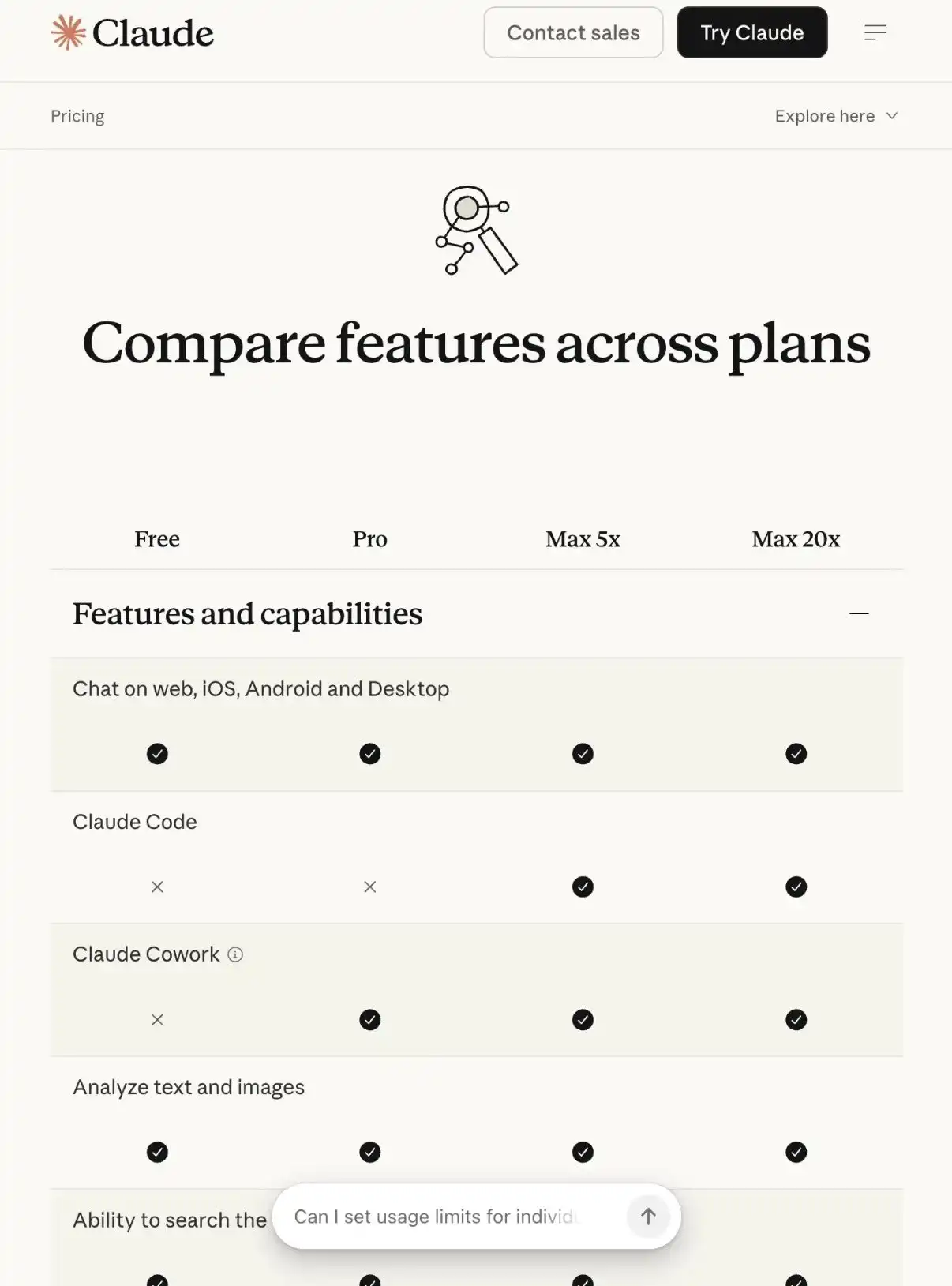
On April 21, some developers noticed significant changes on Anthropic's official pricing page: Claude Code was marked as unavailable (with an "X") in the feature comparison table for the Pro plan ($20/month), whereas the day before the page still stated that the Pro plan "includes Claude Code." Almost simultaneously, the wording in Anthropic's help documentation quietly changed from "Use Claude Code with your Pro or Max plan" to "Use Claude Code with your Max plan."

AI industry observer Ed Zitron first sounded the alarm on the Bluesky platform, and the news quickly sparked discussions on Hacker News, Reddit r/LocalLLaMA, and X platform.

Official Statement Calls it a "Small-Scale Test," but Documentation is Fully Rewritten

Facing the developer community's intense reaction, Anthropic Growth Lead Amol Avasare responded that day on the X platform, stating this was only a small-scale test targeting about 2% of newly registered users, and existing Pro and Max subscribers would not be affected.

However, multiple media outlets pointed out that Avasare's statement contradicted the actual situation: the feature comparison matrix on the pricing page had been updated site-wide, and the help documentation had also been modified simultaneously. These changes were visible to all visitors and did not resemble a灰度 test for 2% of users. According to The Register, as of publication time, an Anthropic spokesperson had not responded further to this contradiction.

In subsequent tweets, Avasare explained the logic behind the adjustment: when the Max plan was launched a year ago, Claude Code was not bundled with it, Cowork did not exist, and asynchronous agents running for hours were not yet the norm. Since then, Claude Code usage has surged significantly post-Opus 4, and user usage patterns have fundamentally changed. He admitted, "Usage per subscriber has increased substantially, and our current plan structure was not designed for this."

This statement actually revealed a key point: providing Claude Code access for a $20 monthly fee has become unsustainable in terms of computing costs. According to industry analysis, each Claude Code programming session consumes far more tokens than regular chat, and the computational cost of long programming sessions could be several times the subscription fee.

From $20 to $100, Developers Pushed to a Decision Point

If this change is ultimately implemented permanently, Pro users who wish to continue using Claude Code would need to upgrade to the Max 5x plan starting at $100/month, or the Max 20x plan at $200/month. The price has increased fivefold.

Developers reacted quickly and strongly. A GitHub issue titled "Breaking Change: Claude Code CLI Removed from Pro Plan Without Notice" appeared within hours.

A related post on Hacker News received over 100 upvotes and more than 40 comments in less than an hour. One user's experience was representative: he started with the $20 Pro plan in January, upgraded to $200 due to frequently hitting usage limits, downgraded to $100 due to quality drops in Claude Opus 4.6, and recently downgraded back to $20 because he was satisfied with OpenAI Codex's performance on GPT-5.4. "I went from the most enthusiastic recommender to my current state," he wrote.

The reaction on the Reddit r/LocalLLaMA community was more direct. A post titled "Anthropic removes Claude Code from Pro plan, users call it 'the best time to switch to local models'" received extensive discussion, focusing on the progress made by open-source models like Meta's Llama series, Mistral, and DeepSeek in programming capabilities over the past year, as well as the maturity of local deployment tools like Ollama and LM Studio.

OpenAI Quickly Strikes, Codex Remains in Free and Plus Plans

Competitors did not miss this window.

From OpenAI's side, an employee responsible for Codex-related work posted on the X platform: "I don't know what they're doing over there, but Codex will continue to be available in the free and Plus ($20) plans. We have the compute and efficient models to support it. For important changes, we communicate with the community in advance."
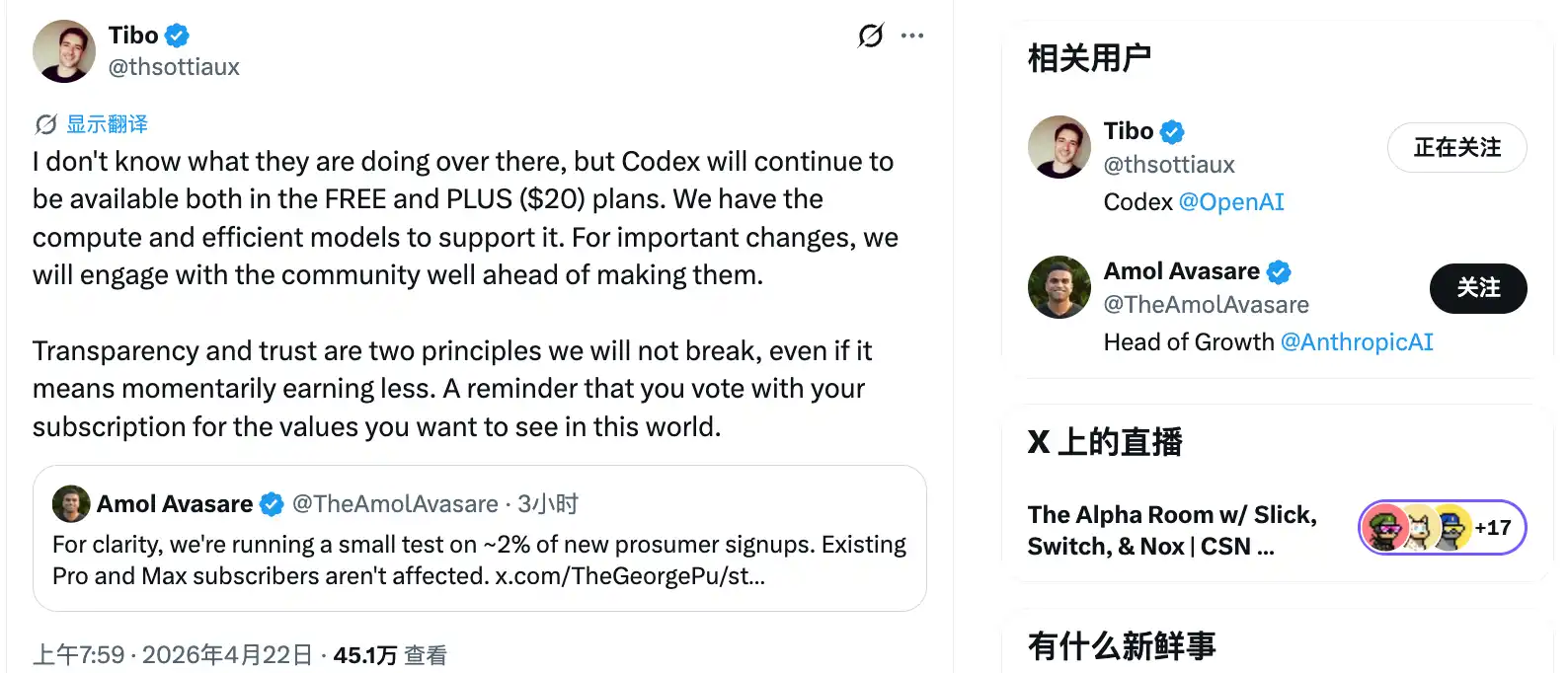
The timing and wording of this statement were highly targeted.

OpenAI's Codex, as the main competitor to Claude Code, is currently offered in the ChatGPT Plus ($20/month) plan with a usage limit of 30 to 150 messages every 5 hours, and also has basic access in the free plan. Additionally, weeks ago, OpenAI released a Codex plugin specifically designed for Claude Code users, allowing developers to directly call Codex for code review or task delegation within the Claude Code workflow.

Google is also active; Gemini CLI is currently completely free. According to The New Stack, Anthropic has recently been under pressure regarding computing supply. Not only did it remove Pro access to Claude Code, but it also previously cut off third-party client OpenClaw's access to Claude via subscription accounts. Platform stability issues and frequent outages have also provided opportunities for competitors.


Perguntas relacionadas

QWhat change did Anthropic make to its Pro plan regarding Claude Code, and when was it noticed?

AAnthropic removed Claude Code from its $20/month Pro plan on April 21, as noticed by developers who saw the pricing page updated to show Claude Code as unavailable for Pro users, whereas it was previously included.

QHow did Anthropic's growth head, Amol Avasare, explain the removal of Claude Code from the Pro plan?

AAmol Avasare claimed it was a 'small-scale test' affecting only about 2% of new sign-ups, stating that existing Pro and Max subscribers would not be impacted, and attributed the change to significantly increased usage and computational costs.

QWhat was the reaction from the developer community to Anthropic's change?

AThe developer community reacted strongly, with immediate backlash on platforms like Hacker News, Reddit, and X. Many expressed frustration, with some considering switching to local models or alternatives, and a GitHub issue was quickly created to highlight the abrupt change.

QHow did OpenAI respond to Anthropic's removal of Claude Code from the Pro plan?

AOpenAI swiftly responded by affirming that its Codex would remain available in both free and Plus ($20/month) plans, emphasizing their ability to support it with sufficient compute and efficient models, and criticizing Anthropic's lack of prior communication.

QWhat are the pricing implications for Pro users if they want to continue using Claude Code after this change?

AIf the change becomes permanent, Pro users would need to upgrade to the Max plan, which starts at $100/month for the 5x version or $200/month for the 20x version, effectively increasing the cost fivefold or more to access Claude Code.

Leituras Relacionadas

US Stocks Suffer Worst Plunge Since 2025: Three Triggers Ignite Tech Stock Valuation Reset

The US stock market experienced its most severe sell-off since the 2025 tariff crisis on June 5th, 2025. The Nasdaq Composite plummeted 4.18%, the S&P 500 fell 2.64%, and the Dow Jones dropped 695 points. The panic stemmed from three converging factors. First, Broadcom's earnings report ignited fears of a slowdown in AI growth. While its AI chip revenue surged 143% YoY to $10.8B, its Q3 AI revenue guidance of $16B fell short of the $17.2B consensus. This triggered a massive sector-wide sell-off, with the Philadelphia Semiconductor Index crashing 10.26% and semiconductor stocks losing roughly $1.3 trillion in market value in a single day. Second, a shockingly strong May jobs report crushed hopes for Federal Reserve rate cuts. Non-farm payrolls added 172,000 jobs, doubling expectations. This robust data, combined with persistently high oil prices above $92/barrel due to the ongoing Iran war and blockade of the Strait of Hormuz, drastically increased market expectations for a potential Fed rate hike instead of a cut. Higher interest rates compress the valuations of growth-heavy tech stocks. Third, the prolonged Iran conflict continues to fuel inflationary pressures, complicating the Fed's policy decisions and undermining the "inflation is tamed" narrative. Together, these events challenged the twin pillars of the market rally: the "limitless AI growth" story and expectations for imminent monetary easing. The sell-off spread globally, impacting Asian and European markets and cryptocurrencies. The article posits this is likely a severe "valuation repricing" rather than the end of the AI story. The underlying demand for AI remains strong, but investor expectations for growth speed and the prices they are willing to pay are being recalibrated. Key upcoming factors include the June FOMC meeting, future AI company earnings, and developments in the Iran conflict.

marsbitHá 2h

US Stocks Suffer Worst Plunge Since 2025: Three Triggers Ignite Tech Stock Valuation Reset

marsbitHá 2h

From Madison Square Garden to Kalshi: Prediction Markets Break into the NBA Finals

From Madison Square Garden to Kalshi: Prediction Markets Break into the NBA Finals Prediction markets are playing a significant role in the 2026 NBA Finals, particularly around the New York Knicks' unexpected 2-0 series lead. Platforms like Kalshi and Polymarket have seen massive trading volumes, exceeding hundreds of millions of dollars on championship and related markets. Their influence extends beyond online trading. Kalshi's official partnership with Madison Square Garden has given it prominent physical branding at the arena. Furthermore, local businesses like The Jeffrey bar are using prediction market contracts to hedge the risk of game-result-based promotions, turning potential losses into manageable costs—a concept similar to the famous "Mattress Mack" strategy from traditional sports betting. These markets differentiate themselves by offering a wider, more entertainment-focused range of "event contracts" beyond typical game outcomes, such as predicting celebrity attendance. They also have broader accessibility across the U.S. compared to age- and location-restricted traditional sportsbooks. However, their rapid integration into sports raises regulatory and ethical questions. The NBA is cautiously engaging, discussing integrity frameworks with regulators like the CFTC. While the league permits minor investments like Giannis Antetokounmpo's stake in Kalshi, it advocates for strict rules to prevent insider trading. Many fans express concern on platforms like Reddit, fearing that the close ties between prediction markets, the league, and players could compromise the game's integrity. The NBA Finals has thus become a high-stakes testing ground, showcasing prediction markets' commercial potential while challenging traditional boundaries between financial trading, entertainment, and gambling.

marsbitHá 4h

From Madison Square Garden to Kalshi: Prediction Markets Break into the NBA Finals

marsbitHá 4h

Recursive Self-Improvement AI Gains Traction, Google Pours Cold Water, While DeepSeek and Others Approach the Fringes

The term "recursive self-improvement" (RSI), where AI improves itself autonomously, is gaining momentum in the AI industry. Startups like Recursive Superintelligence and projects such as Andrej Karpathy's Auto-Research aim to create systems where AI designs, implements, and validates its own research, moving toward superintelligence. While Google CEO Sundar Pichai cautions that such exponential acceleration is not yet a reality, progress is evident. For instance, Anthropic reported its Claude Code writes nearly 100% of the team's code, though it still lacks true self-direction. Analysts frame RSI development in stages: "adequacy" (systems functioning without humans), "parity" (matching human research quality), and "supremacy" (exceeding human-AI collaboration). Reaching parity could trigger rapid, unpredictable advancement due to AI's continuous operation. In China, companies like DeepSeek and Baidu incorporate self-optimization techniques without explicitly branding them as RSI, focusing on algorithmic efficiency and reinforcement learning. However, challenges remain, including "model collapse" from training on AI-generated data and the immense computational and open-collaboration requirements. Ultimately, RSI represents a trend of increasing automation in AI development, potentially reducing human oversight in the creation process itself.

marsbitHá 4h

Recursive Self-Improvement AI Gains Traction, Google Pours Cold Water, While DeepSeek and Others Approach the Fringes

marsbitHá 4h

Trading

Spot
Futuros
活动图片




