Anthropic Removes Claude Code from Pro Plan, Developer Community Erupts, OpenAI Seizes the Opportunity to Strike

marsbitPublicado em 2026-04-22Última atualização em 2026-04-22

Resumo

Anthropic has removed its coding agent, Claude Code, from the $20/month Pro plan, triggering strong backlash from the developer community. The change was reflected in updated pricing pages and documentation, which now state that Claude Code is only available to Max plan subscribers, starting at $100/month. Anthropic’s growth lead, Amol Avasare, described the move as a "small-scale test" affecting only 2% of new users, but the broad updates to public documentation contradicted this claim. He later acknowledged that rising computational costs due to increased usage made the previous pricing structure unsustainable. Developers expressed frustration on platforms like Hacker News, Reddit, and GitHub, with some calling it a reason to switch to local or open-source models like Llama or Mistral. In response, OpenAI quickly emphasized that its competing product, Codex, remains available in both free and $20/month Plus plans, and reaffirmed its commitment to transparent communication with users. Google’s Gemini CLI remains free, adding further competitive pressure. The incident highlights growing tension between AI service affordability and the high compute costs of advanced coding assistants.

Author: Claude, Deep Tide TechFlow

Deep Tide Guide: On April 21, Anthropic quietly removed its programming agent Claude Code from the $20/month Pro plan, with related pricing pages and help documents updated simultaneously. Although Growth Lead Amol Avasare claimed this was only a "small-scale test" targeting about 2% of new users, the site-wide documentation has been completely rewritten to state "Max plan only," sparking a massive backlash in the developer community. OpenAI promptly publicly stated that Codex will remain in the free and Plus plans, while the local model camp called this incident "the best time to switch to self-hosting."
Anthropic is testing developers' price tolerance limits, at the possible cost of user trust.

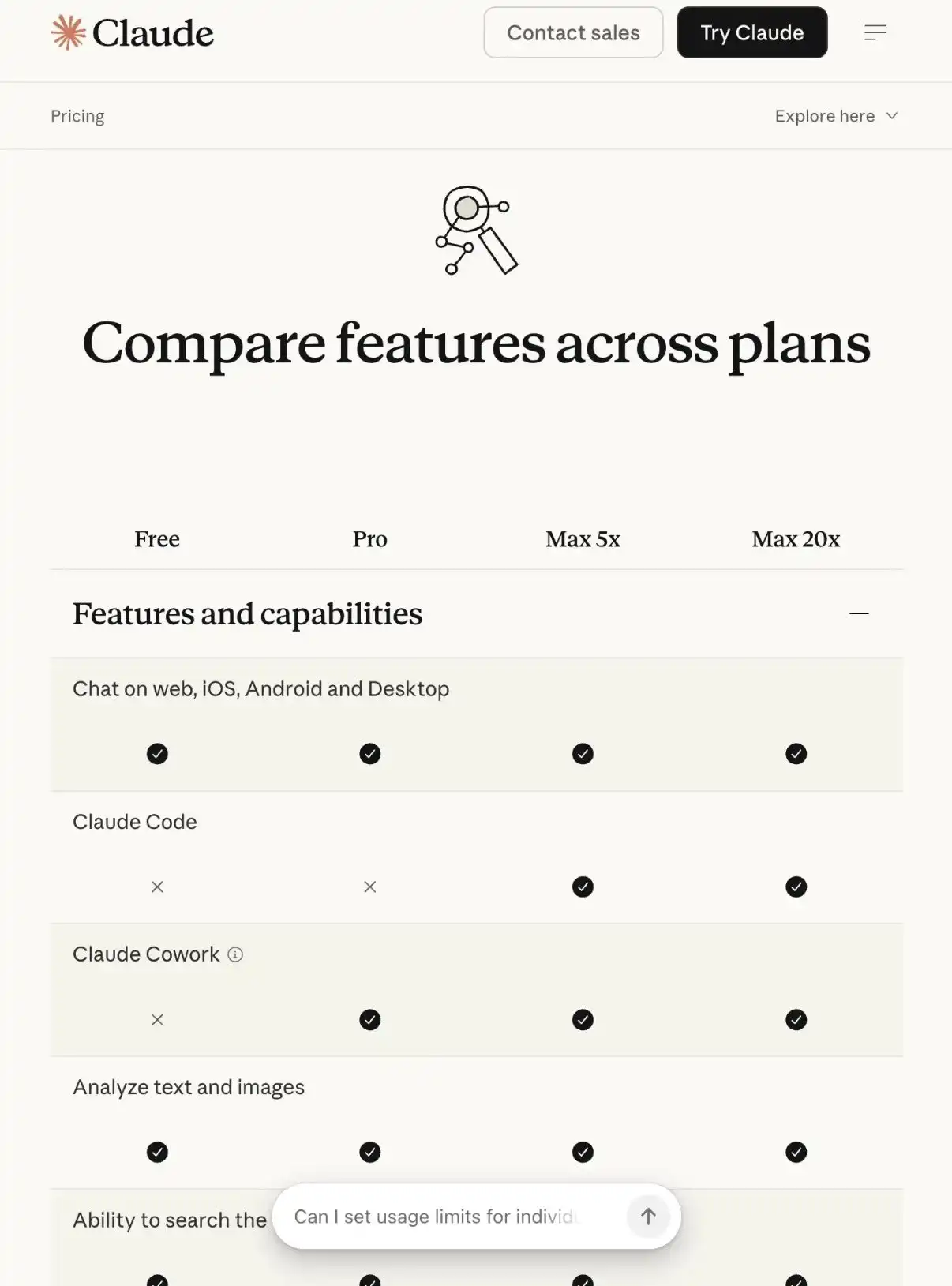
On April 21, some developers noticed significant changes on Anthropic's official pricing page: Claude Code was marked as unavailable (with an "X") in the feature comparison table for the Pro plan ($20/month), whereas the day before the page still stated that the Pro plan "includes Claude Code." Almost simultaneously, the wording in Anthropic's help documentation quietly changed from "Use Claude Code with your Pro or Max plan" to "Use Claude Code with your Max plan."

AI industry observer Ed Zitron first sounded the alarm on the Bluesky platform, and the news quickly sparked discussions on Hacker News, Reddit r/LocalLLaMA, and X platform.

Official Statement Calls it a "Small-Scale Test," but Documentation is Fully Rewritten

Facing the developer community's intense reaction, Anthropic Growth Lead Amol Avasare responded that day on the X platform, stating this was only a small-scale test targeting about 2% of newly registered users, and existing Pro and Max subscribers would not be affected.

However, multiple media outlets pointed out that Avasare's statement contradicted the actual situation: the feature comparison matrix on the pricing page had been updated site-wide, and the help documentation had also been modified simultaneously. These changes were visible to all visitors and did not resemble a灰度 test for 2% of users. According to The Register, as of publication time, an Anthropic spokesperson had not responded further to this contradiction.

In subsequent tweets, Avasare explained the logic behind the adjustment: when the Max plan was launched a year ago, Claude Code was not bundled with it, Cowork did not exist, and asynchronous agents running for hours were not yet the norm. Since then, Claude Code usage has surged significantly post-Opus 4, and user usage patterns have fundamentally changed. He admitted, "Usage per subscriber has increased substantially, and our current plan structure was not designed for this."

This statement actually revealed a key point: providing Claude Code access for a $20 monthly fee has become unsustainable in terms of computing costs. According to industry analysis, each Claude Code programming session consumes far more tokens than regular chat, and the computational cost of long programming sessions could be several times the subscription fee.

From $20 to $100, Developers Pushed to a Decision Point

If this change is ultimately implemented permanently, Pro users who wish to continue using Claude Code would need to upgrade to the Max 5x plan starting at $100/month, or the Max 20x plan at $200/month. The price has increased fivefold.

Developers reacted quickly and strongly. A GitHub issue titled "Breaking Change: Claude Code CLI Removed from Pro Plan Without Notice" appeared within hours.

A related post on Hacker News received over 100 upvotes and more than 40 comments in less than an hour. One user's experience was representative: he started with the $20 Pro plan in January, upgraded to $200 due to frequently hitting usage limits, downgraded to $100 due to quality drops in Claude Opus 4.6, and recently downgraded back to $20 because he was satisfied with OpenAI Codex's performance on GPT-5.4. "I went from the most enthusiastic recommender to my current state," he wrote.

The reaction on the Reddit r/LocalLLaMA community was more direct. A post titled "Anthropic removes Claude Code from Pro plan, users call it 'the best time to switch to local models'" received extensive discussion, focusing on the progress made by open-source models like Meta's Llama series, Mistral, and DeepSeek in programming capabilities over the past year, as well as the maturity of local deployment tools like Ollama and LM Studio.

OpenAI Quickly Strikes, Codex Remains in Free and Plus Plans

Competitors did not miss this window.

From OpenAI's side, an employee responsible for Codex-related work posted on the X platform: "I don't know what they're doing over there, but Codex will continue to be available in the free and Plus ($20) plans. We have the compute and efficient models to support it. For important changes, we communicate with the community in advance."
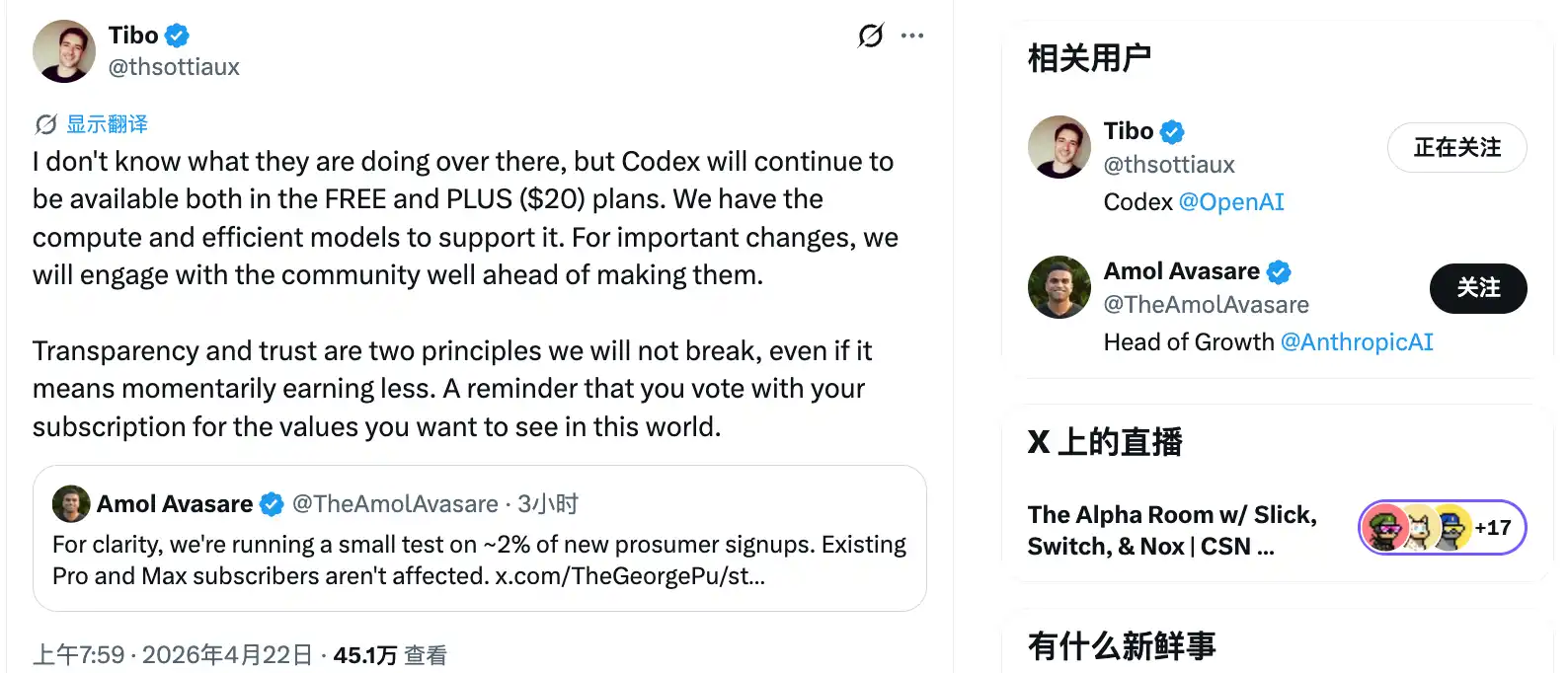
The timing and wording of this statement were highly targeted.

OpenAI's Codex, as the main competitor to Claude Code, is currently offered in the ChatGPT Plus ($20/month) plan with a usage limit of 30 to 150 messages every 5 hours, and also has basic access in the free plan. Additionally, weeks ago, OpenAI released a Codex plugin specifically designed for Claude Code users, allowing developers to directly call Codex for code review or task delegation within the Claude Code workflow.

Google is also active; Gemini CLI is currently completely free. According to The New Stack, Anthropic has recently been under pressure regarding computing supply. Not only did it remove Pro access to Claude Code, but it also previously cut off third-party client OpenClaw's access to Claude via subscription accounts. Platform stability issues and frequent outages have also provided opportunities for competitors.


Perguntas relacionadas

QWhat change did Anthropic make to its Pro plan regarding Claude Code, and when was it noticed?

AAnthropic removed Claude Code from its $20/month Pro plan on April 21, as noticed by developers who saw the pricing page updated to show Claude Code as unavailable for Pro users, whereas it was previously included.

QHow did Anthropic's growth head, Amol Avasare, explain the removal of Claude Code from the Pro plan?

AAmol Avasare claimed it was a 'small-scale test' affecting only about 2% of new sign-ups, stating that existing Pro and Max subscribers would not be impacted, and attributed the change to significantly increased usage and computational costs.

QWhat was the reaction from the developer community to Anthropic's change?

AThe developer community reacted strongly, with immediate backlash on platforms like Hacker News, Reddit, and X. Many expressed frustration, with some considering switching to local models or alternatives, and a GitHub issue was quickly created to highlight the abrupt change.

QHow did OpenAI respond to Anthropic's removal of Claude Code from the Pro plan?

AOpenAI swiftly responded by affirming that its Codex would remain available in both free and Plus ($20/month) plans, emphasizing their ability to support it with sufficient compute and efficient models, and criticizing Anthropic's lack of prior communication.

QWhat are the pricing implications for Pro users if they want to continue using Claude Code after this change?

AIf the change becomes permanent, Pro users would need to upgrade to the Max plan, which starts at $100/month for the 5x version or $200/month for the 20x version, effectively increasing the cost fivefold or more to access Claude Code.

Leituras Relacionadas

Agents Take Over Traffic Distribution Power: What Are Tencent, ByteDance, and Alibaba Competing For?

In the race to dominate the AI era's entry point, China's tech giants—Tencent, ByteDance, and Alibaba—are aggressively deploying AI Agents to control the future of traffic distribution. Alibaba is pursuing a dual-track "closed loop + openness" strategy. Its Qianwen app is evolving into a super-Agent integrated across its ecosystem (Taobao, Alipay, etc.) to handle complex tasks like travel planning. Concurrently, it is opening its platform to external brands (Luckin Coffee, KFC) and has launched a B2B Agent platform, "Wukong," targeting enterprise automation. Its other flagship, Quark, aims to be an "AI super search box" for information and tasks. ByteDance is executing an omnipresent "sprawl strategy." Its Doubao app boasts over 300 million monthly active users and is evolving into a default AI entry point for daily life, with plans for paid versions and e-commerce integration. Its core weapon is the Kouzi platform, a visual "AI assembly factory" for developers to build custom Agents. ByteDance is also pushing hardware integration, collaborating on AI phones and developing smart glasses to embed Doubao everywhere. Tencent is playing its long-held "ultimate card" by quietly embedding an AI Agent directly into WeChat. This Agent, accessible via a swipe, can understand user commands and automatically execute tasks by calling upon WeChat's millions of mini-programs (e.g., finding and ordering coffee). This leverages WeChat's unparalleled 1.4-billion-user ecosystem to position the app as an AI-powered "service operating system," a move that could dramatically reshape the competitive landscape. The core battleground is shifting from competing for "user screen time" to competing to be the "default execution layer" for user intent. The business model is evolving from an "attention economy" to an "intent economy," where the Agent that can most efficiently fulfill a user's need gains control over service access and token flow. This represents a fundamental change in how users connect with digital services, making the fight for the Agent入口 (entry point) a pivotal moment for redefining industry leadership in the AI age.

marsbitHá 26m

Agents Take Over Traffic Distribution Power: What Are Tencent, ByteDance, and Alibaba Competing For?

marsbitHá 26m

From Banning Doubao to Embracing Honor: Why Did WeChat Suddenly 'Change Its Face'?

The article explores the sudden shift in WeChat's strategy towards AI assistants from mobile phone manufacturers, transitioning from strict opposition to active collaboration. For over a year, WeChat fiercely resisted attempts by phone AI assistants (like ByteDance's Doubao in late 2025) to control its features via GUI automation ("simulated clicking"), citing security and data control concerns. This stance created a significant barrier for system-level AI integration. Now, Tencent has initiated A2A (Agent-to-Agent) partnerships with major phone brands like Honor, Xiaomi, OPPO, and vivo. This model allows a phone's system AI (e.g., Honor's YOYO) to parse a user's voice command and send a structured request directly to WeChat's own internal AI agent via secure APIs. WeChat then executes the action (e.g., sending a message) and returns the result. The article attributes Tencent's "change of face" to strategic pressure. While leading in social app usage, Tencent trails rivals like ByteDance and Alibaba in standalone AI app popularity. WeChat, with its vast mini-program ecosystem, is Tencent's key asset for an AI comeback. The upcoming WeChat AI agent aims to handle tasks like booking and payments within the app. However, phone system assistants remain the primary AI entry point for most users. The A2A collaboration allows Tencent to extend WeChat's AI reach to this crucial system layer while maintaining control over its core functions and data. For phone manufacturers, embracing A2A is a pragmatic move. The GUI route proved unviable due to WeChat's blocks. A2A offers a compliant path to integrate a vital service, enhancing their AI assistants' usefulness. It allows them to focus on developing their own AI ecosystems for other services while cooperating on WeChat access. The collaboration is framed as a mutual, strategic necessity: Tencent gains a distribution channel, and manufacturers gain a key functionality. The partnership relies on a "dual authorization" mechanism for security, requiring both user and app consent for each action. While questions about long-term data privacy practices remain, experts note A2A is more secure and compliant than GUI automation. Ultimately, this cooperation is seen as a tentative, calculated truce. Tencent's long-term goal is to make WeChat an AI-powered "service OS." Phone manufacturers aim to make their system AI the central user interface. Their paths may converge or clash in the future, but for now, the A2A deal represents the opening chapter in the battle for the AI-era user入口, driven by necessity and strategic calculus on both sides.

marsbitHá 2h

From Banning Doubao to Embracing Honor: Why Did WeChat Suddenly 'Change Its Face'?

marsbitHá 2h

Trading

Spot
Futuros
活动图片




