Employees leaving Anthropic to start a business, securing $200 million in funding right from the start.
Recently, two prominent figures who left Anthropic — Behnam Neyshabur and Harsh Mehta — announced their entrepreneurial venture, founding a startup named Mirendil. Its vision is similar to Tian Yuandong's previously announced startup project, both aiming to create AI capable of self-evolution to accelerate human scientific progress. The technical approach is 'recursive self-improvement'.
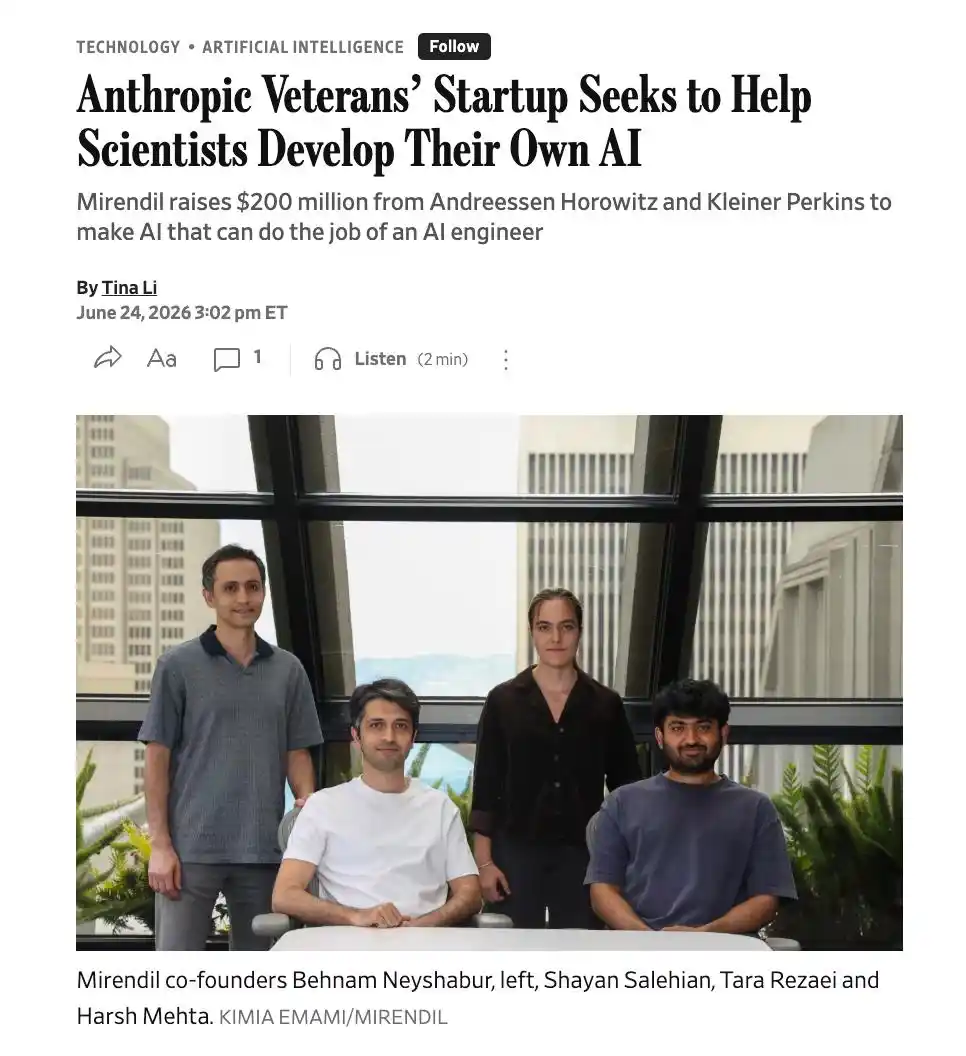
The company's founding team consists of 20 researchers and engineers from cutting-edge institutions like Anthropic, xAI, Google DeepMind, and OpenAI. They came together driven by a passion for science and a commitment to building technology that propels scientific advancement. The company name 'Mirendil' comes from 'The Lord of the Rings,' meaning 'Jewel-friend' in Elvish.
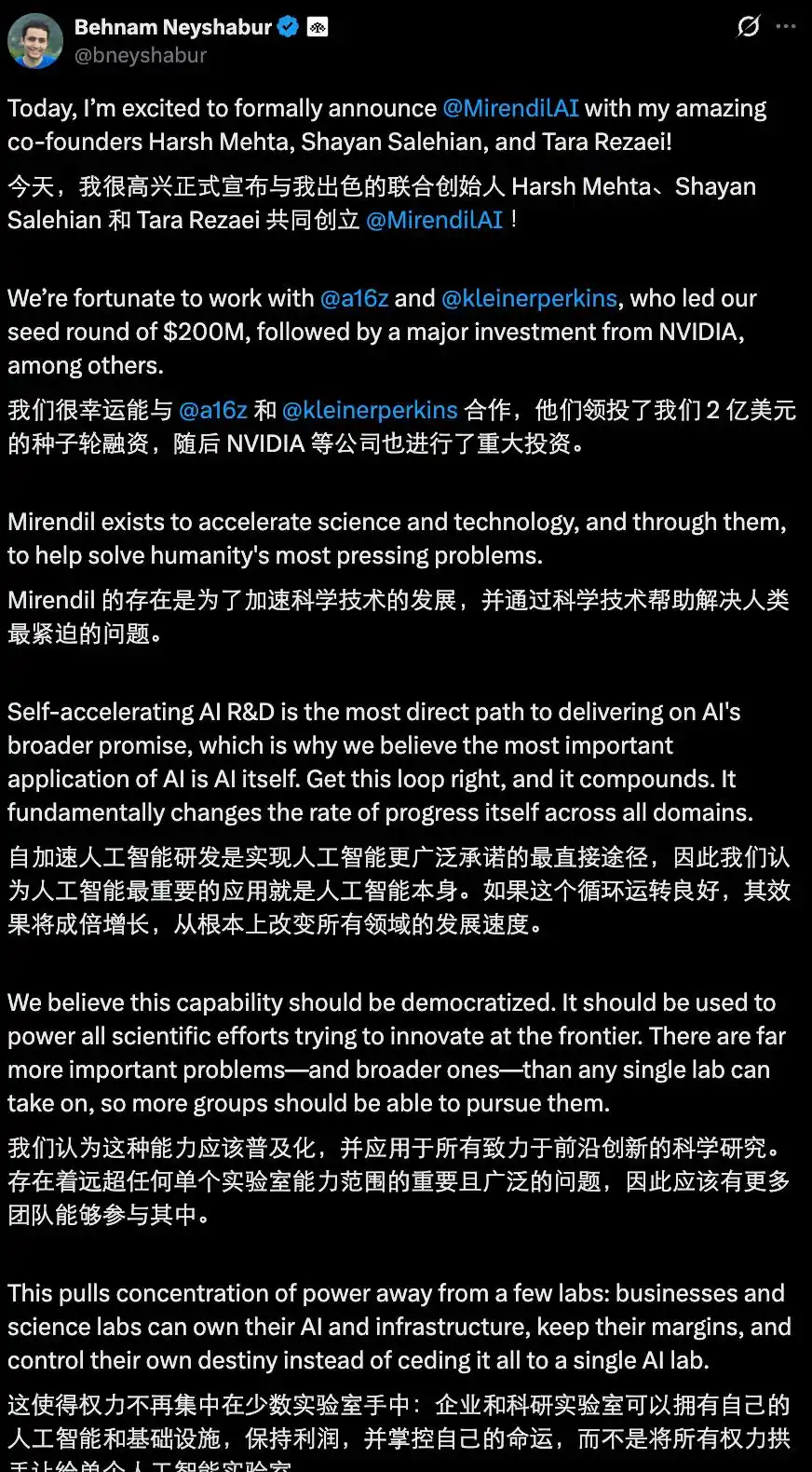
They raised $200 million in seed funding from venture capital firms Andreessen Horowitz, Kleiner Perkins, and NVIDIA. Post-funding, the company's valuation reached $1 billion, making it one of the AI startups with a notably high seed-round valuation in recent years.
Origin: An Unfamiliar Email,
A Seven-Year 'Partnership'
The founders' story begins in 2019.
At that time, Mehta was a regular researcher at Google, while Neyshabur had just joined Google and was already gaining some renown in academic circles for his in-depth research into the fundamental question of 'why AI models work' — as Mehta himself put it, 'he was already a bit of a star in the field.' Mehta mustered the courage to send him an unfamiliar email, and thus their connection began.
They were both passionate about 'using AI to accelerate scientific research' early on, but at the time, limited by model capabilities, this idea remained in the realm of imagination. It wasn't until late 2024 that both joined Anthropic, and in December 2025, shortly after the release of Claude Opus 4.5, they chose to leave to start their own company.
The release of Claude Opus 4.5 significantly enhanced AI Agents' ability to handle complex tasks. Perhaps it was this breakthrough that convinced them the timing was ripe.
Mission: Not 'AI for Science',
But 'AI for AI for Science'
Mirendil's positioning sounds a bit convoluted, but Neyshabur clarified it in one sentence: 'What we do is have AI help scientists build their own AI, rather than just directly using AI to assist science.'
In other words, their goal is to build a tool platform that allows research teams in various vertical fields like medicine and materials science to independently train and iterate their own specialized AI models — without relying on general-purpose models provided by major tech companies. An example they give is: helping researchers build a model to predict Alzheimer's disease risk.
This involves a more controversial technical path — Recursive Self-Improvement, which involves AI continuously optimizing its own code and capabilities. Neyshabur directly stated that this is the shortest path to 'AI-accelerated science,' while also believing it can be advanced safely under human supervision. 'I don't accept the argument that it can't be done; it's just a very difficult problem.'
Competition: Major Companies' Moats,
Precisely Mirendil's Opportunity
The logic behind Mirendil's ability to secure this funding is also quite clear.
Currently, major AI companies, including Anthropic, are increasingly using AI to accelerate their own research. According to Anthropic's disclosure, as of May this year, over 80% of its internal code was already written by Claude. However, at the same time, these major companies explicitly restrict external developers from using their models to train competitive products in their user agreements.
This 'for internal use only, not for lending' strategy, in the view of a16z investor Matt Bornstein, is just a normal reaction from major companies as 'rational economic actors.' But precisely because of this, a structural gap has emerged in the market, necessitating an independent company to take on this task.
In addition to the two co-founders, Mirendil's core team includes Shayan Salehian, who was an early member at Musk's xAI, and Tara Rezaei, a graduate of MIT. The company currently has about 20 technical staff, with offices located in downtown San Francisco.
In the coming months, Mirendil plans to release its first model and product, gathering early feedback from users. Neyshabur's vision for this is: 'We hope that in the future, there will be thousands of labs in the world, each tackling the most important problems of our time. We want to be the force that empowers them.'
Reference Links:
https://x.com/bneyshabur/status/2069860934148079800
https://www.wsj.com/tech/ai/anthropic-veterans-startup-seeks-to-help-scientists-develop-their-own-ai-09e2f3e5?mod=author_content_page_1_pos_1
This article is from the WeChat public account 'Almost Human', author: Almost Human Editorial Department







