Anthropic and OpenAI Personally Sever the Logic of Pre-IPO Crypto-Stocks

Odaily星球日报Publicado em 2026-05-12Última atualização em 2026-05-12

Resumo

The pre-IPO token market has been rocked by strong statements from Anthropic and OpenAI. Both AI giants have updated official warnings, declaring that any sale or transfer of their company shares without explicit board approval is "invalid" and will not be recognized on their corporate records. This directly targets Special Purpose Vehicles (SPVs), the common legal structure used by pre-IPO token platforms. These platforms typically use an SPV to acquire shares from employees or early investors, then issue blockchain-based tokens representing a claim on the SPV's economic benefits. Anthropic and OpenAI's position means that if an SPV's share purchase lacked authorization, the underlying asset could be deemed worthless, nullifying the token's value. Anthropic explicitly warned that any third party selling its shares—via direct sales, forwards, or tokens—is likely fraudulent or offering a valueless investment. The crackdown highlights risks in the popular SPV model, including complex multi-layered "Russian doll" SPV structures that obscure legal ownership, add fees, and concentrate risk. If one layer is invalidated, the entire chain could collapse. Following the announcements, tokens like ANTHROPIC and OPENAI on platforms like PreStocks fell sharply (over 20%). In contrast, purely speculative pre-IPO prediction contracts remained stable, as they involve no actual share ownership. The move is seen as a corrective measure amid a market frenzy where some pre-IPO token valuation...

Original | Odaily Planet Daily (@OdailyChina)

Author | Azuma (@azuma_eth)

The pre-IPO (Pre-IPO) stock token market has just experienced a severe shock. The epicenter of this earthquake stems from two statements issued by two major AI companies, Anthropic and OpenAI.

Anthropic and OpenAI Successively Declare They 'Do Not Acknowledge' Unauthorized Sales

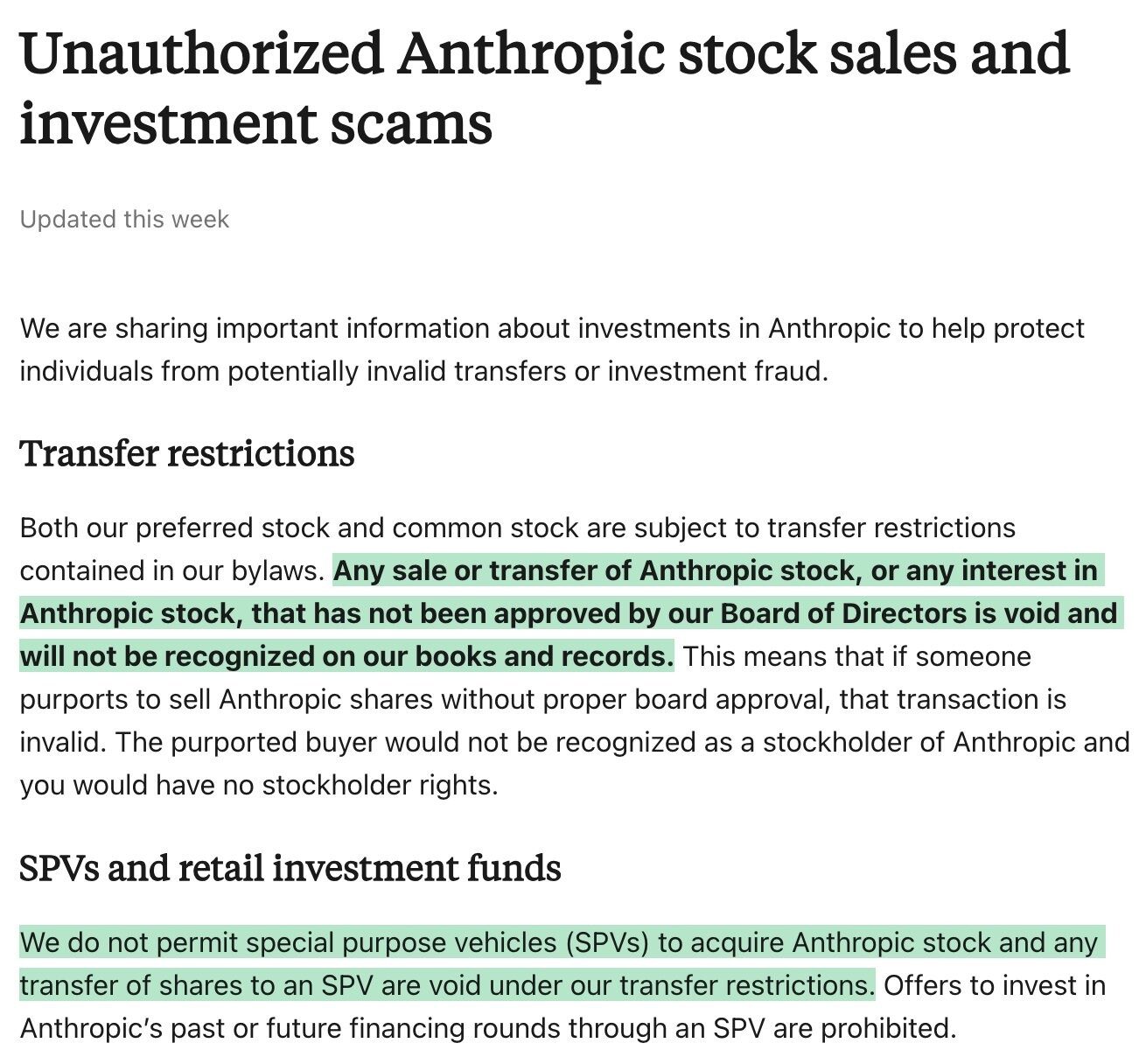
Today, Anthropic updated an official statement it released in February titled "On Unauthorized Sales of Anthropic Stock and Investment Scams".

Anthropic explicitly stated in the article: "Any sale or transfer of Anthropic stock that is not approved by our Board of Directors, or any disposition of economic interests in Anthropic stock, is invalid (note the term 'invalid') and will not be recognized on the company's books and records. This means that if someone sells Anthropic stock without board approval, the transaction will be deemed invalid. The purported buyer will not be recognized as a shareholder of Anthropic and will not enjoy any shareholder rights."
Shortly after Anthropic updated its statement, OpenAI also followed up with an announcement stating: "All equity is subject to transfer restrictions. No shares may be transferred, directly or indirectly, without the Company's written consent. Any sale without consent is not only unauthorized but also invalid."
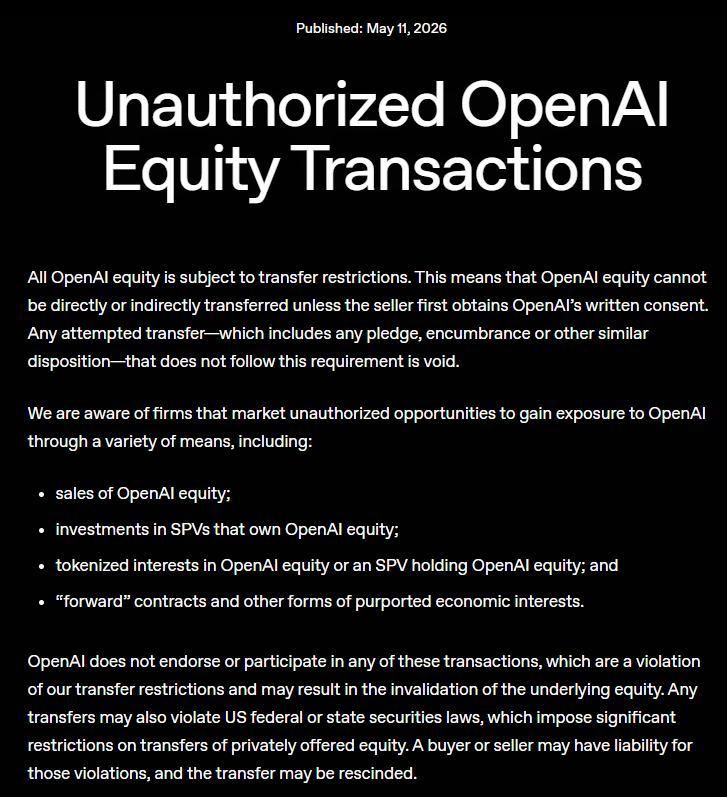
In their announcements, both Anthropic and OpenAI explained that the companies' preferred and common shares are subject to transfer restrictions stipulated in their charters, meaning all stock transfers require board consent.

Anthropic particularly emphasized that the company also does not permit "Special Purpose Vehicles" (SPVs) to acquire its shares, and any transfer of shares to an SPV violates the company's transfer restrictions...... Certain investment funds may claim to provide indirect access to Anthropic stock, but these funds are likely attempting to circumvent transfer restrictions. Therefore, any third party claiming to sell Anthropic stock to the public — whether through direct sales, forward contracts, stock tokens, or other mechanisms — may be engaged in fraud or offering worthless investments due to Anthropic's transfer restrictions.
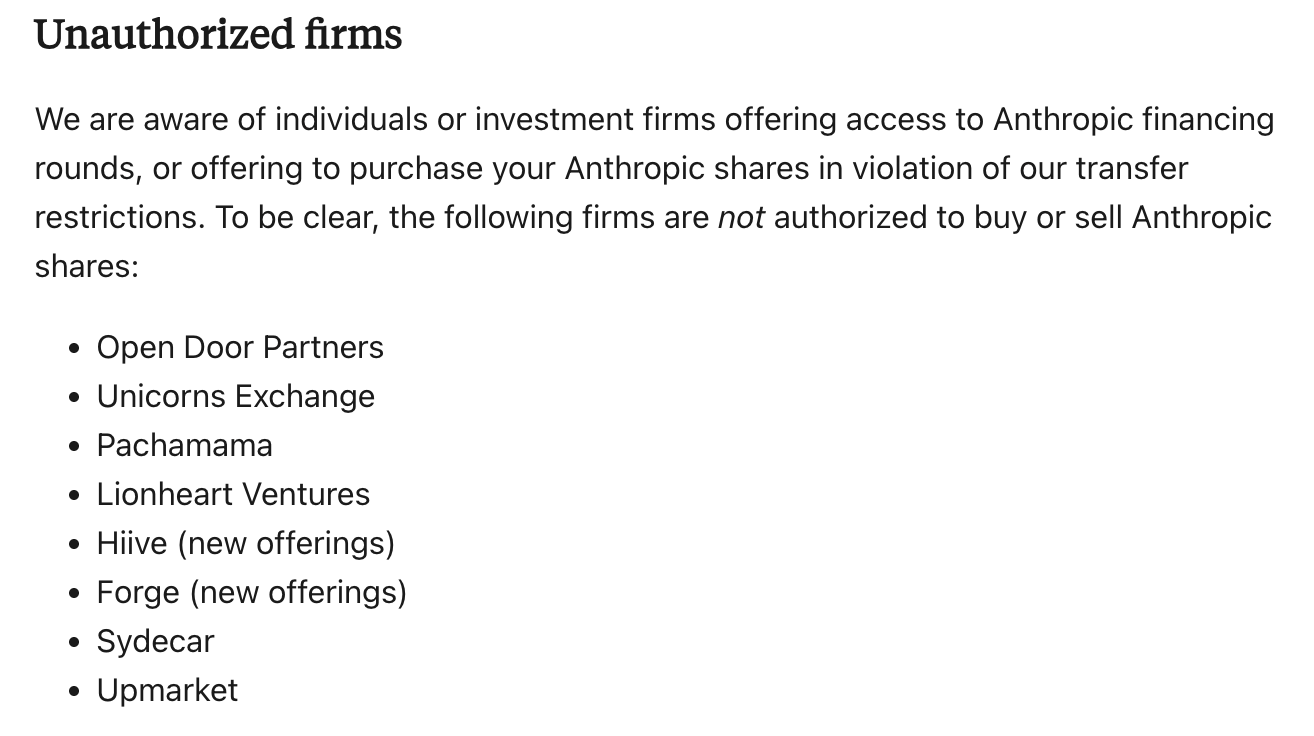
  • Odaily Note: The image shows platforms named by Anthropic for unauthorized equity transfers.

What is an SPV?

To understand why this update has such a massive impact on the pre-IPO stock token market, one must first understand what an SPV is.

In traditional pre-IPO stock trading, directly transferring original shares is extremely difficult, restricted not only by company charters but also involving complex legal procedures. In this context, SPVs emerged.

An SPV is a legal entity established separately for a specific transaction or investment purpose, which can be understood as a 'shell company specifically used to hold a certain asset' — multiple investors can indirectly hold shares in a company or a type of asset by contributing capital to the same SPV, thereby achieving centralized ownership, lowering entry barriers, and optimizing legal and tax structures. SPVs are especially common in popular pre-IPO stock trades. As many star companies are often unwilling to directly introduce a large number of small shareholders, institutions typically first establish an SPV, which then uniformly invests in the target company.

For example, the so-called "early participation in Anthropic or OpenAI share subscriptions" in the market essentially involves investors first contributing capital to an SPV, which then uniformly acquires the unlisted equity of Anthropic.

Currently, most pre-IPO stock token platforms in the market (such as Prestock) adopt the SPV structure.

  • The platform or its partners will register an SPV in a certain jurisdiction. The sole task of this SPV is to buy original shares of Anthropic in the secondary market (usually from employees or early investors);
  • The platform then issues derivative tokens on-chain (such as ANTHROPIC or OPENAI), which are legally defined in agreements as "claims to the economic benefits of that SPV";
  • In theory, these tokens are 1:1 pegged to the original shares; for every token issued, the offline SPV should hold a corresponding share of stock.

But now the problem is, Anthropic and OpenAI have explicitly stated they 'do not acknowledge unauthorized stock transfers'. This means if an SPV transfers stock without board approval (which is basically impossible to obtain), the stock held by that SPV may be considered invalid in the eyes of Anthropic and OpenAI — if the SPV's stock is invalid, then the "economic benefits" referenced by the on-chain tokens become worthless.

The Risk of SPV "Nesting"

A significant reason why Anthropic and OpenAI are so resistant to SPVs is that with the ongoing speculative frenzy around their pre-IPO stock tokens (Anthropic's pre-IPO valuation once soared to $1.4 trillion, far higher than its last funding round valuation), the risk of SPVs becoming over-financialized has begun to surface.

Among these risks, the "nesting" problem of SPVs is most noteworthy — many investors buying pre-IPO stock tokens believe they are purchasing company shares, but in reality, they only hold claims to the economic benefits of some SPV. Even more exaggeratedly, many SPVs do not directly hold Anthropic's original shares but are themselves nested two or three SPV layers down.

This "nesting" structure is, in fact, very dangerous.

  • Legal Transparency Issues: With each additional layer, the authenticity of the underlying asset becomes more ambiguous. Investors find it difficult to confirm whether the SPV at the very bottom has actually received board approval for the transfer.
  • Management Fee Exploitation: Each SPV layer charges management fees, performance fees, and dividends. After layers of skimming, investors' actual returns are severely diluted.
  • Risk of Wipeout: If the equity transfer at any layer is deemed "invalid" by Anthropic, the entire value chain can collapse instantly.

Whether for reputation or investor protection considerations, Anthropic and OpenAI clearly do not want to see this situation.

Pre-IPO Stock Tokens Plunge, Contracts Remain Relatively Stable

Once the announcements from Anthropic and OpenAI spread, the market reacted immediately.

ANTHROPIC on PreStocks plunged sharply, once falling below $1,000, temporarily reported at $1,082 as of 12:00, down 20.62% for the day; OPENAI temporarily reported at $1,440, down 26.82% for the day.
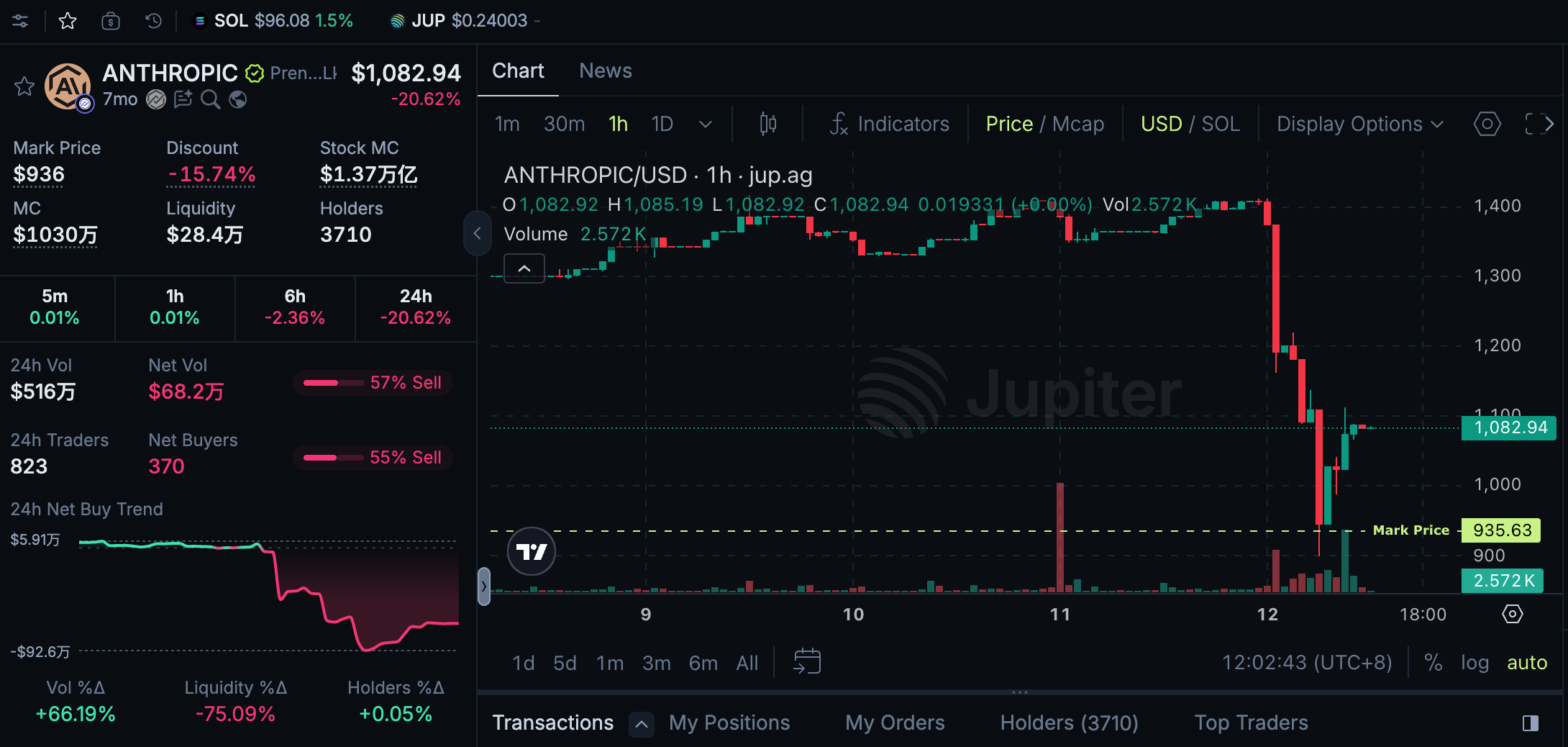
Investors' panic is easily understood. Since Anthropic and OpenAI explicitly stated they do not acknowledge unauthorized holdings, the "rights" behind these tokens face the probability of becoming "worthless paper," and holders may face significant risks in confirming ownership and legal litigation costs.

Interestingly, while pre-IPO stock tokens were under pressure, another type of pre-IPO trading product performed relatively stably — pre-IPO contracts that rely entirely on market bilateral speculation. This is because such products do not inherently hold any real stock; the restrictions by Anthropic and OpenAI have no direct impact on them. They are essentially "bilateral bets" on the future IPO price, relying on price competition between buyers and sellers.

Future Trend Predictions

Facing Anthropic and OpenAI's "non-acknowledgment" stance, two contrasting voices have emerged within the industry.

Some believe the logic of pre-IPO crypto-stock trading is dead. If headliners like Anthropic and OpenAI take the lead in banning SPVs, other giants may follow suit. With the backing of equity rights being shaken, whether pre-IPO stock tokens still hold value is questionable.

However, others, including Rivet founder Nick Abouzeid, believe this is not a big deal. Trading pre-IPO stock tokens through unofficial channels is inherently a gamble; buyers should have been prepared for the possibility that the "company would not acknowledge" them from day one — what you lack is direct investment opportunities; obtaining such opportunities through other means always carries certain risks.

In summary, with the continuous expansion of pre-IPO stock token premiums and increasingly fervent market sentiment, the stance of Anthropic and OpenAI undoubtedly pours a bucket of cold water on the entire sector.

Over the past few months, more and more investors have begun to view pre-IPO stock tokens as a "low-barrier channel to participate in the growth of top AI companies." The valuations of some AI-concept pre-IPO stock tokens have clearly detached from reality, even experiencing frenzied speculation far exceeding the valuations of their last funding rounds. Against this backdrop, the public "debunking" by Anthropic and OpenAI is, in a way, redrawing boundaries for this wildly growing new market.

For speculators, this is a risk education; but for the industry's long-term development, the market may also need such a "de-bubbling" moment.


Perguntas relacionadas

QWhat did Anthropic and OpenAI declare regarding the transfer of their stocks?

ABoth Anthropic and OpenAI declared that any transfer or sale of their company stock without the express approval of their respective boards of directors is unauthorized and considered 'invalid.' They will not recognize such transfers on their company books and records, meaning buyers in these unauthorized transactions would not be considered shareholders and would have no shareholder rights.

QWhat is an SPV (Special Purpose Vehicle) and what is its role in pre-IPO stock token trading?

AA Special Purpose Vehicle (SPV) is a legal entity created for a specific transaction or investment purpose, often acting as a 'shell company' to hold an asset. In pre-IPO stock token trading, platforms use SPVs to indirectly acquire shares of a target company (like Anthropic) from employees or early investors. The platform then issues blockchain tokens representing a claim on the economic benefits of the SPV, theoretically pegged 1:1 to the underlying shares.

QWhy did the announcements by Anthropic and OpenAI cause a significant drop in the price of pre-IPO stock tokens?

AThe announcements caused a significant price drop because they fundamentally questioned the value of the underlying assets. By declaring unauthorized stock transfers 'invalid,' Anthropic and OpenAI implied that the shares held by the SPVs backing the tokens might be worthless. This creates substantial legal and ownership risks for token holders, leading to panic selling and a loss of confidence in these instruments.

QWhat is the 'nesting doll' risk associated with SPVs mentioned in the article?

AThe 'nesting doll' risk refers to a structure where an SPV does not directly hold the target company's shares but instead holds interests in other SPVs, which themselves may hold shares or interests in further SPVs. This creates several dangers: it obscures the true ownership and validity of the underlying shares, subjects investor returns to multiple layers of management fees, and increases the risk of total loss ('going to zero') if any layer in the chain is deemed invalid by the target company.

QAccording to the article, how did pre-IPO stock futures contracts react compared to the token market after the announcements?

AAccording to the article, pre-IPO stock futures contracts remained relatively stable compared to the collapsing token market. This is because these futures contracts are purely speculative derivatives based on the future IPO price and do not involve any claim on or holding of the actual company shares. Therefore, they were not directly affected by Anthropic's and OpenAI's statements regarding the invalidity of unauthorized share transfers.

Leituras Relacionadas

Fei-Fei Li's Team Clarifies the Concept of 'World Models', Sora Merely a Renderer

"World Models" has become a widely used yet confusing term in AI. To address this, a team led by Fei-Fei Li and World Labs proposed a functional taxonomy based on the Partially Observable Markov Decision Process framework. This taxonomy categorizes systems called "world models" into three distinct projections: Renderers, Simulators, and Planners. Renderers, like OpenAI's Sora and other video generation models, focus on producing photorealistic visual outputs for human perception. They prioritize visual fidelity over physical accuracy. Simulators, such as NVIDIA Omniverse, aim to compute precise future environmental states for computational tasks like engineering analysis or digital twins. Planners, like Vision-Language-Action models, take in observations and goals to output executable actions for robots or agents. The article clarifies that most current "world models," including Sora, are primarily Renderers. They generate convincing visuals but lack the core ability to simulate state transitions based on actions, a key requirement for a true world model in classic reinforcement learning definitions. This conceptual confusion has practical implications, leading to potential misalignment in technology selection, investment, and public understanding of AI capabilities. Clear categorization is crucial. It helps enterprises avoid costly mistakes (e.g., using a renderer for robot training), allows investors to accurately assess markets, and enables researchers to build comparable benchmarks. While future systems may integrate these functions, recognizing current boundaries is essential for honest assessment and progress.

marsbitHá 1h

Fei-Fei Li's Team Clarifies the Concept of 'World Models', Sora Merely a Renderer

marsbitHá 1h

Bloomberg Uncovered: How Do China's Wealthy Circumvent the Annual $50,000 Limit to Transfer Assets?

**Summary: How Wealthy Chinese Circumvent $50,000 Annual Foreign Exchange Limits** Despite China's strict capital controls, including an annual $50,000 per person foreign exchange quota, an estimated $150 billion in funds still leaves the country annually via various gray and underground channels. This report outlines the evolution of China's "capital wall" and the methods used to bypass it. **The Evolving Capital Controls:** * **Foundation (1994):** The system of "current account convertibility with strict capital account controls" was established. * **Quota Set (2007):** The $50,000 individual annual forex purchase limit was formalized. * **Crackdown Begins (2015-2017):** Following market volatility, enforcement tightened. Banks were required to scrutinize transactions, and channels like using UnionPay cards for Hong Kong insurance premiums or buying overseas property were blocked. * **Digital & Legal Upgrades (2024-2026):** Enhanced algorithms now flag suspicious patterns (e.g., "smurfing"). The Common Reporting Standard (CRS) provides Chinese tax authorities with data on citizens' offshore accounts. Unlicensed cross-border brokers have been targeted. **Five Primary Methods for Moving Capital:** 1. **Underground Banking / "Hawala" (Duiqiao):** The largest-scale method. No money crosses borders. Clients pay RMB to a domestic account; an overseas associate deposits equivalent foreign currency into the client's offshore account. Risks include high fees, account freezes, and legal penalties. 2. **"Smurfing" or "Ant Moving":** Using multiple individuals' $50,000 quotas to pool funds for one offshore recipient. Increasingly detected by anti-money laundering algorithms. 3. **Trade Invoice Manipulation:** Businesses over-invoice imports or under-invoice exports via offshore shell companies, creating a pretext to transfer excess funds abroad under the guise of trade. 4. **Channel Migration:** After a crackdown on internet brokers, funds flow toward more compliant but costly channels like major banks' cross-border wealth management services or Qualified Domestic Institutional Investor (QDII) quotas. 5. **Structural Arrangements:** High-net-worth individuals use complex, high-cost legal structures involving offshore trusts, insurance, and investment migration programs to transfer asset ownership. **Regulatory Response: Focusing on People, Not Just Money** The current strategy extends oversight from enterprises to **individual residents**. Tools like CRS allow retroactive visibility into offshore assets. Cryptocurrencies, once seen as a potential loophole, are now actively monitored and prosecuted as an illegal channel. The underlying driver remains: with significant wealth concentrated among millions of affluent households seeking diversification amid domestic economic shifts, the incentive to move assets offshore persists despite regulatory barriers.

marsbitHá 1h

Bloomberg Uncovered: How Do China's Wealthy Circumvent the Annual $50,000 Limit to Transfer Assets?

marsbitHá 1h

Trading

Spot
Futuros
活动图片




