Ant Digital Tech Proposes New Architecture for Agent Economy, Covering Four Layers: Identity, Payment, Risk Control, and Compliance

marsbitPublicado em 2026-04-20Última atualização em 2026-04-20

Resumo

Ant Digital Technologies (Ant Digital) has introduced a new architectural framework for the agentic economy, named the "4R Full-Stack Architecture," at the Hong Kong Web3 Festival. The framework is designed to address four core challenges in AI agent operations: identity, payment, risk control, and compliance. The four layers include: - **Agentic Runtime**, featuring DTClaw with the CARLI security model to enforce behavioral constraints and ensure controllability and auditability; - **Payment Rails**, which provide on-chain payment channels supporting smart decision-making, verifiable credentials, instant settlement, and cross-chain asset transfers; - **Agent Registry**, leveraging DIDs and the ERC-8004 standard to assign verifiable on-chain identities to agents; - **Root Infrastructure**, built on Jovay Layer2 and ZKVM technology to enable high-speed micro-payments and trusted off-chain computation with on-chain verification. According to CTO Yan Ying, the architecture aims to resolve fundamental gaps in the current agent economy—such as execution vulnerabilities, identity issues, payment barriers, and trust deficits—by redesigning underlying infrastructure rather than applying superficial fixes. The initiative builds on Ant Digital’s extensive experience in financial-grade security, privacy computing, and blockchain.

On April 20, Ant Digital Tech introduced the "4R Full-Stack" architecture concept for the agent economy at the Hong Kong Web3 Festival, encompassing four layers: Agentic Runtime, Payment Rails, Agent Registry, and Root Infrastructure. This framework aims to provide AI agents with a technical infrastructure covering identity, payment, risk control, and compliance.

Ant Digital Tech CTO Yan Ying pointed out in her speech that the current foundation of the agent economy suffers from "four gaps": execution failures due to prompt logic vulnerabilities, responsibility vacuums caused by AI's lack of credible identity, transaction barriers from payment gateways designed for humans, and collaboration risks arising from a lack of trust between unfamiliar agents. "These cannot be resolved by simply patching software; they require a redesign from the underlying infrastructure level," she said.

According to Yan Ying, the core product of the Agentic Runtime layer is DTClaw, which incorporates the CARLI security model to enforce constraints on agent behavior at the execution level. It supports multi-model compatibility and financial-grade compliance standards, aiming to make every AI operation controllable, auditable, and recoverable.

The Payment Rails layer builds native on-chain payment channels, integrating agent intelligent decision-making with verifiable credential chain technology. This ensures precise payment intent recognition and full-link security control while achieving transparency and immutability in the transaction process. For high-frequency micro-transaction scenarios, the platform constructs a native instant settlement network that supports cross-chain, multi-asset seamless flow, and intelligent routing, significantly improving capital turnover efficiency. Additionally, by providing a standardized development toolchain and a seamless wallet integration experience, the solution greatly reduces development barriers and user costs, forming a payment closed-loop that balances financial-grade security and an optimal user experience.
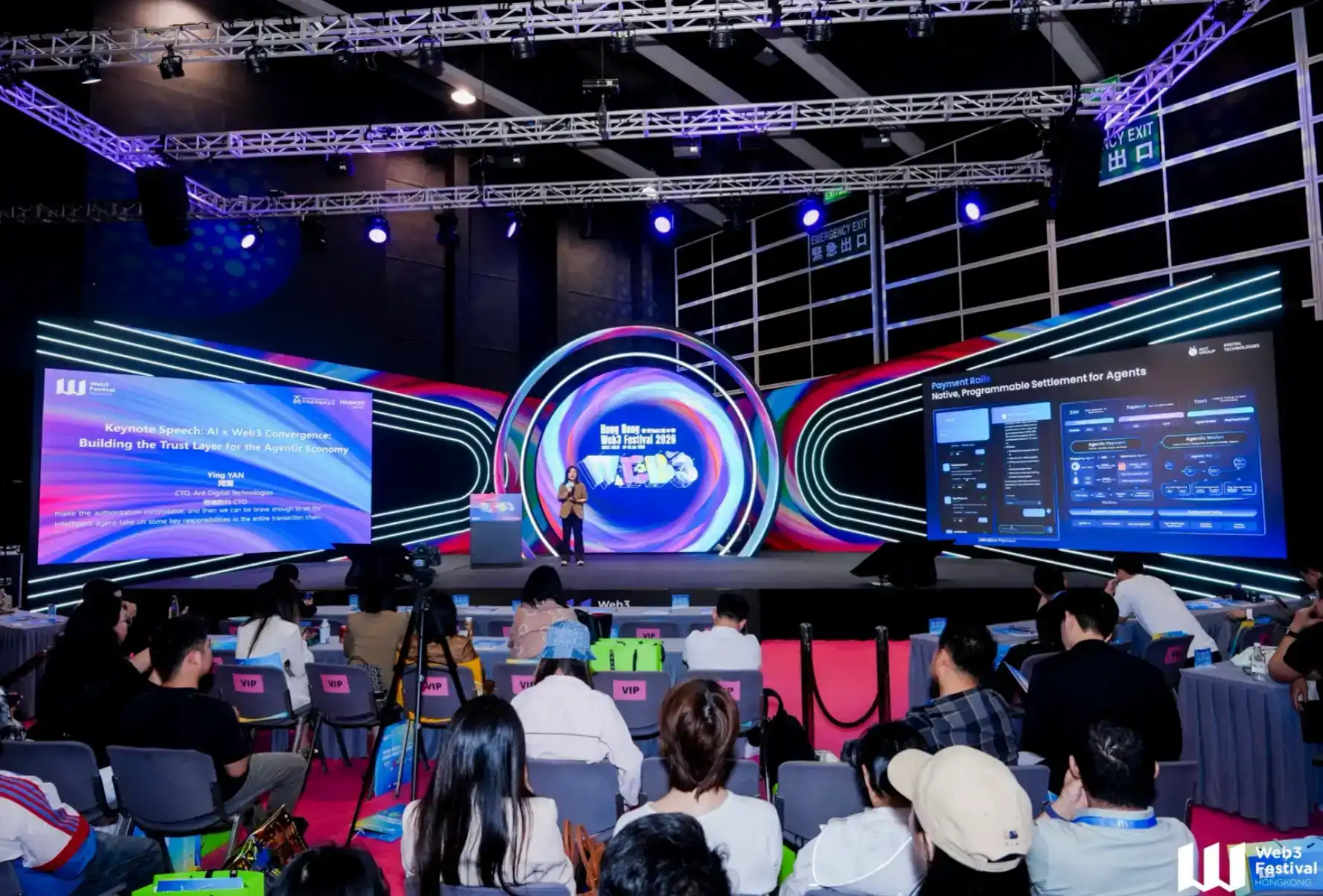
The Agent Registry layer issues on-chain identities for each agent based on DID (Decentralized Identity) and the ERC-8004 standard, ensuring that every collaboration between agents is documented. The Root Infrastructure layer serves as the architectural foundation, utilizing Jovay Layer2 to achieve 120-millisecond confirmation times to support AI micro-payments, and combining ZKVM technology to enable off-chain computation and on-chain verification, addressing the trust issues in AI economy computing power. Yan Ying stated, "The Root Infrastructure uses blockchain and privacy computing technologies to provide agents with an immutable contract execution environment. Even two unfamiliar AIs can establish trust based on code and conduct transactions with confidence."

Currently, AI is evolving from the era of Chat and Action to the era of the agent economy. Yan Ying believes that the qualitative change in the third stage lies not in AI becoming smarter, but in it beginning to possess assets and transaction rights. She noted that over the past decade, Ant Digital Tech has accumulated extensive engineering practices in financial-grade security, privacy computing, blockchain, and compliance systems, and the 4R architecture is built upon this foundation with全新研发和设计 (entirely new research and design).


Perguntas relacionadas

QWhat is the '4R Full-Stack' architecture proposed by Ant Digital Tech, and what are its four layers?

AThe '4R Full-Stack' architecture is a framework for the agentic economy proposed by Ant Digital Tech. Its four layers are: Agentic Runtime, Payment Rails, Agent Registry, and Root Infrastructure.

QAccording to Ant Digital Tech's CTO, what are the 'four fractures' in the current foundation of the agentic economy?

AThe 'four fractures' are: 1) Execution loss of control due to prompt logic vulnerabilities, 2) A responsibility vacuum caused by AI's lack of a trusted identity, 3) Transaction barriers from payment gateways designed for humans, and 4) Collaboration risks from a lack of trust between unfamiliar agents.

QWhat is the core product in the Agentic Runtime layer and what is its primary function?

AThe core product in the Agentic Runtime layer is DTClaw. Its primary function is to enforce mandatory constraints on agent behavior at the execution level, making every AI operation controllable, auditable, and recoverable.

QHow does the Payment Rails layer facilitate transactions for AI agents?

AThe Payment Rails layer builds native on-chain payment channels that integrate agent intelligent decision-making with verifiable credential chain technology. It ensures precise payment intent recognition, full-link security, transparency. It also features an instant settlement network for high-frequency micro-transactions, supporting cross-chain, multi-asset flow and smart routing.

QWhat technologies are used in the Root Infrastructure layer to support the agentic economy?

AThe Root Infrastructure layer utilizes Jovay Layer2 to achieve 120-millisecond confirmation times to support AI micro-payments, and combines ZKVM technology to enable off-chain computation with on-chain verification, solving the trust problem in AI economy computing power.

Leituras Relacionadas

Vitalik: Building Index-Tracking Assets Based on Options Rather Than Debt

Vitalik Buterin proposes constructing index-tracking assets using synthetic options rather than debt-based mechanisms. The core problem is enabling exposure to a price index (T, e.g., USD/ETH) in a trust-minimized environment where only ETH is a trustless asset, relying solely on a decentralized oracle. Traditional approaches, like algorithmic stablecoins, use debt positions and require real-time, binding oracles for liquidations, which are difficult to secure. This article suggests a paradigm shift: eliminating liquidation and using options as the fundamental building block, requiring only a "slow" oracle. The design defines two synthetic assets, P and N, with parameters for the index T, a strike price S, and an expiry M. At any time, 1 ETH can be split to create a (P, N) pair or merged back. At expiry M, the oracle determines T's value x. P receives min(1, S/x) ETH, and N receives max(0, 1 - S/x) ETH. This structure inherently avoids insolvency risk (P+N=1) and can share an oracle with prediction markets. To gain stable exposure to T (e.g., USD), a user would hold deeply "in-the-money" P options (with S significantly below the current price) and periodically "roll" them to lower strikes as the price approaches the current strike, rebalancing their portfolio. This transfers the decision of *when* to act from a protocol-enforced liquidation (requiring a real-time oracle) to the user or an automated wrapper. Users can manage MEV risk and oracle dependency by choosing their rebalancing timing and data sources. A key trade-off is accepting some quadratic drift (deviation from perfect peg), estimated at 1-4% annualized volatility. Buterin argues this cost is reasonable compared to fiat currency volatility or equilibrium shifts in other stablecoins. The success of this model depends heavily on designing low-slippage market mechanisms for the rebalancing process, leveraging users' low time preference to execute trades patiently.

marsbitHá 41m

Vitalik: Building Index-Tracking Assets Based on Options Rather Than Debt

marsbitHá 41m

"Water Scarcity": The Hidden Fatal Flaw of AI Infrastructure

“Water Scarcity: The Hidden Vulnerability of AI Infrastructure” In June 2026, SpaceX revised its IPO prospectus to highlight a core resource constraint alongside power and processors: water. This move signals a pivotal shift where water scarcity has transformed from an operational cost to a major, uncontrollable investment risk, directly threatening AI data center expansion. The scale of the problem is immense. U.S. data centers consumed an estimated 17 billion gallons of water for direct cooling in 2023, with indirect water use for power generation exceeding 211 billion gallons. Giants like Google alone use billions of gallons annually, with single sites consuming volumes equivalent to a medium-sized city. This water is largely “consumptive,” evaporated into the atmosphere and lost. This massive demand is colliding with scarcity. Tech companies are building “water tigers” in arid regions, sparking community protests in places like Mexico and Arizona, where data centers can legally use millions of gallons daily—enough for tens of thousands of residents. These conflicts are not about illegality, but about a mismatch between historic water allocation frameworks and new, colossal demand. The consequences are real. Community opposition, largely centered on water, has reportedly stalled or canceled $64 billion in U.S. data center projects over two years. Simultaneously, investors are pressuring companies for greater water footprint transparency, viewing it as a financial risk, not just an ESG metric. Technological solutions like air or liquid cooling involve trade-offs between water and electricity use, with final choices dictated by local constraints. The irony is stark: while industry leaders envision AI as a utility “like water,” its physical infrastructure is straining real-world water supplies. The race for AI supremacy may ultimately be governed not by the fastest chip, but by the slowest water meter.

marsbitHá 1h

"Water Scarcity": The Hidden Fatal Flaw of AI Infrastructure

marsbitHá 1h

Global Card Issuance Enters a Compliance-Driven Era: WasabiCard is Building the Next-Generation Payment Infrastructure

Global card issuance is entering a compliance-driven era, with WasabiCard building next-generation payment infrastructure. The platform asserts that as stablecoins increasingly enter cross-border payments, corporate settlements, and global commerce, the industry is shifting focus from "availability" and "growth-driven" models to long-term, compliant operation under global frameworks. Competition will center on sustainable compliance and global infrastructure capabilities. Stablecoins are evolving from on-chain assets into key payment tools in global business, with card issuance acting as critical infrastructure connecting digital assets to traditional payment networks like Visa and Mastercard. This expansion has revealed structural issues, including cross-regional issuance, BIN resource management, and insufficient AML and risk controls. In response, the industry is moving away from reliance on "grey efficiency" towards prioritizing compliance, risk management, and long-term operational stability. WasabiCard outlines its strategy: collaborating with licensed principals and local partners for localized operations, building robust KYC/AML systems, strictly separating commercial and consumer BIN usage, and enhancing global issuance, payment, and cross-border fund flow infrastructure. The goal is to build stable, scalable payment infrastructure amid evolving global regulations, shifting industry competition from scale to infrastructure capability. As stablecoins integrate further with global commerce, payment infrastructure will become a fundamental, embedded component of internet business. WasabiCard will continue to develop capabilities in global card issuance, stablecoin payments, cross-border fund flows, and API-driven financial workflows.

marsbitHá 1h

Global Card Issuance Enters a Compliance-Driven Era: WasabiCard is Building the Next-Generation Payment Infrastructure

marsbitHá 1h

Trading

Spot
Futuros
活动图片




