Another Big Scandal in the Crypto World? AI Doomsday Theory... What Are KOLs Talking About?

比推Publicado em 2026-02-24Última atualização em 2026-02-24

Resumo

Based on the provided content, here is an English summary: The article discusses trending topics among crypto KOLs on social media platform X. The main points include: 1. **Crypto "Strict Father" Action:** Speculation about an imminent major regulatory crackdown on insider trading, with a list of targets allegedly locked in and set to be revealed on the 26th. Multiple embedded images suggest this is a major point of discussion. 2. **Bit Mining Company Sells Bitcoin:** The mining company Bitdeer, with a market cap of $1.9 billion, has drawn controversy for selling off its entire Bitcoin holdings. 3. **AI and Financial Crisis Debate:** A significant online debate questions whether AI will trigger a financial crisis by 2028. The discussion includes concerns about AI's current unreliability for critical tasks, its high cost compared to human labor, and its potential to cause massive unemployment and economic disruption. Opinions vary on the likelihood of an extreme crisis versus a scenario of long-term economic stagnation and inequality. Links are provided to read the full discussions. 4. **Private Equity Mogul Comments on Justin Sun:** Well-known Chinese private equity investor Dan Bin made comments about Tron founder Justin Sun. Replies to this note Sun's controversial reputation but acknowledge the foresight of his past investment ideas, and praise Dan Bin for adapting to new market trends like AI. The article is a roundup of community discussions and explicitly states ...

Dear readers, Wishing you great success as you start work~

What have the KOLs in the crypto circle been talking about in the past 24 hours?

Note: The following content is compiled from the X platform and represents personal opinions. It does not represent the stance of this platform and should not be considered investment advice.

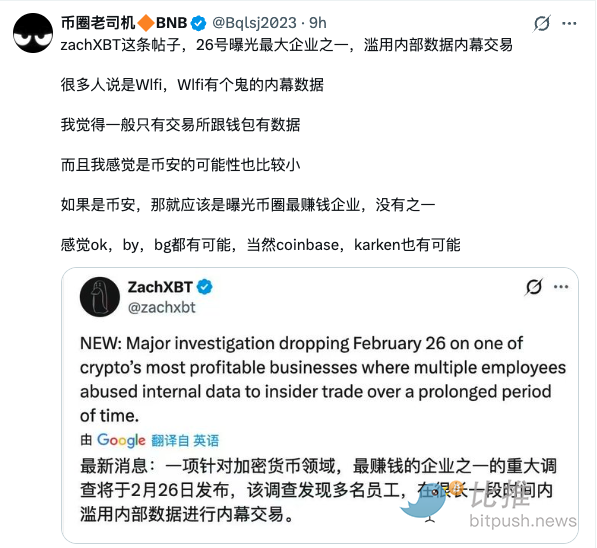
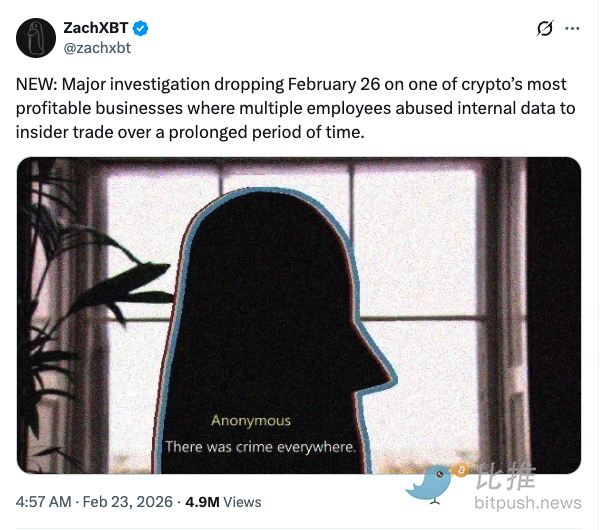
Crypto "Strict Father" is about to take action: Insider trading list locked in, to be revealed on the 26th!

Mining company Bitdeer with a market cap of $1.9 billion liquidates Bitcoin, sparking controversy


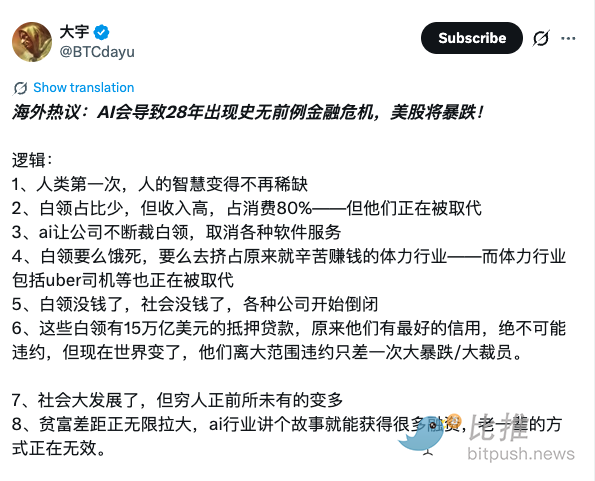
Hot topic overseas: Will AI trigger a financial crisis in 2028?

Click to read the full article:

https://www.bitpush.news/articles/7613842;

<极>https://www.bitpush.news/articles/7613859


Popular replies:

The first point about SaaS dying by mid-2026 is unreliable. Currently, AI accuracy is only 95% to 99%, and this is an inherent characteristic of GenAI. Which company is willing to bear this inaccuracy in mission-critical business? Would you dare use software generated by Vibe Code for tax filing? Would you dare use software generated by Vibe Code for building construction?;

For now, humans are cheaper than tokens. Try running a few tasks with lobsters; even simple ones like checking flight tickets are more expensive than humans;

First inflation, then deflation, but there is still a long period in between, depending on when AI productivity is realized and the race of capital expenditure;

AI will definitely bring huge unemployment and distribution crises, and may even trigger a severe recession. However, the most extreme scenario of an "unprecedented financial crisis + a sharp drop in US stocks" has a low probability of occurring in 2028 (20–30%?). What is more likely is "Japan-style long-term stagnation + class solidification + coexistence of inflation and asset bubbles;";

Since AI can raise a large amount of money just by telling a story, why don't these people switch to the AI industry?;

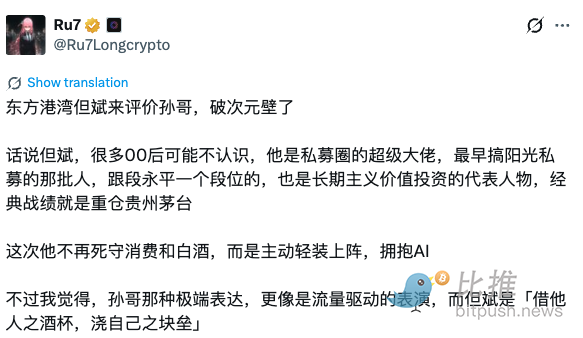
Private equity big shot Dan Bin comments on Brother Sun

Popular replies:

You can doubt Brother Sun's character, but you can't doubt the foresight of his investment philosophy. I remember listening to Brother Sun's podcast on喜马拉雅 in 2018, and many of the things he talked about have now come true;

Dan Bin is quite famous. His shift to investing in AI shows that he is also keeping up with new market trends;

Learning from the younger generation, I admire Dan Bin's breadth of vision and open-mindedness;


Twitter:https://twitter.com/BitpushNewsCN

Bitpush TG discussion group:https://t.me/BitPushCommunity

Bitpush TG subscription: https://t.me/bitpush

Original article link:https://www.bitpush.news/articles/7613895

Perguntas relacionadas

QWhat major cryptocurrency mining company sold off all its Bitcoin holdings, causing controversy?

ABitdeer, a mining company with a market capitalization of $1.9 billion, sold off all its Bitcoin holdings, sparking debate.

QAccording to the article, what potential global crisis is AI predicted to trigger by 2028?

AAI is predicted to potentially trigger an unprecedented financial crisis and a stock market crash by 2028, according to discussions among KOLs.

QWhat is the date mentioned for the revelation of a list related to insider trading in the crypto circle?

AThe list related to insider trading is scheduled to be unveiled on the 26th.

QWhich well-known private equity investor commented on 'Brother Sun' (Sun Yuchen) in the article?

ADan Bin, a prominent private equity investor, commented on 'Brother Sun' (Sun Yuchen).

QWhat is a key criticism mentioned in the popular replies regarding the current use of Generative AI (GenAI) in business?

AA key criticism is that GenAI's current accuracy is only 95-99%, and this inherent unreliability makes companies unwilling to use it for mission-critical tasks, as people are currently cheaper than AI tokens for many operations.


Leituras Relacionadas

OpenAI Post-Training Engineer Weng Jiayi Proposes a New Paradigm Hypothesis for Agentic AI

OpenAI engineer Weng Jiayi's "Heuristic Learning" experiments propose a new paradigm for Agentic AI, suggesting that intelligent agents can improve not just by training neural networks, but also by autonomously writing and refining code based on environmental feedback. In the experiment, a coding agent (powered by Codex) was tasked with developing and maintaining a programmatic strategy for the Atari game Breakout. Starting from a basic prompt, the agent iteratively wrote code, ran the game, analyzed logs and video replays to identify failures, and then modified the code. Through this engineering loop of "code-run-debug-update," it evolved a pure Python heuristic strategy that achieved a perfect score of 864 in Breakout and performed competitively with deep reinforcement learning (RL) algorithms in MuJoCo control tasks like Ant and HalfCheetah. This approach, termed Heuristic Learning (HL), contrasts with Deep RL. In HL, experience is captured in readable, modifiable code, tests, logs, and configurations—a software system—rather than being encoded solely into opaque neural network weights. This offers potential advantages in explainability, auditability for safety-critical applications, easier integration of regression tests to combat catastrophic forgetting, and more efficient sample use in early learning stages, as demonstrated in broader tests on 57 Atari games. However, the blog acknowledges clear limitations. Programmatic strategies struggle with tasks requiring long-horizon planning or complex perception (e.g., Montezuma's Revenge), areas where neural networks excel. The future vision is a hybrid architecture: specialized neural networks for fast perception (System 1), HL systems for rules, safety, and local recovery (also System 1), and LLM agents providing high-level feedback and learning from the HL system's data (System 2). The core proposition is that in the era of capable coding agents, a significant portion of an AI's learned experience could be maintained as an auditable, evolving software system.

marsbitHá 42m

OpenAI Post-Training Engineer Weng Jiayi Proposes a New Paradigm Hypothesis for Agentic AI

marsbitHá 42m

Your Claude Will Dream Tonight, Don't Disturb It

This article explores the recent phenomenon of AI companies increasingly using anthropomorphic language—like "thinking," "memory," "hallucination," and now "dreaming"—to describe machine learning processes. Focusing on Anthropic's newly announced "Dreaming" feature for its Claude Agent platform, the piece explains that this function is essentially an automated, offline batch processing of an agent's operational logs. It analyzes past task sessions to identify patterns, optimize future actions, and consolidate learnings into a persistent memory system, akin to a form of reinforcement learning and self-correction. The article draws parallels to similar features in other AI agent systems like Hermes Agent and OpenClaw, which also implement mechanisms for reviewing historical data, extracting reusable "skills," and strengthening long-term memory. It notes a key difference from human dreaming: these AI "dreams" still consume computational resources and user tokens. Further context is provided by discussing the technical challenges of managing AI "memory" or context, highlighting the computational expense of large context windows and innovations like Subquadratic's new model claiming drastically longer contexts. The core critique argues that this strategic use of human-centric vocabulary does more than market products; it subtly reshapes user perception. By framing algorithms with terms associated with consciousness, companies blur the line between tool and autonomous entity. This linguistic shift can influence user expectations, tolerance for errors, and even perceptions of responsibility when systems fail, potentially diverting scrutiny from the companies and engineers behind the technology. The article concludes by speculating that terms like "daydreaming" for predictive task simulation might be next, continuing this trend of embedding the idea of an "inner life" into computational processes.

marsbitHá 44m

Your Claude Will Dream Tonight, Don't Disturb It

marsbitHá 44m

Trading

Spot
Futuros
活动图片