Android Flaw Leaves 30 Million Crypto Wallets Open To Attack: Microsoft Analysts

bitcoinistPublicado em 2026-04-11Última atualização em 2026-04-11

Resumo

Microsoft analysts revealed a critical security flaw in the EngageLab SDK (v4.5.4), leaving over 30 million Android crypto wallets vulnerable to attack. The "intent redirection" vulnerability allowed a malicious app to bypass Android's sandbox and gain read/write access to a wallet's private data, including seed phrases and keys, without any user interaction. A patch (SDK 5.2.1) was released in mid-2025. Users who haven't updated their apps since then are advised to not only update but also move their funds to new wallets with fresh seed phrases, as any unpatched wallet is considered compromised. The flaw also affected over 50 million apps in total.

A patch has been available for nearly a year, but millions of Android users may still be running vulnerable crypto wallet apps — leaving their funds and private keys exposed to a known security flaw.

Microsoft’s Defender Security Research Team went public last week with details of a vulnerability it first caught in April 2025. The flaw lived inside a widely used software component called the EngageLab SDK, version 4.5.4.

Because that SDK is baked into thousands of Android apps, a single malicious app could trigger a chain reaction that reached far beyond itself.

How The Attack Works

The method is called “intent redirection.” An attacker’s app sends a specially crafted message to any app running the flawed SDK version. Once that message lands, the targeted app is tricked into handing over read and write access to its own data — including stored seed phrases and wallet addresses.
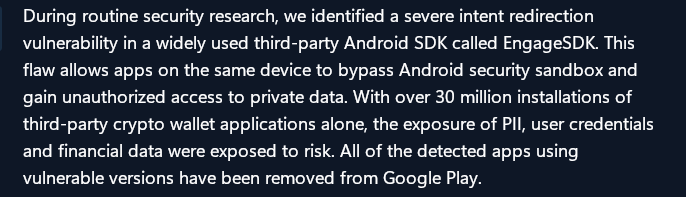
Source: Microsoft

Android’s built-in sandbox system, which normally keeps apps from seeing each other’s data, was bypassed entirely. According to Microsoft, the attack affected more than 50 million apps across the Android ecosystem, with roughly 30 million of those being crypto wallets.

The vulnerability did not require the user to do anything wrong. No suspicious links. No phishing pages. Just having the wrong apps installed at the same time was enough.
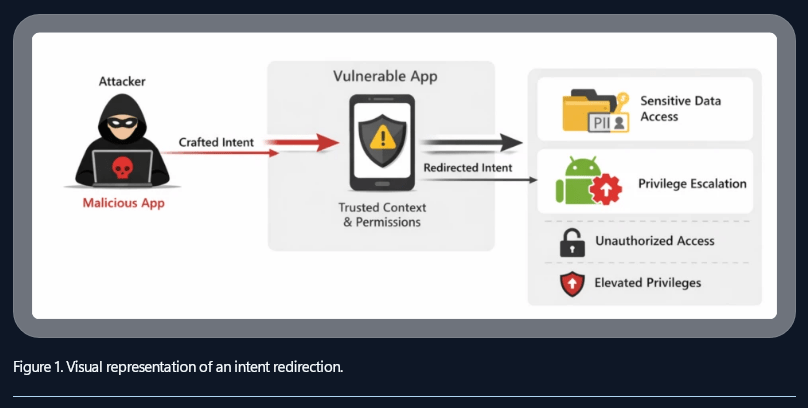
Source: Microsoft

Response From Microsoft And Google

Microsoft moved quickly after its discovery. By May 2025, the company had brought Google and the Android Security Team into the response. EngageLab released a fixed version — SDK 5.2.1 — shortly after.

Reports indicate that both Microsoft and Google have since directed users on how to verify whether their wallet apps have been updated through Google Play Protect.

BTCUSD trading at $72,906 on the 24-hour chart: TradingView

Officials also pointed to a broader concern: apps installed as APK files from outside the Play Store are at higher risk, since they bypass the security checks that Google applies to apps listed in its official marketplace.

What Users Should Do Now

For most users who update their apps regularly, the risk has likely passed. But for anyone who has not updated since mid-2025, the recommended action goes beyond a simple app refresh.

Security teams are advising those users to move their funds into entirely new wallets, generated with fresh seed phrases. Any wallet that was active and unpatched during the exposure window should be treated as potentially compromised.

The disclosure comes alongside a separate Android chip vulnerability flagged the previous month and a new US Treasury initiative that pairs government agencies with crypto firms to share cybersecurity threat information — a sign that mobile security in the crypto space is drawing attention at the highest levels.

Featured image from Bleeping Computer, chart from TradingView

Perguntas relacionadas

QWhat is the name of the vulnerable software component and which version was affected?

AThe vulnerable software component is the EngageLab SDK, specifically version 4.5.4.

QWhat is the attack method called and how does it work?

AThe attack method is called 'intent redirection.' A malicious app sends a specially crafted message to an app running the flawed SDK, tricking it into granting read and write access to its own data, including seed phrases and wallet addresses.

QHow many crypto wallet apps were estimated to be affected by this vulnerability?

ARoughly 30 million crypto wallet apps were estimated to be affected.

QWhat is the primary action recommended for users who had an unpatched wallet app?

AUsers are advised to move their funds into entirely new wallets generated with fresh seed phrases, as the old wallet should be treated as potentially compromised.

QWhich two major companies collaborated on the response to this vulnerability after its discovery?

AMicrosoft and Google (specifically the Android Security Team) collaborated on the response.

Leituras Relacionadas

For Hedging, Buy Gold and Oil; For Explosive Growth, Buy AI; Bitcoin, the 'Outdated' Asset, Enters a Bear Market

Bitcoin’s price has recently fallen sharply, hitting a two-month low near $66,000, with Ethereum also dropping to a three-month low. While surface explanations point to ETF outflows, geopolitical tensions, and corporate selling, a deeper issue is emerging: Bitcoin is losing a crucial asset competition. For years, Bitcoin thrived in a low-rate environment where investors sought alternatives amid inflation fears and dissatisfaction with traditional options. Now, the market landscape has shifted, leaving Bitcoin stuck in an "awkward middle ground," facing challenges on three fronts: 1. **As an inflation hedge, gold is winning.** Investors worried about persistent inflation are turning to tangible assets like gold, energy stocks, and commodity producers, which offer more direct pricing power and physical backing. 2. **For growth exposure, AI is winning.** Those seeking high growth now favor AI-related companies with actual revenues and profits, an area where Bitcoin's lack of cash flow puts it at a disadvantage. 3. **Within crypto, infrastructure and stablecoins are winning.** Even investors wanting crypto exposure have alternatives like exchanges, stablecoin issuers, and tokenization firms, whose performance is directly tied to real-world adoption and offers clearer operational leverage. The recent market reaction to inflation warnings highlights this shift. Instead of boosting Bitcoin as "digital gold," such news now drives flows toward traditional inflation-sensitive assets. Therefore, recent events like ETF outflows and corporate selling are seen not as causes, but as symptoms of this new reality. Capital has more compelling options, and investors are becoming more selective. The emerging bear case for Bitcoin is no longer about it being a fraud or failed technology, but rather that **scarcity alone is no longer enough**. It is no longer seen as the best hedge, the best growth asset, or the only crypto play.

marsbitHá 6m

For Hedging, Buy Gold and Oil; For Explosive Growth, Buy AI; Bitcoin, the 'Outdated' Asset, Enters a Bear Market

marsbitHá 6m

SaaS Battle Royale: The Survivors Who Win All Share One Common Trait

**Summary** The AI revolution has triggered a "SaaS apocalypse," forcing a brutal market shakeout. The key dividing line is the pricing model. Companies like Snowflake and Datadog, which charge based on consumption (e.g., data processed or compute used), are thriving. AI workloads actively *generate* more demand for their services, fueling growth. Datadog's accelerating revenue is a prime example. Microsoft and Palantir, as platform/ecosystem players, also benefit by acting as essential channels for AI deployment. In contrast, traditional SaaS firms built on per-seat or per-task licensing (e.g., Intuit, Adobe) face direct pressure, as AI threatens to automate the very human tasks their software supports. Companies like Salesforce, a per-seat giant, are caught in the middle. While showing strong AI monetization (e.g., its Agentforce platform) and experimenting with consumption-based "Flex Credits," its stock remains under pressure, illustrating that the market rewards *completed* transitions, not just the intent. The recent Microsoft Build conference underscored key trends: AI is evolving from an assistant to an autonomous "agent," and platform providers like Microsoft are consolidating their control. The market's recovery is highly selective, focused on identifying which companies are "fed by AI" versus "eaten by AI." Future focus will be on the diffusion of this recovery to transforming companies and the real-world adoption data of AI agents like Microsoft Copilot.

marsbitHá 23m

SaaS Battle Royale: The Survivors Who Win All Share One Common Trait

marsbitHá 23m

Trading

Spot
Futuros
活动图片





