Android Flaw Leaves 30 Million Crypto Wallets Open To Attack: Microsoft Analysts

bitcoinistPublicado em 2026-04-11Última atualização em 2026-04-11

Resumo

Microsoft analysts revealed a critical security flaw in the EngageLab SDK (v4.5.4), leaving over 30 million Android crypto wallets vulnerable to attack. The "intent redirection" vulnerability allowed a malicious app to bypass Android's sandbox and gain read/write access to a wallet's private data, including seed phrases and keys, without any user interaction. A patch (SDK 5.2.1) was released in mid-2025. Users who haven't updated their apps since then are advised to not only update but also move their funds to new wallets with fresh seed phrases, as any unpatched wallet is considered compromised. The flaw also affected over 50 million apps in total.

A patch has been available for nearly a year, but millions of Android users may still be running vulnerable crypto wallet apps — leaving their funds and private keys exposed to a known security flaw.

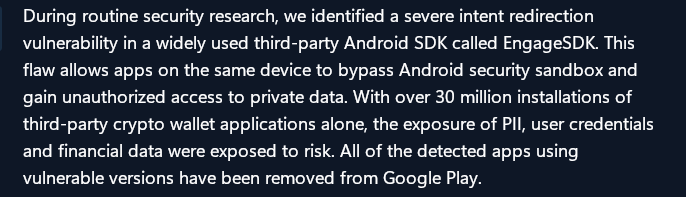
Microsoft’s Defender Security Research Team went public last week with details of a vulnerability it first caught in April 2025. The flaw lived inside a widely used software component called the EngageLab SDK, version 4.5.4.

Because that SDK is baked into thousands of Android apps, a single malicious app could trigger a chain reaction that reached far beyond itself.

How The Attack Works

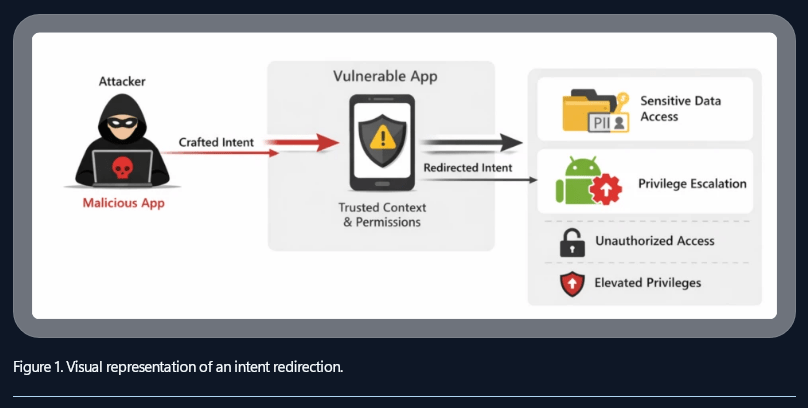
The method is called “intent redirection.” An attacker’s app sends a specially crafted message to any app running the flawed SDK version. Once that message lands, the targeted app is tricked into handing over read and write access to its own data — including stored seed phrases and wallet addresses.
Source: Microsoft

Android’s built-in sandbox system, which normally keeps apps from seeing each other’s data, was bypassed entirely. According to Microsoft, the attack affected more than 50 million apps across the Android ecosystem, with roughly 30 million of those being crypto wallets.

The vulnerability did not require the user to do anything wrong. No suspicious links. No phishing pages. Just having the wrong apps installed at the same time was enough.
Source: Microsoft

Response From Microsoft And Google

Microsoft moved quickly after its discovery. By May 2025, the company had brought Google and the Android Security Team into the response. EngageLab released a fixed version — SDK 5.2.1 — shortly after.

Reports indicate that both Microsoft and Google have since directed users on how to verify whether their wallet apps have been updated through Google Play Protect.

BTCUSD trading at $72,906 on the 24-hour chart: TradingView

Officials also pointed to a broader concern: apps installed as APK files from outside the Play Store are at higher risk, since they bypass the security checks that Google applies to apps listed in its official marketplace.

What Users Should Do Now

For most users who update their apps regularly, the risk has likely passed. But for anyone who has not updated since mid-2025, the recommended action goes beyond a simple app refresh.

Security teams are advising those users to move their funds into entirely new wallets, generated with fresh seed phrases. Any wallet that was active and unpatched during the exposure window should be treated as potentially compromised.

The disclosure comes alongside a separate Android chip vulnerability flagged the previous month and a new US Treasury initiative that pairs government agencies with crypto firms to share cybersecurity threat information — a sign that mobile security in the crypto space is drawing attention at the highest levels.

Featured image from Bleeping Computer, chart from TradingView

Perguntas relacionadas

QWhat is the name of the vulnerable software component and which version was affected?

AThe vulnerable software component is the EngageLab SDK, specifically version 4.5.4.

QWhat is the attack method called and how does it work?

AThe attack method is called 'intent redirection.' A malicious app sends a specially crafted message to an app running the flawed SDK, tricking it into granting read and write access to its own data, including seed phrases and wallet addresses.

QHow many crypto wallet apps were estimated to be affected by this vulnerability?

ARoughly 30 million crypto wallet apps were estimated to be affected.

QWhat is the primary action recommended for users who had an unpatched wallet app?

AUsers are advised to move their funds into entirely new wallets generated with fresh seed phrases, as the old wallet should be treated as potentially compromised.

QWhich two major companies collaborated on the response to this vulnerability after its discovery?

AMicrosoft and Google (specifically the Android Security Team) collaborated on the response.

Leituras Relacionadas

Interview with Robinhood Executive: Meme + Tokenized US Stocks as "Barbell" Customer Acquisition Strategy, All Business Lines Achieve Hundreds of Millions in Revenue

Interview with Robinhood executive Johann Kerbrat reveals the company's "barbell" customer acquisition strategy for its new Robinhood Chain, combining meme tokens with tokenized stocks. Three weeks after mainnet launch, the chain has seen over $3B in weekly DEX volume and 105M transactions. Kerbrat explains the logic behind the permissionless chain: meme tokens attract DeFi users, while tokenized real-world assets (RWA), currently over 90 US stocks and ETFs accessible in 120+ countries, serve global users. The goal is to bring Robinhood's 27 million funded accounts on-chain by simplifying DeFi with a user-friendly interface, exemplified by features like Robinhood Earn which offers yield without requiring wallet management. Built on Arbitrum's technology stack for its speed, low cost, and Ethereum's security, the chain focuses on financial products like Earn, spot trading, and perpetuals. Kerbrat downplays direct competition with platforms like Base, emphasizing the goal of expanding the overall market for on-chain assets. He details selective partnerships (e.g., Morpho, Lighter) based on compliance, unique UX, and differentiation. While regulatory clarity is pending for US perpetuals, the expansion continues via Bitstamp in Europe. Finally, Kerbrat positions Robinhood as a "super app" integrating stocks, options, crypto, banking, and AI trading, with all major business lines generating hundreds of millions in revenue. For the chain, current priority is driving adoption over maximizing gas fee revenue.

marsbitHá 33m

Interview with Robinhood Executive: Meme + Tokenized US Stocks as "Barbell" Customer Acquisition Strategy, All Business Lines Achieve Hundreds of Millions in Revenue

marsbitHá 33m

Fidelity Q3 Report: BTC, ETH, and SOL Continue to Build Bottoms; How Much Further Will This Crypto Bear Market Go?

Fidelity's Q3 Crypto Signal Report analyzes the current bear market, noting Bitcoin (BTC), Ethereum (ETH), and Solana (SOL) are in a prolonged bottoming phase. Key indicators like the weighted Net Unrealized Profit/Loss (NUPL) have turned negative (-0.01), signaling the market is slightly below its aggregate cost basis, with BTC acting as the primary stabilizing asset. BTC's dominance has risen to 68%, indicating a lack of capital rotation to other digital assets. Performance has been weak across the board, with BTC, ETH, and SOL down significantly year-to-date. Market sentiment is depressed, exacerbated by substantial outflows from spot ETPs and a challenging macro environment. The report compares the current ~203-day downtrend to historical ~300-day bottoming cycles, suggesting the process may be two-thirds complete, with late 2026 as a potential timeframe to monitor. For Bitcoin, NUPL at 0.09 indicates cautious sentiment, while momentum signals remain negative. The Yardstick metric points to potential undervaluation relative to network security (hashrate). Ethereum's NUPL is deep in the "capitulation" zone at -0.43, a historically positive signal for future returns, though its momentum and network fee revenue are negative. Solana shows the deepest NUPL at -0.72 but demonstrates relative resilience in on-chain activity and stablecoin transfer volume. The report concludes that while several metrics are near historical capitulation levels, a definitive market bottom has not yet been established. The path forward likely involves continued consolidation, with BTC's relative strength and fundamental on-chain usage for ETH and SOL providing key areas for investor observation.

marsbitHá 48m

Fidelity Q3 Report: BTC, ETH, and SOL Continue to Build Bottoms; How Much Further Will This Crypto Bear Market Go?

marsbitHá 48m

Trading

Spot
活动图片