Analyzing RENDER’s 11% surge: Is the momentum sustainable?

ambcryptoPublicado em 2026-04-03Última atualização em 2026-04-03

Resumo

Render (RENDER) surged 11.23% to $1.91, reaching a three-week high, with trading volume rising 48% to $81.5 million. Derivatives data showed strong bullish sentiment, as Open Interest increased by 21% to $60 million and the Long/Short Ratio rose to 1.28, indicating dominant long positions. However, spot netflow turned positive at $460k, suggesting increased selling pressure as profit-taking resumed. Technical indicators like the RSI at 64 and positive DMI signal strong upward momentum, but if profit-taking intensifies, RENDER could retrace to the $1.6 support level. Breaking the $2 resistance is possible if bullish conditions persist.

Render [RENDER] continued with its bullish streak, breaking out of the recent downtrend and summiting a three-week high of $1.92.

As of this writing, RENDER traded at $1.91, up 11.23% on the daily charts, adding to its 6% weekly gains. Over the same period, the altcoin’s volume rose 48% to $81.5 million, reflecting increased market participation.

RENDER speculators take hold of the market

While the market continued to suffer from reduced liquidity, RENDER has shown solid strength, consistent with active market participation.

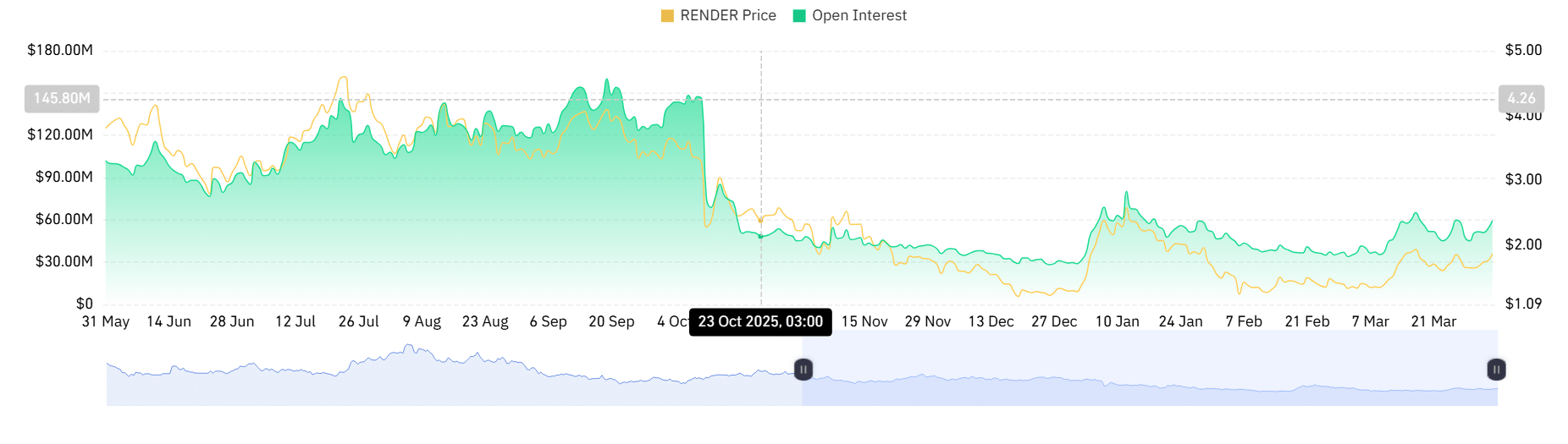
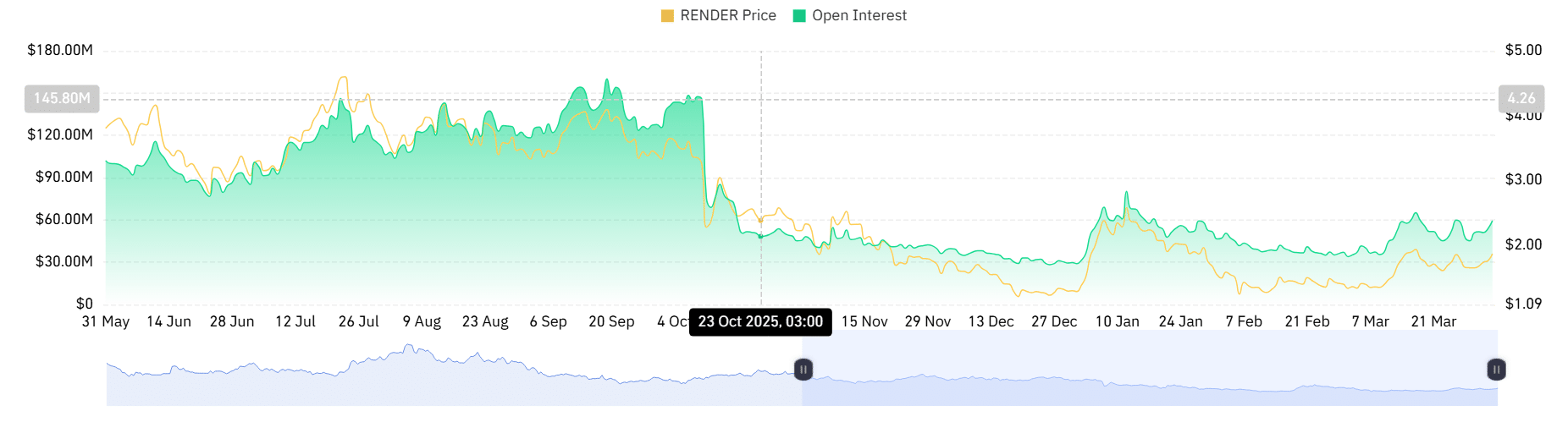
On the derivatives side in particular, RENDER has experienced sustained demand for Futures positions. CoinGlass data showed that altcoin Open Interest rose 21% to $60 million, while derivatives volume climbed 35% to $128 million.
Source: CoinGlass

Such a jump in OI and Volume showed increased Futures market participation and steady capital inflows. In fact, over $9 million flowed into the futures positions over the past eight hours as of the 3rd of April.

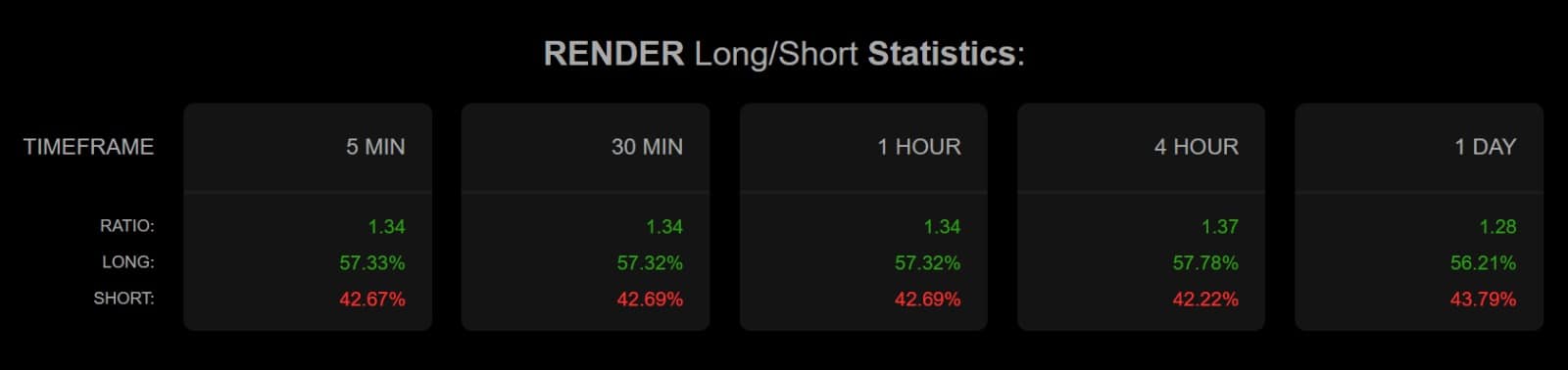
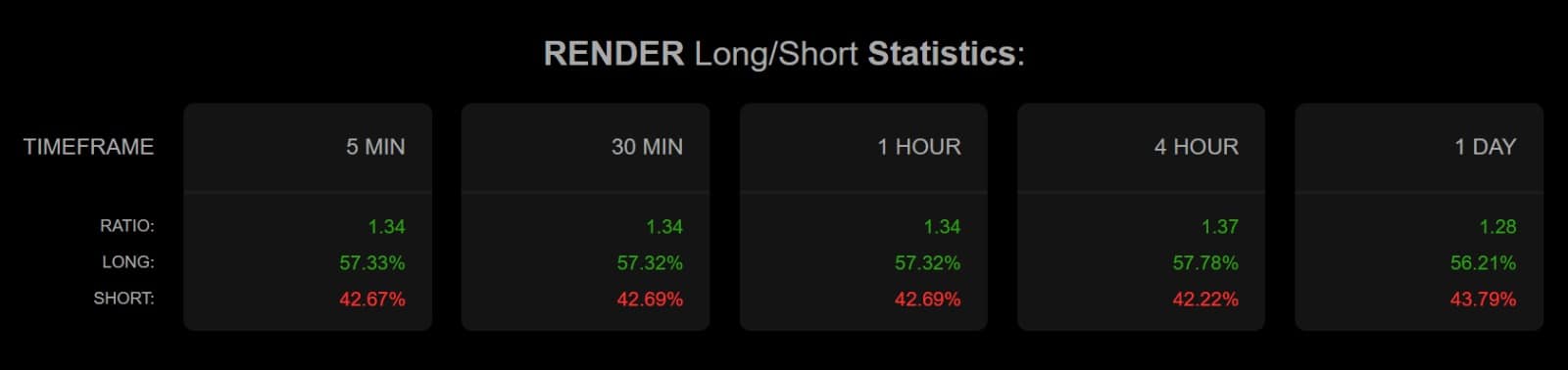
Meanwhile, the altcoin’s Long/Short Ratio rose to 1.28, signaling a higher demand for long positions. As such, longs accounted for 56%, while shorts accounted for 43% of the total Futures positions.
Source: Coinalyze

When longs dominate, it suggests that most participants were bullish and aggressively positioned for more gains.

Profit takers return to the market

With RENDER reaching a three-week high, holders who have been underwater rushed to cash out.

Looking at exchange activity, Spot Netflow turned positive after being negative for two consecutive days. At press time, Netflow was $460k, a significant reversal from -$507 the previous day.
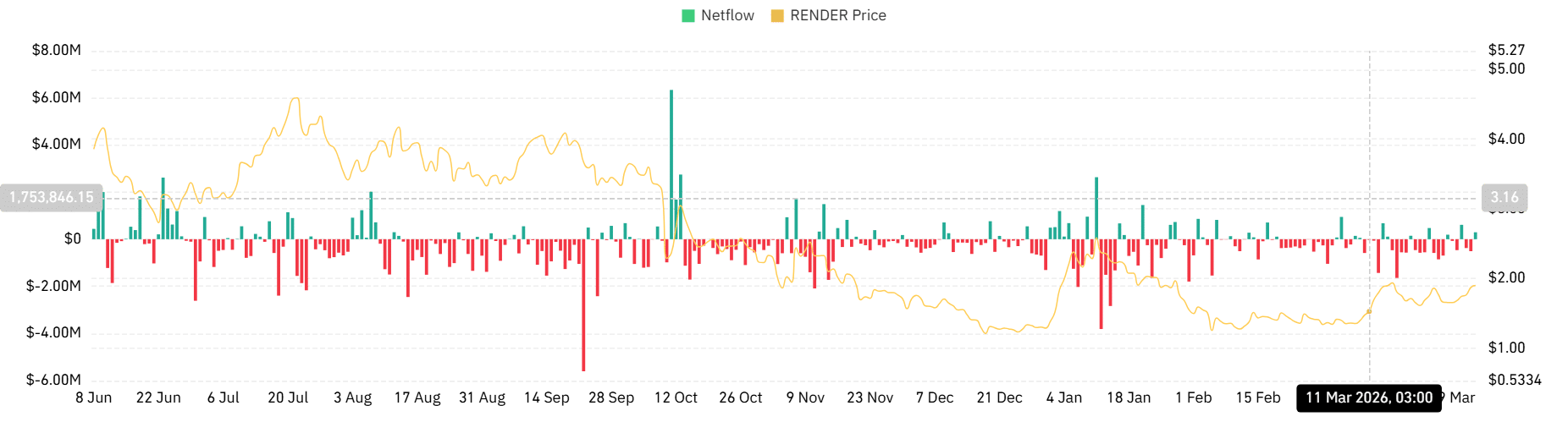
Source: CoinGlass

A positive netflow implied that the market saw more sellers than buyers. Such a shift in market behavior has historically weakened the market and led to pullbacks. Thus, extended profit realization could threaten recent gains and cause another slip.

Can the upside momentum hold?

RENDER has recorded a sustained week-long bullish momentum since it held the $1.6 support level. Buyers continually stepped in and defended higher price levels.

The altcoin’s Relative Strength Index (RSI) rose to 64, signaling strong upside momentum and buyer control of the market.

At the same time, the positive index of the Directional Movement Index (DMI) climbed to 27 while the negative index fell to 11. The rise in these two momentum indicators indicated strong upside momentum and confirmed the trend’s strength.
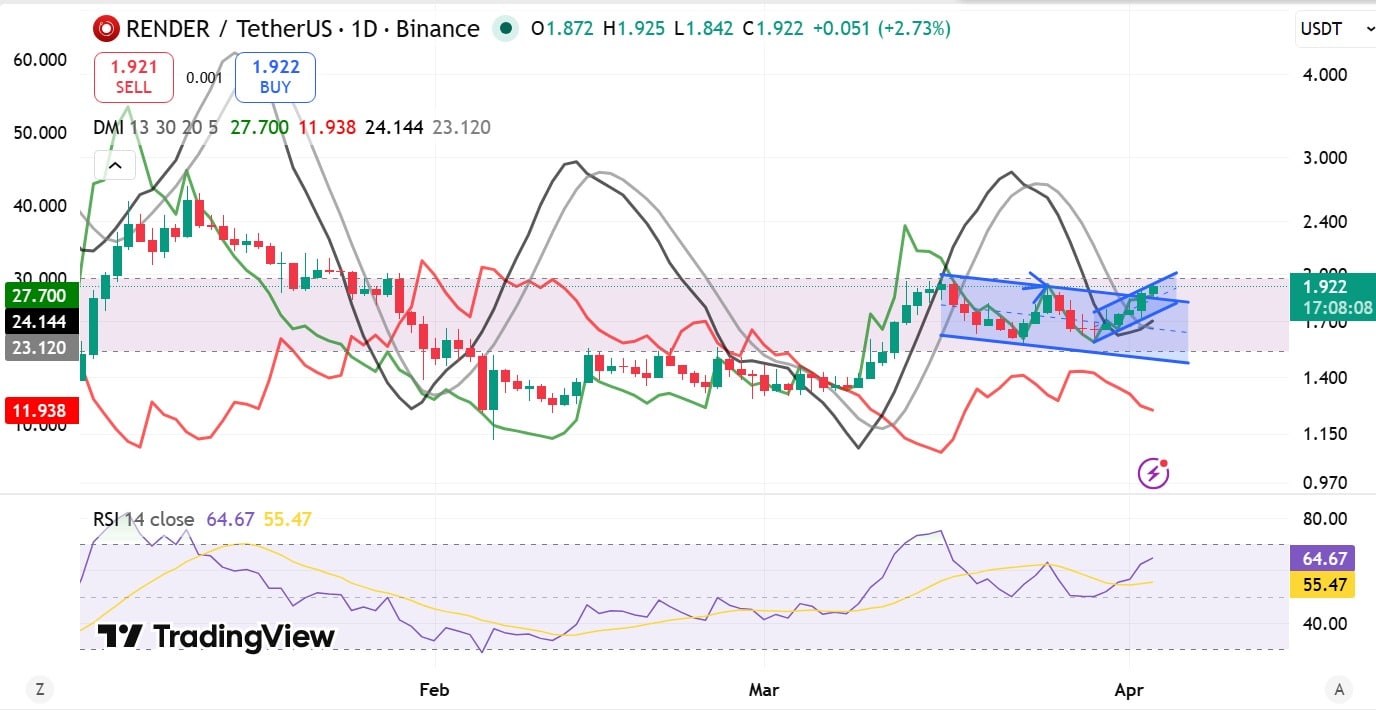
Source: Tradingview

Therefore, the two signals indicate a potential continuation of the market demand trend. While profit takers remain active, their positioning is still not strong enough.

If the prevailing market conditions hold, RENDER could flip its immediate resistance at $2. However, if profit-taking accelerates and overwhelms demand, the altcoin could retrace to $1.6.


Final Summary

  • RENDER surges 11%, touching a three-week high of $1.92 amid sustained demand.
  • RENDER has shown strong upside momentum amid sustained short-term demand, but profit-takers’ return risks capping market gains.


Perguntas relacionadas

QWhat was the price of RENDER and its percentage gain as mentioned in the article?

ARENDER traded at $1.91, up 11.23% on the daily charts.

QWhat does the Long/Short Ratio of 1.28 for RENDER indicate about market sentiment?

AA Long/Short Ratio of 1.28 signals a higher demand for long positions, with longs accounting for 56% of total Futures positions, indicating that most participants were bullish and positioned for more gains.

QWhat does a positive Spot Netflow value imply for the RENDER market?

AA positive Spot Netflow value of $460k implies that there were more sellers than buyers, which historically weakens the market and can lead to pullbacks due to profit realization.

QWhat key support level did RENDER hold to maintain its week-long bullish momentum?

ARENDER held the $1.6 support level, which allowed buyers to continually step in and defend higher price levels, sustaining the bullish momentum.

QAccording to the article, what are the two potential price scenarios for RENDER depending on market conditions?

AIf prevailing market conditions hold, RENDER could flip its immediate resistance at $2. However, if profit-taking accelerates and overwhelms demand, it could retrace to $1.6.

Leituras Relacionadas

OpenAI Post-Training Engineer Weng Jiayi Proposes a New Paradigm Hypothesis for Agentic AI

OpenAI engineer Weng Jiayi's "Heuristic Learning" experiments propose a new paradigm for Agentic AI, suggesting that intelligent agents can improve not just by training neural networks, but also by autonomously writing and refining code based on environmental feedback. In the experiment, a coding agent (powered by Codex) was tasked with developing and maintaining a programmatic strategy for the Atari game Breakout. Starting from a basic prompt, the agent iteratively wrote code, ran the game, analyzed logs and video replays to identify failures, and then modified the code. Through this engineering loop of "code-run-debug-update," it evolved a pure Python heuristic strategy that achieved a perfect score of 864 in Breakout and performed competitively with deep reinforcement learning (RL) algorithms in MuJoCo control tasks like Ant and HalfCheetah. This approach, termed Heuristic Learning (HL), contrasts with Deep RL. In HL, experience is captured in readable, modifiable code, tests, logs, and configurations—a software system—rather than being encoded solely into opaque neural network weights. This offers potential advantages in explainability, auditability for safety-critical applications, easier integration of regression tests to combat catastrophic forgetting, and more efficient sample use in early learning stages, as demonstrated in broader tests on 57 Atari games. However, the blog acknowledges clear limitations. Programmatic strategies struggle with tasks requiring long-horizon planning or complex perception (e.g., Montezuma's Revenge), areas where neural networks excel. The future vision is a hybrid architecture: specialized neural networks for fast perception (System 1), HL systems for rules, safety, and local recovery (also System 1), and LLM agents providing high-level feedback and learning from the HL system's data (System 2). The core proposition is that in the era of capable coding agents, a significant portion of an AI's learned experience could be maintained as an auditable, evolving software system.

marsbitHá 19m

OpenAI Post-Training Engineer Weng Jiayi Proposes a New Paradigm Hypothesis for Agentic AI

marsbitHá 19m

Your Claude Will Dream Tonight, Don't Disturb It

This article explores the recent phenomenon of AI companies increasingly using anthropomorphic language—like "thinking," "memory," "hallucination," and now "dreaming"—to describe machine learning processes. Focusing on Anthropic's newly announced "Dreaming" feature for its Claude Agent platform, the piece explains that this function is essentially an automated, offline batch processing of an agent's operational logs. It analyzes past task sessions to identify patterns, optimize future actions, and consolidate learnings into a persistent memory system, akin to a form of reinforcement learning and self-correction. The article draws parallels to similar features in other AI agent systems like Hermes Agent and OpenClaw, which also implement mechanisms for reviewing historical data, extracting reusable "skills," and strengthening long-term memory. It notes a key difference from human dreaming: these AI "dreams" still consume computational resources and user tokens. Further context is provided by discussing the technical challenges of managing AI "memory" or context, highlighting the computational expense of large context windows and innovations like Subquadratic's new model claiming drastically longer contexts. The core critique argues that this strategic use of human-centric vocabulary does more than market products; it subtly reshapes user perception. By framing algorithms with terms associated with consciousness, companies blur the line between tool and autonomous entity. This linguistic shift can influence user expectations, tolerance for errors, and even perceptions of responsibility when systems fail, potentially diverting scrutiny from the companies and engineers behind the technology. The article concludes by speculating that terms like "daydreaming" for predictive task simulation might be next, continuing this trend of embedding the idea of an "inner life" into computational processes.

marsbitHá 21m

Your Claude Will Dream Tonight, Don't Disturb It

marsbitHá 21m

Trading

Spot
Futuros

Artigos em Destaque

Como comprar RENDER

Bem-vindo à HTX.com!Tornámos a compra de RenderToken (RENDER) simples e conveniente.Segue o nosso guia passo a passo para iniciar a tua jornada no mundo das criptos.Passo 1: cria a tua conta HTXUtiliza o teu e-mail ou número de telefone para te inscreveres numa conta gratuita na HTX.Desfruta de um processo de inscrição sem complicações e desbloqueia todas as funcionalidades.Obter a minha contaPasso 2: vai para Comprar Cripto e escolhe o teu método de pagamentoCartão de crédito/débito: usa o teu visa ou mastercard para comprar RenderToken (RENDER) instantaneamente.Saldo: usa os fundos da tua conta HTX para transacionar sem problemas.Terceiros: adicionamos métodos de pagamento populares, como Google Pay e Apple Pay, para aumentar a conveniência.P2P: transaciona diretamente com outros utilizadores na HTX.Mercado de balcão (OTC): oferecemos serviços personalizados e taxas de câmbio competitivas para os traders.Passo 3: armazena teu RenderToken (RENDER)Depois de comprar o teu RenderToken (RENDER), armazena-o na tua conta HTX.Alternativamente, podes enviá-lo para outro lugar através de transferência blockchain ou usá-lo para transacionar outras criptomoedas.Passo 4: transaciona RenderToken (RENDER)Transaciona facilmente RenderToken (RENDER) no mercado à vista da HTX.Acede simplesmente à tua conta, seleciona o teu par de trading, executa as tuas transações e monitoriza em tempo real.Oferecemos uma experiência de fácil utilização tanto para principiantes como para traders experientes.

210 Visualizações TotaisPublicado em {updateTime}Atualizado em 2025.03.21

Como comprar RENDER

Discussões

Bem-vindo à Comunidade HTX. Aqui, pode manter-se informado sobre os mais recentes desenvolvimentos da plataforma e obter acesso a análises profissionais de mercado. As opiniões dos utilizadores sobre o preço de RENDER (RENDER) são apresentadas abaixo.

活动图片












