Analyst’s Bitcoin Price Crash Prediction From May 2025 Resurfaces And It Says The Bottom Is Not In

bitcoinistPublicado em 2026-02-09Última atualização em 2026-02-09

Resumo

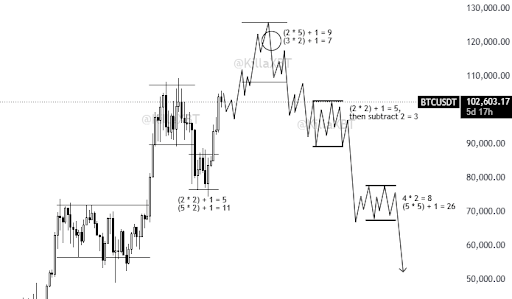
A previously published Bitcoin price crash projection from analyst KillaXBT, dating back to May 13, 2025, has regained attention for accurately predicting the current market downturn. The model uses rotational market mathematics to identify cycle stages—accumulation, distribution, and breakdown—and signaled that Bitcoin had not yet reached a macro bottom. The analysis highlighted key levels, including accumulation phases that fueled the rally and distribution zones near $115,000–$120,000 where exhaustion signals emerged. The chart correctly anticipated rejections at highs, fading momentum, and eventual breakdowns, with Bitcoin transitioning into mid-range consolidation around $100,000 before falling further. Currently, Bitcoin is trading in a lower distribution band near $70,000, with the model suggesting extended bearish consolidation. Relief rallies lack strength, and volatility remains high on declines. The projection indicates a potential capitulation toward $50,000 to complete the distribution phase, concluding that the true market bottom has not yet been established.

A previously published Bitcoin price crash projection from May 13, 2025, has re-entered market discourse after several prominent crypto traders on X recirculated the chart and commended the foresight behind the analysis from KillaXBT. The model mapped Bitcoin’s full cycle structure — from accumulation to distribution and breakdown — long before the current correction unfolded. Now, the same framework is signaling that Bitcoin has yet to establish a macro bottom.

Chart Signals That Nailed The Bitcoin Price Crash

KillaXBT’s framework is built on rotational market mathematics, measuring how many times price cycles are within a range before exhaustion. The analyst segmented Bitcoin’s structure into consolidation blocks and assigned swing counts to identify when liquidity had been fully absorbed.

In the early phase, accumulation rotations labeled “(2×2)+1 = 5” and “(5×2)+1 = 11” defined the base that ultimately fueled Bitcoin’s impulsive rally. These counts indicated that internal liquidity cycling was complete, clearing the path for expansion. Once that move matured, the price transitioned into a high-range consolidation beneath the cycle peak.

Inside the 115,000–120,000 distribution zone, the chart identified overlapping exhaustion clusters marked “(2×5)+1 = 9” and “(3×2)+1 = 7.” For traders, stacked counts at highs typically signal supply absorption. Although Bitcoin printed marginal higher highs, momentum was fading — a textbook late-stage distribution signal.
Source: Chart from KillaXBT on X

Market behavior followed that roadmap. Bitcoin formed repeated rejection wicks near the highs, upside momentum slowed, and breakout attempts failed to secure acceptance above resistance. Volume compression reinforced the distribution thesis. Instead of continuation, the price rolled over.

The model then mapped a transition into mid-range consolidation around the 100,000 psychological level, with BTCUSDT referenced near 102,603. Annotated “(2×2)+1 = 5, then subtract 2 = 3,” the structure signaled weakening bounce capacity. Price action mirrored the setup: multiple support tests, lower highs, and eventual breakdown — completing the crash phase outlined in the May 2025 forecast.

Bitcoin Price Could Drop Further Before Hitting Bottom

The resurfaced chart’s larger significance lies in its forward projection. After the six-figure range failed, the model guided Bitcoin into a lower distribution band around 70,000. This zone carried heavier rotational counts — “4×2 = 8” and “(5×5)+1 = 26” — implying extended consolidation within a bearish continuation framework.

Current market behavior continues to align with that structure. Bitcoin has already rotated into lower support territory following the 100K breakdown, while volatility has expanded on selloffs rather than recoveries. Relief rallies remain corrective, lacking the impulsive follow-through required to confirm bottom formation.

The chart’s final stage shows a potential capitulation toward the $50,000 area, marked by a sharp move below the lower range. Structurally, this is an unfinished downside that completes the current distribution phase.

The sequence is straightforward: accumulation pushed prices higher, the rise led to distribution, and now distribution is causing further breakdowns. Because no consolidation has shown the expansion profile typical of a macro base, the model maintains that the true bottom is not yet in.

BTC trading at $69,162 on the 1D chart | Source: BTCUSDT on Tradingview.com

Perguntas relacionadas

QWhat is the main prediction of the resurfaced Bitcoin price analysis from May 2025?

AThe analysis predicts that the Bitcoin price crash is not over yet and that the true macro bottom has not been established, with a potential further drop toward the $50,000 area.

QWho created the Bitcoin price projection model that is being discussed?

AThe model was created by an analyst known as KillaXBT.

QWhat key mathematical concept does KillaXBT's framework use to analyze Bitcoin's price action?

AThe framework is built on rotational market mathematics, measuring how many times price cycles are within a range before exhaustion, using formulas like (2x2)+1=5 to identify liquidity absorption and exhaustion clusters.

QAccording to the model, what was the significance of the distribution zone between $115,000 and $120,000?

AThis zone was identified as a high-range distribution area with overlapping exhaustion clusters, signaling supply absorption and marking a late-stage distribution phase before the price rolled over.

QWhat is the model's final projected stage for the current Bitcoin price cycle?

AThe model's final projected stage is a potential capitulation event, involving a sharp move below the lower consolidation range toward the $50,000 area to complete the current distribution phase.

Leituras Relacionadas

Bitcoin's 'Rally Ends,' Officially Entering the Later Stage of a Bear Market?

Bitcoin prices declined 13% this week, reversing the recent rebound and signaling a likely transition into the later stages of a bear market. Key on-chain metrics deteriorated, with the short-term holder cost basis falling below the Realized Price—a pattern last seen in early 2022, characteristic of bear market maturity. The rally to ~$82k proved to be a bear market bounce, as evidenced by the 90-day realized profit/loss ratio failing to sustain above the bullish threshold of 2. Daily realized losses surged to $1.35B, including significant selling from long-term holders who accumulated near cycle tops, indicating ongoing supply redistribution. Price was rejected almost precisely at the aggregate US spot ETF cost basis of ~$83k, turning that level into resistance and leaving the average ETF investor underwater again. Spot market selling pressure intensified, with the 7-day volume delta turning significantly negative to its weakest level since February. While a major long liquidation event cleared over $400M in leverage, spot demand has not yet stepped in to absorb the resulting supply. Options markets continue pricing in higher future volatility (elevated volatility risk premium) and maintain a skew toward put options, reflecting persistent demand for downside protection, though not yet panic. Overall, market structure remains fragile. Sustained recovery likely requires a reclaim of the ETF cost basis, a shift back to positive spot demand, and a slowdown in realized loss-taking. Until then, the market risks further downside or extended consolidation within the broader bear trend.

Foresight NewsHá 1h

Bitcoin's 'Rally Ends,' Officially Entering the Later Stage of a Bear Market?

Foresight NewsHá 1h

How Risky is the "Death Spiral" of MSTR and STRC?

Summary: This article explores the perceived "death spiral" risk between MicroStrategy (MSTR), its Bitcoin holdings, and its perpetual preferred stock (STRC), drawing comparisons to the LUNA-UST collapse. While both systems feature price anchors, high yields for holders, and potential feedback loops, their core mechanisms differ fundamentally. The MSTR-STRC structure relies on continuous financing to sustain its high dividend payouts, primarily through stock ATM offerings. A negative feedback cycle could occur: falling MSTR stock price makes raising equity capital harder, increasing pressure to sell Bitcoin, which undermines STRC confidence and further depresses MSTR. However, unlike LUNA-UST's automated, direct linkage, the MSTR-STRC loop is weaker and has brakes: STRC dividends can be deferred or rates lowered, and STRC holders have a $100/share liquidation preference in bankruptcy, providing a price floor. The company's sustainability hinges on its ability to continue financing. Its current ~$900 million USD reserves cover only about 6.3 months of its ~$1.71 billion annual interest/dividend burden. The next six months are critical, aligning with both the potential bottom in Bitcoin's four-year cycle and the depletion timeline of its reserves. While a LUNA-style catastrophic collapse is deemed highly unlikely due to structural differences, the key question is whether MicroStrategy can navigate this period through healthy deleveraging to restart its capital engine.

Foresight NewsHá 1h

How Risky is the "Death Spiral" of MSTR and STRC?

Foresight NewsHá 1h

Trading

Spot
Futuros
活动图片





