Analyst Shares Dogecoin Quantitative Roadmap To New All-Time Highs, Here’s What It Says

bitcoinistPublicado em 2026-03-19Última atualização em 2026-03-19

Resumo

Cryptocurrency analyst Cryptollica has shared a quantitative roadmap suggesting Dogecoin (DOGE) could reach new all-time highs. The analyst, DOGE is transitioning from a meme-driven asset to one gaining institutional interest. The roadmap identifies $0.08 as a critical "absolute bedrock" support level, where institutional buyers have historically absorbed selling pressure. Currently trading near this level, DOGE is quantitatively refusing to break lower. If the bear market extends, DOGE may bottom around $0.08 before a bullish reversal propels it above $0.50 by late 2026 or early 2027. The analyst highlights a "Terminal Apex" where downward momentum has exhausted, and pricing asymmetry is at a peak. Algorithms are accumulating supply while retail investors panic-sell. Two strategies are outlined: accumulating near current levels just above $0.08, or waiting for a confirmed breakout candle—though that may mean buying at a higher price. At the time of writing, DOGE is trading around $0.095, down over 5% in 24 hours.

Crypto analyst Cryptollica has shared a quantitative roadmap that could send Dogecoin to a new all-time high (ATH). This came as the analyst noted that DOGE is no longer a meme driven by internet culture and is now getting institutional attention.

The Dogecoin Quantitative Roadmap To A New ATH

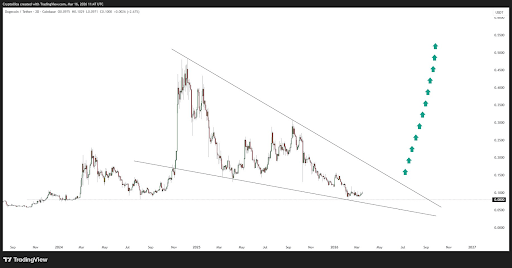
In an X post, Cryptollica shared a quantitative roadmap that could send Dogecoin to a new ATH. He noted that institutional quantitative models see DOGE as a perfectly engineered macroeconomic fractal while the retail crowd is paralyzed by micro-volatility. As part of this quantitative roadmap, the analyst pointed to the $0.08 level, which he described as an “absolute bedrock” and institutional floor for the meme coin.

Cryptollica noted a horizontal dotted axis at $0.08, while reiterating that this level was an impenetrable “Volumetric Bedrock” where smart money has historically placed massive absorption blocks. He added that Dogecoin’s price is currently resting directly on this mathematical floor, and is quantitatively refusing to break lower.
Source: Chart from Cryptollica on X

His accompanying chart showed that Dogecoin could bottom out at this level if the bear market extends into the latter part of this year. DOGE could then see a bullish reversal, sending it to new highs above $0.5.This rally above $0.5 is expected to happen between year-end and the start of 2027.

Key Indicators To Keep An Eye On

Cryptollica drew attention to the heavy descending black vector that is suppressing Dogecoin’s price against the $0.08 support. The analyst said that DOGE is now suffocating in a “Terminal Apex” and that the downward kinetic energy is dead. “There is literally zero room left for sideways movement,” he declared.

Furthermore, the analyst noted that a massive Descending Wedge resting perfectly on an absolute horizontal floor means that the pricing asymmetry is at its absolute peak. Cryptollica assured that the green vectors on his accompanying chart are not a guess but the systemic kinetic projection of the trapped energy. He claimed that algorithms are silently vacuuming the remaining supply while retail investors panic-sell.

With Dogecoin at the exact millimeter of the structural apex, Cryptollica outlined two algorithmic protocols that could determine investors’ next move. One is a front-run of the breakout, in which investors are gradually accumulating right now while the DOGE price is trading just above this $0.08 ‘bedrock’ support. The analyst said that the second move investors could make is to wait for the massive green breakout candle to confirm the trend and then end up buying higher because of a lack of conviction.

At the time of writing, the Dogecoin price is trading at around $0.09547, down over 5% in the last 24 hours, according to data from CoinMarketCap.

DOGE trading at $0.09 on the 1D chart | Source: DOGEUSDT on Tradingview.com

Perguntas relacionadas

QWhat is the key support level for Dogecoin according to analyst Cryptollica's quantitative roadmap?

AThe key support level is $0.08, which Cryptollica describes as an 'absolute bedrock' and institutional floor for Dogecoin.

QAccording to the analyst, what is the expected price target and timeframe for Dogecoin to reach a new all-time high?

AThe analyst expects Dogecoin to rally above $0.5, potentially reaching new all-time highs between year-end and the start of 2027.

QWhat two algorithmic protocols does Cryptollica outline for investors considering Dogecoin?

AThe two protocols are: 1) Front-running the breakout by gradually accumulating DOGE near the $0.08 support, or 2) Waiting for a massive green breakout candle to confirm the trend but potentially buying at higher prices.

QHow does Cryptollica characterize the current market behavior between institutions and retail investors regarding Dogecoin?

ACryptollica states that institutional quantitative models see DOGE as a perfectly engineered macroeconomic fractal, while retail investors are paralyzed by micro-volatility and are panic-selling, with algorithms vacuuming up the supply.

QWhat is the current trading price of Dogecoin mentioned at the end of the article?

AAt the time of writing, Dogecoin is trading at approximately $0.09547, down over 5% in the last 24 hours.

Leituras Relacionadas

Agents Take Over Traffic Distribution Power: What Are Tencent, ByteDance, and Alibaba Competing For?

In the race to dominate the AI era's entry point, China's tech giants—Tencent, ByteDance, and Alibaba—are aggressively deploying AI Agents to control the future of traffic distribution. Alibaba is pursuing a dual-track "closed loop + openness" strategy. Its Qianwen app is evolving into a super-Agent integrated across its ecosystem (Taobao, Alipay, etc.) to handle complex tasks like travel planning. Concurrently, it is opening its platform to external brands (Luckin Coffee, KFC) and has launched a B2B Agent platform, "Wukong," targeting enterprise automation. Its other flagship, Quark, aims to be an "AI super search box" for information and tasks. ByteDance is executing an omnipresent "sprawl strategy." Its Doubao app boasts over 300 million monthly active users and is evolving into a default AI entry point for daily life, with plans for paid versions and e-commerce integration. Its core weapon is the Kouzi platform, a visual "AI assembly factory" for developers to build custom Agents. ByteDance is also pushing hardware integration, collaborating on AI phones and developing smart glasses to embed Doubao everywhere. Tencent is playing its long-held "ultimate card" by quietly embedding an AI Agent directly into WeChat. This Agent, accessible via a swipe, can understand user commands and automatically execute tasks by calling upon WeChat's millions of mini-programs (e.g., finding and ordering coffee). This leverages WeChat's unparalleled 1.4-billion-user ecosystem to position the app as an AI-powered "service operating system," a move that could dramatically reshape the competitive landscape. The core battleground is shifting from competing for "user screen time" to competing to be the "default execution layer" for user intent. The business model is evolving from an "attention economy" to an "intent economy," where the Agent that can most efficiently fulfill a user's need gains control over service access and token flow. This represents a fundamental change in how users connect with digital services, making the fight for the Agent入口 (entry point) a pivotal moment for redefining industry leadership in the AI age.

marsbitHá 53m

Agents Take Over Traffic Distribution Power: What Are Tencent, ByteDance, and Alibaba Competing For?

marsbitHá 53m

From Banning Doubao to Embracing Honor: Why Did WeChat Suddenly 'Change Its Face'?

The article explores the sudden shift in WeChat's strategy towards AI assistants from mobile phone manufacturers, transitioning from strict opposition to active collaboration. For over a year, WeChat fiercely resisted attempts by phone AI assistants (like ByteDance's Doubao in late 2025) to control its features via GUI automation ("simulated clicking"), citing security and data control concerns. This stance created a significant barrier for system-level AI integration. Now, Tencent has initiated A2A (Agent-to-Agent) partnerships with major phone brands like Honor, Xiaomi, OPPO, and vivo. This model allows a phone's system AI (e.g., Honor's YOYO) to parse a user's voice command and send a structured request directly to WeChat's own internal AI agent via secure APIs. WeChat then executes the action (e.g., sending a message) and returns the result. The article attributes Tencent's "change of face" to strategic pressure. While leading in social app usage, Tencent trails rivals like ByteDance and Alibaba in standalone AI app popularity. WeChat, with its vast mini-program ecosystem, is Tencent's key asset for an AI comeback. The upcoming WeChat AI agent aims to handle tasks like booking and payments within the app. However, phone system assistants remain the primary AI entry point for most users. The A2A collaboration allows Tencent to extend WeChat's AI reach to this crucial system layer while maintaining control over its core functions and data. For phone manufacturers, embracing A2A is a pragmatic move. The GUI route proved unviable due to WeChat's blocks. A2A offers a compliant path to integrate a vital service, enhancing their AI assistants' usefulness. It allows them to focus on developing their own AI ecosystems for other services while cooperating on WeChat access. The collaboration is framed as a mutual, strategic necessity: Tencent gains a distribution channel, and manufacturers gain a key functionality. The partnership relies on a "dual authorization" mechanism for security, requiring both user and app consent for each action. While questions about long-term data privacy practices remain, experts note A2A is more secure and compliant than GUI automation. Ultimately, this cooperation is seen as a tentative, calculated truce. Tencent's long-term goal is to make WeChat an AI-powered "service OS." Phone manufacturers aim to make their system AI the central user interface. Their paths may converge or clash in the future, but for now, the A2A deal represents the opening chapter in the battle for the AI-era user入口, driven by necessity and strategic calculus on both sides.

marsbitHá 2h

From Banning Doubao to Embracing Honor: Why Did WeChat Suddenly 'Change Its Face'?

marsbitHá 2h

Trading

Spot
Futuros
活动图片