Analyst Says 3 Possible XRP Price Paths As XRPL Activity Explodes

bitcoinistPublicado em 2026-03-19Última atualização em 2026-03-19

The XRP price is showing signs of a recovery after breaking above the $1.4 resistance that had held it down for weeks. As the cryptocurrency attempts to climb even higher, market analysts remain divided on its next move, outlining three possible price paths. At the same time, the XRP Ledger (XRPL) is surging, with ecosystem usage reaching new levels. This spike in on-chain activity is helping to fuel new optimism and could play a key role in supporting XRP’s upward momentum.

Analyst Outlines Three Scenarios For The XRP Price

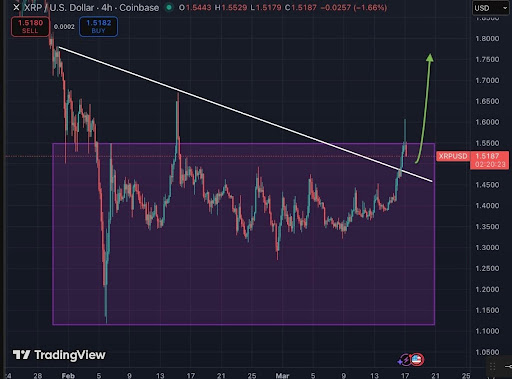
A crypto market analyst known as Bird on X has laid out three potential scenarios for the XRP price as the cryptocurrency traded around $1.52 at the time of the analysis. Despite experiencing a major rebound this week, XRP has given up much of those gains and is now back down to $1.46, reflecting a 4% decline in the last 24 hours, according to CoinMarketCap.

In his 4-hour chart, Bird shows that XRP has been grinding sideways since early February, with the XRP price respecting a descending trendline that has capped each recovery attempt. That trendline, drawn from the January highs near $1.85 to $1.45 in March, has now been decisively broken, with price briefly pushing toward $1.60 before pulling back.
Source: X

Following this reversal, XRP is now testing the upper boundary of a clearly defined range that has held it between roughly $1.15 and $1.55 for weeks. Bird marks this area as a purple rectangular zone on the chart, reflecting a broader accumulation range where bulls and bears have been battling.

With XRP now at a key inflection point, Bird has outlined three potential pathways currently shaping market sentiment. The first scenario points to a deeper pullback that sweeps recent lows before any meaningful rally materializes. The second path sees XRP climbing to $1.80 before entering another prolonged sideways period lasting months.

The third and most optimistic scenario suggests that XRP’s corrective phase could be complete, with the cryptocurrency now positioned for a bullish continuation higher without revisiting lower levels. Bird made his preference clear, stating that he hopes XRP takes the third path.

Supporting the bullish case, the analyst has also pointed to a notable uptick in on-chain activity across the XRP Ledger, alongside fresh news and narratives beginning to circulate about the project. He also flagged the timing around St. Patrick’s Day on March 21 as a possible calendar catalyst that could fuel near-term momentum.

XRP Ledger Surpasses 7.7 Million Holders

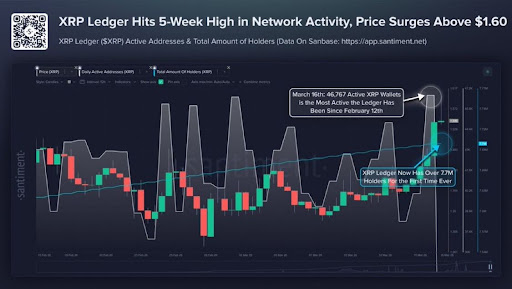
Expanding on the recent surge in the XRP Ledger, data from crypto analytics platform Santiment reveals that XRPL has exceeded 7.7 million holders for the first time since its 13-year history, as network participation continues to accelerate at a notable pace.
Source: Santiment

The milestone arrived alongside a sharp surge in daily active addresses. On March 16, active wallets reached 46,767, the highest level since February 12 and representing a five-week peak in network engagement. The activity spike also coincided with the XRP price jumping over 14% within a 48-hour window, pushing the cryptocurrency above $1.60.


XRP price retraces gains from earlier in the week | Source: XRPUSDT on Tradingview.com

Leituras Relacionadas

Stuck Polymarket: The Real Test After Riding the Traffic Boom Has Arrived

Polymarket, a leading prediction market platform, is facing significant technical challenges as its growth outpaces its current infrastructure on Polygon. Users are experiencing laggy transactions, unresponsive orders, and delayed confirmations, severely impacting the trading experience. In response, DeFi Engineering VP Josh Stevens outlined a comprehensive engineering overhaul. The plan includes reducing on-chain data delays, fixing order cancellation issues, rebuilding the central limit order book (CLOB), improving website performance, and developing a unified SDK and API. A major revelation was the ongoing "chain migration," indicating a potential move away from Polygon. The core issue is that Polymarket has evolved from a simple prediction market into a high-frequency trading platform, making Polygon's limitations—such as block space, gas fees, and block time—a ceiling for further growth. The migration is not just a simple chain switch but a fundamental rebuild of its trading system to support more complex products like perpetual contracts (Perps). This announcement has sparked competition among chains like Solana, Sui, and Algorand, all vying to host Polymarket. For Polygon, losing this key application, which contributes significantly to its gas fee revenue, would be a major setback. The real test for Polymarket is no longer attracting users but proving it can provide a stable, reliable trading environment that retains them.

Odaily星球日报Há 55m

Stuck Polymarket: The Real Test After Riding the Traffic Boom Has Arrived

Odaily星球日报Há 55m

Lowering Expectations for BTC's Next Bull Market

The author, Alex Xu, explains his decision to significantly reduce his Bitcoin holdings (from full to ~30% of his portfolio) during the current bull cycle, citing a lowered long-term outlook for BTC's price appreciation in the next cycle. He outlines six key reasons for this reduced expectation: 1. **Diminished Growth Drivers:** The narrative of exponential user adoption has largely played out with institutional ETF adoption. The next major growth phase—adoption by sovereign national reserves or central banks—seems unlikely in the near future. 2. **Personal Opportunity Cost:** More attractive investment opportunities have emerged in other assets, such as undervalued companies. 3. **Industry-Wide Contraction:** The broader crypto industry is struggling, with most Web3 business models (SocialFi, GameFi, DePIN) failing. This overall萧条 (depression) reduces the fundamental demand and consensus for Bitcoin. 4. **Strain on Major Buyer:** MicroStrategy, a major corporate buyer of BTC, faces rising financing expenses for its debt, which could slow its purchasing rate and create significant marginal pressure on the market. 5. **Increased Competition from Gold:** The emergence of "tokenized gold" has closed the functional gap (portability, divisibility) between physical gold and Bitcoin, offering a strong competitor in the non-sovereign store-of-value space. 6. **Security Budget Concerns:** The block reward halving continues to exacerbate the long-standing issue of funding Bitcoin's network security, with new fee source explorations like Ordinals and L2s largely failing. The author's decision to hold a significant (though reduced) position reflects a cautious, not bearish, outlook. He remains open to increasing his exposure if the fundamental reasons for his skepticism change or if new positive catalysts emerge.

marsbitHá 1h

Lowering Expectations for BTC's Next Bull Market

marsbitHá 1h

Can Iran 'Control' the Strait of Hormuz?

Iran has announced a comprehensive plan to assert control over the strategic Strait of Hormuz, a critical global oil shipping chokepoint. The proposed measures include requiring all vessels to obtain Iranian permission for passage, imposing fees for security, environmental protection, and navigation management—preferably paid in Iranian rials—and absolutely banning Israeli ships. Vessels from countries deemed hostile by Iran’s top security bodies may also be barred. Analysts suggest Iran’s motives are multifaceted: increasing pressure on the U.S. and Israel by leveraging control over oil transit to influence global prices and inflation; creating a new revenue stream, potentially exceeding $7.7 billion annually, to counter Western sanctions and support postwar reconstruction; and using transit permissions as bargaining chips in future negotiations, notably with the U.S. However, the plan faces significant practical and diplomatic challenges. Enforcing comprehensive interception and fee collection in the busy waterway, patrolled by international military forces, would be difficult. The U.S. has already countering with a blockade of Iranian ports and threats to intercept any ship paying fees, potentially strangling Iran’s oil exports and fee revenue. Broad international opposition, led by European and Gulf states, and legal controversies further complicate implementation. The proposal may ultimately serve more as a negotiating tactic than a feasible policy, with its execution remaining highly uncertain.

marsbitHá 2h

Can Iran 'Control' the Strait of Hormuz?

marsbitHá 2h

Trading

Spot
Futuros
活动图片




