An Expensive Fantasy: The Evaporation of Wealth in Metaverse Real Estate

比推Publicado em 2026-03-20Última atualização em 2026-03-20

Resumo

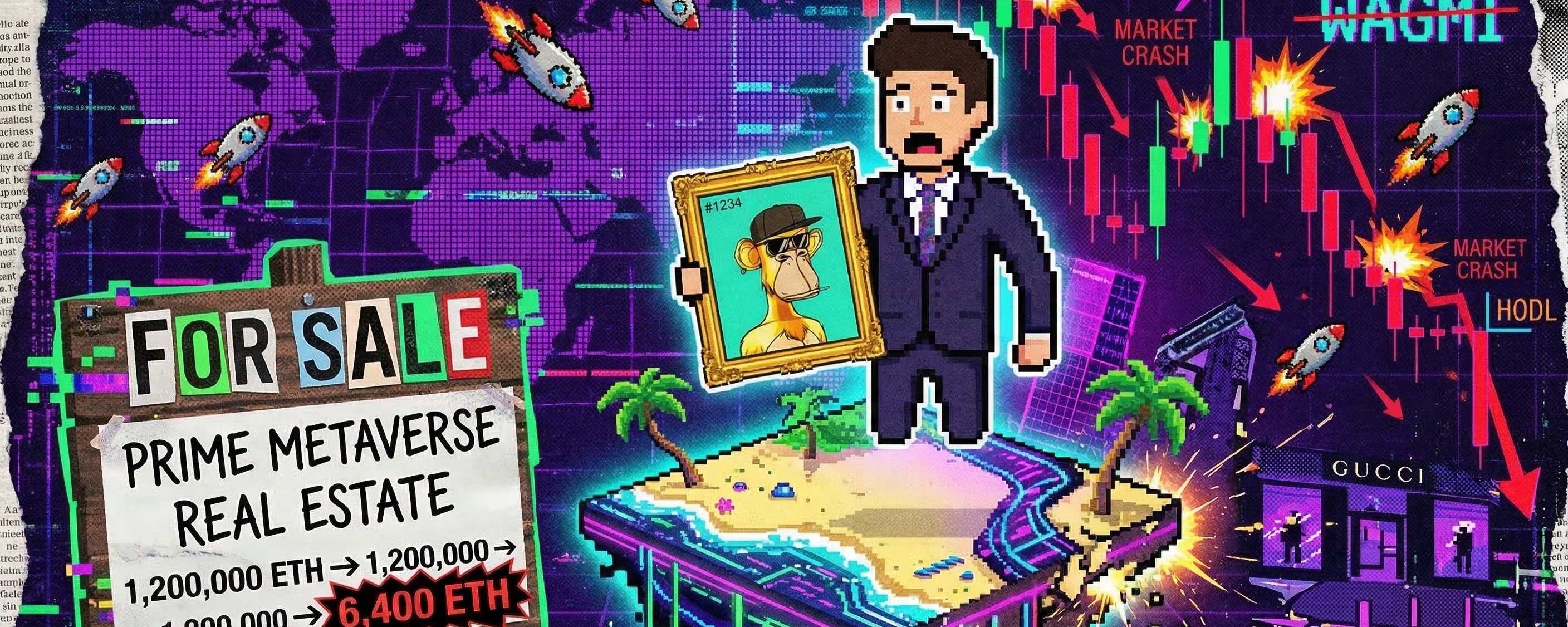
An investor recounts losing a $1.2 million fortune in the metaverse real estate crash, with their portfolio now valued at just $6,400. They purchased 11 virtual properties across platforms like Decentraland, The Sandbox, and Meta’s Horizon Worlds, driven by hype and promises of a digital frontier. Despite early enthusiasm, low user engagement, corporate pullouts (like Gucci), and platform shutdowns led to catastrophic value declines. The investor reflects on the culture of “diamond hands” (holding assets despite massive losses) and irrational optimism, while also noting losses from NFT investments like a Bored Ape. Meta’s $84 billion loss on its metaverse division underscores the speculative bubble’s collapse. The narrative concludes with a shift to AI-based virtual land investment, repeating the cycle of high-risk speculation.

Author: @gothburz

Compiled by: Big Pliers | PANews Lobster

Original Title: Metaverse Real Estate Victim's Account: My $1.2 Million Is Now Only $6,400


"Diamond hands" means: even if your investment drops by 94%, you never sell. We’ve packaged this financial paralysis as a personality trait.

My net worth peaked at $1.2 million.

But not a single cent of that money was real.

I’m not speaking philosophically. I mean, it existed on some servers—and those servers are now shut down.

I owned eleven properties in the metaverse. Three in Decentraland, four in The Sandbox, two in Voxels, one in Otherside. And a seaside villa in Horizon Worlds—I paid $214,000 for it because Mark Zuckerberg himself said it was the "next frontier."

Last week, that "frontier" closed.

It’s now a mobile app.

Last year, I sent the same message to 340 people: "You have no idea how early we were."

I stopped sending those messages later. Not because I admitted I was wrong, but because most of them had blocked me.

I entered the metaverse real estate market in November 2021. Everyone was buying back then. Someone spent $450,000 just to be Snoop Dogg’s neighbor in a game. In a video game. Where the avatars didn’t even have legs.

Yes, those avatars had no legs.

But I thought that was actually a good sign.

"Legs are coming eventually," I told everyone in the Discord group. "Legs are on the product roadmap." Three hundred people immediately replied with rocket emojis.

I gave myself a title—"Digital Real Estate Tycoon."

I put it in my Twitter bio.

I put it in my LinkedIn job title.

I even went on a podcast to talk about it. That podcast had eleven listeners. Three were bots. The rest were my own alt accounts.

My combined virtual properties were larger than my actual apartment.

But my actual apartment has furniture.

Location, location, location.

My most valuable asset was a plot right next to a virtual Gucci store.

In 2023, Gucci pulled out.

The store is still there. No one goes in. It’s like a shopping mall in Ohio—but with worse graphics and no food court.

I didn’t sell.

Diamond hands.

That’s what we always said—"diamond hands." It means: even if your investment drops by 94%, you never sell. We packaged this financial paralysis as a personality trait.

There was a guy in my Discord group who spent $2.4 million on a manor on a prime 618 plot in Decentraland. Prime location. High foot traffic.

I asked him what "foot traffic" meant on a platform with a daily active user count of 38.

He said I didn’t understand the technology.

He was right, I didn’t.

But I kept buying more.

We had a DAO—a decentralized autonomous organization. Meaning, everyone votes on decisions.

There were nine of us total. Three never showed up. Two voted on everything without reading the proposals. The other four were me and my alt accounts.

We voted to "acquire strategic plots."

Unanimously approved.

I cast four votes myself.

My portfolio peaked at $1.2 million. I told everyone. I made a spreadsheet. I predicted a 40x return by 2025. I made a business plan. One slide said:

"We are building a digital economy."

That slide had a rocket emoji.

That was my entire financial model.

In 2023, I spent $189,000 on a Bored Ape NFT.

Now it’s worth $14,000.

I don’t talk about that ape.

But I still use it as my profile picture. If someone asks, I say "I’m long-term bullish."

"Long-term bullish" means: if I sold, I’d cry in a Panera Bread.

My mom asked me what a Bored Ape was.

I said: "Digital art on the blockchain."

She asked why it was more expensive than her car.

I said: "You don’t understand Web3."

She said: "All I know is you live in a studio apartment."

She’s not in my Discord group.

Justin Bieber spent $1.3 million on one.

Now it’s probably worth around $90,000.

Hearing that made me feel better.

That’s the power of community.

WAGMI. We're All Gonna Make It.

We said it every day. In group chats. As the floor price kept dropping. As trading volume dried up. As 95% of NFT projects went to zero.

We’re all gonna make it.

None of us made it.

But we said it with absolute conviction, paired with laser-eye profile pictures. That has to count for something, right?

It doesn’t.

But we said it did. That’s called decentralized consensus.

Meta spent $84 billion on the metaverse.

Let me say that again.

$84 billion.

More than the GDP of Luxembourg. More than the combined GDPs of Iceland, Luxembourg, and Malta. They poured that money into a platform where avatars had no legs, the graphics looked like a 2006 Wii game, and the concurrent user count was lower than the lunch rush at a Chipotle in Des Moines.

They just removed Horizon Worlds from VR headsets.

It continues to exist as a mobile app.

My seaside villa is now a mobile app.

Location, location, location.

Zuckerberg renamed the entire company for this. Facebook became Meta. A $900 billion company changed its legal name because the CEO watched *Ready Player One* and said, "I want that."

Reality Labs division: lost $10 billion in 2021, $14 billion in 2022, $16 billion in 2023, $18 billion in 2024, $19 billion in 2025.

This isn’t strategy; it’s speedrunning.

This year, they laid off 1,500 employees from Reality Labs. Shut down three VR studios. Canceled Supernatural. Put the entire VR social vision in a coffin and announced: "We’re pivoting to AI and wearables."

This pivot took four years and burned $84 billion.

I pivoted too.

I’m now an AI real estate investor.

I bought a plot in an AI-generated virtual world that doesn’t exist yet. The founder said it’s at the "intersection of spatial computing and large language models."

I have no idea what that means.

I gave him $40,000.

He has a whitepaper, 47 pages. I read the title and the tokenomics section. That section was a pie chart. I love pie charts. They make everything look planned.

This project has a roadmap. Q1: Build community. Q2: Launch beta. Q3: Expand ecosystem. Q4: Blank.

Q4 is always blank.

That’s the slot reserved for the exit.

My accountant asked me to value my metaverse portfolio for tax purposes.

I said: $1.2 million.

He said: Current market value.

I said: $6,400.

He stared at me for eleven seconds.

I know because I counted.

He asked if I had any other investments.

I showed him my NFTs.

He stared longer.

I said these are "cultural artifacts with long-term provenance."

He asked if I had considered buying a 401(k).

I said 401(k)s are "legacy artifacts of traditional finance."

He told me to leave his office.

The metaverse is dead.

I don’t accept that.

I am a digital real estate tycoon. I own eleven properties across four platforms. I have a seaside villa that’s now a mobile app, a plot next to an empty Gucci store, and a cartoon monkey that cost more than my actual car.

Location, location, location.

This location is nothingness.

But I was early.

I’m always early.

It’s the same thing as being wrong—just said with more confidence.


Twitter:https://twitter.com/BitpushNewsCN

Bitpush TG Discussion Group:https://t.me/BitPushCommunity

Bitpush TG Subscription: https://t.me/bitpush

Original article link:https://www.bitpush.news/articles/7621504

Perguntas relacionadas

QWhat was the peak value of the author's metaverse real estate portfolio, and what is its current estimated value?

AThe peak value of the author's metaverse real estate portfolio was $1.2 million. Its current estimated value is $6,400.

QAccording to the author, what does the term 'diamond hands' mean in the context of their investment strategy?

AAccording to the author, 'diamond hands' means refusing to sell an investment even after it has fallen by 94%, a form of financial paralysis that was packaged as a personality trait.

QWhich major company invested heavily in the metaverse, how much did it lose, and what was the consequence for the author's property?

AMeta (formerly Facebook) invested heavily in the metaverse, losing over $100 billion across several years. A consequence for the author was that their $214,000 Horizon Worlds 'ocean-view villa' was moved from VR to a mobile app after the platform was shut down on VR headsets.

QWhat expensive NFT did the author purchase and what is the significant difference between its purchase price and its current value?

AThe author purchased a Bored Ape Yacht Club (BAYC) NFT for $189,000. It is now worth approximately $14,000, representing a significant loss.

QWhat ironic justification does the author use for their continued investment in digital assets despite the massive financial losses?

AThe author ironically justifies their continued investment by claiming they were 'early,' which they state is the same thing as being wrong, but said with more confidence.

Leituras Relacionadas

The Shutdown of Claude Mythos Revealed the True Cost of Renting AI to Me

The sudden shutdown of Claude Mythos this week starkly highlights a critical, often overlooked risk for founders: when your core capability relies entirely on someone else's platform, your fate is not in your own hands. The key question becomes: who truly owns the intelligence your product depends on? For years, the debate around open-source models focused on cost. Now, the evidence is clear: fine-tuned open-source models can achieve frontier-level quality for specific, mission-critical tasks at a fraction of the cost. However, the deeper issue is control. Relying on a third-party API is like renting; it works until the landlord changes the rules, raises the rent, or asks you to leave—as Mythos experienced. The lesson is not to stop using frontier models—they are incredible infrastructure. The goal is ownership. Ownership means starting with a powerful open-source model and shaping it around what makes your company unique: your data, workflows, domain expertise, and definition of "good." Over time, the model becomes less generic and more reflective of your business, creating durable value. The optimistic conclusion is that AI's future doesn't hinge on one superior model. There is no single frontier. The frontier includes proprietary models, models fine-tuned on company-specific knowledge, specialized models for narrow problems, and intelligent routers orchestrating model ensembles. The most interesting development is not models getting smarter, but intelligence becoming increasingly customizable. The winning companies will be those that transform intelligence into a unique, owned asset. Looking ahead, the vision is not one model dominating all, but many teams owning the part of the frontier that matters most to them.

marsbitHá 29m

The Shutdown of Claude Mythos Revealed the True Cost of Renting AI to Me

marsbitHá 29m

Tiger Research: U.S. Strategic Bitcoin Reserve - Should the Market Be Happy or Disappointed?

Tiger Research analyzes the evolution of U.S. legislative efforts regarding a strategic Bitcoin reserve, concluding the market impact is limited in the short term but potentially positive long-term. The core event was a March 2025 executive order by former President Trump, which designated confiscated Bitcoin as a strategic reserve and promised not to sell existing holdings (approx. 190k BTC). As it contained no mandate to purchase new Bitcoin, the market reacted negatively, with prices dropping 5.7%. Legislative history shows a significant retreat from initial ambitions. The 2024 "BITCOIN Act" proposed mandatory purchases of 1 million BTC over five years. Reintroduced in 2025, it stalled due to high fiscal costs, concerns over dollar hegemony, and opposition from the Treasury Secretary. The current frontrunner, the 2026 "American Retirement and Monetary Advancement (ARMA) Act," is a compromise. It lacks any purchase requirement, instead focusing on consolidating existing government-held Bitcoin and legally prohibiting its sale for at least 20 years. While ARMA has higher passage odds due to bipartisan support and no purchase mandate, its immediate market effect is neutral. It eliminates potential government selling pressure but creates no new demand. The long-term significance is that formally establishing Bitcoin as a national reserve asset in law could later reignite debates on mandatory purchases. Therefore, the path to a government buyer is longer than initially priced by the market, but the directional narrative remains intact.

marsbitHá 32m

Tiger Research: U.S. Strategic Bitcoin Reserve - Should the Market Be Happy or Disappointed?

marsbitHá 32m

US Stock Market Trend (June 16): SpaceX Rises 42% in Two Days, New Fed Chairman Takes Office Today

**U.S. Stocks Trend (June 16): SpaceX Soars 42% in Two Days, New Fed Chair Takes Office Today** Markets surged on Monday following former President Trump's social media announcement of a completed U.S.-Iran deal to reopen the Strait of Hormuz, pending a June 19 signing. The news triggered a broad risk-on rally: oil prices crashed, tech stocks soared, bond yields fell, and defensive sectors lagged. **Market Performance:** The Nasdaq jumped 3.07%, led by semiconductor stocks like Micron (+9.2%). The S&P 500 gained 1.65%, and the Dow rose 0.92% to a record high. However, the Russell 2000 small-cap index underperformed (+0.72%). SpaceX continued its hot streak, rising another 5% pre-market after disclosures of large buys by an Australian billionaire and Cathie Wood's ARK. Boeing also rallied on the transportation optimism. Conversely, energy stocks like Chevron fell over 3% on the oil price plunge, with other defensive sectors also selling off. The day's action showed a clear rotation of funds from energy/defensive plays into AI and tech narratives. **Macro & Outlook:** The VIX fear index fell 8.37%. Treasury yields declined, and WTI crude dropped over 5%. Attention now shifts to a packed schedule: the Bank of Japan is widely expected to hike rates to 1.0% on Tuesday. The Fed's June meeting concludes Wednesday, marking new Chair Wash's debut. While rates are expected to hold, his tone on stubborn inflation and the "dot plot" will be crucial for gauging the 2024 rate path. The formal Iran deal signing is set for Friday. **Trend Perspective:** While the peace deal is a genuine positive, Monday's explosive rally may have gotten ahead of itself, pricing in a swift resolution to inflation concerns. The shortened trading week faces a triple test: BoJ tightening, the Fed's policy stance, and deal implementation details. Tech and semiconductors, which led the surge, remain vulnerable to any disappointment from these key events. The real price discovery begins with the central banks' communications this week.

marsbitHá 53m

US Stock Market Trend (June 16): SpaceX Rises 42% in Two Days, New Fed Chairman Takes Office Today

marsbitHá 53m

Trading

Spot
Futuros
活动图片