An App Made for 1000 RMB Now Valued at 10 Million

marsbitPublicado em 2026-01-12Última atualização em 2026-01-12

Resumo

Three post-95s developers spent 1,000 RMB and less than a month to create an app called “Died Yet?” — now valued at 10 million RMB. The app allows users to check in daily to confirm they are alive. If a user misses two consecutive check-ins, the system automatically sends an email to their emergency contact. Launched on January 8, it quickly topped Apple’s paid app chart at 8 RMB per download. Paying users grew 200-fold in days. A capital offer followed: the founders are considering selling 10% equity for 1 million RMB, implying a 10 million RMB valuation. The app taps into a real anxiety: China has over 120 million people living alone, a number expected to reach 200 million by 2030. The app’s viral name, “Died Yet?”, originated from an online meme and was key to its success. A copycat app, “Alive Yet?”, emerged within 24 hours, but the founders argue the concept—not the tech—is the core value. The piece contrasts this with crypto valuations, citing Fuel Network—a project once valued at $1 billion with minimal users, now down 99%—to highlight different valuation models: one driven by real users and payments, the other by narrative and tokenomics. The author concludes that “Died Yet?” offers more tangible value than most speculative assets.

Written by: Curry, Shenchao TechFlow

Three post-95s spent 1000 RMB and took less than a month to create an App.

Now it's valued at 10 million. A ten-thousand-fold increase.

This App is called "Is He Dead", and its function is ridiculously simple: open it every day and check in to prove you're still alive. If you don't check in for two consecutive days, the system automatically sends an email to your emergency contact.

That's it?

Yeah, that's it.

On January 8th, it topped the Apple paid charts, costing 8 RMB to download. Founder Mr. Guo said that the number of paying users has increased 200-fold in the past few days and is still rising.

Capital came knocking. Mr. Guo said he plans to sell 10% of the shares for 1 million RMB. Doing the math, that's a valuation of 10 million.
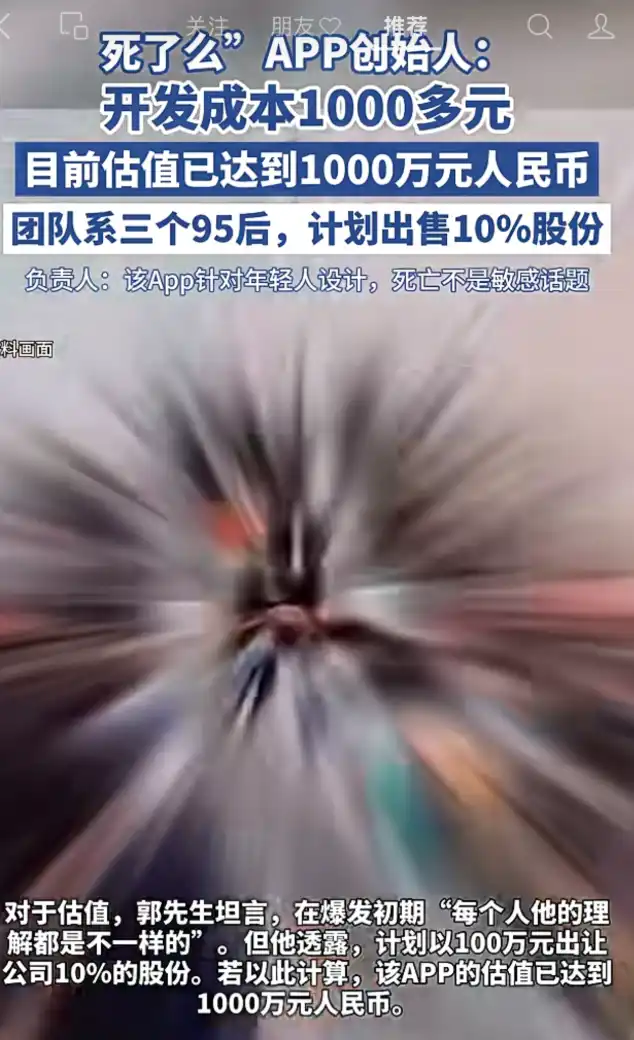
The name "Is He Dead" comes from a viral internet meme a few years ago.

Someone asked on a social platform: What App does everyone need and will definitely download?

A highly upvoted answer: Is He Dead.

Mr. Guo and his team saw this discussion and thought it had potential. They went to trademark the name and found that surprisingly, no one had registered it.

So they made it.

Why did something so simple become popular?

China's solo-living population exceeded 120 million in 2024. By 2030, it's projected to be 150 to 200 million. These people live in rental apartments in cities like Beijing, Shanghai, Guangzhou, and Shenzhen, sharing a common, very real anxiety:

If something happens to me at home one day, how long will it take for someone to find out? So, 8 RMB buys the confirmation that "someone knows I'm still alive."

Less than 24 hours after "Is He Dead" went viral, a copycat appeared.

An App called "Is He Alive" was listed on the Apple App Store, with exactly the same function, free to download.
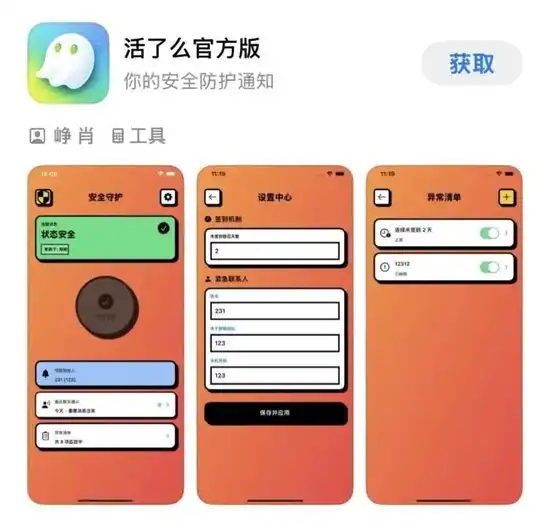
In response, Mr. Guo was very calm: The advantage of this product is not its technical barrier, but its discovery of user needs.

Translation: You can copy the function, but you can't copy my name.

Indeed. The three words "Is He Dead" are the most valuable part of this product. If it had been called "Solo Living Safety Guard," it would probably still be gathering dust in a corner of the App Store.

Looking back, an APP with no technical barrier, costing 1000 RMB, valued at 10 million, is that expensive?

Well, you might want to look at the valuation methods once used in the crypto industry?

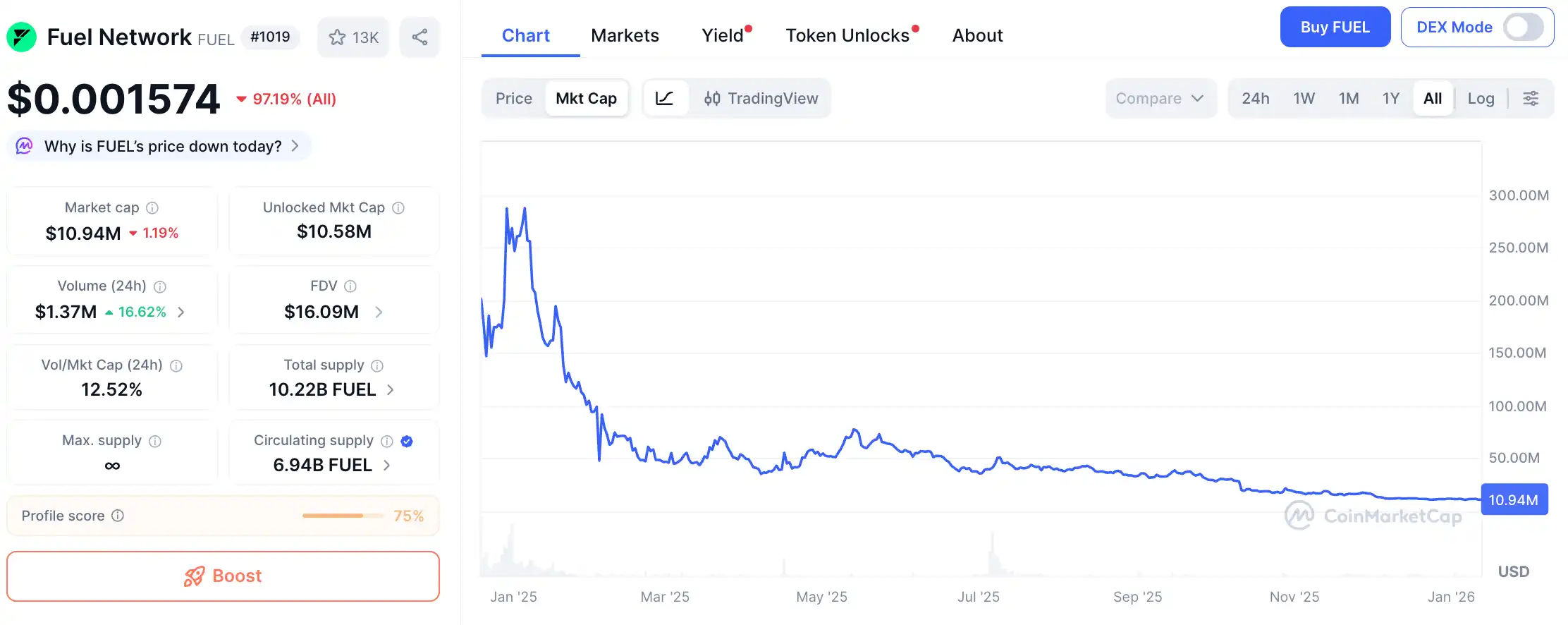
In 2025, there was a crypto project called Fuel Network, working on a "modular blockchain execution layer." VCs gave it a valuation of 1 billion USD, roughly over 7 billion RMB.

700 times the valuation of "Is He Dead".

What does Fuel Network have?

A whitepaper, a roadmap, endorsements from a bunch of Tier1 institutions, videos of the founders speaking at major conferences.

But not many people actually using it.

What is Fuel Network's market cap now? Around 16 million USD. Down about 99% from its peak.
I'm not saying all crypto projects are scams.

I'm saying:

In the crypto world, a project can have no users, no revenue, no one actually using it, and still get a valuation of 1 billion USD.

In the world of "Is He Dead", you need people to actually pay 8 RMB to download it for it to count.

One gives a valuation first and then looks for users. The other has users first and then discusses valuation.

Which is more reasonable? I don't know.

What's more absurd is that the logic of "Is He Dead" is almost heresy in the crypto world.

You tell everyone: We have real users, real payments, solving a real need.

People will definitely ask: What's the narrative? The token economic model? What's the FDV?

You say: No token, just selling the App, 8 RMB each.

Everyone: Then why would I invest in you?

This isn't a joke. The crypto industry's valuation system operates like this.

Users aren't important, revenue isn't important; what's important is whether the story is sexy enough, whether the token can list on major exchanges, and whether the unlock schedule is long enough for early investors to have time to dump.

If "Is He Dead" issued a token, created a "Solo Living Chain", and painted a big picture of the "global loneliness economy", its valuation might really increase tenfold.

But then, it might not have real users anymore.

Perhaps the reason "Is He Dead" became popular is precisely because it serves people who have this anxiety but don't actually need it that badly.

The people who truly need it probably can't use it.

This is actually quite similar to the crypto industry:

Those who truly need "financial inclusion" are often the ones who can least use DeFi.

In the end, whether 10 million is expensive depends on what ruler you use.

Using the internet ruler: one month of development, a team of three, no funding, no burning cash, reaching number one on the paid charts, 10 million is not expensive.

Using the crypto ruler: no token, no narrative, no FDV, only 10 million? That's too cheap. How about issuing a token?

I think the most ironic point is the divide between Web2 and Web3:

In one world, "having users" is a prerequisite for valuation. In another world, "having users" is an accident of valuation.

After writing this, I actually downloaded "Is He Dead" and checked in.

8 RMB for peace of mind.

At least it's more reliable than most of the shitcoins I've bought.

Perguntas relacionadas

QWhat is the name of the app developed by three post-95s with an initial cost of 1000 RMB, and what is its core function?

AThe app is called '死了么' (translated as 'Is It Dead'). Its core function is to allow users to sign in daily to prove they are alive. If a user fails to sign in for two consecutive days, the system automatically sends an email to their emergency contact.

QHow much did the app '死了么' cost to download, and what was its performance on the Apple paid charts?

AThe app cost 8 RMB to download. It reached number one on the Apple paid charts on January 8th.

QWhat is the estimated valuation of the '死了么' app, and how was this valuation determined?

AThe app has an estimated valuation of 10 million RMB. This was determined as the founder, Mr. Guo, plans to sell 10% of the company's shares for 1 million RMB.

QAccording to the article, what is the valuation approach in the crypto industry contrasted with that of the '死了么' app?

AIn the crypto industry, projects can receive high valuations based on narratives, token economic models, and backing from institutions, even without real users or revenue. In contrast, the '死了么' app's valuation is based on actual user downloads and payments, emphasizing real user demand.

QWhat ironic point does the article make about the target audience of the '死了么' app and its similarity to the crypto industry?

AThe article points out that the app likely serves people who have the anxiety of being found in case of an emergency but don't truly need it, while those who genuinely need it might not use it. This is similar to the crypto industry, where those who truly need 'financial inclusion' are often the least able to use DeFi.

Leituras Relacionadas

Must-Watch Events Next Week|CLARITY Act Could Face Senate Vote; SpaceX, Circle to Report Earnings (8.3-8.9)

**Summary: Key Events and Developments to Watch (August 3-9)** The upcoming week is marked by significant financial disclosures, key legislative deadlines, and notable product updates. **Major Financial Events:** Several companies are scheduled to release their Q2 2026 earnings. American Bitcoin (ABTC) will report on August 3, followed by SpaceX and Hut 8 Mining Corp. on August 4, and Circle on August 5. Notably, a significant portion of SpaceX shares (up to 12% of total shares) will be unlocked on August 6 following their earnings release. **Key Legislative Deadline:** The U.S. Senate faces an August 7 deadline to secure 60 votes for the CLARITY Act, a bipartisan bill aiming to establish a federal regulatory framework for cryptocurrencies. The Senate may hold a full vote on the bill during the week. **Economic Data:** The U.S. July Non-Farm Payrolls report will be released on August 7, providing crucial labor market data. **Technology & Product Updates:** * **Shutdowns:** DeFi portfolio tracker Zapper and wallet app Ctrl Wallet will cease operations on August 3. * **Upgrades:** LayerZero will deprecate its v1 relayers on August 3. XRP Ledger's new version 3.3.0, featuring five new functions, is expected next week. * **AI:** Elon Musk announced that the advanced Grok 4.6 AI model is set for release around August 7. * **Bitcoin:** The BIP-110 forced signaling for a potential Bitcoin network change is scheduled to begin around August 8. **Other Notable Events:** Chinese robotics firm Unitree Tech has set its preliminary price inquiry for its IPO for August 5. South Korean exchange Upbit will delist AQT and AERGO tokens on August 3.

marsbitHá 1h

Must-Watch Events Next Week|CLARITY Act Could Face Senate Vote; SpaceX, Circle to Report Earnings (8.3-8.9)

marsbitHá 1h

Stocks Are Plummeting More Sharply Than Cryptocurrencies. Where Has the Money Gone?

Stock Markets Plunge Deeper Than Cryptocurrencies: Where Did the Money Go? In late July, Seoul's Kospi index triggered circuit breakers for two consecutive days, plummeting over 40% from its June high. The collapse was led by heavyweight stocks like SK Hynix, whose record profits still disappointed investors, and devastating leveraged ETFs, with one major product losing over 83% of its value. This signaled a global, forced deleveraging targeting the most crowded trades. Interestingly, while stocks exhibited extreme volatility akin to crypto markets, Bitcoin rose nearly 15% in July after a prior steep drop. Analysis shows the money fleeing equities did not flow into Bitcoin. Instead, Bitcoin had already absorbed its sell-off in May-June, when U.S. spot Bitcoin ETFs saw historic outflows. The true safe-haven beneficiary was gold, whose price rose over 20% year-on-year, highlighting a decoupling between Bitcoin and gold as "digital gold." The sell-off was a targeted unwinding of leveraged positions in tech and semiconductors, accelerated by broker-dealer risk management and shifts in the AI narrative, including new competition from Chinese memory chipmakers. The retreat path was clear: from high-valuation tech stocks to cash and U.S. Treasuries, then to gold. For Bitcoin to attract sustained institutional inflows, conditions like eased global liquidity pressure, a "soft-landing" Fed rate cut, and U.S. regulatory clarity via legislation like the stalled CLARITY Act are needed. Currently, Bitcoin is not a safe haven but an already-cleared asset. Its low correlation with tech stocks, however, makes it a potential diversification play for institutional portfolios once the storm passes. The money isn't here yet, but the positioning is underway.

marsbitHá 1h

Stocks Are Plummeting More Sharply Than Cryptocurrencies. Where Has the Money Gone?

marsbitHá 1h

In Conversation with Ray Dalio: We Are Currently in an AI Bubble, with 1% of My Portfolio in Bitcoin

Ray Dalio, founder of Bridgewater Associates, warns in an interview that the current AI boom shows classic bubble characteristics, which could lead to significant economic downturns as seen in past cycles like 1929 or 2000. He explains that speculative enthusiasm, fueled by debt and overvaluation, often precedes a crash when rising rates or taxation force asset sales, causing widespread losses and recession. Dalio also outlines his "Big Cycle" theory, describing an approximate 80-year pattern where widening wealth gaps, massive government deficits, and shifting geopolitical power (like China's rise) create internal conflict and global instability. He emphasizes that we are in a late-cycle, transitional phase where traditional powers like the US and UK face decline. For personal wealth protection, Dalio advises diversification beyond cash into assets like stocks, bonds, real estate, and particularly gold, which he prefers over Bitcoin. While he holds about 1% of his portfolio in Bitcoin as a non-printable hard asset, he views gold as more secure from technological or governmental threats. Regarding AI's impact, Dalio believes it will disproportionately benefit capital owners, worsening inequality by replacing both physical and cognitive labor. He suggests that human intuition and emotional intelligence, combined with AI, will be key for future workers. On taxation, Dalio argues that wealth taxes are impractical and risk triggering asset sell-offs, reducing productive investment. He points to the UK as a cautionary example of debt, low productivity, and political strife. Geopolitically, Dalio foresees a more regionalized world, with the US showing weakness in prolonged conflicts like with Iran, akin to past imperial declines. The ideal outcome, he suggests, is coexisting powerful blocs (e.g., Americas, China-Asia Pacific) without major war.

marsbitHá 4h

In Conversation with Ray Dalio: We Are Currently in an AI Bubble, with 1% of My Portfolio in Bitcoin

marsbitHá 4h

Trading

Spot
活动图片





