An App Made for 1000 RMB Now Valued at 10 Million

marsbitPublicado em 2026-01-12Última atualização em 2026-01-12

Resumo

Three post-95s developers spent 1,000 RMB and less than a month to create an app called “Died Yet?” — now valued at 10 million RMB. The app allows users to check in daily to confirm they are alive. If a user misses two consecutive check-ins, the system automatically sends an email to their emergency contact. Launched on January 8, it quickly topped Apple’s paid app chart at 8 RMB per download. Paying users grew 200-fold in days. A capital offer followed: the founders are considering selling 10% equity for 1 million RMB, implying a 10 million RMB valuation. The app taps into a real anxiety: China has over 120 million people living alone, a number expected to reach 200 million by 2030. The app’s viral name, “Died Yet?”, originated from an online meme and was key to its success. A copycat app, “Alive Yet?”, emerged within 24 hours, but the founders argue the concept—not the tech—is the core value. The piece contrasts this with crypto valuations, citing Fuel Network—a project once valued at $1 billion with minimal users, now down 99%—to highlight different valuation models: one driven by real users and payments, the other by narrative and tokenomics. The author concludes that “Died Yet?” offers more tangible value than most speculative assets.

Written by: Curry, Shenchao TechFlow

Three post-95s spent 1000 RMB and took less than a month to create an App.

Now it's valued at 10 million. A ten-thousand-fold increase.

This App is called "Is He Dead", and its function is ridiculously simple: open it every day and check in to prove you're still alive. If you don't check in for two consecutive days, the system automatically sends an email to your emergency contact.

That's it?

Yeah, that's it.

On January 8th, it topped the Apple paid charts, costing 8 RMB to download. Founder Mr. Guo said that the number of paying users has increased 200-fold in the past few days and is still rising.

Capital came knocking. Mr. Guo said he plans to sell 10% of the shares for 1 million RMB. Doing the math, that's a valuation of 10 million.
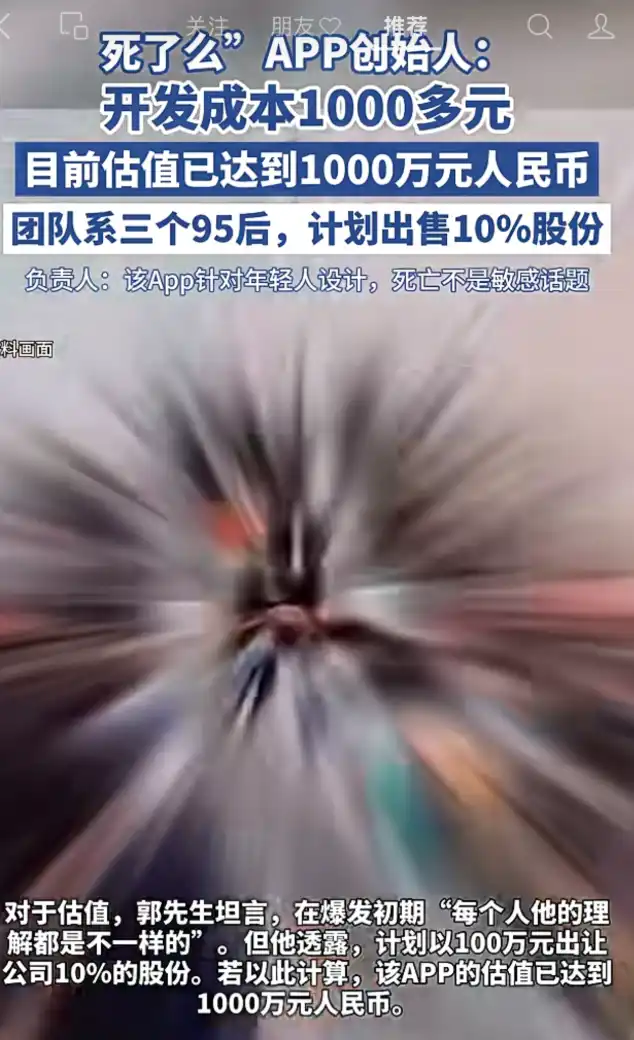
The name "Is He Dead" comes from a viral internet meme a few years ago.

Someone asked on a social platform: What App does everyone need and will definitely download?

A highly upvoted answer: Is He Dead.

Mr. Guo and his team saw this discussion and thought it had potential. They went to trademark the name and found that surprisingly, no one had registered it.

So they made it.

Why did something so simple become popular?

China's solo-living population exceeded 120 million in 2024. By 2030, it's projected to be 150 to 200 million. These people live in rental apartments in cities like Beijing, Shanghai, Guangzhou, and Shenzhen, sharing a common, very real anxiety:

If something happens to me at home one day, how long will it take for someone to find out? So, 8 RMB buys the confirmation that "someone knows I'm still alive."

Less than 24 hours after "Is He Dead" went viral, a copycat appeared.

An App called "Is He Alive" was listed on the Apple App Store, with exactly the same function, free to download.
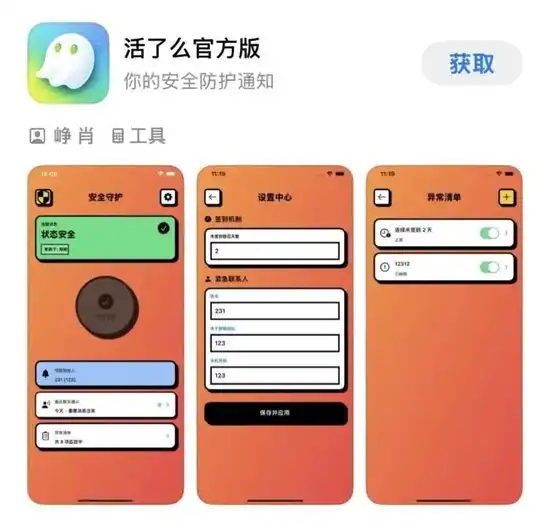
In response, Mr. Guo was very calm: The advantage of this product is not its technical barrier, but its discovery of user needs.

Translation: You can copy the function, but you can't copy my name.

Indeed. The three words "Is He Dead" are the most valuable part of this product. If it had been called "Solo Living Safety Guard," it would probably still be gathering dust in a corner of the App Store.

Looking back, an APP with no technical barrier, costing 1000 RMB, valued at 10 million, is that expensive?

Well, you might want to look at the valuation methods once used in the crypto industry?

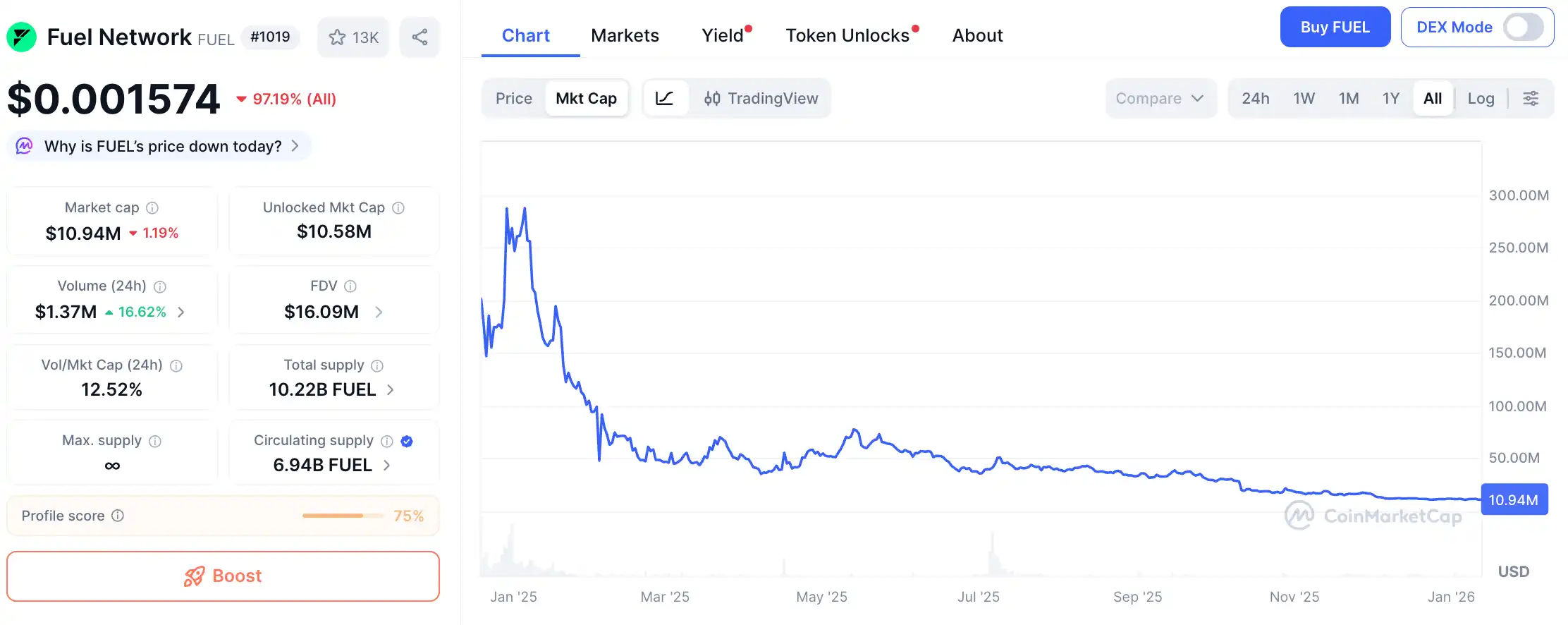
In 2025, there was a crypto project called Fuel Network, working on a "modular blockchain execution layer." VCs gave it a valuation of 1 billion USD, roughly over 7 billion RMB.

700 times the valuation of "Is He Dead".

What does Fuel Network have?

A whitepaper, a roadmap, endorsements from a bunch of Tier1 institutions, videos of the founders speaking at major conferences.

But not many people actually using it.

What is Fuel Network's market cap now? Around 16 million USD. Down about 99% from its peak.
I'm not saying all crypto projects are scams.

I'm saying:

In the crypto world, a project can have no users, no revenue, no one actually using it, and still get a valuation of 1 billion USD.

In the world of "Is He Dead", you need people to actually pay 8 RMB to download it for it to count.

One gives a valuation first and then looks for users. The other has users first and then discusses valuation.

Which is more reasonable? I don't know.

What's more absurd is that the logic of "Is He Dead" is almost heresy in the crypto world.

You tell everyone: We have real users, real payments, solving a real need.

People will definitely ask: What's the narrative? The token economic model? What's the FDV?

You say: No token, just selling the App, 8 RMB each.

Everyone: Then why would I invest in you?

This isn't a joke. The crypto industry's valuation system operates like this.

Users aren't important, revenue isn't important; what's important is whether the story is sexy enough, whether the token can list on major exchanges, and whether the unlock schedule is long enough for early investors to have time to dump.

If "Is He Dead" issued a token, created a "Solo Living Chain", and painted a big picture of the "global loneliness economy", its valuation might really increase tenfold.

But then, it might not have real users anymore.

Perhaps the reason "Is He Dead" became popular is precisely because it serves people who have this anxiety but don't actually need it that badly.

The people who truly need it probably can't use it.

This is actually quite similar to the crypto industry:

Those who truly need "financial inclusion" are often the ones who can least use DeFi.

In the end, whether 10 million is expensive depends on what ruler you use.

Using the internet ruler: one month of development, a team of three, no funding, no burning cash, reaching number one on the paid charts, 10 million is not expensive.

Using the crypto ruler: no token, no narrative, no FDV, only 10 million? That's too cheap. How about issuing a token?

I think the most ironic point is the divide between Web2 and Web3:

In one world, "having users" is a prerequisite for valuation. In another world, "having users" is an accident of valuation.

After writing this, I actually downloaded "Is He Dead" and checked in.

8 RMB for peace of mind.

At least it's more reliable than most of the shitcoins I've bought.

Perguntas relacionadas

QWhat is the name of the app developed by three post-95s with an initial cost of 1000 RMB, and what is its core function?

AThe app is called '死了么' (translated as 'Is It Dead'). Its core function is to allow users to sign in daily to prove they are alive. If a user fails to sign in for two consecutive days, the system automatically sends an email to their emergency contact.

QHow much did the app '死了么' cost to download, and what was its performance on the Apple paid charts?

AThe app cost 8 RMB to download. It reached number one on the Apple paid charts on January 8th.

QWhat is the estimated valuation of the '死了么' app, and how was this valuation determined?

AThe app has an estimated valuation of 10 million RMB. This was determined as the founder, Mr. Guo, plans to sell 10% of the company's shares for 1 million RMB.

QAccording to the article, what is the valuation approach in the crypto industry contrasted with that of the '死了么' app?

AIn the crypto industry, projects can receive high valuations based on narratives, token economic models, and backing from institutions, even without real users or revenue. In contrast, the '死了么' app's valuation is based on actual user downloads and payments, emphasizing real user demand.

QWhat ironic point does the article make about the target audience of the '死了么' app and its similarity to the crypto industry?

AThe article points out that the app likely serves people who have the anxiety of being found in case of an emergency but don't truly need it, while those who genuinely need it might not use it. This is similar to the crypto industry, where those who truly need 'financial inclusion' are often the least able to use DeFi.

Leituras Relacionadas

Bitcoin Mining Farms Are Becoming AI Factories

Bitcoin mines are transforming into AI factories. This shift is driven by the convergence of three key assets from the previous crypto cycle: infrastructure, talent, and capital. Crypto mining companies like Crusoe, CoreWeave, and Bitdeer are repurposing their core competency—securing power, land, and grid connections in remote locations—to build data centers for AI clients. These firms are signing multi-billion dollar, long-term contracts with companies like Anthropic, AWS, and Microsoft, as AI's demand for reliable, high-capacity compute surpasses the profitability of Bitcoin mining. Simultaneously, crypto entrepreneurs and engineers are applying their skills to new AI ventures. Examples include OpenSea's co-founder launching OpenRouter (an AI model aggregator), and former Coinbase engineers building Fal.ai (a generative media infrastructure platform). Their experience in building scalable, global software networks translates effectively to the AI space. Furthermore, capital accumulated during the crypto boom is now fueling AI. Figures like Jed McCaleb (co-founder of Ripple) funded Voltage Park, a large-scale GPU cloud provider. Notably, some crypto investments, like FTX's early bets on Anthropic and Cursor, have generated astronomical paper returns, demonstrating how high-risk crypto capital flowed into AI before it became mainstream. The transition is not just about repurposing hardware, but about redirecting critical resources—power infrastructure, distributed systems expertise, and venture funding—to the next technological frontier: artificial intelligence.

链捕手Há 35m

Bitcoin Mining Farms Are Becoming AI Factories

链捕手Há 35m

Morpho Launches Fixed-Rate Product Midnight: Lenders and Borrowers Set Their Own Rates, Ending the Era of Interest Rate Models

Morpho Launches Fixed-Rate Product Midnight: Lenders and Borrowers Set Their Own Rates, Ending the Era of Algorithmic Interest Models On-chain lending has grown to $60 billion but remains minuscule compared to traditional finance's $200 trillion annual credit volume. Morpho identifies the lack of fixed rates and maturity dates as key bottlenecks. Institutions need predictability, not the passive floating rates set by algorithmic models. Midnight allows lenders and borrowers to directly quote rates, set terms, and become price makers, not takers. Fixed-rate lending is now viable due to cheaper, faster blockchains and the entry of institutions demanding control and certainty over returns, costs, and duration. Morpho Blue previously gave users control over risk; Midnight adds control over interest rates. Past attempts at on-chain fixed-rate lending failed primarily because they were built on top of floating-rate pools (creating unpredictability) or lacked sufficient active participants. Midnight avoids these pitfalls as a standalone primitive with fixed rates at its core, built upon Morpho Blue's existing large and active user base. Midnight offers distinct value: institutions gain predictable term structures and full control; fintech companies can offer tailored fixed-rate products; lenders/borrowers achieve predictability and efficiency; and curators can now differentiate by configuring both risk and interest rates. Morpho Midnight is not a replacement for Morpho Blue. The Morpho network will now feature two complementary market structures: floating-rate/open-term (Blue) for flexibility and fixed-rate/fixed-term (Midnight) for predictability. Liquidity can flow between them. The launch will be gradual, prioritizing security. Initially, it will support direct lending on Base network with one trading pair (cbBTC/USDC) and limited maturity dates. Advanced features like auto-rollovers will be introduced later.

marsbitHá 36m

Morpho Launches Fixed-Rate Product Midnight: Lenders and Borrowers Set Their Own Rates, Ending the Era of Interest Rate Models

marsbitHá 36m

Trading

Spot
活动图片