An 18-Year-Old Hacker Brags on Discord, Accidentally Reveals a $19 Million Theft Case

marsbitPublicado em 2026-05-13Última atualização em 2026-05-13

Resumo

An 18-year-old American hacker, Dritan Kapllani Jr., has been exposed by on-chain investigator ZachXBT for allegedly masterminding a series of social engineering attacks that stole approximately $19 million from crypto users. The investigation began after a Discord voice call on April 23, 2026, where Dritan shared his screen to boast, revealing an Exodus wallet holding around $3.68 million. Tracing this address, ZachXBT linked it to a major March 14, 2026 theft of 185 BTC (worth ~$13 million at the time), with about $5.3 million of that sum funneled into Dritan's wallet. Further analysis revealed the wallet also contained over $5.85 million from multiple social engineering thefts dating back to 2025. In a May 11, 2026 unsealed criminal complaint against another individual, Trenton Johnson, a key co-conspirator marked "CC-1" is identified, with the on-chain community pointing to Dritan. While not formally charged yet, he is now named in the judicial narrative. Another individual, Meme coin KOL yelotree, faces charges for allegedly assisting in money laundering. Dritan, known for a lavish lifestyle on social media, was previously seen as having a "protagonist aura" within hacking circles, evading consequences as associates were apprehended. However, now that he has turned 18, he is facing legal accountability for his past actions.

Author | Asher(@Asher_0210)

Last night, on-chain investigator ZachXBT exposed an 18-year-old hacker from the United States named Dritan Kapllani Jr. According to the disclosed information, this young man is suspected of involvement in multiple social engineering attacks targeting crypto users, with a total involved amount of approximately $19 million. Although he has not been formally charged yet, he has been included in U.S. judicial documents as a 'co-conspirator'.

This case quickly drew attention, not only due to the massive amount involved but also because of its highly dramatic starting point—a voice call meant for showing off wealth became the breakthrough for the entire investigation.

Just Bragged Once on Discord

On April 23, 2026, a dispute in a Discord voice channel kicked off this series of events.

It was a voice call known as 'Band 4 Band', where participants compared their 'strength' in the most direct way—by displaying their holdings. The atmosphere quickly shifted from banter to competition. Driven by this mood, in order to prove he was richer, Dritan directly started a screen share, showing his Exodus wallet interface with a balance of about $3.68 million.
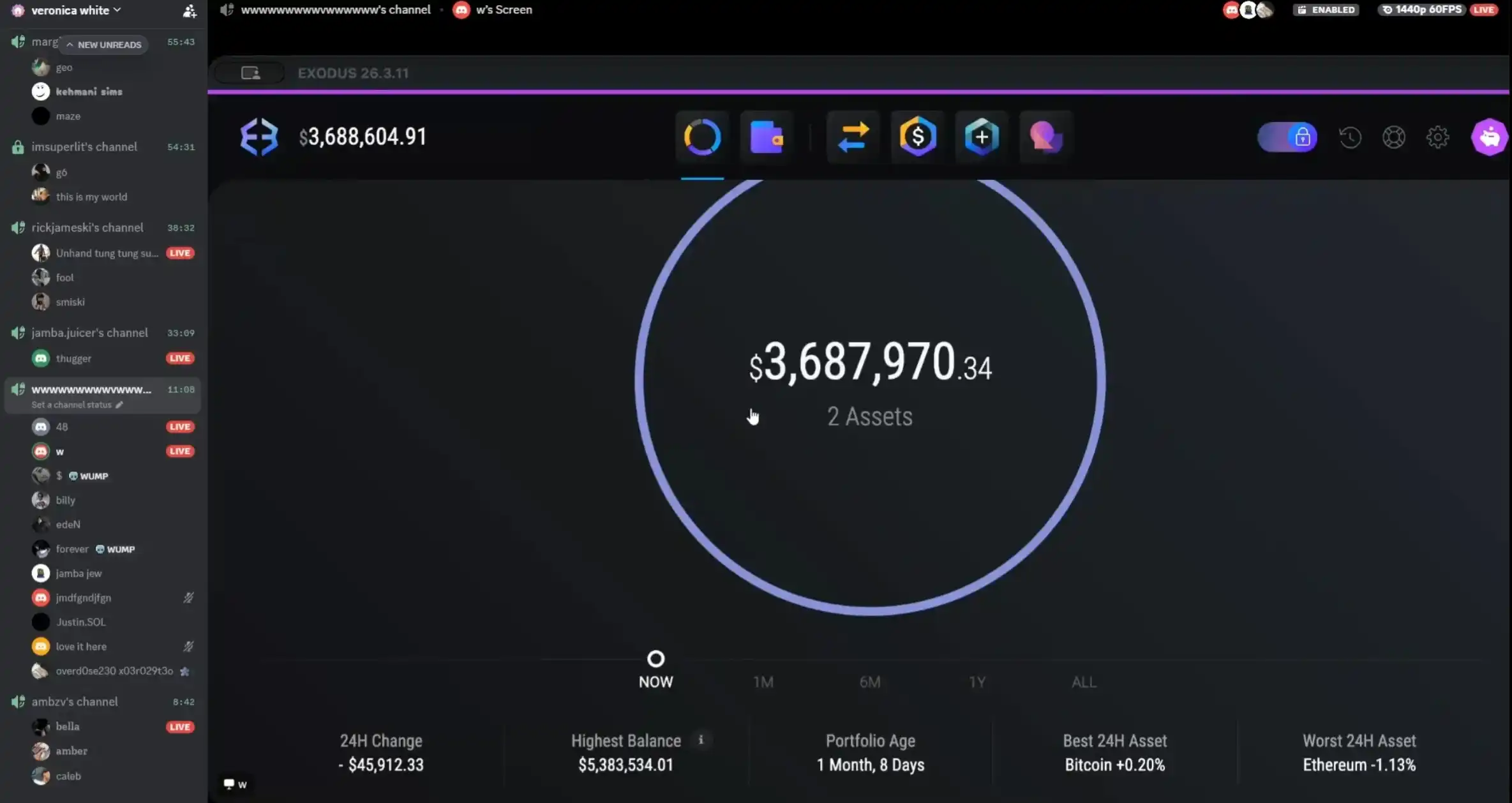
A few weeks later, this scene was revisited. On-chain investigator ZachXBT started from this address, piecing together originally scattered transactions one by one, gradually revealing a longer trail of funds.

A Trail of 185 Bitcoin Theft Funds Emerges

Going back to March 14, 2026, a social engineering theft involving 185 Bitcoins occurred, valued at about $13 million at the time. The funds were quickly moved out of the original address and rapidly entered an on-chain splitting system.

Just the next day, approximately $5.3 million of it was transferred into the wallet Dritan had shown during the Discord voice call (address: 0x4487db847db2fc99372a985743a26f46e0b2bba6). Over the following weeks, this sum of about $5.3 million was continuously split, transferred through multiple addresses, and flowed to different destinations. By the time of the April 23rd voice conversation, about $1.6 million had been further moved.
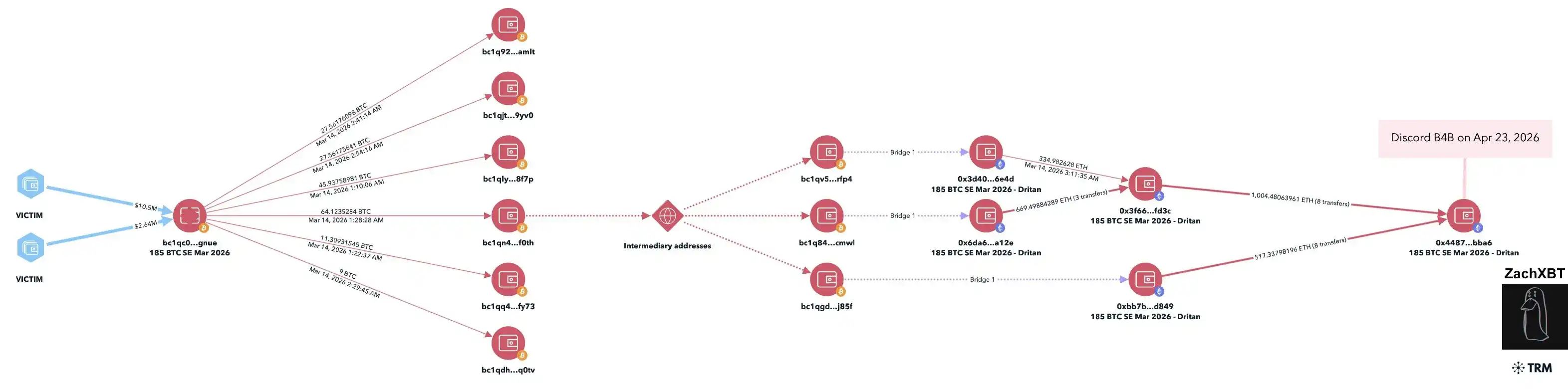
Not the First Time Involved in Crypto Theft

Tracing back from the wallet address Dritan showed, it soon became clear that the funds inside weren't just from that 185 Bitcoin theft.

According to on-chain analysis, the funds in this wallet can be traced back to multiple social engineering thefts in 2025, totaling over $5.85 million. Different victims, different times, but after the funds were transferred away, they would be quickly split, then moved through a series of addresses, following a very similar path. Matching up these funds transaction by transaction shows that many transfers ultimately landed in this wallet address Dritan displayed.

It's worth noting that Dritan once had a 'Band 4 Band' dispute with hacker John Daghita (Lick). Lick was later arrested for allegedly stealing approximately $46 million in U.S. government funds. In a later deleted Telegram post, he had publicly disclosed Dritan's old address (address: 0x97da0685dbba50b4cbabb0ca9e8336f4fbe41122), an act now appearing more like retaliation.

Judging from the on-chain behavior, this old address is highly consistent with the fund flow of the wallet Dritan displayed in terms of fund splitting methods, transfer paths, and subsequent destinations, and is therefore believed to be used by the same controlling party.

First Official 'Mention' in Judicial Documents

It wasn't until May 11, 2026, that this on-chain fund trail was formally confirmed for the first time in a judicial document. That day, the criminal indictment against Trenton Johnson was unsealed. He was charged for his involvement in the 185 Bitcoin theft case and faces up to 40 years in prison.

In the indictment, a key co-conspirator is labeled as 'Co-Conspirator 1 (CC-1)', and the on-chain analysis community has linked this identity to Dritan Kapllani Jr. Although Dritan has not been formally charged yet, he has moved from being an 'associated address' in on-chain inference to a 'co-conspirator' in the judicial narrative.

Furthermore, the same document mentions another involved person—Meme coin KOL yelotree, who is accused of assisting in money laundering through his Miami-based car rental business and faces up to 30 years in prison.

Turning 18, The End of a Decadent Life

Previously, Dritan had long lived a lavish lifestyle, frequently posting related content on Instagram and interacting with other hackers via Telegram. Within hacker circles, he was once considered to have a sort of 'protagonist aura'—multiple associated groups around him (such as ACG, 41 / RM Boyz, etc.) were successively dealt with by law enforcement, yet he himself remained untouched.

However, as he turned 18, this 'aura' came to an end, and his past actions began to be pursued legally.


Perguntas relacionadas

QWho exposed the 18-year-old hacker Dritan Kapllani Jr. and what was the alleged total amount involved?

AHe was exposed by on-chain detective ZachXBT. He is alleged to have participated in multiple social engineering attacks targeting crypto users, with a cumulative amount involved of approximately $19 million.

QWhat was the dramatic starting point for the investigation into Dritan Kapllani Jr.'s activities?

AThe investigation began after he screen-shared his Exodus wallet, showing a balance of about $3.68 million, during a 'Band 4 Band' argument in a Discord voice call where participants compared their wealth.

QAccording to the article, which specific wallet address did Dritan share in the Discord call, and what major theft was it linked to?

AThe wallet address he shared was 0x4487db847db2fc99372a985743a26f46e0b2bba6. It was linked to a 185 Bitcoin social engineering theft worth about $13 million that occurred on March 14, 2026, with approximately $5.3 million from that theft flowing into this address.

QWhat is Dritan Kapllani Jr.'s current legal status according to the unsealed indictment against Trenton Johnson?

AIn the unsealed criminal indictment against Trenton Johnson, Dritan Kapllani Jr. is referred to as 'Co-Conspirator 1 (CC-1).' While he has not been formally charged yet, he has been officially named as a co-conspirator in the judicial narrative.

QHow did the article describe the change in Dritan Kapllani Jr.'s situation after he turned 18?

AThe article states that after turning 18, his 'main character halo' (a perception of immunity) ended. His past actions are now subject to legal accountability, marking an end to his previously lavish and seemingly consequence-free lifestyle.

Leituras Relacionadas

The Value Distribution of Stablecoins

**Summary: The Value Distribution of Stablecoins** The article argues that stablecoins are evolving from mere trading tools into broader channels for dollar access. It divides the stablecoin ecosystem into four layers to analyze how value is distributed: 1. **Issuance Layer:** Mints stablecoins, holds reserve assets, and captures the spread between reserve yield and user costs (e.g., Tether, Circle). This layer currently earns the largest profit margin. 2. **Infrastructure Layer:** Connects stablecoins to the traditional financial system, handling fiat on/off-ramps, banking integration, compliance (KYC/AML), and asset management (e.g., Bridge, BVNK). This is the "unglamorous" but critical work, building the essential bridges between crypto and real-world finance. 3. **Acquiring/Distribution Layer:** Integrates stablecoins into merchant systems, manages payment flows, and provides enterprise financial software (e.g., Stripe, Coinbase). They act as the access point for businesses. 4. **Application Layer:** The end-users and businesses that ultimately use stablecoins for payments, settlements, or as a store of value. They benefit from convenience but have little pricing power. The core thesis is that while the issuance layer currently dominates profits, the often-overlooked **infrastructure layer holds significant long-term potential**. The real challenge and barrier to mass adoption is not the on-chain transfer of stablecoins (which is simple), but the complex "last mile" integration into existing business workflows, banking systems, and regulatory frameworks across different countries. Companies in this layer are currently in a "land grab" phase, investing heavily to build networks, secure bank partnerships, and establish compliance pathways. While their position is currently pressured by the profitable issuers above and distribution platforms below, the article suggests that if stablecoins become a default financial rail for businesses, the infrastructure providers who have done the hard work of integration will ultimately gain strong pricing power and become entrenched, essential players.

marsbitHá 3h

The Value Distribution of Stablecoins

marsbitHá 3h

The Value Distribution of Stablecoins

The Value Distribution of Stablecoins The article argues that stablecoins are evolving from a mere trading tool into a broad "dollar channel." It analyzes the industry's value chain through four layers: 1. **Issuance Layer (e.g., Tether, Circle):** The top layer that mints stablecoins, holds reserve assets, and captures the thickest interest rate spread. 2. **Infrastructure Layer (e.g., Bridge, BVNK):** Connects stablecoins to the traditional financial system, handling critical but complex "dirty work" like fiat on/off-ramps, banking integration, compliance (KYC/AML), and cross-border settlement. 3. **Acquiring/Distribution Layer (e.g., Stripe, Coinbase):** Embeds stablecoins into merchant systems, manages payment flows, and integrates with enterprise software. 4. **Application Layer:** End-users and businesses that ultimately use stablecoins for payments, settlement, or storing value. The author posits that while the issuance layer currently captures the most profit, the most overlooked and potentially critical layer is infrastructure. The core challenge for stablecoin adoption isn't the on-chain transfer (which is simple), but bridging the gap between blockchain and the real-world financial system. This involves solving practical problems for businesses: fiat conversion, reconciliation, tax handling, and user onboarding. Infrastructure companies are currently in a difficult "land-grab" phase—building networks, securing banking relationships, and achieving compliance country-by-country. They face pressure from both the profitable issuance layer above and distribution platforms below. However, the author suggests this layer is building a crucial moat. Once stablecoins become a default business rail, the infrastructure players who have done the hard work of integration may gain significant, durable value and pricing power.

链捕手Há 4h

The Value Distribution of Stablecoins

链捕手Há 4h

How to Do Research Well: Deliberately Practice the Real Skills That Matter

No one truly teaches you how to do research. You're often given a desk, a pre-selected problem, and vague instructions to "create something new." Consequently, many people reverse-engineer the job based on visible outputs—papers, posts, announcements—learning only how to *appear* like a researcher rather than how to *become* one. True research capability is built from stacking small, trainable skills, nearly all of which can be developed through deliberate practice. **Pick Your Own Problem:** Most researchers absorb problems from advisors or trends, lacking the underlying reasoning. Choosing a problem you genuinely care about, as John Schulman advises, leads to original work. Develop "taste" like a muscle: predict experiment outcomes, guess paper results from methods, and track which findings remain important over time. **Upgrade Your Inputs:** Relying on shared reading lists (arXiv hot lists, filtered group chats) leads to unoriginal conclusions. Undervalued old literature often holds crucial insights (e.g., MoE, LSTM, backpropagation). Richard Sutton's "The Bitter Lesson" or Claude Shannon's 1952 talk on creative thinking are more predictive than lengthy modern surveys. Breadth matters as much as depth: draw from neuroscience, mechanism design, hardware knowledge, and honest statistics. Read papers directly, especially appendices and limitations sections. **Write Everything Down:** As Paul Graham noted, writing exposes flaws in seemingly mature ideas. Writing is the cheapest defense against self-deception. Following Feynman's principle, Darwin programmatically wrote down facts contradicting his theory to combat memory bias. Maintain a detailed log of hypotheses, setups, predictions, results, and updated understandings. Reviewing past logs fosters essential humility.

marsbitHá 6h

How to Do Research Well: Deliberately Practice the Real Skills That Matter

marsbitHá 6h

Trading

Spot
Futuros

Artigos em Destaque

Como comprar NIGHT

Bem-vindo à HTX.com!Tornámos a compra de Midnight (NIGHT) simples e conveniente.Segue o nosso guia passo a passo para iniciar a tua jornada no mundo das criptos.Passo 1: cria a tua conta HTXUtiliza o teu e-mail ou número de telefone para te inscreveres numa conta gratuita na HTX.Desfruta de um processo de inscrição sem complicações e desbloqueia todas as funcionalidades.Obter a minha contaPasso 2: vai para Comprar Cripto e escolhe o teu método de pagamentoCartão de crédito/débito: usa o teu visa ou mastercard para comprar Midnight (NIGHT) instantaneamente.Saldo: usa os fundos da tua conta HTX para transacionar sem problemas.Terceiros: adicionamos métodos de pagamento populares, como Google Pay e Apple Pay, para aumentar a conveniência.P2P: transaciona diretamente com outros utilizadores na HTX.Mercado de balcão (OTC): oferecemos serviços personalizados e taxas de câmbio competitivas para os traders.Passo 3: armazena teu Midnight (NIGHT)Depois de comprar o teu Midnight (NIGHT), armazena-o na tua conta HTX.Alternativamente, podes enviá-lo para outro lugar através de transferência blockchain ou usá-lo para transacionar outras criptomoedas.Passo 4: transaciona Midnight (NIGHT)Transaciona facilmente Midnight (NIGHT) no mercado à vista da HTX.Acede simplesmente à tua conta, seleciona o teu par de trading, executa as tuas transações e monitoriza em tempo real.Oferecemos uma experiência de fácil utilização tanto para principiantes como para traders experientes.

313 Visualizações TotaisPublicado em {updateTime}Atualizado em 2026.06.02

Como comprar NIGHT

Discussões

Bem-vindo à Comunidade HTX. Aqui, pode manter-se informado sobre os mais recentes desenvolvimentos da plataforma e obter acesso a análises profissionais de mercado. As opiniões dos utilizadores sobre o preço de NIGHT (NIGHT) são apresentadas abaixo.

活动图片