Altcoin season odds – Some promise, but look out for THESE volatility risks!

ambcryptoPublicado em 2026-01-17Última atualização em 2026-01-17

Resumo

The altcoin market is showing signs of strength, with a notable rally in early January as Bitcoin's dominance declined. However, the altcoin season index remains low at 33, indicating it is not yet altcoin season. Market sentiment is muted compared to a year ago, yet traders are heavily leaning long on altcoins, with some like XRP showing unusually high long/short ratios, increasing vulnerability to volatility. From a technical perspective, the altcoin market cap (excluding Ethereum) has been in a steady uptrend since November 2023 and may challenge its all-time high in the coming months. A Bitcoin rally above $107.5k could significantly boost overall market sentiment. However, declining stablecoin inflows to exchanges since September and reduced reserves since November suggest a lack of fresh capital entering the market. Instead, rallies may be driven by capital rotation within the crypto space rather than new investments. Buyers should remain cautious of potential volatility and price bounces within longer-term downtrends.

The altcoin market is gathering strength. This was most clearly visible in the first week of the year, when Bitcoin [BTC] rallied from $87.5k to $94.8k. During this period, Bitcoin’s Dominance fell from 59.58% to 58.7%. The altcoin market cap, excluding Ethereum [ETH], saw a hike of $82.56 billion or 9.97% too.

However, it is nowhere near altcoin season yet. In fact, according to CoinGlass data, the altcoin season index had a reading of 33 at press time.

Yes, the market sentiment is very much muted compared to the same time a year ago. This will affect capital flows into the industry. Even so, traders much preferred going long on altcoins, data revealed.

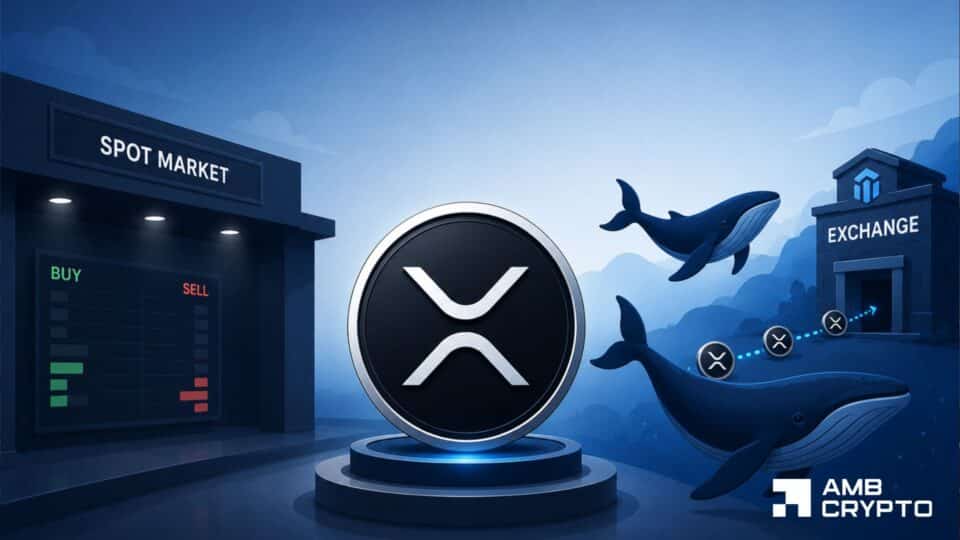
In a post on X, analytics platform Alphractal warned that the long/short ratio of most altcoins was above 1 – Evidence of a crowded long trade.

The platform labeled XRP’s long/short ratio of 3.06 as “unusually high” to demonstrate that major cap assets were vulnerable to price volatility and long-side pressure.

The bullish case for altcoins

From a technical analysis perspective, TOTAL3 might be in a strong position in the long run. The weekly chart showed a steady uptrend in progress, unbroken since November 2023. Before the November breakout, a 1.5-year-long consolidation occurred.

The altcoin market (excluding Ethereum) looked likely to challenge the all-time high at $1.19 trillion over the next month or two. Experts believe that spot demand may be driving the current Bitcoin rally. If Bitcoin manages to reclaim $107.5k, it would likely dramatically alter the market-wide sentiment.

Traders and investors need to remain vigilant

A recent AMBCrypto report highlighted that stablecoin inflows to exchanges have dropped sharply since September. The 30-day moving average of stablecoin inflows to exchanges has not recovered to its August-September 2025 levels.

The falling stablecoin exchange reserves since November might be another worrisome trend. Together, the metrics warned of a lack of significant capital inflows to the market as a whole. Rather, it could be capital rotations within the market fueling certain coins’ rallies.


Final Thoughts

  • Weekly structure of the altcoin market cap (TOTAL3) was in a great position, and the strong start to January could encourage buyers.
  • Buyers should be wary of an altcoin price bounce amid a longer-term downtrend, driven by capital rotation within the market instead of an influx of fresh capital.


Perguntas relacionadas

QWhat was the change in Bitcoin's Dominance during the first week of the year, and what happened to the altcoin market cap (excluding Ethereum)?

ABitcoin's Dominance fell from 59.58% to 58.7%. The altcoin market cap, excluding Ethereum, saw an increase of $82.56 billion, a 9.97% hike.

QAccording to the article, what is the current reading of the altcoin season index, and what does it indicate?

AThe altcoin season index had a reading of 33 at press time, indicating that the market is nowhere near an altcoin season.

QWhat does an unusually high long/short ratio for an asset like XRP (3.06) signify, according to the analytics platform Alphractal?

AAn unusually high long/short ratio is evidence of a crowded long trade, which makes major cap assets vulnerable to price volatility and long-side pressure.

QWhat two key metrics related to stablecoins suggest a lack of significant capital inflows into the crypto market?

AThe 30-day moving average of stablecoin inflows to exchanges has not recovered to its August-September 2025 levels, and stablecoin exchange reserves have been falling since November.

QWhat is the primary risk for buyers in the altcoin market, as highlighted in the article's final thoughts?

AThe primary risk is that an altcoin price bounce could be driven by capital rotation within the market instead of an influx of fresh capital, which may occur amid a longer-term downtrend.

Leituras Relacionadas

From Gas Limit to 'Keyed Nonces', How to Understand the Next Step in Ethereum Scalability?

Ethereum’s scalability efforts are shifting toward a user-centric approach—focusing not only on higher TPS, but on translating technical upgrades into lower costs, smoother operations, and better wallet experiences. Two recent developments highlight this direction: - **Raising the Gas Limit to 200 million**: Following the Fusaka upgrade that increased it to 60 million, a consensus has formed around a potential future increase to 200 million. This would boost Ethereum’s execution capacity, but it is planned alongside other upgrades—such as ePBS, Block-Level Access Lists (BAL), and EIP-8037—to manage state growth and keep node operation viable for average participants. - **Keyed Nonces (EIP-8250)**: This proposal aims to improve how transactions are queued. Instead of a single linear nonce per account, it introduces multiple independent nonce domains. This prevents different types of transactions—such as private payments, session keys, or batch operations—from blocking each other. Vitalik Buterin views this as a foundational step toward better privacy support and more flexible state scalability. Together, these upgrades are part of a broader move to push complexity from wallets, DApps, and relays back into the protocol layer. For everyday users, this means future Ethereum interactions could become less congested, more intuitive, and safer—especially as core improvements in account abstraction, cross-L2 interoperability, and node decentralization continue to progress. Ultimately, Ethereum is evolving to handle not just more transactions, but more varied and complex on-chain use cases while preserving its decentralized foundation.

marsbitHá 25m

From Gas Limit to 'Keyed Nonces', How to Understand the Next Step in Ethereum Scalability?

marsbitHá 25m

Leaving OpenAI, How Much Has Their Net Worth Increased?

Former OpenAI employees have collectively accrued near-trillion dollar valuations through ventures and investments, charting AI's future. The article highlights two main paths: founding high-value companies like Anthropic and Perplexity, or applying insider insights as investors. Leopold Aschenbrenner exemplifies the investor path. After being fired from OpenAI, he leveraged firsthand knowledge of AI's massive energy demands to make hugely successful public market bets on nuclear and fuel cell companies, practicing "cross-industry cognitive arbitrage." Other alumni, like the Zero Shot VC fund founders, use their technical foresight for early-stage investing. Their key advantage lies not just in picking winners, but in knowing which technical approaches are likely dead ends—a "veto list" derived from internal OpenAI experience. Angel investing within the network, as seen with Mira Murati and Sam Altman, operates on deep, pre-existing understanding of a founder's capabilities, reducing due diligence to near zero. This creates an ecosystem bound by a shared belief in AGI's imminent arrival, differing from networks like the "PayPal Mafia" which were built on shared past struggles. The shift of these builders to investors signals a profound conviction: their situational awareness of the AI landscape is now so clear that deploying capital based on that judgment is more efficient than building themselves. They are allocating bets on the future they helped shape from the inside.

marsbitHá 36m

Leaving OpenAI, How Much Has Their Net Worth Increased?

marsbitHá 36m

Countdown to the AI Bull Market? Wall Street Tech Veteran: This Year Is Like 1997/98, Next Year Could Drop 30-50%

"AI Bull Market Countdown? Wall Street Veteran: This Year Feels Like 1997/98, Next Year Could Drop 30-50%" In an interview, veteran tech analyst Dan Niles draws parallels between the current AI boom and the 1997-98 period of the internet boom, suggesting the bull run isn't over yet. The core new driver is identified as "Agentic AI," which performs multi-step tasks and consumes vastly more computing power than conversational AI. This shift is expected to boost demand for cloud infrastructure and benefit CPU makers like Intel and AMD, potentially pressuring GPU leader Nvidia. However, Niles warns of significant short-term overbought conditions in semiconductors. His central warning is for a potential major market correction of 30-50% starting in early 2027. Drivers include a slowdown from high growth comparables, the outsized capital demands of companies like OpenAI, and a wave of massive tech IPOs sucking liquidity from the market. A J.P. Morgan survey of 56 global investors aligns with this view, finding that 54% expect a >30% U.S. stock correction by 2027. Among mega-cap tech, Niles favors Google due to its full-stack AI capabilities and cash flow, expresses concern about Meta's user growth, and sees potential for Apple's AI Siri and foldable iPhone. Niles advises investors to be nimble, hold significant cash, and closely monitor the conflicting signals from equities, oil prices, and bond yields, which he believes cannot all be correct simultaneously.

marsbitHá 1h

Countdown to the AI Bull Market? Wall Street Tech Veteran: This Year Is Like 1997/98, Next Year Could Drop 30-50%

marsbitHá 1h

Trading

Spot
Futuros

Artigos em Destaque

Como comprar F

Bem-vindo à HTX.com!Tornámos a compra de Synfutures (F) simples e conveniente.Segue o nosso guia passo a passo para iniciar a tua jornada no mundo das criptos.Passo 1: cria a tua conta HTXUtiliza o teu e-mail ou número de telefone para te inscreveres numa conta gratuita na HTX.Desfruta de um processo de inscrição sem complicações e desbloqueia todas as funcionalidades.Obter a minha contaPasso 2: vai para Comprar Cripto e escolhe o teu método de pagamentoCartão de crédito/débito: usa o teu visa ou mastercard para comprar Synfutures (F) instantaneamente.Saldo: usa os fundos da tua conta HTX para transacionar sem problemas.Terceiros: adicionamos métodos de pagamento populares, como Google Pay e Apple Pay, para aumentar a conveniência.P2P: transaciona diretamente com outros utilizadores na HTX.Mercado de balcão (OTC): oferecemos serviços personalizados e taxas de câmbio competitivas para os traders.Passo 3: armazena teu Synfutures (F)Depois de comprar o teu Synfutures (F), armazena-o na tua conta HTX.Alternativamente, podes enviá-lo para outro lugar através de transferência blockchain ou usá-lo para transacionar outras criptomoedas.Passo 4: transaciona Synfutures (F)Transaciona facilmente Synfutures (F) no mercado à vista da HTX.Acede simplesmente à tua conta, seleciona o teu par de trading, executa as tuas transações e monitoriza em tempo real.Oferecemos uma experiência de fácil utilização tanto para principiantes como para traders experientes.

250 Visualizações TotaisPublicado em {updateTime}Atualizado em 2025.03.21

Como comprar F

Discussões

Bem-vindo à Comunidade HTX. Aqui, pode manter-se informado sobre os mais recentes desenvolvimentos da plataforma e obter acesso a análises profissionais de mercado. As opiniões dos utilizadores sobre o preço de F (F) são apresentadas abaixo.

活动图片