All about why blockchain firms will now become part of U.S Treasury’s cybersecurity program

ambcryptoPublicado em 2026-04-10Última atualização em 2026-04-10

Resumo

The U.S. Department of the Treasury has launched a new initiative through its Office of Cybersecurity and Critical Infrastructure Protection (OCCIP) to include blockchain and crypto firms in a cybersecurity program. This move aims to share timely cyber threat intelligence to help these firms prevent and respond to attacks. The announcement comes amid ongoing security challenges in the crypto industry, highlighted by incidents like the 2026 Drift Protocol attack, which resulted in approximately $285 million in losses and was linked to state-backed cyber operations. The article underscores that security vulnerabilities remain a critical systemic risk in crypto, capable of triggering prolonged market downturns, as seen during the 2022 crash following the collapse of FTX. By providing early warnings and fostering coordinated risk management, the Treasury’s program seeks to strengthen institutional confidence and reduce the likelihood of future large-scale market disruptions.

When we talk about “risk” in crypto, the real and often underestimated risk lies in security.

Over the years, the crypto industry has expanded rapidly, bringing institutional participation, new products, and large-scale adoption. And yet, the underlying investment risk has not fully disappeared. The reason is simple – Security vulnerabilities continue to exist across smart contracts, bridges, wallets, and exchanges.

Seen in this light, the latest move by the U.S Treasury becomes relevant. Notably, the U.S Department of the Treasury has launched a new cybersecurity initiative. Through its Office of Cybersecurity and Critical Infrastructure Protection (OCCIP), the program will share timely cyber threat information with eligible crypto and blockchain firms to help them prevent and respond to attacks.
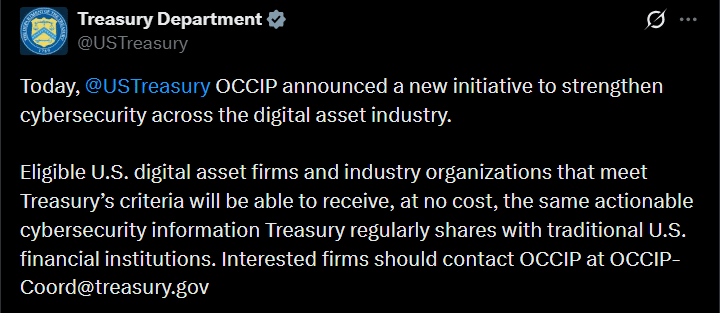
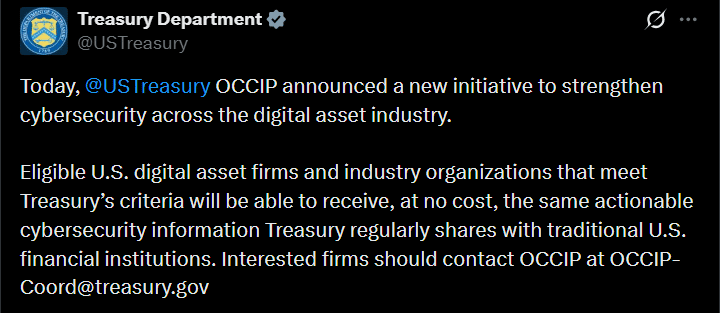
Source: X

Interestingly, the timing of this initiative feels almost deliberate.

Just four months into 2026, the crypto market has already faced another reminder of its security gaps. The recent Drift Protocol attack exposed vulnerabilities within the platform’s trading mechanisms, resulting in losses estimated at around $285 million. In fact, early investigations have linked the activity to DPRK-style operations, suggesting a level of planning typically associated with state-backed cyber groups.

Against this backdrop, the U.S Treasury’s decision to roll out a cybersecurity program for digital asset firms carries significant importance. The key question now is – Will stronger government-backed cybersecurity coordination help strengthen institutional confidence in crypto assets?

OCCIP’s significance viewed through crypto’s 2022 crash

The impact of security lapses goes far beyond a temporary wave of FUD in the market.

In some cases, the consequences are long-lasting. The collapse of FTX in 2022 serves as a clear example. What initially appeared to be a single exchange failure quickly evolved into a security crisis for the entire industry. Billions of dollars were lost, and major lending firms faced significant liquidity stress.

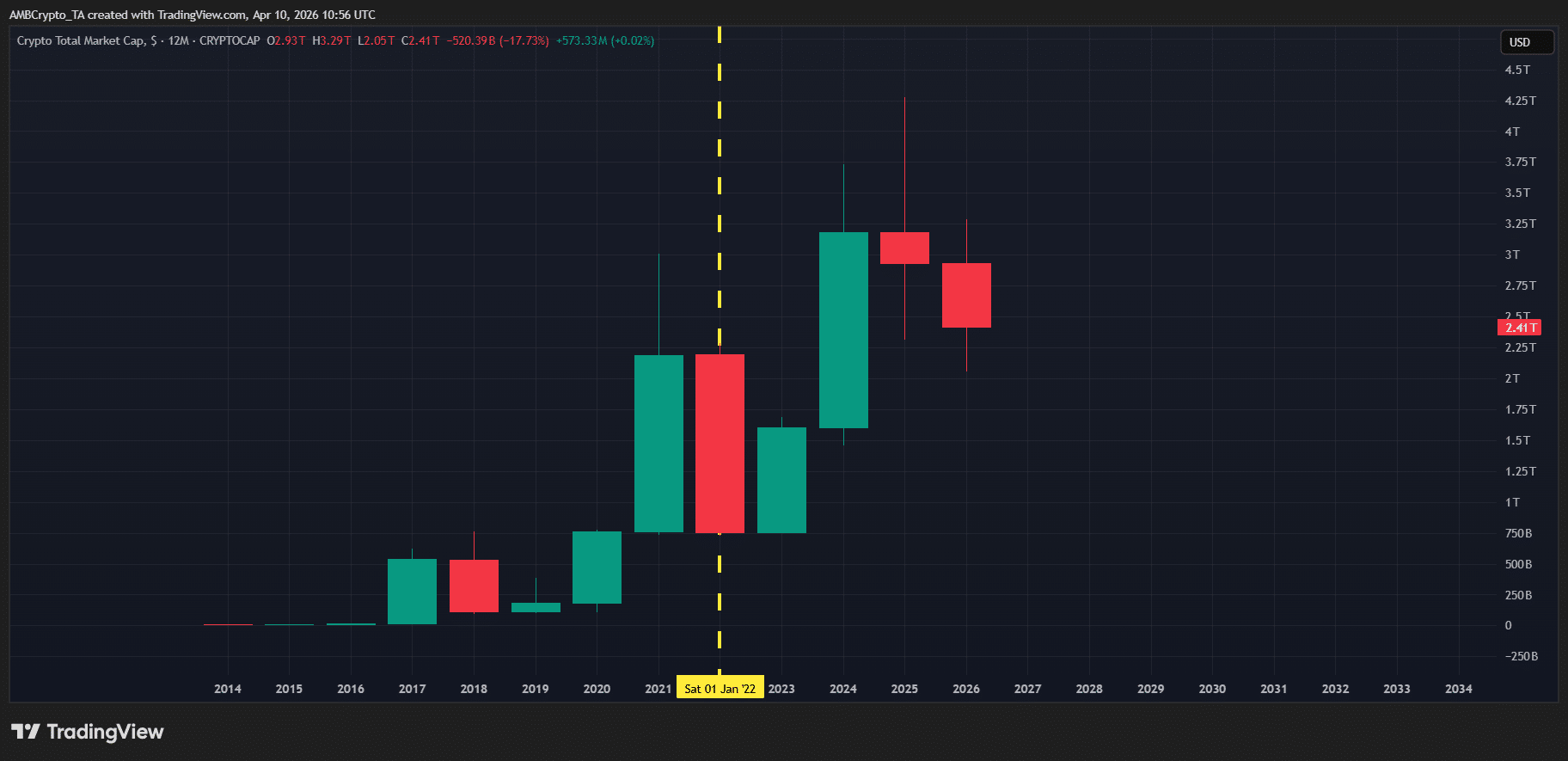
From a technical standpoint, the impact was equally severe. The crypto market ended 2022 down roughly 66%, a period still considered one of the harshest bear markets in crypto history. Recovery was slow rather than immediate.

Throughout 2023, the market managed to regain only 50% of the losses as investors remained cautious.

In fact, it wasn’t until the 2024 cycle that broader momentum returned.
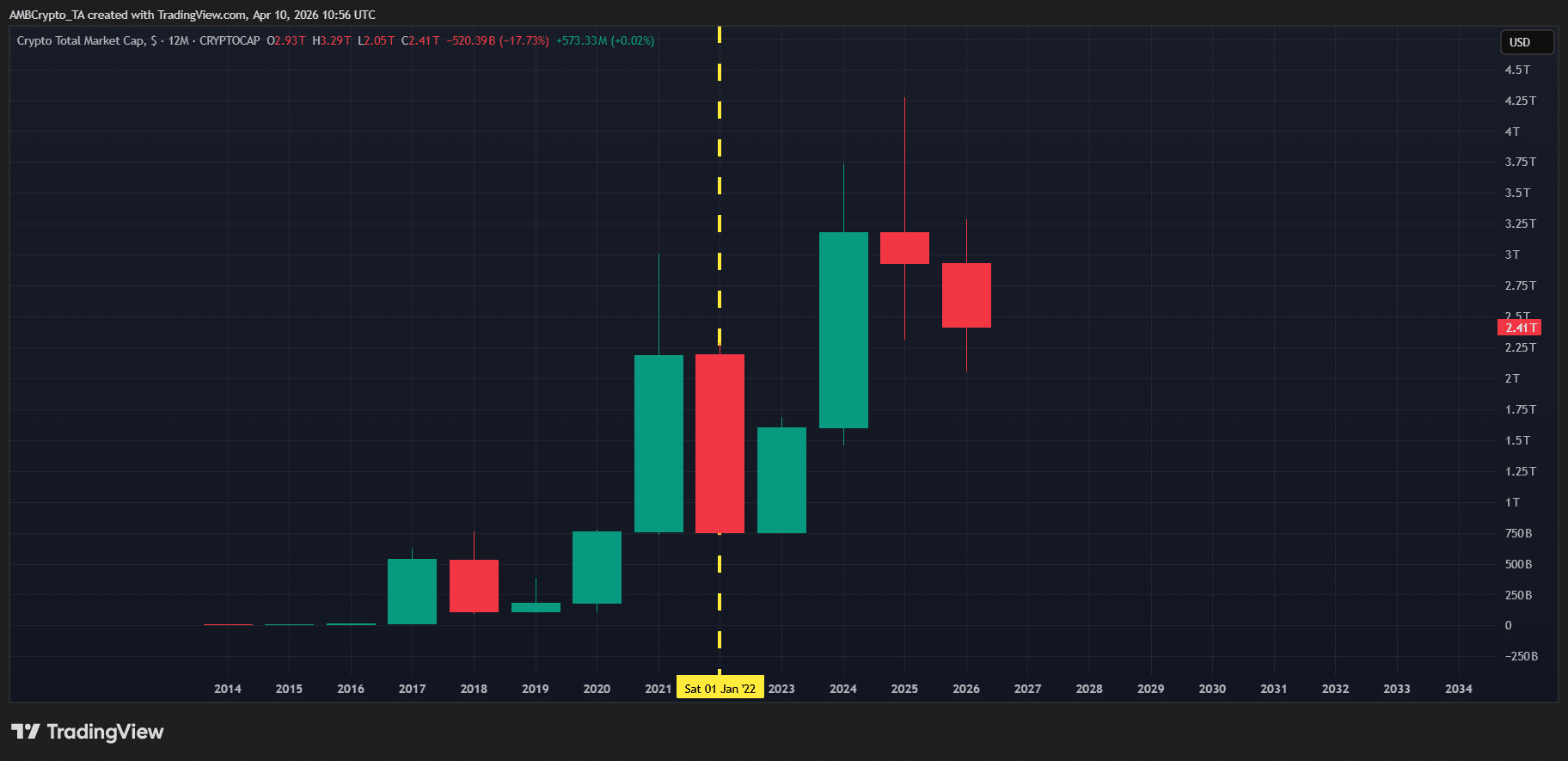
Source: TradingView (TOTAL/USDT)

In essence, the impact of major security failures in crypto extends well beyond price correction.

Instead, they reshape market cycles, delay institutional adoption, and reinforce the industry’s need for stronger security infrastructure and coordinated risk management. Fast forward to now, this is exactly where the U.S Treasury’s OCCIP program starts to become relevant.

From a broader perspective, risks around digital assets have not disappeared. Instead, they are evolving. Alongside protocol exploits and exchange breaches, newer concerns like quantum computing threats are beginning to enter the discussion, keeping long-term security risks on the radar and raising concerns about another 2022-style market shock.

However, the shift now seems to be towards prevention rather than reaction. With OCCIP, digital asset firms will gain access to early warning signals, allowing them to strengthen defenses before vulnerabilities escalate. In turn, this will help keep institutional confidence intact, lowering the chances of another market shock.


Final Summary

  • Security is crypto’s real systemic risk, with repeated exploits showing how security failures can trigger long-term market downturns.
  • By giving digital asset firms access to cyber intelligence, the U.S Treasury’s move could reduce the risk of another shock.


Perguntas relacionadas

QWhat is the main focus of the U.S. Treasury's new cybersecurity initiative for blockchain firms?

AThe U.S. Treasury's new cybersecurity initiative, through its Office of Cybersecurity and Critical Infrastructure Protection (OCCIP), aims to share timely cyber threat information with eligible crypto and blockchain firms to help them prevent and respond to attacks.

QHow did the 2022 FTX collapse demonstrate the long-lasting impact of security failures in crypto?

AThe FTX collapse in 2022 evolved from a single exchange failure into an industry-wide security crisis, resulting in billions of dollars lost, significant liquidity stress for major lending firms, and a prolonged market downturn with the crypto market ending the year down roughly 66%.

QWhat recent security incident in 2026 highlighted ongoing vulnerabilities, according to the article?

AThe recent Drift Protocol attack in early 2026 exposed vulnerabilities in the platform's trading mechanisms, resulting in estimated losses of around $285 million, with investigations linking the activity to DPRK-style operations.

QHow does the OCCIP program aim to change the approach to cybersecurity risks for digital asset firms?

AThe OCCIP program shifts the approach from reaction to prevention by providing digital asset firms with early warning signals and cyber intelligence, allowing them to strengthen defenses before vulnerabilities escalate and reduce the risk of market shocks.

QWhat broader risks beyond protocol exploits and exchange breaches are mentioned as emerging concerns?

ANewer concerns like quantum computing threats are beginning to enter the discussion, keeping long-term security risks on the radar and raising concerns about potential future market shocks.

Leituras Relacionadas

Report: Warsh Prepared to Raise Interest Rates in September if Inflation Data Remains Strong in Coming Weeks

Report: Fed Chair Walsh Prepared to Hike Rates in September If Upcoming Inflation Data Stays Strong According to a Financial Times report, Federal Reserve Chair Walsh is prepared to raise interest rates at the September policy meeting if inflation data in the coming weeks remains hot and market expectations for a hike increase. Following this news, short-term US Treasury yields rose. Walsh has adhered to a pared-back communication strategy despite recent market volatility and criticism that his limited guidance has weakened the Fed's inflation-fighting credibility. Sources close to his thinking acknowledge some communication missteps since he took office but insist these won't derail his overall reform agenda. His most significant policy shift has been drastically reducing forward guidance, a practice he has long criticized for boxing in policymakers. Futures markets now price in roughly a 55% chance of a 25-basis-point rate increase in September. Sources indicate that while Walsh has raised the possibility of using balance sheet reduction to tighten policy, interest rates remain the primary tool for now. The Fed's preferred inflation gauge was at 3.7% in June. Walsh is expected to deliver his first major speech at the upcoming Jackson Hole symposium, seen as a key opportunity to clarify his policy framework and address perceived shortcomings in his messaging.

marsbitHá 12m

Report: Warsh Prepared to Raise Interest Rates in September if Inflation Data Remains Strong in Coming Weeks

marsbitHá 12m

Chainalysis: Robbery of Crypto Investors Using a 'Soldering Iron' Nets $30 Million in Half a Year

According to a report from Chainalysis, criminals have stolen over $30 million from cryptocurrency investors through violent physical attacks, known as "wrench attacks," in the first half of 2026. This puts the year on track to surpass the record $58 million stolen via such methods in all of 2025. There were 46 documented violent incidents globally by the end of June, up from 40 in the same period of 2025. These attacks, which include kidnappings, home invasions, and hostage-taking, increasingly threaten the personal safety of crypto holders and their families. Only about 26% of these attacks resulted in a ransom being paid, a significant drop from a 49% success rate in 2025. Chainalysis notes the true scale of the problem is likely underreported. The criminals often identify targets in advance through data leaks, social media, or insider information before using low-skilled enforcers for the physical assault. France is a major hotspot, with 30 publicly known incidents by mid-2026, compared to 19 in all of 2025. French authorities have reported over 70 cases, suggesting the real number is even higher. A suspected leak of taxpayer data from the French tax service and a separate breach at crypto tax firm Waltio are considered key factors enabling criminals to find targets. Stolen funds are moved using various methods, from direct transfers to centralized exchanges to more sophisticated techniques involving blockchain bridges, decentralized exchanges, and money-mixing services. The report highlights a lack of a unified industry methodology for tracking these incidents, as evidenced by a different count (52 cases) from analytics firm CertiK for the same period.

cryptonews.ruHá 13m

Chainalysis: Robbery of Crypto Investors Using a 'Soldering Iron' Nets $30 Million in Half a Year

cryptonews.ruHá 13m

Shareholders' Accurate Reduction of 1.4 Billion Shares, Under Heavy Performance Pressure, Meish Technology Makes an Emergency Cross-Border Move into Indium Phosphide

Domestic distributed audio-visual and AI vision solutions provider Meish Technology (001229.SZ), despite its AI concept, has shown signs of fatigue shortly after listing, with consecutive declines in revenue and net profit. Amid this pressure, the company is making an urgent foray into the hot "indium phosphide" semiconductor concept. The company moved swiftly, establishing a wholly-owned subsidiary in July and holding an extraordinary shareholders' meeting in August to authorize management to advance the project. This rapid capital operation is seen as a move to tap into the AI computing power industry chain. However, behind this "cross-border self-rescue" lies deep pressure on fundamental performance, precise high-level减持 by a major shareholder who cashed out approximately 142 million yuan just before the stock price peaked, and the new business remaining at a very preliminary "blueprint" stage with no substantive impact on performance yet. Meish Tech's core business of "distributed audio-video control systems" faces intense competition. While maintaining high gross margins, its revenue growth and profit growth have seriously diverged. Although its AI business revenue surged in 2025, it failed to halt the overall profit decline. Since its 2022 IPO, the company's performance has declined, with 2026 first-quarter results even showing a loss. The half-year 2026 forecast predicts a profit plunge of over 70% year-on-year. In this context, the跨界 into the high-tech barrier, capital-intensive indium phosphide field appears more like a gamble driven by market valuation concerns than a strategy based on deep technical积累.

marsbitHá 23m

Shareholders' Accurate Reduction of 1.4 Billion Shares, Under Heavy Performance Pressure, Meish Technology Makes an Emergency Cross-Border Move into Indium Phosphide

marsbitHá 23m

Just 3.5 Months After Its Founding, It Started Making External Investments: The Embodied AI Sector Is Collectively 'Investing While Fundraising'

A counterintuitive trend is emerging in China's embodied AI sector: numerous startups that are still actively raising capital themselves are now making strategic investments in other companies. An analysis of 29 such enterprises reveals a pattern of "fundraising while investing," where companies, often still in early funding rounds, rapidly deploy capital into the ecosystem. These 29 investment entities, primarily based in the Pearl River Delta and Yangtze River Delta regions, have executed over 125 investment deals. Notably, 17 of them (59%) are humanoid robot manufacturers, making them the most active investors. The trend shows that newer companies are investing faster; firms founded after 2023 made their first external investment in an average of just 22.8 months, with one company, Poke Robotics, doing so within 3.8 months of its founding. Zhiyuan Robot (智元机器人) stands out as the most active corporate venture capital (CVC) player, completing 37 investments in 23 months. A more complex, networked investment structure is also forming, where companies like Lingchu Intelligent (灵初智能) and Lingxin Qiaoshou (灵心巧手), which received investments from larger players, have themselves become active investors, extending the strategic reach of capital down the supply chain. This collective shift from a few large players to widespread participation signals a strategic move to use capital as a lever to accelerate industry consolidation. Companies are seeking to quickly integrate critical supply chain elements—such as dexterous hands, joint motors, and AI data platforms—into their ecosystems to gain a competitive edge in a rapidly evolving, highly contested market window. The strategy aims to compress the decade-long process of traditional supply chain integration into just a few years, though it carries risks related to technology bets and ongoing capital burn. As the sector's IPO pipeline grows, this "fundraise and invest" model may soon become a standard industry practice.

marsbitHá 26m

Just 3.5 Months After Its Founding, It Started Making External Investments: The Embodied AI Sector Is Collectively 'Investing While Fundraising'

marsbitHá 26m

Trading

Spot
活动图片