All about U.S Congress’s new bill and its intent to protect open-source developers

ambcryptoPublicado em 2026-02-28Última atualização em 2026-02-28

Resumo

A bipartisan group of U.S. lawmakers introduced the Promoting Innovation in Blockchain Development Act on February 26, aiming to clarify liability for blockchain developers. The bill seeks to protect open-source software developers from being prosecuted under money-transmitting laws, particularly amending Section 1960 of the U.S. Code to limit liability to entities that control customer assets or execute transfers. It comes amid growing regulatory scrutiny and cases like Tornado Cash that raised concerns about criminalizing non-custodial developers. Industry groups, including the Solana Institute and the Blockchain Association, have endorsed the bill, emphasizing the need to distinguish between developers and financial intermediaries. The proposal is part of a broader legislative effort, alongside bills like the Blockchain Regulatory Certainty Act and the GENIUS Act, to provide regulatory clarity and protect innovation in the crypto ecosystem.

A bipartisan coalition introduced the Promoting Innovation in Blockchain Development Act on 26 February. It aims to clarify liability for blockchain developers.

The proposal, led by Congressmen Scott Fitzgerald, Ben Cline, and Zoe Lofgren, arrived as regulatory pressure intensified around decentralized infrastructure. At the same time, prosecutions involving Tornado Cash amplified concerns about criminalizing open-source software development.

The bill, therefore, amends Section 1960 of the U.S Code, a statute originally designed to combat money laundering. However, enforcement trends increasingly extended its scope towards non-custodial developers who only publish or maintain code.

Under the proposal, liability would apply mainly to entities controlling customer assets or executing transfers on users’ behalf. Meanwhile, developers who simply write or distribute open-source software would fall outside prosecutorial reach.

Congressman Ben Cline emphasized the issue, stating, “For too long, federal overreach has blurred the line between bad actors and the innovators building next-generation technology.”

Similarly, Rep. Scott Fitzgerald had previously stated,

“For years, innovators and software developers have been caught in the crosshairs of an aggressive regulatory approach.”

Industry stakeholders rally behind developer protection bill

Early reactions to the Promoting Innovation in Blockchain Development Act emerged quickly across the blockchain policy ecosystem as the proposal entered public debate. Initial responses focused on the bill’s central premise of protecting non-custodial developers from money-transmitter liability.

The Solana Institute responded quickly, emphasizing the importance of developer protections at a critical stage for open-source infrastructure.

The organization stated,

“We’re grateful to Rep. Fitzgerald, Rep. Ben Cline, and Rep. Zoe Lofgren for championing developers at this critical junction for open-source software development and the crypto ecosystem with the introduction of the Promoting Innovation in Blockchain Development Act.”

Shortly afterwards, broader industry advocacy groups reinforced similar sentiments. The Blockchain Association, for instance, publicly endorsed the legislation through CEO Summer Mersinger.

These responses indicate coordinated industry approval, as stakeholders view the bill as establishing a clear boundary between open-source developers and custodial financial intermediaries.

Crypto bills reshape the U.S regulatory landscape

Recent statements from the Blockchain Association highlight rising momentum for developer protections in Washington. This advocacy also coincides with the Blockchain Regulatory Certainty Act, S.3611, debated in early 2026. Despite passing the House in July 2025, the CLARITY Act is still in a stalled state.

As negotiations continue, advocates warn that removing developer exemptions could revive enforcement pressure. Meanwhile, the GENIUS Act added stablecoin guardrails while avoiding liability expansion towards software developers.

Parallelly, the Promoting Innovation in Blockchain Development Act narrows Section 1960 towards custodial actors.

Therefore, industry groups have intensified lobbying across dozens of Senate offices in late February 2026. BRCA now stands as a pivotal test for America’s evolving crypto regulatory framework.


Final Summary

  • U.S crypto legislation momentum strengthens developer protections, supporting innovation across major networks.
  • Policy alignment around BRCA and the CLARITY Act may reduce regulatory risk for leading assets such as Bitcoin and Ethereum.

Perguntas relacionadas

QWhat is the main purpose of the Promoting Innovation in Blockchain Development Act introduced in February?

AThe main purpose of the Promoting Innovation in Blockchain Development Act is to clarify liability for blockchain developers, specifically aiming to protect non-custodial open-source developers from being prosecuted under money-transmitter laws.

QWhich specific U.S. Code section does the new bill seek to amend and why?

AThe bill seeks to amend Section 1960 of the U.S. Code, a statute originally designed to combat money laundering, because its enforcement has increasingly been extended towards non-custodial developers who only publish or maintain code.

QAccording to the bill's supporters, what distinction does the legislation make regarding liability?

AThe legislation distinguishes that liability would mainly apply to entities that control customer assets or execute transfers on users' behalf, while developers who simply write or distribute open-source software would be outside of prosecutorial reach.

QWhich industry organization publicly endorsed the bill through its CEO, Summer Mersinger?

AThe Blockchain Association publicly endorsed the legislation through its CEO, Summer Mersinger.

QHow does the article describe the current state of the CLARITY Act (S.3611) as of early 2026?

AAs of early 2026, the CLARITY Act is described as being in a stalled state, despite having passed the House in July 2025.

Leituras Relacionadas

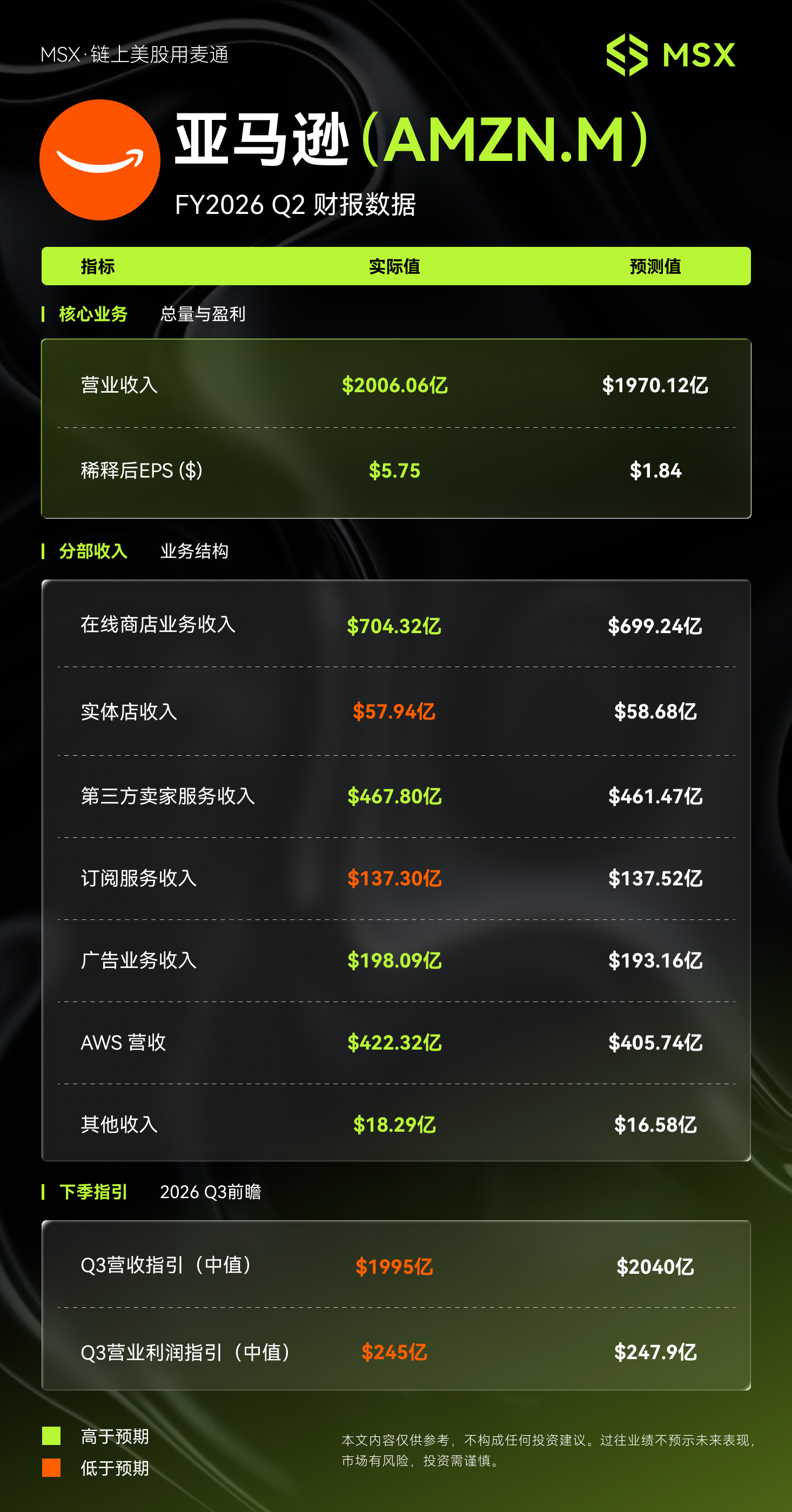
MSX US Stock Daily Insight: Amazon 2026 Q2 Earnings: AWS Records Fastest Growth in Five Years

**MSX Daily US Stock Observation: Amazon's Q2 2026 Earnings: AWS Achieves Fastest Growth in Five Years** Amazon's latest quarterly results exceeded expectations, driven by a strong performance from its cloud computing unit. The company reported revenue of $200.66 billion, surpassing estimates of approximately $197 billion. The key highlight was Amazon Web Services (AWS), which generated $42.232 billion in revenue, surging 37% year-over-year. This marked the segment's fastest growth pace in 18 quarters, indicating robust demand for cloud services. Reported Earnings Per Share (EPS) of $5.75 significantly exceeded the $1.84 forecast. However, this figure included a substantial one-time, non-operating gain of $53.4 billion, primarily from the revaluation of Amazon's investment in AI company Anthropic. Excluding this item, core operating profit was $27.461 billion, a strong increase of 43% compared to the same period last year. Despite the positive results, Amazon provided guidance for the upcoming third quarter that fell short of market expectations. The company's revenue guidance midpoint is $199.5 billion, below the consensus estimate of around $204 billion. Operating profit guidance of $24.5 billion also slightly missed expectations of approximately $247.9 billion. Furthermore, Amazon raised its forecast for full-year capital expenditures to $220 billion, citing rising memory chip costs, which weighed on investor sentiment regarding future profitability. In summary, Amazon's quarter showcased accelerating momentum in its core AWS business. The underlying operational profit growth remains solid. However, cautious forward guidance and increased investment spending present key areas for monitoring in the coming quarters, as the market assesses whether the current growth phase will translate into sustained profit margin expansion.

Odaily星球日报Há 5m

MSX US Stock Daily Insight: Amazon 2026 Q2 Earnings: AWS Records Fastest Growth in Five Years

Odaily星球日报Há 5m

Cyclical Stock or Growth Stock? Coinbase's Q2 Earnings Report Reveals 'Valuation Disagreement'

Coinbase's Q2 2026 financial results revealed a mixed performance, reigniting debate over whether the company should be valued as a cyclical stock tied to crypto markets or a growth stock with future potential. Total revenue missed expectations at $1.22 billion, down 19% year-over-year. Transaction revenue fell to $599 million, with retail crypto spot trading revenue dropping 30% to $452 million, back to 2023 levels. The company reported a net loss of $359 million, marking its third consecutive quarterly loss. Despite CEO Brian Armstrong's positive commentary on metrics like a 10.3% overall crypto trading market share and 106% growth in prediction markets, the market reacted negatively, with shares dropping over 5% after-hours. A key issue is the decline in core retail trading. While Coinbase touted record market share, this figure includes derivatives and new products. Its traditional crypto spot trading share is likely shrinking. New ventures like prediction markets, while growing, contributed less than $30 million, insufficient to offset the core revenue decline. The valuation debate hinges on perspective. As a cyclical stock, Coinbase remains deeply tied to the crypto bear market, with user attrition and competitive pressures justifying a lower valuation. The company's strategy appears focused on surviving until the next bull cycle. Viewed as a growth stock, however, Coinbase shows promising diversification. Subscription and service revenue reached $555 million, nearly matching transaction revenue. Stablecoin revenue, its second-largest source at $292 million, remains strong through its partnership with Circle. Critically, Coinbase is positioning itself as a leader in the emerging on-chain "agent economy." Over 90% of agent-based stablecoin transactions occur on its Base network, which it believes could handle trillions in future agent transactions. The recent acquisition of Deribit also aims to boost its international derivatives offering. In summary, Coinbase's present struggles are clear, but its future hinges on whether its investments in revenue diversification, stablecoins, and the agent economy can ultimately transform its business model and justify a growth premium.

Odaily星球日报Há 25m

Cyclical Stock or Growth Stock? Coinbase's Q2 Earnings Report Reveals 'Valuation Disagreement'

Odaily星球日报Há 25m

Global Market Share Survey: Japanese Firms Lead in Semiconductor Materials

Global Market Share Survey: Japanese Firms Lead in Semiconductor Materials According to the 2025 "Major Goods and Services Market Share Survey" by Nikkei, Japanese companies maintain strong positions in semiconductor-related materials. In silicon wafers, Shin-Etsu Chemical ranks first with a 26.3% share, followed by SUMCO at 17.8%. Together, they hold 44.1% of the market, widening their lead over competitors from Taiwan, Germany, and South Korea. In photoresists, Tokyo Ohka Kogyo, JSR, and Shin-Etsu Chemical occupy the top three spots, with a combined share of 60.5%. Despite their strength in materials, Japanese firms have a weaker presence in core semiconductor segments like DRAM and NAND flash memory, where South Korean and U.S. companies dominate. For instance, SK Hynix and Samsung lead in DRAM, while China’s CXMT doubled its share to 6% in 2025. The semiconductor market is projected to grow rapidly, with WSTS forecasting a 90% increase to $1.5112 trillion by 2026. Major players like Samsung, SK Hynix, and Micron are making massive investments to expand capacity. To maintain their edge in materials, Japanese companies must similarly commit to large-scale, risk-taking investments. In contrast, Japan’s automotive sector shows stagnation. Toyota remains the global leader but with only a slight share increase to 12.3%, while Japanese brands are absent from the top five in the EV market. In shipbuilding, Imabari Shipbuilding rose to third place globally with a 7.2% share, benefiting from large container ship deliveries. However, Chinese and South Korean firms dominate the sector, holding the top two positions. Japan aims to revitalize its shipbuilding industry through government and corporate efforts, targeting a near doubling of output by 2035. Addressing labor shortages and adopting advanced technologies like physical AI will be critical for competitiveness.

marsbitHá 49m

Global Market Share Survey: Japanese Firms Lead in Semiconductor Materials

marsbitHá 49m

Trading

Spot
活动图片