All about Dogecoin’s ‘muted’ price action and the distribution pressure on it

ambcryptoPublicado em 2026-03-21Última atualização em 2026-03-21

Resumo

Dogecoin's on-chain activity surged with 1.037 billion DOGE transferred, yet the price remained stagnant around $0.094. This divergence suggests the high volume stems from redistribution, exchange movements, or internal transfers rather than genuine buying pressure. Whale activity, including $90 million+ flows into exchanges like Bitget, indicates distribution, increasing sell-side pressure. Although exchange balances dropped 30% since late 2025, intermittent large inflows continue to introduce overhead resistance. With top holders controlling 66% of supply and not accumulating, DOGE remains range-bound, balancing between distribution and absorption forces.

Dogecoin’s [DOGE] on-chain activity has expanded sharply lately. And yet, the price action stayed muted, establishing a clear imbalance between flow and valuation. Transfer volume climbed to 1.037 billion DOGE, roughly $97.8 million, while the price held near $0.094 with gains of only 0.3%.

As this divergence developed, the transaction count increased to 26,627 alongside 32,915 active addresses, reflecting rising network engagement. However, the price failed to respond in tandem, shifting attention towards the composition of these flows.

The high volume is more likely a sign of redistribution, exchange routing, or internal wallet movements than accumulation. As activity intensifies without directional follow-through, the gap between volume and price will only widen.

This pattern also suggested that raw on-chain expansion, when unadjusted for internal transfers, does not quite confirm genuine demand or sustained buying pressure.

Whale flows signal distribution behind Dogecoin’s volume spike

As transaction volume cools down, whale flows can help clarify why the price has been unresponsive. Transfers above $90 million moved into Bitget-linked wallets within 24 hours, signaling distribution into available liquidity.

As these flows hit exchanges, they increased immediate sell pressure, which absorbed incoming demand rather than pushing the price higher.

Meanwhile, top-100 holders still control over 66% of supply, translating to approximately 101.99 billion DOGE, without expanding balances, reinforcing the absence of accumulation. This behavior implied a late-cycle rotation, where large players offload into retail-driven activity. As supply met demand at these levels, the price stabilized near $0.094 instead of breaking out.

However, since holdings have been concentrated, the downside stayed controlled, leaving DOGE range-bound until either accumulation resumes or sell pressure intensifies.

Exchange flows keep Dogecoin range-bound

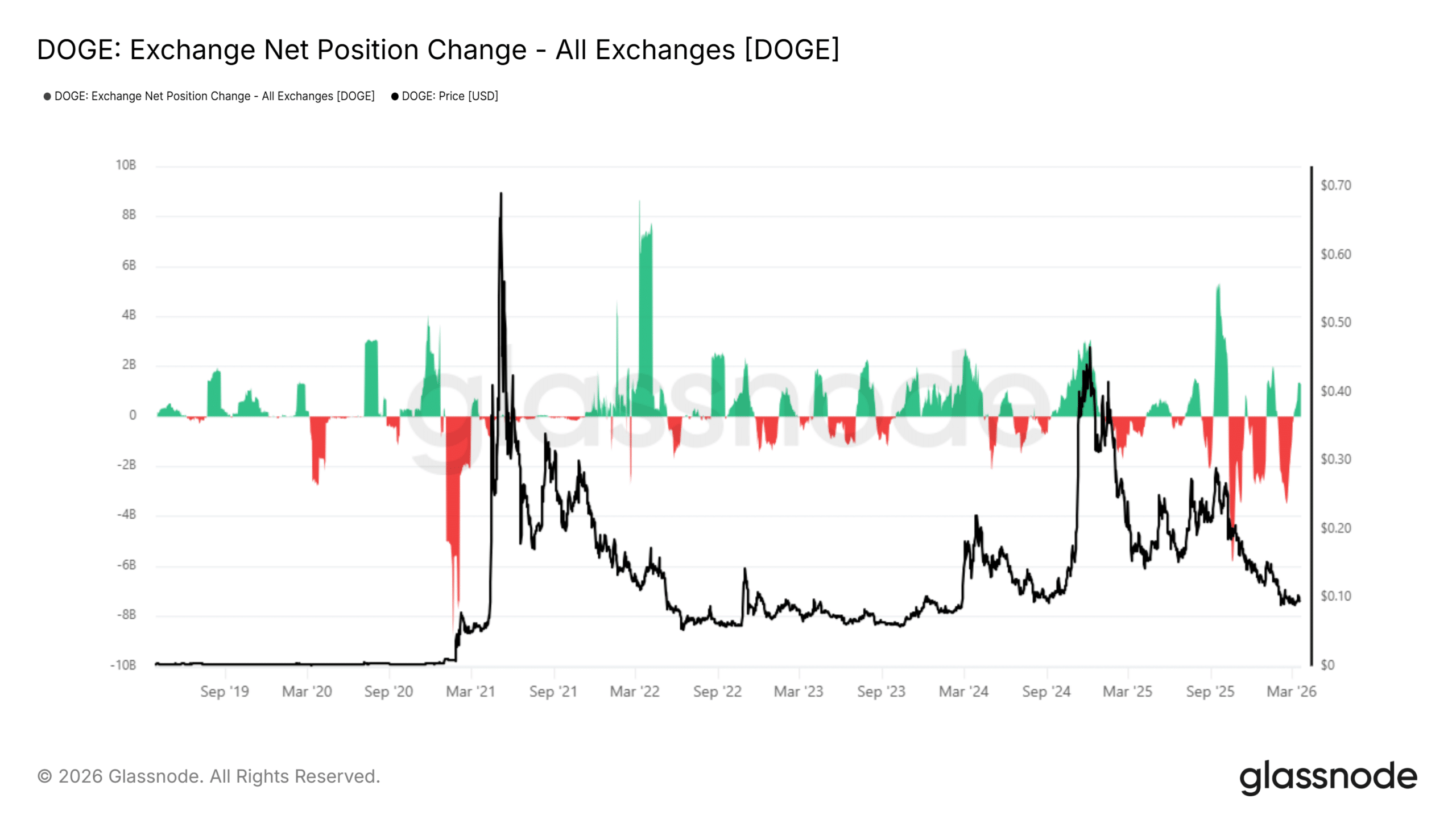
Exchange flows add context to the redistribution narrative. For example – The Net Position change showed repeated spikes above 4 billion DOGE, reflecting strong inflows into exchanges during key periods.
Source: Glassnode

As these inflows rise, the price often stalls or declines, reinforcing sell-side pressure. More recently, persistent negative flows hinted at intermittent outflows – Indicative of periods of absorption or accumulation.

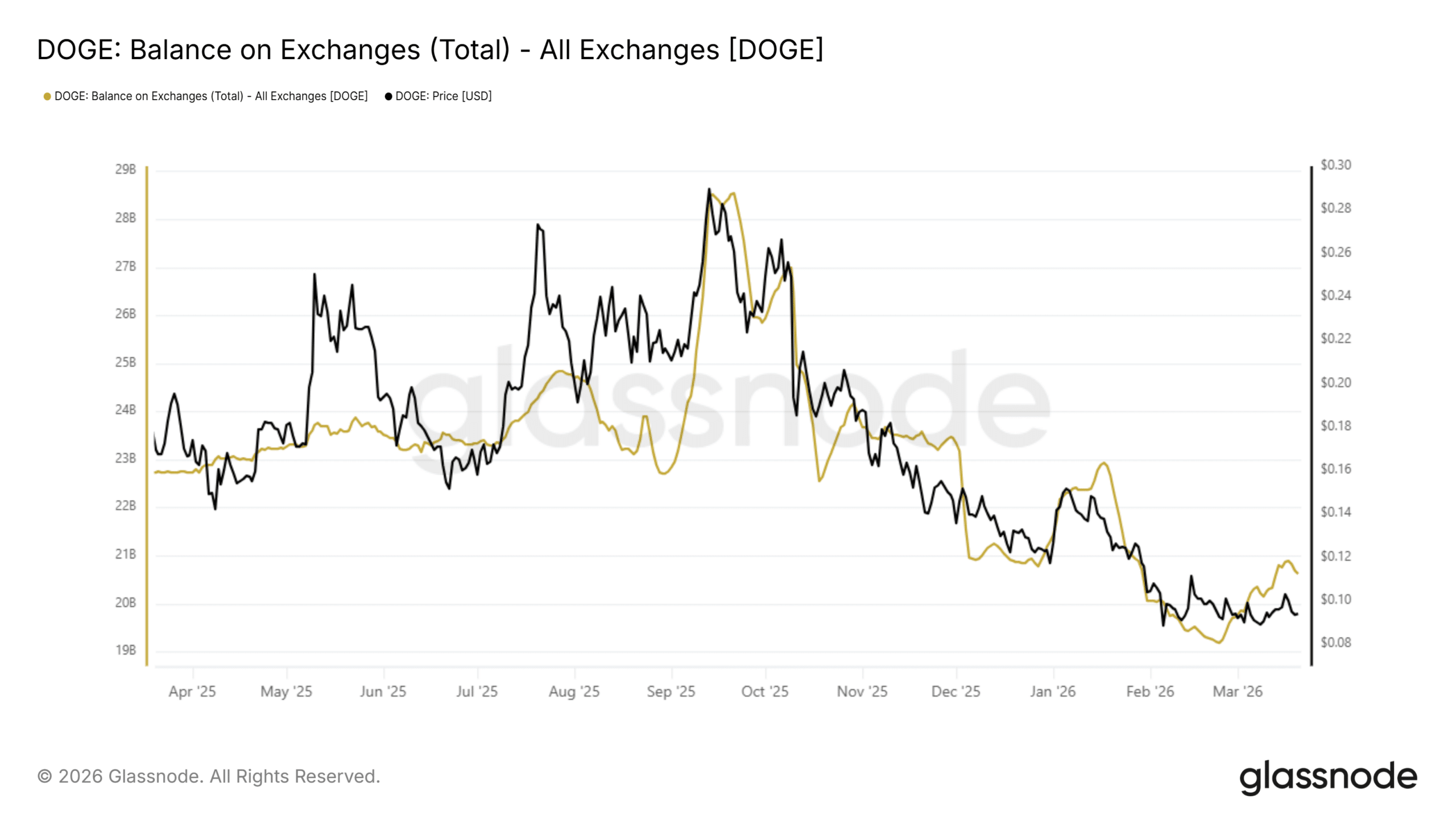
At the same time, total Exchange Balances declined from nearly 29 billion DOGE in late 2025 to around 20 billion DOGE at press time – Marking a roughly 30% drop. This reduction could allude to supply moving off exchanges, which can support price over time.
Source: Glassnode

However, intermittent inflow spikes have still introduced some overhead pressure. This is likely to keep DOGE range-bound as opposing forces balance market direction.


Final Summary

  • Dogecoin’s [DOGE] on-chain volume of 1.037 billion DOGE with the price near $0.094 reflected whale-led redistribution into exchanges.
  • Exchange inflows above 4 billion DOGE, alongside a 30% drop in balances, revealed ongoing absorption, despite intermittent sell pressure keeping price compressed.


Perguntas relacionadas

QWhat was the key divergence observed in Dogecoin's on-chain activity and price action?

ADogecoin's on-chain transfer volume climbed sharply to 1.037 billion DOGE, yet the price remained muted, holding near $0.094 with minimal gains of only 0.3%, establishing a clear imbalance between network flow and valuation.

QAccording to the article, what does the high transaction volume more likely signify rather than accumulation?

AThe high volume is more likely a sign of redistribution, exchange routing, or internal wallet movements, rather than genuine demand or sustained buying pressure from accumulation.

QHow did whale flows contribute to the unresponsive price of Dogecoin?

AWhale transfers above $90 million moved into Bitget-linked wallets, signaling distribution into available liquidity. This increased immediate sell pressure on exchanges, which absorbed incoming demand instead of pushing the price higher.

QWhat does the 30% drop in total exchange balances from late 2025 to the time of the article suggest?

AThe decline from nearly 29 billion DOGE to around 20 billion DOGE suggests that supply is moving off exchanges, which can be a supportive factor for the price over time, indicating periods of absorption.

QWhat are the two opposing forces that the article suggests are keeping DOGE's price range-bound?

AThe two opposing forces are intermittent inflow spikes that introduce overhead sell pressure and the reduction of supply on exchanges from absorption, which balance market direction and keep the price compressed.

Leituras Relacionadas

Goldman Sachs: July Smashes Through Crowded Trades, U.S. Stock Bull Market Not Broken but Harder to Navigate

Goldman Sachs: July Sees Crowded Trades Unwound, U.S. Bull Market Intact but Getting Tougher. The U.S. stock market in July did not see an index-level crash, but rather a significant unwinding of speculative positions. While the S&P 500 remained stable—trading within a narrow 3.5% range and staying within 2% of its high—underlying market dynamics were volatile. Heavily crowded trades, particularly in high-momentum tech, AI-linked stocks, and Asian strategies, faced severe pressure and forced deleveraging. Data indicates this was a meaningful cleanse, not a minor adjustment. Global tech exposure saw its largest sell-off in over five years, leverage in Korean equity ETFs plummeted, and Goldman's prime brokerage recorded the largest gross exposure reduction since late 2022. Leverage on momentum factors among fundamental long/short clients fell to the 28th percentile of its one-year range. The AI trade narrative shifted from pure potential to a focus on tangible returns. While Meta failed to show clear AI monetization, Microsoft and Amazon provided evidence that massive capital expenditure is translating into scalable revenue and product growth, preventing a blanket sell-off of the AI sector. The Federal Reserve's more opaque communication style and volatility in long-end Treasury yields have introduced new friction, particularly for rate-sensitive growth and tech stocks. The broader outlook for U.S. equities remains favorable, supported by a strong economy, robust earnings, and substantial AI capital expenditure. However, risk/reward is no longer cheap, and the market's upward elasticity has weakened. The Nasdaq 100's trajectory—up 12% year-to-date despite significant pullbacks—illustrates that the bull trend persists but the path is becoming more difficult. The key lesson from July is that the market no longer rewards crowded, highly leveraged trades, requiring more disciplined and liquid portfolio approaches.

marsbitHá 2h

Goldman Sachs: July Smashes Through Crowded Trades, U.S. Stock Bull Market Not Broken but Harder to Navigate

marsbitHá 2h

Interview with Robinhood Executive: Meme + Tokenized US Stocks as "Barbell" Customer Acquisition Strategy, All Business Lines Achieve Hundreds of Millions in Revenue

Interview with Robinhood executive Johann Kerbrat reveals the company's "barbell" customer acquisition strategy for its new Robinhood Chain, combining meme tokens with tokenized stocks. Three weeks after mainnet launch, the chain has seen over $3B in weekly DEX volume and 105M transactions. Kerbrat explains the logic behind the permissionless chain: meme tokens attract DeFi users, while tokenized real-world assets (RWA), currently over 90 US stocks and ETFs accessible in 120+ countries, serve global users. The goal is to bring Robinhood's 27 million funded accounts on-chain by simplifying DeFi with a user-friendly interface, exemplified by features like Robinhood Earn which offers yield without requiring wallet management. Built on Arbitrum's technology stack for its speed, low cost, and Ethereum's security, the chain focuses on financial products like Earn, spot trading, and perpetuals. Kerbrat downplays direct competition with platforms like Base, emphasizing the goal of expanding the overall market for on-chain assets. He details selective partnerships (e.g., Morpho, Lighter) based on compliance, unique UX, and differentiation. While regulatory clarity is pending for US perpetuals, the expansion continues via Bitstamp in Europe. Finally, Kerbrat positions Robinhood as a "super app" integrating stocks, options, crypto, banking, and AI trading, with all major business lines generating hundreds of millions in revenue. For the chain, current priority is driving adoption over maximizing gas fee revenue.

marsbitHá 4h

Interview with Robinhood Executive: Meme + Tokenized US Stocks as "Barbell" Customer Acquisition Strategy, All Business Lines Achieve Hundreds of Millions in Revenue

marsbitHá 4h

Trading

Spot
活动图片




