AI Leads to Layoffs? Research Shows AI Is More Expensive Than the People It Replaces

marsbitPublicado em 2026-06-09Última atualização em 2026-06-09

Resumo

Title: AI Layoffs? Research Shows AI is More Expensive Than the Workers It Replaces. This year, nearly 50,000 employees have been laid off due to AI, with companies initially believing AI could replace human jobs. However, recent findings indicate that the actual operational costs of AI often exceed the expense of the human labor it was meant to replace. Examples include Uber exhausting its annual AI budget in just four months, Microsoft cutting Claude Code licenses due to high costs, and an Anthropic employee incurring $150,000 in API usage in a single month. A CloudZero survey reveals that 45% of enterprises spend over $100,000 monthly on AI, yet only 8% of S&P 500 companies report any AI-related revenue, and half struggle to measure ROI. Analyst Scott Galloway predicts a shift toward cheaper Chinese AI models, which are 10 to 30 times more affordable than American counterparts. Data shows Chinese models' usage among developers surged from 1% in 2024 to over 60% by mid-2026, with 80% of U.S. AI startups adopting them. This trend may prompt regulatory responses, such as potential restrictions from the Trump administration.

Authors: Scott Galloway / Ed Elson / Mia Silverio

Translation: TechFlow

TechFlow Introduction: Nearly 50,000 people have been laid off this year due to AI, but more and more companies are finding that the cost of using AI is higher than human labor. Uber burned through its entire 2026 AI budget in four months, Microsoft is cutting Claude Code licenses in multiple departments, and an Anthropic employee used up $150,000 in API credits in a single month. Scott Galloway believes companies will ultimately turn to Chinese large language models that are 10-30 times cheaper, which will force Trump to impose restrictions.

Is AI More Expensive Than the People It Replaces?

Nearly 50,000 employees have been laid off this year, citing AI as the reason. This figure nearly equals the total for all of 2025. For companies adopting AI, the logic is simple: AI can do the jobs people do.

But in recent weeks, this logic has hit a wall. More and more companies are discovering that the actual cost of using AI is higher than the human labor it is intended to replace.
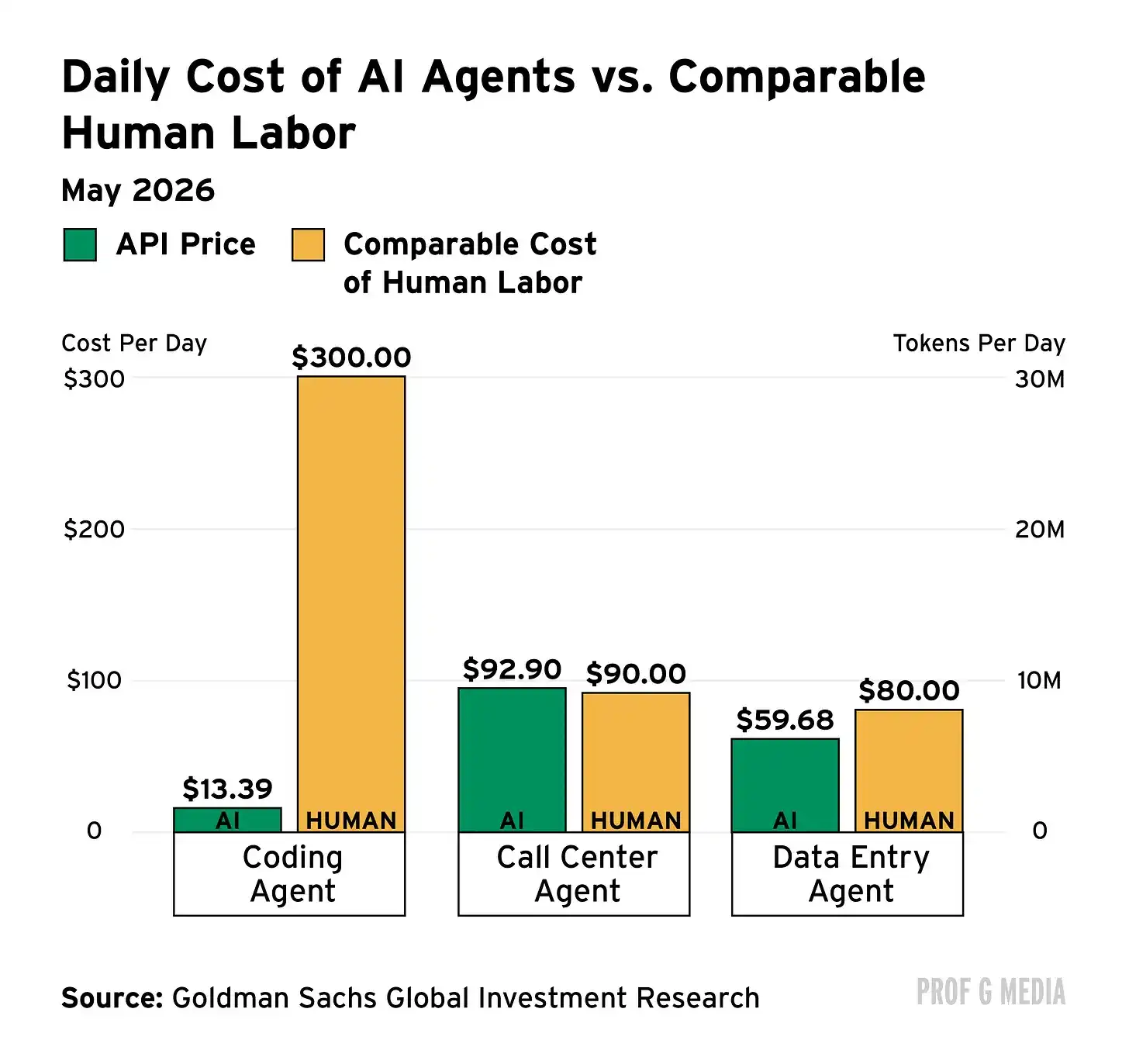
Figure: The AI Cost Shock for Businesses – AI spending and cost feedback from companies like Uber, Microsoft, Nvidia, Meta

Uber burned through its entire 2026 AI budget in just four months. The COO said it's becoming increasingly difficult to justify AI expenditures internally. Microsoft is cutting Claude Code licenses in multiple departments for one simple reason: cost.

A Nvidia executive stated that compute costs now "far exceed employee costs." Meta, Pinterest, and Spotify all cited rising inference costs as a drag on margins in their Q1 earnings reports.

How big are corporate AI budgets? A survey by cloud cost management company CloudZero shows that in 2025, 45% of businesses spent over $100,000 per month on AI, up from only 20% the previous year.

An even more extreme case within Anthropic: one employee spent $150,000 on Claude Code in a single month. For that to be financially justifiable, this engineer would need to do the work of 11 average engineers.

In the current market, the performative value of the word "efficiency" has been consistently rewarded, to the point where companies don't even need to actually calculate efficiency. 79% of S&P 500 companies mentioned AI in their recent earnings calls, but only 8% disclosed any AI-related revenue.
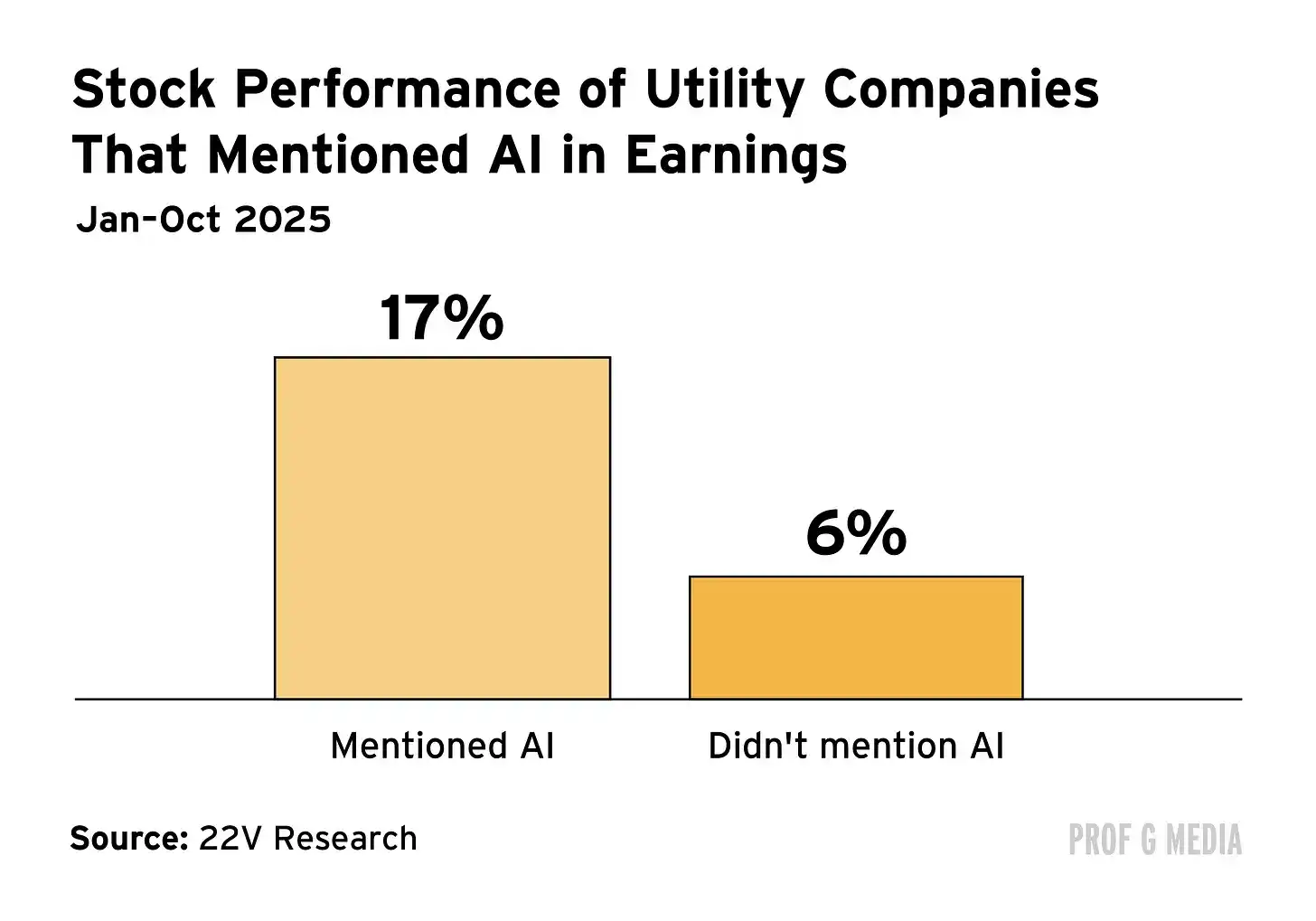
Figure: S&P 500 Companies' AI Rhetoric vs. Actual Revenue Disclosure

The same CloudZero report also found that only half</strong of the surveyed companies expressed confidence in their ability to assess the return on their AI investments. Match Group CEO Spencer Rascoff said AI costs the company $5 to $10 million annually. When asked about ROI, he said, "I think we benefit from it, but it's hard to feel."

Chinese Large Models Will Be the Biggest Winners

Scott Galloway's judgment is: companies will ultimately turn to the cheapest models, which are Chinese large language models. Chinese models are 10 to 30 times cheaper than American models.

Data is already validating this trend: the share of Chinese models in developer usage surged from about 1% in 2024 to over 60% in May of this year, and 80% of US AI startups are using Chinese open-source AI models.
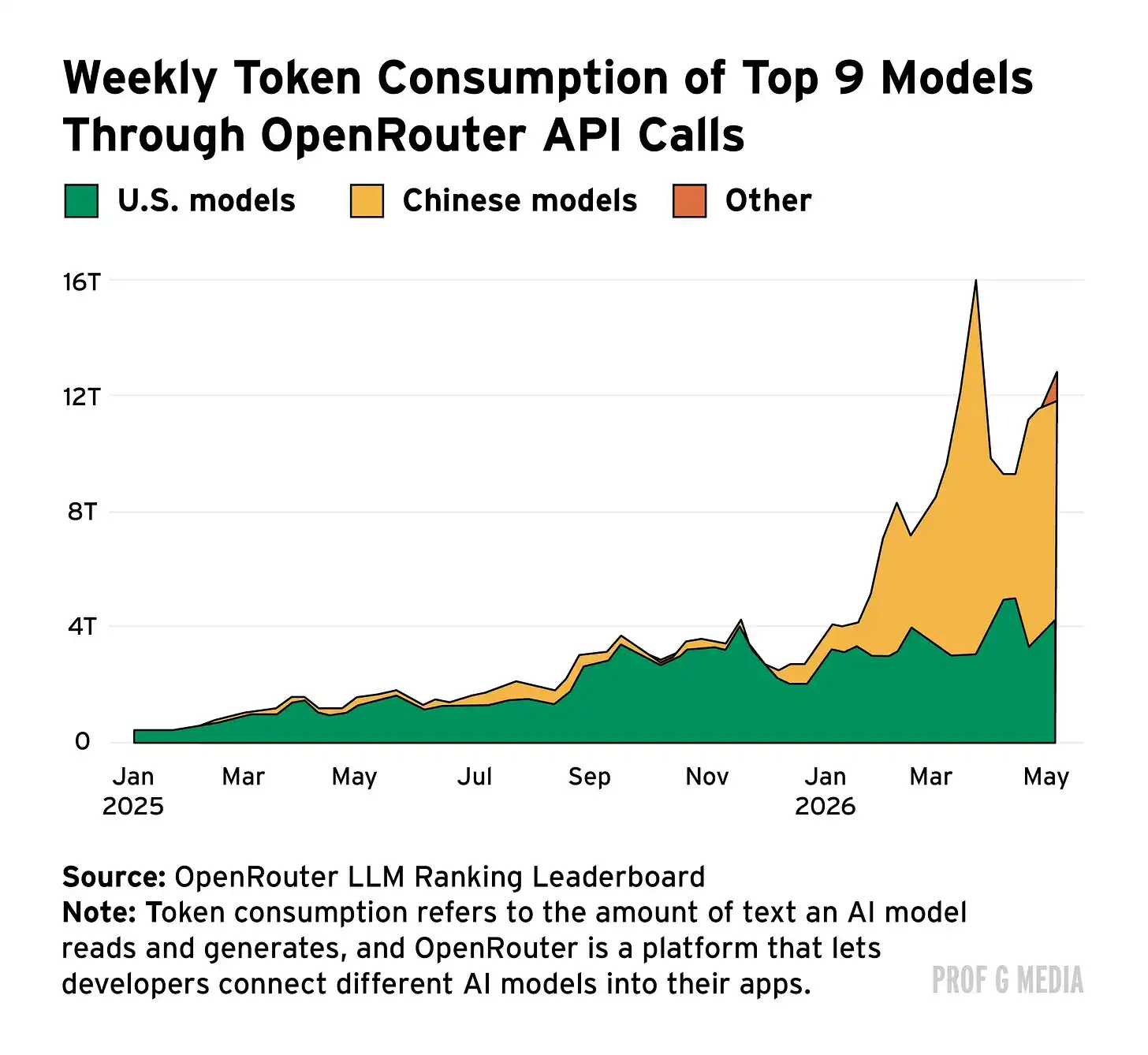
Figure: Changes in Share of Chinese Large Models in Developer Usage & Usage by US AI Startups


Criptomoedas em alta

Perguntas relacionadas

QWhat is the main finding about AI's cost compared to human labor based on the article?

AThe article finds that an increasing number of companies are discovering that the actual operational cost of AI is higher than the cost of the human labor it is intended to replace.

QWhich companies are mentioned as facing significant AI cost challenges?

AUber, Microsoft, Nvidia, Meta, Pinterest, Spotify, and Anthropic are mentioned as companies facing high AI costs or budgetary issues.

QAccording to the article, what percentage of S&P 500 companies disclosed AI-related revenue in their recent earnings calls?

AOnly 8% of S&P 500 companies disclosed any AI-related revenue in their recent earnings calls, despite 79% mentioning AI.

QWhat does Scott Galloway predict will be the solution for companies struggling with high AI costs?

AScott Galloway predicts that companies will eventually turn to cheaper Chinese large language models, which are 10 to 30 times less expensive than American models.

QWhat dramatic increase in usage of Chinese AI models is highlighted in the data presented?

AThe data shows that the share of Chinese models among developers soared from about 1% in 2024 to over 60% by May of the article's year, with 80% of U.S. AI startups using Chinese open-source AI models.

Leituras Relacionadas

human.tech Launches Clean SDK for Privacy-First Web3 Apps

human.tech has launched the Clean SDK, a toolkit enabling developers to build privacy-first Web3 applications with transparent accountability. Released alongside Aztec's version 5, the SDK provides components for integrating zero-knowledge identity verification, sanctions screening, and private transactions, without developers handling sensitive user data or building compliance infrastructure from scratch. It uses zero-knowledge proofs and programmable verification to allow apps to confirm user legitimacy and sanctions compliance while keeping identities confidential. The first application built on the SDK, Shield, a privacy bridge to Aztec, also launched. It allows users to transfer assets privately while proving a unique human is behind each transfer and that funds have passed sanctions checks, as verified by a May 2026 audit. The SDK offers three core verification techniques: Proof of Innocence (sanctions screening against 23 sources), Proof of Personhood (simpler verification via Human Passport), and Proof of Clean Hands (higher-assurance zero-knowledge government ID checks). This allows apps to authenticate users and transactions without exposing personal data. Designed for Aztec builders, the SDK lets developers add programmable privacy to decentralized apps, eliminating the need to create their own verification and ZK infrastructure. Shield demonstrates its practical use for private bridges, but the SDK aims to enable a wider ecosystem of private, accountable financial apps and services. The launch addresses growing demand for infrastructure that balances privacy and accountability. The SDK avoids traditional identity databases, storing encrypted data off-chain, screening at both entry and exit points, and including a gated disclosure mechanism for legal requests. human.tech's products, including the Clean SDK, focus on using zero-knowledge technology to enable verifiable personhood and privacy in digital systems.

TheNewsCryptoHá 25m

human.tech Launches Clean SDK for Privacy-First Web3 Apps

TheNewsCryptoHá 25m

Unlocking $100 Million in Liquidity? Pump.fun's New Policy Tests the 5-Minute Pump Technique

Pump.fun, a popular meme coin launchpad, has introduced a new standard mechanism called BOOST. It aims to address a significant capital efficiency issue: when a newly launched token graduates from its initial bonding curve to a liquidity pool (LP), roughly 20% of its liquidity becomes permanently locked as "dead liquidity," estimated to waste over $100 million annually. Instead of locking these funds permanently, BOOST repurposes them. Upon a token's migration, approximately 20% of the settlement funds (e.g., 17.6 SOL or ~$2516 USDC) are used to buy back the token on the open market over a 5-minute period via a Time-Weighted Average Price (TWAP) mechanism. All purchased tokens are immediately burned. This creates a brief, systematic buy pressure immediately after migration, potentially generating a short-term price surge ("pump") while permanently reducing the token's circulating supply. The goal is to enhance the immediate post-launch trading experience, potentially increasing trader retention and sustainable protocol revenue, which funds ongoing token buybacks. However, concerns exist that this artificial 5-minute boost could lower the barrier for launching low-quality tokens and lead to steeper price crashes once the buy pressure stops, if followed by large sell-offs. The feature automatically applies to tokens migrating after July 21, 2024, but not to previously migrated tokens or those launched via the Mayhem AI Agent lab.

marsbitHá 32m

Unlocking $100 Million in Liquidity? Pump.fun's New Policy Tests the 5-Minute Pump Technique

marsbitHá 32m

Podcast Notes | Conversation with GSR Asset Management Head: To Determine if This Crypto Rally is Real, Just Watch the Lending Rates on Aave

Podcast Summary: Dialogue with GSR's Head of Asset Management: To Determine if This Crypto Rally is Real, Just Check Lending Rates on Aave Andy Baehr, Managing Director of Asset Management at GSR, discusses the current crypto market, characterizing it as stuck in a state of "ambivalence" with short-lived, unsustainable rallies. He outlines a simple framework: the market moves between "ambivalence" and "conviction" (sustained upward momentum). Currently, every rally resembles a single-stage rocket booster that quickly fizzles out. Baehr identifies three key signals to watch: 1) DeFi lending rates, 2) the potential passage of the CLARITY Act, and 3) the market forming a consensus on the "Fed hawkish peak." He emphasizes that the most immediate indicator for the sustainability of the recent CPI-triggered rally is the USDC borrowing rate on Aave, currently around 3.75%—close to U.S. Treasury yields. The absence of a credit spread indicates low leverage demand and a lack of market energy. He explains that a healthy, sustained rally requires layered buying pressure. Last year's rally progressed from an ETH short squeeze to crypto-native trader influx and finally to ETF inflows. Currently, this structure is missing. Other potential structural buyers like Digital Asset Treasury (DAT) companies are absent, and ETF flows have proven transient. Baehr notes that while small-cap crypto tokens outperformed large caps in Q2—a potential sign of capitation in major assets—capital is also flowing to more exciting opportunities like AI stocks and tech IPOs, leaving crypto sidelined. Regarding DeFi, he highlights that platforms like Aave provide a clear, real-time signal of leverage demand through their supply/demand-driven interest rates. A significant, sustained rate increase would signal genuine market conviction. He also observes the quiet emergence of fixed-income-like products and vaults in DeFi. On regulation, the probability of the CLARITY Act passing before the August 7th deadline has dropped linearly from 75% to below 40% on Polymarket. Baehr suggests its passage would be treated as a bullish surprise, a potent driver for price movement. However, political hurdles, including ethical clause debates and disclosures about the First Family's crypto profits, remain significant obstacles. Ultimately, the market awaits clarity on the Fed's terminal rate under Chair Warsh. Until the "Fed Solstice"—the point where the market collectively understands the peak of hawkish policy—sustained conviction will be difficult to achieve.

marsbitHá 1h

Podcast Notes | Conversation with GSR Asset Management Head: To Determine if This Crypto Rally is Real, Just Watch the Lending Rates on Aave

marsbitHá 1h

Trading

Spot

Artigos em Destaque

Como comprar PEOPLE

Bem-vindo à HTX.com!Tornámos a compra de ConstitutionDAO (PEOPLE) simples e conveniente.Segue o nosso guia passo a passo para iniciar a tua jornada no mundo das criptos.Passo 1: cria a tua conta HTXUtiliza o teu e-mail ou número de telefone para te inscreveres numa conta gratuita na HTX.Desfruta de um processo de inscrição sem complicações e desbloqueia todas as funcionalidades.Obter a minha contaPasso 2: vai para Comprar Cripto e escolhe o teu método de pagamentoCartão de crédito/débito: usa o teu visa ou mastercard para comprar ConstitutionDAO (PEOPLE) instantaneamente.Saldo: usa os fundos da tua conta HTX para transacionar sem problemas.Terceiros: adicionamos métodos de pagamento populares, como Google Pay e Apple Pay, para aumentar a conveniência.P2P: transaciona diretamente com outros utilizadores na HTX.Mercado de balcão (OTC): oferecemos serviços personalizados e taxas de câmbio competitivas para os traders.Passo 3: armazena teu ConstitutionDAO (PEOPLE)Depois de comprar o teu ConstitutionDAO (PEOPLE), armazena-o na tua conta HTX.Alternativamente, podes enviá-lo para outro lugar através de transferência blockchain ou usá-lo para transacionar outras criptomoedas.Passo 4: transaciona ConstitutionDAO (PEOPLE)Transaciona facilmente ConstitutionDAO (PEOPLE) no mercado à vista da HTX.Acede simplesmente à tua conta, seleciona o teu par de trading, executa as tuas transações e monitoriza em tempo real.Oferecemos uma experiência de fácil utilização tanto para principiantes como para traders experientes.

543 Visualizações TotaisPublicado em {updateTime}Atualizado em 2026.06.02

Como comprar PEOPLE

Discussões

Bem-vindo à Comunidade HTX. Aqui, pode manter-se informado sobre os mais recentes desenvolvimentos da plataforma e obter acesso a análises profissionais de mercado. As opiniões dos utilizadores sobre o preço de PEOPLE (PEOPLE) são apresentadas abaixo.

活动图片












