AI-Driven New Era: SunAgent Reshapes the New Paradigm of On-Chain Interactions on TRON with AI-Powered Intelligent Interaction Hub

marsbitPublicado em 2025-12-26Última atualização em 2025-12-26

Resumo

AI-Powered New Era: SunAgent Reshapes On-Chain Interaction Paradigm on TRON with AI-Powered Intelligent Hub As AI reshapes business and society at an unprecedented scale, the crypto world faces a pivotal moment. The convergence of AI and blockchain represents not just a high-growth market but a fundamental "paradigm shift" in underlying interaction logic. However, a significant "interaction gap" exists due to the complex, inefficient design of traditional on-chain operations, requiring users to switch between wallets, DApps, and explorers. SunAgent emerges as an architectural response to this core challenge, positioning itself as a "smart scheduling hub" within the TRON ecosystem. It allows users to execute complex on-chain operations through natural language dialogue, eliminating the need for app switching. By deeply integrating the capabilities of SUN.io, SunPump, TronLink, and TRONSCAN, it weaves disparate on-chain scenarios into a cohesive "conversational interface." Its technical core is a specialized AI agent that acts as an "on-chain operation engine," not a simple chatbot. For example, a user can command: "Help me issue a Shiba Inu-themed Meme token with a total supply of 100 million." SunAgent's LLM parses the instruction, auto-generates parameters, creates a meme image via AI, deploys the contract on SunPump, and presents the action plan for user confirmation. The entire multi-step process is simplified to "one command + one confirmation," embodying the "Dialogue...

As artificial intelligence reshapes business and society with unprecedented breadth and depth, the efficiency-driven crypto world has reached a critical juncture. A study by Fortune Business Insights shows that the market at the intersection of AI and blockchain is expanding at a rapid compound annual growth rate of nearly 30%. This not only heralds a high-growth track but also marks a profound "paradigm shift" starting from the underlying interaction logic.

However, between the broad future pointed to by this grand trend and the current user experience lies a pressing "interaction gap" that needs to be bridged. The root cause lies in the complex and inefficient design logic of traditional on-chain interactions: to complete a basic transaction, users often need to repeatedly switch between wallets, DApps, and blockchain explorers. This design, which prioritizes technical sovereignty at the relative expense of operational convenience, has built a fortress of security but has also无形中 closed the door to the mass market.

This is the core proposition of the integration of AI and blockchain. It should not merely be an overlay of technical architectures but must become a user-oriented "interaction revolution." Against this backdrop, the comprehensive upgrade of SunAgent has emerged. It is not an incremental improvement but an architectural-level response to this fundamental dilemma. Its core mission is to become the "intelligent scheduling hub" for users in the TRON ecosystem, allowing them to complete complex on-chain operations within the TRON ecosystem directly through natural language dialogue without switching applications.

Therefore, SunAgent deeply integrates the full ecosystem capabilities of SUN.io, SunPump, TronLink, and TRONSCAN, weaving originally independent and cumbersome on-chain scenarios into a coherent "dialogue interface." This marks a strategic shift in the TRON ecosystem's focus from consolidating financial infrastructure to providing users with an极致, barrier-free interaction experience. SunAgent's ambition is to become the core entry point and intelligent navigation for the next generation of users to seamlessly access the Web3 world.
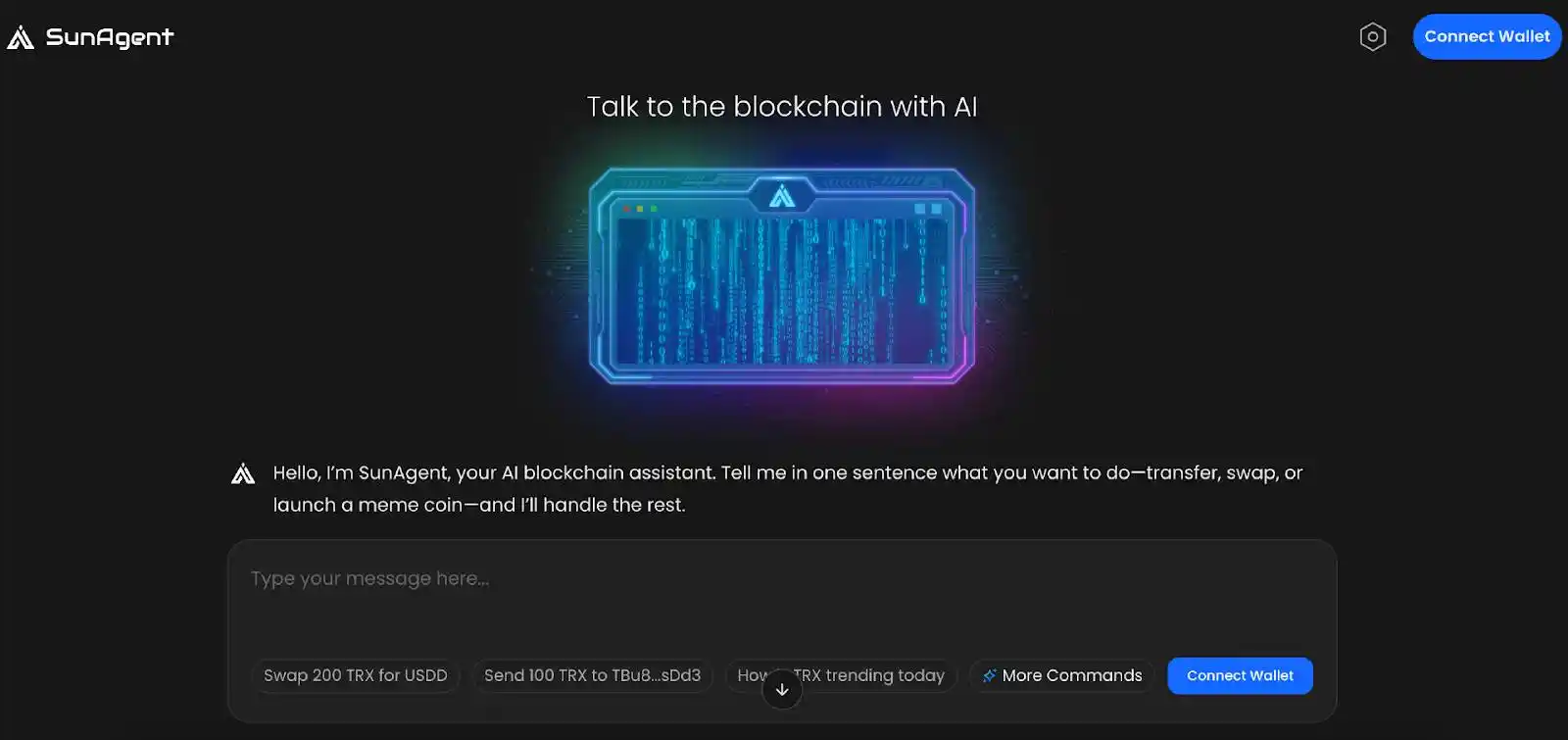
Revolutionizing the On-Chain World with Dialogue: SunAgent Leads the New Paradigm of "Intelligent Interaction"

The technological core of SunAgent is a dedicated AI agent deeply coupled with the TRON ecosystem. It is not a simple chatbot but an "on-chain operation engine" with complex task understanding and execution capabilities. For novices, it is a随身 "on-chain mentor," guiding them through the entire process from idea to launch; for experienced users, it is an efficient "strategy execution terminal" that can implement complex strategies with one click.

This revolutionary experience brought by "intelligent interaction" can be most直观ly demonstrated through a typical scenario. Imagine a user who knows little about blockchain but has a creative idea: to create and issue a Meme token themed around Shiba Inu with a total supply of 100 million. In the past, this would have been a daunting task. Even using existing token issuance platforms, users still needed to complete a set of complex operations: setting token economic parameters, uploading images, configuring liquidity, etc. This not only requires some professional knowledge but also the反复 switching between multiple pages and authorizations, which is prone to errors and dampens enthusiasm.

Now, SunAgent compresses all this into one conversation. After connecting the TronLink wallet, the user simply types into the dialog box: "Help me issue a Shiba Inu-themed Meme token with a total supply of 100 million." The system's large language model will immediately parse the instruction, automatically generate key parameters such as the token's name, symbol, and total supply, call upon AI to create a matching Meme image, and then complete the deployment of the token contract on SunPump. The system will present this complete "operation plan" clearly for the user to preview.

After the user confirms, they only need to sign and authorize this single transaction that aggregates all steps once in a wallet like TronLink to complete the token issuance. After the transaction is completed, SunAgent will also provide the transaction hash and a link to TRONSCAN, making the entire process completely transparent and traceable. From idea to on-chain asset, the complex multi-step process is simplified into "one sentence instruction + one confirmation." This is the most直观 embodiment of the "Dialogue as a Service" concept.

The "plan preview + user confirmation" dual-control mechanism adopted by SunAgent keeps the decision-making power始终 in the user's hands. Moreover, the private key is always controlled locally by the user; the system never touches it and cannot sign on behalf of the user, fundamentally ensuring asset sovereignty. Simultaneously, the system has built-in real-time feasibility checks before transactions (such as balance, address validity), significantly reducing the risk of failure and fund loss due to configuration errors.

By combining the cognitive capabilities of large language models with the executable environment of blockchain, SunAgent is advancing on-chain interaction from the "manual operation era" to the "intelligent agent era". The essence of its technical architecture is to build an intelligent yet absolutely user-obedient intermediate layer between the user and the complex blockchain infrastructure, allowing the technology itself to fade into the background and letting value flow as naturally as conversation.

SunAgent: The Intelligent Core Driving Efficiency in the TRON Ecosystem

The core advantage of SunAgent lies in its超越 of the role of a single application, acting as the "intelligent connector" and "efficiency multiplier" for the TRON ecosystem. It is not another independent DApp but rather an intelligent protocol layer deeply integrated into the ecosystem, seamlessly accessing and调度 core components from SUN.io (swap), SunPump (Meme tokens), TronLink (asset management) to TRONSCAN (data). Users no longer need to care about which application a function is hidden in; they can mobilize the entire ecosystem through a unified dialogue entry point.

This design彻底重构 the user experience. It weaves originally complex core scenarios like Swap, token issuance, staking, voting, and querying into a coherent dialogue flow. To maximize user convenience, SunAgent also comes pre-loaded with templates covering various functions. Clicking the corresponding command automatically fills the input box, which can be slightly modified or sent directly, for example:

l 「TRX price today」

l 「Help me swap 100 USDT for TRX」

l 「Transfer 100 TRX to TBu8...SdD3」

l 「Help me issue a Meme token called SunCat with a total supply of 100 million」

Through the极致 experience brought by SunAgent, users can bid farewell to the "manual labor" of繁琐 switching between multiple tabs, instead obtaining complete services through concise instructions: from a swap instruction to the execution of the optimal trading path; from an idea to an AI-generated and one-click deployed Meme token; from complex asset management needs to automatically completed staking, voting, and transfers. This is not just a simplification of interaction but also encapsulates the complexity of the ecosystem behind intelligence, realizing the ultimate vision of "one assistant, connecting the entire ecosystem".

This deep integration makes SunAgent an internal "value circulation accelerator" for the ecosystem. On one hand, it attracts and retains a large number of users through its极致 experience, bringing持续增长的流量与活性 to all protocols within the ecosystem. On the other hand, as a unified调度 layer, it efficiently guides user assets to flow between different protocols, significantly improving the allocation efficiency of生态资源 and the synergistic effects between protocols, thereby激发ing a network effect where the whole is greater than the sum of its parts.

This efficiency-driven positive cycle not only consolidates the ecological foundation but also paves the way for more forward-looking product synergy. The unified entry point and smooth experience built by SunAgent effectively create a highly sticky user pool and a standardized interaction layer for the entire TRON ecosystem. This makes deep collaboration with AI products from different scenarios and building combinatorial innovation possible.

Under this vision, SunAgent and SunGenX, another AI token issuance assistant within the same ecosystem, form a "twin-engine" driving future growth: SunGenX acts like an aggressive "creation engine," simplifying the Meme token issuance process into a lightweight interaction on social media,极大地拓展ing the realization path of creativity. SunAgent, meanwhile, acts like a周全 "intelligent co-pilot," focused on enhancing users' comprehensive execution and asset management efficiency in the complex on-chain world. Working together, they not only cover the entire lifecycle from idea generation to asset management but also jointly practice the advanced concept of "Dialogue as a Service," leading the TRON ecosystem and the entire industry into a new era of smarter, more user-friendly on-chain interaction.

Facing the rolling tide of AI, the industry has moved from initial conceptual fervor to a pragmatic stage of seeking real user value and scalable applications. Therefore, the upgrade of SunAgent is a highly implementable paradigm under the trend of AI and blockchain integration. It does not空谈 the grand narrative of decentralized AI but instead confronts the most real and common user pain points, using the key of "natural language dialogue" to unlock the shackles restraining the mass adoption of DeFi. This marks a key leap in the strategic focus of the TRON ecosystem—from building powerful underlying infrastructure to shaping an intelligent value network centered on smart dialogue and putting users first.

Perguntas relacionadas

QWhat is the core mission of SunAgent in the TRON ecosystem?

ASunAgent's core mission is to act as an 'intelligent scheduling hub' for users in the TRON ecosystem, allowing them to perform complex on-chain operations through natural language dialogue without switching between applications.

QHow does SunAgent simplify the process of creating a Meme token for a user?

AA user simply inputs a command, like 'Help me issue a Meme token with a Shiba Inu theme, total supply 100 million.' SunAgent's LLM parses this, auto-generates parameters, creates a meme image via AI, deploys the contract on SunPump, and presents the plan for the user to confirm with a single signature in their wallet.

QWhat key components of the TRON ecosystem does SunAgent integrate with?

ASunAgent deeply integrates with the full ecosystem capabilities of SUN.io (swaps), SunPump (Meme tokens), TronLink (asset management), and TRONSCAN (on-chain data).

QWhat safety and control mechanisms does SunAgent employ for user transactions?

ASunAgent uses a 'plan preview + user confirmation' dual-control mechanism. The private key is always controlled locally by the user's wallet; the system never touches it or signs on the user's behalf. It also performs real-time pre-transaction feasibility checks.

QHow do SunAgent and SunGenX work together as a 'dual-engine' for the TRON ecosystem?

ASunGenX acts as a 'creation engine,' simplifying the Meme token issuance process into a lightweight social media interaction. SunAgent acts as an 'intelligent co-pilot,' focusing on improving the user's overall execution and asset management efficiency. Together, they cover the entire lifecycle from idea generation to asset management.

Leituras Relacionadas

Silicon Valley 'Startup Guru' Steve Hoffman: Web3 + AI Could Be a Trap

Silicon Valley investor and "Godfather of Startups" Steve Hoffman warns that combining Web3 with AI is likely a trap, not a promising venture. In an interview, Hoffman argues that while AI is a foundational technology touching all industries, Web3 adds complexity, friction, and regulatory risk without solving mainstream consumer or business needs. He advises founders to focus on deep, specialized applications where startups can out-iterate giants, rather than on generic features easily replicated by large tech companies. Hoffman observes that Silicon Valley will lead foundational AI research, while China excels at rapid, large-scale application and commercialization, particularly in robotics. He stresses that AI-driven autonomous agents capable of collaborative, multi-step tasks are 2-4 years away, which will cause significant job displacement. The solution is not to slow AI but to redesign business models around human-AI collaboration and reform social systems like education and retraining. For startups, Hoffman recommends focusing on vertical, expertise-heavy domains to build defensibility. He sees major opportunities in AI fraud detection and cybersecurity. Key founder mindsets include systemic thinking over feature-focus, relentless customer centricity, building adaptive teams, and deeply understanding AI's capabilities and limits. Hoffman is also leading a non-profit initiative to establish university centers aimed at training future leaders in responsible, human-value-aligned AI innovation.

marsbitHá 1h

Silicon Valley 'Startup Guru' Steve Hoffman: Web3 + AI Could Be a Trap

marsbitHá 1h

Token Inefficient, Economy Tokenless

The article "Tokens Aren't Economical, Economics Aren't Tokenized" analyzes a pivotal shift in the AI industry from a technology-driven narrative to one dominated by capital efficiency. It highlights two concurrent trends: a severe capital shortage due to the exorbitant and recurring costs of compute (e.g., OpenAI's high burn rate) and a wave of corporate spin-offs where major tech companies are separating their AI units (like Kuaishou's Kling and Baidu's Kunlunxin). The core argument is that AI's "anti-internet" business model, where user growth increases costs rather than profits, has created a disconnect between high valuations and actual cash flow. Spin-offs address this by allowing AI assets to be valued independently. Within a parent company, they are seen as cost centers, but as standalone entities, they are priced based on their growth potential and scarcity in the primary market, leading to massive valuation premiums (e.g., Kling's estimated value tripling post-spin-off). The industry is at an inflection point, moving from "model worship" to "value realization." The competition is evolving from a pure compute (GPU) race to a broader focus on systemic efficiency and full-stack engineering (involving CPUs and orchestration) to achieve viable commercialization. The year 2026 is framed as a critical moment where the industry must definitively answer how to economically translate AI capability into tangible business value, reshaping the sector's future power structure.

marsbitHá 1h

Token Inefficient, Economy Tokenless

marsbitHá 1h

Crossing the 'Memory Wall': The Wafer-Level Revolution and Computing Power Routes in the AI Inference Era

In 2026, a historic shift occurred in AI as major cloud providers' inference spending surpassed training spending for the first time, signaling a move from "building large models" to "using large models." This shifts the core challenge from computing power to the "memory wall"—the bottleneck of data movement (model weights, activations, KV Cache) between external DRAM and processors, where energy and latency from data transfer far exceed computation itself. Companies like Nvidia face GPU idle time due to bandwidth limits. In contrast, Cerebras Systems adopts a radical "wafer-scale" approach with its Wafer-Scale Engine (WSE). Instead of cutting a silicon wafer into many chips, Cerebras uses almost the entire wafer as one massive chip (WSE-3). This design provides 44GB of on-chip SRAM, delivering memory bandwidth thousands of times higher than traditional HBM (e.g., 21 PB/s vs. Nvidia B200). For LLM inference, weights are streamed layer-by-layer from external MemoryX storage to the chip, avoiding HBM bottlenecks. This results in token generation speeds 1.5–5 times faster than Nvidia's B200 in some models and significant advantages in first-token latency and long-context tasks. Additionally, Cerebras's architecture offers much lower interconnect power consumption (0.15 pJ/bit vs. GPU's ~10 pJ/bit). However, Cerebras faces challenges: SRAM scaling has slowed with advanced nodes, limiting future capacity gains; the chip requires specialized liquid cooling and custom software stacks; and its external I/O bandwidth (150 GB/s) is low compared to NVLink, hindering multi-system scaling for very large models. Competition is intensifying. Major players are pursuing three paths: 1) Developing proprietary inference ASICs (e.g., Google TPU, Microsoft Maia), 2) Leveraging advanced packaging (e.g., TSMC's SoW) to democratize wafer-scale-like integration, potentially eroding Cerebras's process advantage within a few years, and 3) Exploring optical interconnects for ultimate bandwidth. Commercially, Cerebras is transitioning from a hardware vendor to a service provider, facing the immense challenge of building high-power, specialized data centers to meet large contracts (e.g., 250MW/year from 2026–2028). In conclusion, the AI inference era presents a fundamental architectural trade-off. Cerebras opts for extreme physical optimization for low-latency, single-task performance, while Nvidia prioritizes versatility and massive cluster throughput. The path forward remains uncertain, with technology and business models still evolving in the race toward advanced AI.

marsbitHá 1h

Crossing the 'Memory Wall': The Wafer-Level Revolution and Computing Power Routes in the AI Inference Era

marsbitHá 1h

Has Bitcoin's 'Rebound Ended', Officially Entering the Late Bear Market Phase?

**Title: Has Bitcoin's Rebound Ended, Entering the Late Bear Market Phase?** **Summary:** Bitcoin's price has declined by 13% this week, signaling a potential return to late-stage bear market conditions. The price fell to around $67k, positioned between the Realized Price and Realized Cap Weighted Average. For the first time since early 2022, the Short-Term Holder cost basis has dropped below this key average, confirming a hallmark of late-cycle bear markets. Profitability metrics have collapsed sharply. The 7-day average of the Realized Profit/Loss ratio plummeted from a local high of 3.16 to 0.29, mirroring the February panic sell-off. Critically, the 90-day average never breached the threshold of 2, indicating the recent rally to $82k was a bear market bounce, not a structural shift. Realized losses surged to $1.35 billion daily, with $770 million coming from Long-Term Holders selling at a loss. This accelerating redistribution of supply from weak to strong hands is a necessary but ongoing process for a market bottom. The rally stalled almost precisely at the aggregate cost basis (~$83k) of US spot Bitcoin ETF investors, turning that level into strong resistance and leaving the average ETF holder underwater again. Spot market flows have turned decisively negative, showing sellers are dominating order books despite the price drop. While a significant futures long liquidation event cleared over $400 million in leverage, providing a potential reset, sustained spot demand is yet to materialize. Options markets continue to price in higher future volatility (Implied Volatility) than recent price action (Realized Volatility) has shown, with a persistent skew towards put options, indicating ongoing demand for downside protection. In conclusion, multiple metrics point to a fragile market structure. Resistance at the ETF cost basis, accelerating realized losses, dominant spot selling, and cautious options pricing all suggest the bear market trend persists. A sustainable recovery likely requires a resurgence of spot demand, ETF holders returning to profit, and a clear reduction in selling pressure.

marsbitHá 1h

Has Bitcoin's 'Rebound Ended', Officially Entering the Late Bear Market Phase?

marsbitHá 1h

Trading

Spot
Futuros

Artigos em Destaque

Como comprar TRX

Bem-vindo à HTX.com!Tornámos a compra de TRON (TRX) simples e conveniente.Segue o nosso guia passo a passo para iniciar a tua jornada no mundo das criptos.Passo 1: cria a tua conta HTXUtiliza o teu e-mail ou número de telefone para te inscreveres numa conta gratuita na HTX.Desfruta de um processo de inscrição sem complicações e desbloqueia todas as funcionalidades.Obter a minha contaPasso 2: vai para Comprar Cripto e escolhe o teu método de pagamentoCartão de crédito/débito: usa o teu visa ou mastercard para comprar TRON (TRX) instantaneamente.Saldo: usa os fundos da tua conta HTX para transacionar sem problemas.Terceiros: adicionamos métodos de pagamento populares, como Google Pay e Apple Pay, para aumentar a conveniência.P2P: transaciona diretamente com outros utilizadores na HTX.Mercado de balcão (OTC): oferecemos serviços personalizados e taxas de câmbio competitivas para os traders.Passo 3: armazena teu TRON (TRX)Depois de comprar o teu TRON (TRX), armazena-o na tua conta HTX.Alternativamente, podes enviá-lo para outro lugar através de transferência blockchain ou usá-lo para transacionar outras criptomoedas.Passo 4: transaciona TRON (TRX)Transaciona facilmente TRON (TRX) no mercado à vista da HTX.Acede simplesmente à tua conta, seleciona o teu par de trading, executa as tuas transações e monitoriza em tempo real.Oferecemos uma experiência de fácil utilização tanto para principiantes como para traders experientes.

1.8k Visualizações TotaisPublicado em {updateTime}Atualizado em 2026.06.02

Como comprar TRX

Discussões

Bem-vindo à Comunidade HTX. Aqui, pode manter-se informado sobre os mais recentes desenvolvimentos da plataforma e obter acesso a análises profissionais de mercado. As opiniões dos utilizadores sobre o preço de TRX (TRX) são apresentadas abaixo.

活动图片