AI Computing Power Boom: A Global Capital 'High-Interest Poison'?

marsbitPublicado em 2026-08-17Última atualização em 2026-08-17

Resumo

The AI computing boom is fueling a surge in global borrowing, pushing inflation-adjusted "real" yields on government bonds to multi-year highs. Major US tech firms like Alphabet, Amazon, and Meta have already issued over $220 billion in bonds this year, more than double 2025's total, to fund massive AI infrastructure investment. Concurrently, persistent high fiscal deficits in the US and Europe are flooding the market with sovereign debt. This deluge of bond supply, coupled with expectations of robust economic growth and reduced central bank bond buying, is driving up real yields—the true cost of capital after inflation. While strong corporate earnings have so far shielded stock markets from the negative impact, analysts warn that rising real yields threaten to erode the attractiveness of equities and could eventually curb investment and consumption, posing risks to economic growth. Experts caution that the structural forces behind higher yields, particularly heavy government and corporate borrowing, show no signs of abating.

In the past few weeks, market indicators measuring inflation-adjusted borrowing costs in major global economies have soared to their highest levels in over a decade.

In the past few weeks, market indicators measuring inflation-adjusted borrowing costs in major global economies have soared to their highest levels in over a decade. As AI companies and governments ramp up bond issuance, risks for the stock market and the global economy are accumulating...

Real yields, the returns bond investors demand above the inflation rate, are a core measure of the true cost of borrowing for governments and corporations. This indicator typically depends on expectations for economic growth, interest rate trends, and the supply-demand dynamics of capital.

Currently, the U.S. 30-year real yield, measured by inflation-linked bonds, is approaching an 18-year high—around 3%, while 10-year real yields in the UK and Germany are also hovering near their highest levels in over a decade.
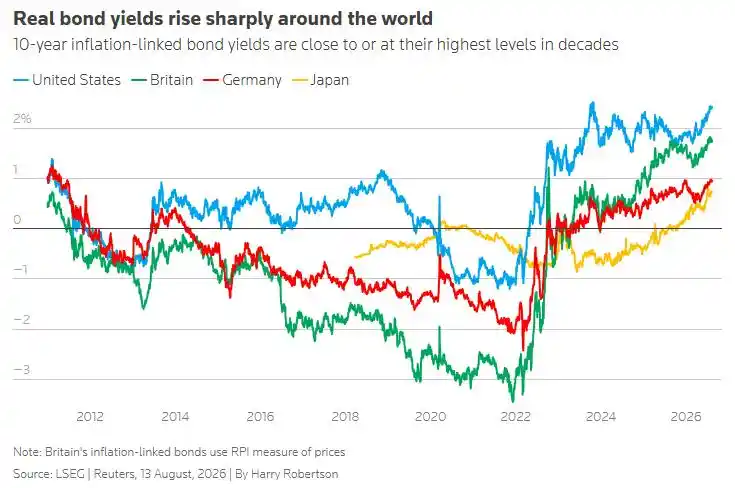
Investors and analysts point out that against the backdrop of high fiscal spending by governments, the explosive growth in borrowing by AI 'hyperscale computing giants' is becoming the latest factor pushing yields higher. This is because buyers are demanding higher returns to continue purchasing the flood of bonds hitting the market.

Despite ongoing conflicts in Iran, overall inflation expectations remain stable, which also means that the rise in real yields has pushed up nominal yields on global bonds in recent months. The winning yield on the 30-year Treasury bond auctioned by the U.S. Treasury last Thursday was 5.22%, marking the highest borrowing cost for that maturity since 2001.

Surge in AI Bond Issuance

According to LSEG data, U.S. tech giants like Alphabet, Amazon, and Meta have issued nearly $220 billion in bonds so far this year, more than double the $108 billion issued in the whole of 2025.
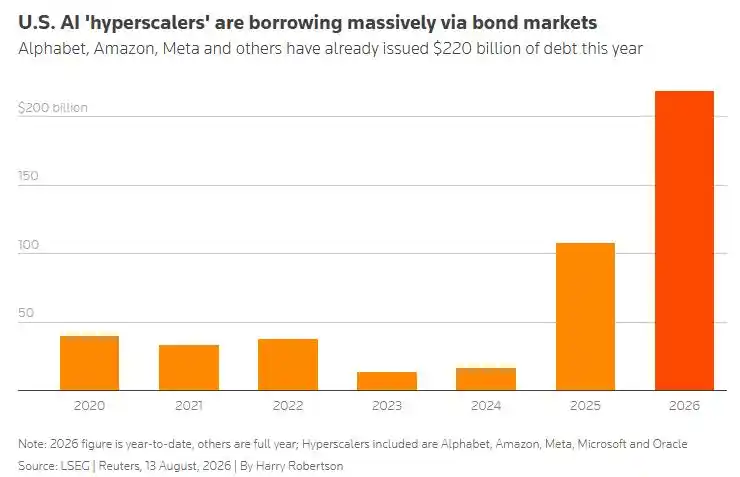
"We are experiencing a capital competition unprecedented in recent years," said Vivek Paul, chief investment strategist for the UK at BlackRock Investment Group.

"Driven by factors like the continued acceleration of AI infrastructure construction, this competitive landscape of capital scarcity is evolving rapidly and is directly reflected in rising bond yields."

Simultaneously, governments worldwide continue to borrow heavily. This year, the U.S. fiscal deficit is expected to account for about 6% of its GDP (approximately $1.9 trillion), France is expected at 5%, and the UK at 4%.

Al Cattermole, senior fixed-income portfolio manager at Mirabaud Asset Management, pointed out: "In Europe, defense spending, energy security, and infrastructure investment are more critical drivers than AI-specific expenditures."

Additionally, markets are digesting expectations for future interest rate hikes, which, all else being equal, tend to further push up real yields.

Max Kitson, European rates strategist at Barclays, stated that relatively strong economic growth—especially in the U.S.—is an important factor. He also noted that major central banks have stopped buying bonds, whereas their bond purchases had long suppressed yields.

Beware of Stock Market Risks

Real yields are the benchmark for measuring the inflation-adjusted true borrowing cost for governments and corporations.

If a bond has a nominal yield of 3% and an expected inflation rate of 2%, its real yield is approximately 1%. Analysts say that in the past, nominal yields were primarily driven by inflation expectations, but recently, real yields have become a more central determining factor.
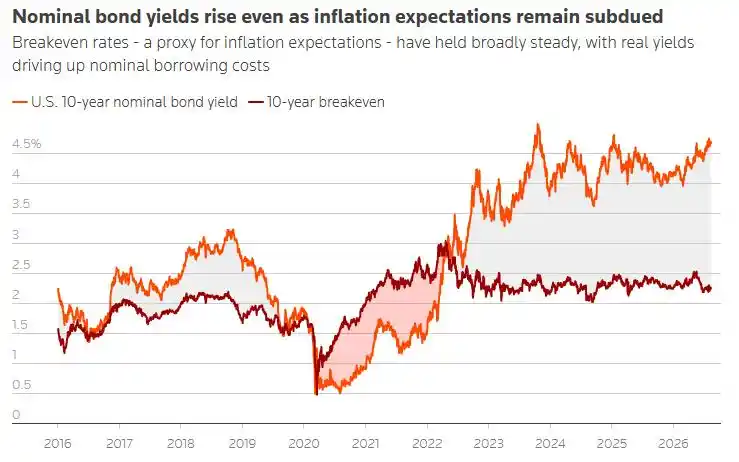
In theory, rising real yields diminish the relative attractiveness of stocks. On one hand, investors can obtain higher inflation-adjusted returns in the bond market; on the other hand, the future cash flows of companies—whose present value is discounted based on yields—will also appear less attractive.

So far, however, thanks to strong corporate earnings and resilient economic performance, the stock market, which has repeatedly hit new highs, has not been brought down by these concerns. JPMorgan recently raised its profit expectations for the S&P 500 index; LSEG I/B/E/S data also shows that the profit growth rate of European blue-chip companies is expected to hit its highest level since the end of 2022.

Matt King, founder of Satori Insights, holds a more cautious view. He points out that major tech giants are currently accelerating their consumption of cash reserves and will become more reliant on credit markets in the future. At that point, the rise in real rates will begin to have a substantial impact.

He wrote in a research note: "We expect real yields to continue rising until the high costs completely suppress this wave of borrowing frenzy driving yields higher—and end the rotation into risk assets that previously fueled the stock market rebound."

Furthermore, higher inflation-adjusted borrowing costs, after reaching a certain critical point, could force businesses and households to cut consumption and investment, thereby dragging down overall economic growth.

Ashok Bhatia, chief investment officer at Neuberger Berman, stated that current U.S. real yields are still below his estimated range of 3%–4% that would substantially impact economic growth. "But the current yield level is already a warning signal: while the current 1.5% to 2% economic growth is considered robust, there is a risk of erosion in the future."

Bhatia added that, given concerns about fiscal policy, he remains cautious on long-term bonds; while Barclays' Kitson believes that due to the general lack of political will to reduce fiscal deficits, real yields may continue to rise in the future.

Kitson concluded: "The structural factors supporting higher yields remain deeply entrenched, and there are currently no signs indicating they will recede in the short term."

This article is from the WeChat public account "STAR Market Daily," author: Xiaoxiang

Perguntas relacionadas

QWhat is the main factor cited as a key driver behind the recent surge in global real yields?

AThe massive borrowing by AI 'hyperscale compute giants' to fund infrastructure expansion, alongside sustained high government spending, is creating intense competition for capital, pushing bond yields higher as investors demand higher returns.

QWhat are the potential risks to the stock market according to the article, given the rising real yields?

ARising real yields can make bonds more attractive relative to stocks and reduce the present value of companies' future cash flows. A more specific risk is that as tech giants deplete cash reserves, their increased reliance on credit markets will make them more vulnerable to higher borrowing costs, potentially disrupting the equity rally.

QHow does the borrowing scale of major US tech companies in 2026 compare to 2025, and what is the primary reason for this increase?

AAccording to LSEG data, the borrowing scale of major US tech companies like Alphabet, Amazon, and Meta in 2026 so far is nearly $220 billion, which is more than double the $108 billion issued in all of 2025. The primary reason for this surge is the acceleration of artificial intelligence infrastructure construction.

QBeyond AI spending, what other key factors are driving high government borrowing and contributing to higher yields in Europe?

AIn Europe, key drivers for high government borrowing and yields include defense spending, energy security investments, and infrastructure investment, which are cited as more critical factors than AI-specific spending.

QWhat is the threshold level for US real yields that, according to Neuberger's Ashok Bhatia, could start to meaningfully impact economic growth?

AAccording to Neuberger's Ashok Bhatia, US real yields would need to reach a range of 3%-4% to start having a material negative impact on economic growth. Current levels, while a warning signal, are below this threshold.

Leituras Relacionadas

Novig Sues Wisconsin as Sports Prediction Market Dispute Heats Up

Novig, a sports event prediction market operator, has filed a lawsuit against Wisconsin's attorney general. The legal dispute centers on whether prediction markets fall under federal derivatives regulations or state gambling laws. The lawsuit, filed in a U.S. district court, seeks a declaratory judgment after Novig began offering event contracts to Wisconsin residents. This case is part of a broader conflict. In April, Wisconsin sued other prediction market platforms like Kalshi and Polymarket, alleging their sports-related contracts violate state gambling laws. Novig argues its contracts are "swaps" regulated exclusively by the federal Commodity Futures Trading Commission (CFTC), under the Commodity Exchange Act. Wisconsin contends they are sports betting. Federal courts have issued conflicting rulings on similar cases, creating legal uncertainty. The outcome is significant as prediction markets are a fast-growing sector, with trading volume reaching $9.5 billion on a single day in August. These markets are also increasingly intertwined with cryptocurrency infrastructure. Simultaneously, Novig is pursuing a nationwide legal strategy, having filed similar lawsuits in four other states. The company also recently secured a marketing partnership with the New York Mets, marking the first such deal with an MLB team. The Wisconsin case's resolution will influence whether prediction markets can operate as national financial products or remain constrained by individual state laws.

cryptonews.ruHá 3m

Novig Sues Wisconsin as Sports Prediction Market Dispute Heats Up

cryptonews.ruHá 3m

Держатели XRP могут торговать опционами на платформе Derive, используя FXRP в качестве залога

XRP holders can now trade options on the Derive platform using FXRP as collateral, as announced by Flare on August 12. This integration allows users to open positions from self-custody wallets while the underlying XRP backing the FXRP remains on the XRP Ledger. According to DeFi analyst Will Procheska, this provides XRP's dedicated holder base with a permissionless options market for generating yield or hedging. Derive's platform combines protocol-level settlements with an order book managed by Derive Trading Co., enabling users to retain asset control while professional market-makers provide liquidity. XRP options on Derive are cash-settled in USDC, so profits or obligations adjust the trader's USDC balance without transferring XRP or FXRP. The platform's portfolio margin system assesses overall account risk but may still trigger liquidations if margin levels fall below requirements. The launch expands Flare's XRPFi ecosystem. FXRP, introduced via the FAssets system in September 2025, creates an on-chain representation of XRP for use in smart contracts. It has since been integrated into spot trading and, more recently, permissionless lending markets on Morpho. This addition of options on Derive offers XRP holders hedging and premium-earning capabilities comparable to other major assets. While regulated XRP options debuted on CME Group in October 2025, Derive provides a decentralized alternative with USDC settlement and direct wallet access. The platform also supports perpetual futures, offering further trading strategies. Flare and Derive are exploring automated "strategy vaults" to simplify yield-generating options approaches for users.

cryptonews.ruHá 4m

Держатели XRP могут торговать опционами на платформе Derive, используя FXRP в качестве залога

cryptonews.ruHá 4m

Trading

Spot
活动图片