AI at a Crossroads: Why Wall Street is Saying "No" to ChatGPT and Claude?

链捕手Publicado em 2026-07-13Última atualização em 2026-07-13

Resumo

The article "AI at a Crossroads: Why Wall Street Says 'No' to ChatGPT and Claude" explores the growing tension between the adoption of powerful, closed-source AI models and the imperative for data privacy and intellectual property (IP) protection in enterprises, particularly in high-stakes sectors like finance. It details how the fundamental architecture of services like OpenAI and Anthropic involves sending user data in plaintext to the vendors' servers, creating risks of IP leakage ("alpha transfer"). While enterprise contracts with "zero-data-retention" clauses offer some assurance, they rely on trust. A significant problem is "shadow AI," where employees use personal accounts, bypassing corporate policies and leading to data breaches. For consumers, the article highlights that AI conversations lack legal protections like attorney-client privilege and can be subpoenaed in legal cases, a fact many users are unaware of. The core of the piece analyzes the technical spectrum of privacy solutions, contrasting **protocol-level privacy** (contracts, anonymous proxies) with more robust **structural-level privacy**. The latter includes: * **TEEs (Trusted Execution Environments) / Confidential Computing:** Running models in hardware-sealed enclaves with remote attestation. * **End-to-End Encryption (E2EE):** Encrypting prompts so only the target enclave can read them. * **Fully Homomorphic Encryption (FHE):** Performing computations on encrypted data without decryption (cur...

Author: Jeff @IOSG


Why Private AI is Needed

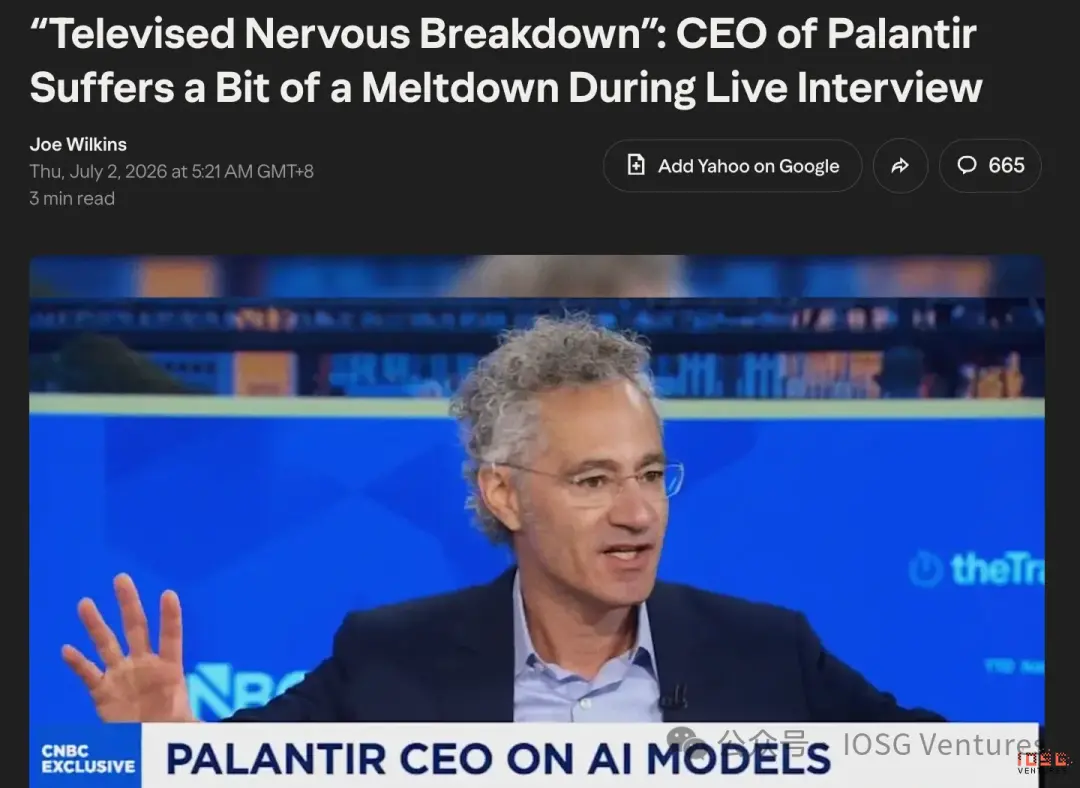
On July 1st, Palantir CEO Alex Karp gave a 20-minute interview on CNBC, which some media described as "a mental breakdown." According to Karp, enterprises are paying a token premium to frontier labs while watching their own IP flow to the model providers. He called this leakage a transfer of alpha, occurring at the architectural layer: every request sent to a closed-source model arrives in plaintext on the service provider's servers. Just days before the broadcast, Palantir announced a partnership with NVIDIA to run the open-source Nemotron model in a customer-controlled environment, accompanied by a nine-point AI sovereignty declaration. PLTR's stock jumped 8% after the CNBC segment aired.
For the past two decades, enterprises adopted cloud software based on trust at the protocol level, and it worked. Each SaaS vendor saw only a slice of enterprise data, and most had little incentive to use customer data to enhance their core products. Salesforce saw sales pipelines, Workday saw personnel, Jira saw development iterations, and AWS provided the storage and compute foundation. Today's AI workflows, however, advocate uploading the entire corpus, along with structured context linking all departments, to maximize productivity. Regardless of intent, upstream providers can now use this data for new features rather than letting it sit idle on servers.

No one is slowing down. Anthropic's annualized revenue reached $47 billion in May, a significant jump from $9 billion at the end of 2025. OpenAI surpassed 900 million weekly active users in February. Both companies completed new funding rounds this spring, with valuations nearing $1 trillion and expected to IPO at even higher market caps. Years of privacy and IP allegations have not dented their momentum.

Some enterprises acted long ago. By February 2023, less than three months after ChatGPT's release, major Wall Street banks had restricted its use. In May 2023, after Samsung engineers leaked chip source code into ChatGPT, the company banned generative AI across its network. In response, OpenAI launched ChatGPT Enterprise in August 2023, promising not to use business data for training and offering a zero-data-retention (ZDR) agreement, which later became a standard requirement for enterprise procurement.

But contracts only lock down corporate accounts. IBM found that by 2025, shadow AI (employees feeding company data into unauthorized AI tools via personal accounts) was involved in one-fifth of data breaches, with heavy shadow AI use adding an average of $670,000 to breach costs. In a 2025 survey by security training company Anagram, 40% of employees said they were willing to violate AI usage policies to complete tasks faster.

Enterprises can at least buy their way out with ZDR contracts, non-training service tiers, and sovereign deployments for governments or Palantir's clients. For ordinary users like us, the debate over whether private AI matters continues—until a court subpoena arrives.

In May 2025, a court order forced OpenAI to retain even deleted consumer chats. In November, a judge ordered 20 million of those records to be handed over to *The New York Times*'s lawyers as evidence. Then came criminal cases: ChatGPT records of a defendant in the Palisades arson case entered evidence, and an affidavit for a Florida double homicide cited a suspect's queries about body disposal. In a July 2025 interview, Sam Altman also acknowledged that ChatGPT conversations are not protected by legal privilege, and OpenAI "could be compelled to hand over" user chat logs in litigation.

The point isn't that only criminals need private conversations. The fact that people's AI conversations are logged and subpoenable is a surveillance surface most users don't know exists. A Kolmogorov Law survey of 1,000 U.S. AI users in October 2025 found that 50% didn't know these conversations could be subpoenaed, while two-thirds believed such chats should receive protections equal to consulting a lawyer or doctor.

Self-hosted or open-source models running in verifiable environments are catching up fast, but the strongest ones still lag the frontier closed-source models by about 4 months in general capability. This puts token-maximizing enterprises and individuals at a crossroads: either forfeit a few months of model quality for privacy, or continue sending sensitive material to Anthropic's servers because that's what competitors are doing to seize productivity advantages.
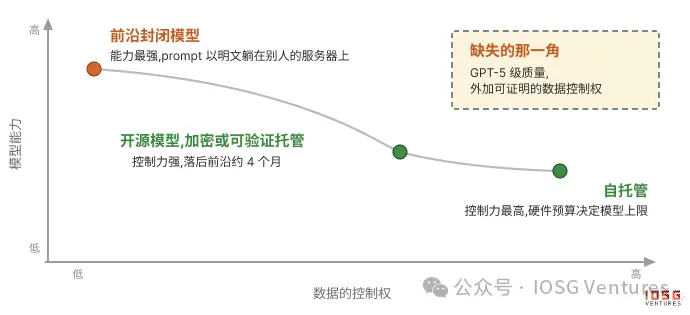
Currently, there is no perfect solution. This report examines attempts to bridge the gap, observing how far frontier intelligence with provable privacy is from being delivered to enterprises and ordinary users.

How Privacy is Currently Achieved

Private AI is not a single engineering feat, but each mechanism in the market today addresses the same event: a prompt leaves your device, travels over the network, lands on a machine running a model, and a response returns. The differences lie in where plaintext exists on this path, who can read it there, and what verifies the privacy of the response.

Protocol-Level Privacy

At this layer, someone other than you reads your plaintext prompt. What happens next relies entirely on a promise.
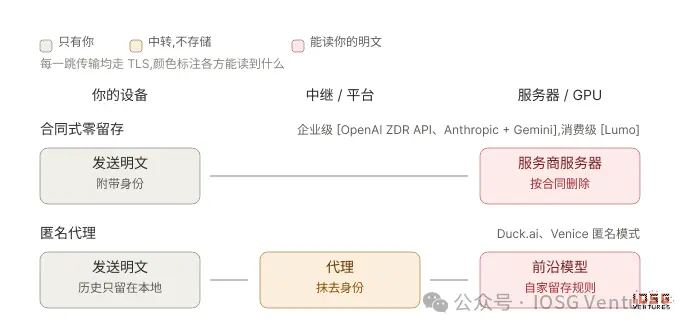
  • Contractual Zero-Retention is the enterprise version. The service provider knows who you are, processes your prompt, and promises not to retain it, enforced by contract and reputation.

  • Anonymous Proxy erases who you are but does not encrypt what you say; the downstream provider still handles plaintext per their own policy. Terms vary: proxies like Duck.ai (DuckDuckGo's chatbot) negotiate deletion agreements with model providers, while Venice advises users to assume providers keep everything. Neither side can verify.

Every segment of the machine-to-machine path runs over TLS, which only encrypts the pipe; the receiving party can read all information. Relays typically use Oblivious HTTP (RFC 9458) to split this knowledge, like asking a friend to pass a note. The friend knows who passed it but can't read the content; the recipient can read the content but doesn't know who wrote it. OHTTP became an IETF standard in January 2024, and many companies now run production traffic over OHTTP relays rented from Cloudflare and Fastly.

This is also the privacy ceiling for accessing closed-source models, due to a matter of arithmetic. A single flagship training run now costs billions of dollars, and these labs' near-trillion-dollar valuations hinge on exclusive ownership of model weights. The duration of the capability gap sustains the premium, so labs guard the weight files like state secrets.

Meta has already unwittingly conducted this experiment. The LLaMA model released in February 2023 was initially available only to researchers, but within a week, its weights were leaked as a torrent on 4chan. Another week later, llama.cpp allowed the smallest 7B model to run locally on a MacBook. Three days after that, Stanford fine-tuned a chat assistant, Alpaca, on the same model for under $600. This leak brought the cost of running Llama down to electricity; anyone with the file could run it at home. In July 2023, Meta officially open-sourced Llama 2 under a commercial license with a 700-million-monthly-active-user exclusion clause. The weights leaked, and the premium followed.

Frontier labs could theoretically provide attestation (remote attestation) for closed-source model inference, but attestation can only prove which piece of code read the prompt, not what that code did with it. To determine if the server retained data, we would need to audit the serving code and reconstruct it to the hash reported by the hardware. But once the serving code is handed over, the lab also surrenders the batching and caching techniques underpinning its profit margins—techniques that will migrate to every future model generation. Apple and Meta can provide remote attestation for the service stacks behind iPhone and WhatsApp because their profits come from devices and ads; revealing the service code costs them almost nothing.

This is why flagship model weights and serving code don't reach external operators. Without external operators, there is no third-party attestation; without attestation, verifiable privacy only exists for open-source models.

Structural-Level Privacy

Each mechanism in this category replaces trust promises with proofs based on hardware, cryptography, or physics. However, each pays a different price for the privacy upgrade, the primary one being that they can only run open-source models.
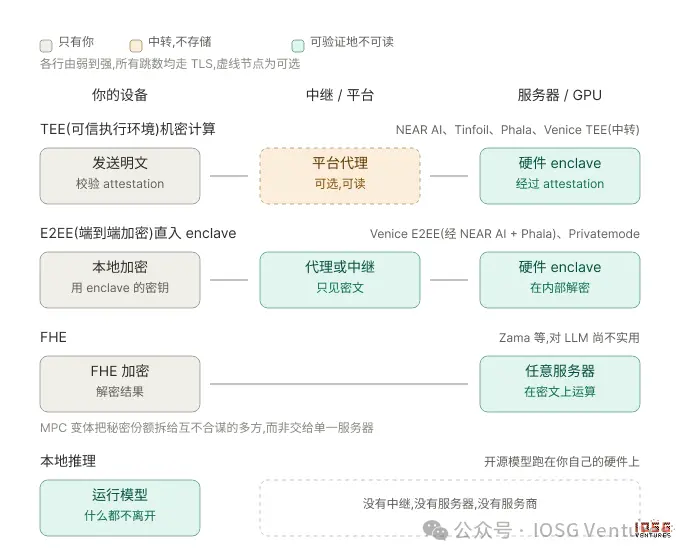
  • TEE (Trusted Execution Environment) Confidential Computing runs inference inside a hardware enclave (a sealed compartment on the chip that even the machine operator cannot open). The chip signs an attestation stating exactly which model and which code were run.

  • The prompt is only sealed at the destination. On the path relayed by the platform proxy, there remains a party that can read plaintext, and what prevents the proxy from logging or leaking the relayed content is only the protocol.
  • E2EE (End-to-End Encryption) seals the readable relay. The user's device encrypts the prompt using the enclave's key; every hop in between carries a sealed envelope only the enclave can open.

  • Trust is placed in the client. The code responsible for encrypting the prompt and verifying the attestation also has the power to revoke this guarantee. Therefore, verifiable E2EE requires both a proven enclave and open, reproducible client code.

  • Compared to TEE's simplicity, E2EE's cost is engineering overhead, which slows feature integration. E2EE turns the proxy into a blind messenger, so all features that rely on reading plaintext must be rebuilt around the client key or reconstructed solely within the enclave.

  • FHE (Fully Homomorphic Encryption, and MPC variants) removes the trusted party entirely. The server performs computations on ciphertext within a locked box it can never open; the key stays with you. MPC (Multi-Party Computation) splits the prompt into secret shares distributed among multiple parties; unless all participants collude, the effect is the same.

  • The cost is speed. FHE natively only performs addition and multiplication, so the non-linear steps required for transformer operation must be rebuilt at high cost. Inference on ciphertext is 10,000 to 100,000 times more expensive than on plaintext, taking seconds to minutes per token for small models, compared to milliseconds unencrypted.

  • Chips customized for encrypted operations promise to narrow the gap, but the first prototype was demoed only in early 2026, with commercial versions still years away.

  • Local Inference removes the path entirely. The model runs on your own hardware. No relay, no server, no service provider, and no verification needed.

  • The obvious costs are expense and model capability. gpt-oss-120b scores about half of GLM-5.2 on the Artificial Analysis index but is 65GB in size, exceeding the combined VRAM of two flagship gaming graphics cards. The full-precision GLM-5.2 can only run on 8-card data center nodes, with GPUs alone costing over $300,000.

Beyond these structural limitations, the cost of putting inference into an enclave is shrinking. For single-card inference, benchmarks from enclave cloud provider Phala show that enclave-mode H100 throughput loss averages less than 7%, and approaches zero for large models because the main cost is moving data onto the chip, not computing within it. For multi-card inference, NVIDIA's new Blackwell GPU supports direct encryption of inter-chip traffic, whereas older H100s can only achieve the same effect by routing through the CPU host at one-seventh the bandwidth. NVIDIA's own benchmarks on Blackwell show less than 8% throughput loss for a 397B model in enclave mode. With these advancements, the performance penalty of private inference itself is no longer a decisive constraint.

In fact, the enclave itself adds almost no extra operating cost for the provider. Every H100 shipped since 2023 has enclave mode built-in; the extra cost is the throughput loss from encryption, not additional chips. Currently, confidential H100 SKUs on Azure rent for $8.90 per hour, compared to $6.98 without enclave, a 27% premium over traditional cloud infrastructure. On the other hand, specialized enclave providers like Phala rent confidential-mode H100s starting at $3.80 per hour, lower than Lambda's price range of $3.99 to $4.29 for regular SXM cards. For managed API solutions, NEAR AI offers gpt-oss-120b endpoints with attestation at $0.15 per million input tokens and $0.55 per million output tokens, on par with plaintext routes from Amazon Bedrock, Together, and Groq. Even for models requiring multiple chips, NEAR AI's pricing for GLM 5.2 matches Fireworks exactly and is 15% cheaper for input and 4% cheaper for output on the larger Kimi K2.6.

While these new private inference providers may be burning profits to gain market share (a statement that holds for any company seeking growth), the structural trend is that the cost of privacy is decreasing for both consumers and operators.

How Can Open-Source Models Win?

Despite shrinking performance overhead, a visible gap remains between frontier models and SOTA open-source models. An entity pursuing maximum productivity must still trust frontier labs not to steal its IP to stay in the top tier.

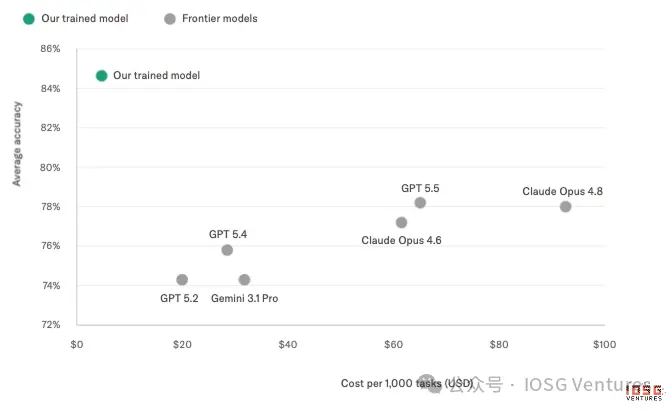
The gap persists, but Bridgewater's AIA Labs and Thinking Machines presented a case on June 30: an open model fine-tuned with expert annotations beat frontier models in both accuracy and cost.

In the study, the team fine-tuned Qwen3-235B on Tinker (Thinking Machines' managed fine-tuning API service). They first sourced annotations from vendors, used that data for initial training, then sent disputed samples to the firm's investment professionals for re-labeling. Training used reinforcement learning (GRPO) with three modifications: round-robin batching (each task takes turns providing a batch), CISPO loss (limiting how far a single answer can shift the model), and on-policy distillation (anchoring to the current best checkpoint to prevent the model from learning from weaker copies).

Tasks were all from investment professionals' daily workflows: determining if a news article was important for C-suite investment professionals, if a central bank document hinted at future interest rate changes, and where templated language began in a document or email. Scores came from an independent test set. Frontier models averaged about 50% with simple prompts and only reached 78.2% with expert prompts, below the 80% threshold set by investment professionals. The fine-tuned Qwen achieved 84.7%, which, per the original wording, means making 29.8% fewer errors than the frontier best, at 13.8x lower inference cost.
https://thinkingmachines.ai/news/learning-to-replicate-expert-judgment-in-financial-tasks/

This case proves open-source models can win in accuracy and cost, but the training process was still not private. The expert annotations used were Bridgewater's private data, passing through Tinker's third-party service, residing at the same trust level as ZDR agreements. The fund also rented compute; the entire training ran on machines it never controlled. Buyers wanting this recipe without trust assumptions have few choices today. Renting bare GPU clusters leaves the training process readable to the cloud operator. Buying the cluster solves data hosting but sends costs skyrocketing.

Routes with attestation have just arrived. In March, Workshop Labs and Tinfoil released Silo, a post-training stack running in Tinfoil enclaves on a single 8-card node, with keys controlled only by the customer. The article states the enclave cost adds 11 minutes to a two-hour training run, and by freezing base weights and training only small adapters on top, the stack can accommodate a trillion-parameter model (Kimi K2 Thinking). The challenge is that reinforcement learning requires moving data back and forth between components, precisely where enclave costs lie.

Less than a month after Silo's release, Workshop Labs was acquired by Thinking Machines. The components needed to run the next Bridgewater-style RL loop within an enclave are now under the same roof.

Privacy at the Harness Layer

Another problem exists outside all private inference mechanisms. These mechanisms manage the path from prompt to model, but every external tool call initiated by an agent opens a path the inference layer cannot touch. The recent harness engineering trend magnifies the problem: every tool, memory store, and data source connected to the model is another destination that reads its slice of the workflow in plaintext. The calendar server reads schedules, the database server reads queries. A fully local agent needing anything outside its training set must still send search terms in plaintext to a search engine; the server cannot answer without reading the plaintext.

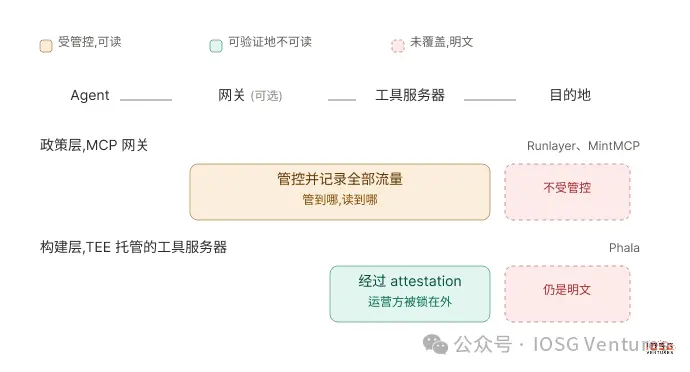
Mainstream solutions still default to the protocol layer. Companies like Runlayer and MintMCP use a central gateway to manage all tool traffic, stripping personally identifiable information (PII) before requests leave. The gateway also decides which servers receive traffic, blocking unvetted ones, and logs each call's destination and content for forensics. Even with independent audits (SOC 2), the tool server must still read the plaintext query to respond; whether it retains a copy depends on its own retention terms, multiplied by every tool in the harness. Furthermore, the gateway itself is an additional trust-dependent reader on the path, not a verification.

Structural solutions target the middle layer. For example, Phala hosts MCP servers directly in TEEs, with directories covering wallets, code execution, and data sources; users can verify privacy claims via attestation rather than trusting the operator. However, TEE-hosted tools ultimately must pass queries in plaintext to the service provider; the enclave seals only the messenger, not the destination.
Only a few destinations have learned to respond without reading, but only for structured queries. Apple provides Private Information Retrieval for iPhones, allowing phone number checks against spam databases without exposing the number; Microsoft uses the same scheme for passwords in Edge. MongoDB's Queryable Encryption encrypts fields client-side before they leave, enabling the server to perform equality and range matches on ciphertext alone.

For open-ended search, today's best answer stops at trust; verifiable encrypted search hasn't left the lab. Brave promises zero data retention on its own 40-billion-page index (not Google's), but it's still at the protocol layer. Exa built a neural index that embeds user keywords into semantics, ranking results by semantic match, but the embedding step still computes from plaintext on Exa's servers. MIT's 2023 Tiptoe paper ranked results on 360 million web pages without exposing the query, but each search burned significant server compute, with ranking quality lagging unencrypted search. Apple's 2024 Wally paper hid real queries among decoys, reducing communication cost up to 31x, but this math only becomes cheap at millions of concurrent queries—a scale no private search system has today.

Encrypted search is possible; it's just that performance and price aren't commercially viable yet.

Outlook

Demand for private AI is growing. Venice AI recently surpassed 3.5 million registered users and 1.3 trillion monthly tokens, followed by a Series A equity funding round at a $1 billion valuation. Proton is a direct competitor; its chat product Lumo surpassed 10 million users within a year of launch. On the infrastructure side, Phala currently processes 2 to 3 billion tokens daily on OpenRouter. Duck.ai routes gpt-oss-120b and Gemma into Tinfoil enclaves, providing verifiable privacy beyond proxy anonymity. This doesn't even count self-hosting, likely the largest channel for private inference, as models run on one's own hardware, leaving no usage trail.

Yet within the massive wave of mainstream AI, private AI occupies only a tiny fraction, and this gap will only close if frontier labs intentionally meet this demand. In May, Google's entire product line processed 3,200 trillion tokens; by that measure, Venice's monthly throughput equals about 18 minutes of Google's. Last November, Google launched Private AI Compute (PAC), running some Gemini-powered features in sealed TPU enclaves isolated from the company itself, with the design independently audited by NCC Group. But the issue is that PAC only covers a few Pixel features like personalized recommendations and recording summaries, not the Gemini app used by hundreds of millions. Google dares to submit the design for audit because these features monetize via devices and ads, not token sales.

Current hosting solutions are also imperfect. Users seeking maximum privacy via E2EE must wait for new features to be rebuilt where the service provider can't read. Private harnesses still rely on protocols at the service layer. Affordable post-training still requires trusting third-party vendors for the best fine-tuning results. Self-hosting sheds all service providers at once, but running the strongest open-source model locally may cost more than the house it's in.

Flaws aside, private AI is already a real and affordable option, and the remaining gaps are narrowing. For ordinary consumers, private chats with open models under no-logging promises cost nothing on Lumo and Venice, while $18–$20 subscriptions from Venice or Tinfoil seal the same chat into enclaves, no more expensive than a ChatGPT subscription. For enterprise workflows, attested endpoints are now even cheaper than plaintext routes. Endpoints like NEAR's E2EE API can already bring encrypted context into enclaves; memory, file uploads, and custom instructions can now operate over E2EE. For attested post-training, NVIDIA's upcoming Vera Rubin NVL72 will expand confidential computing from Blackwell's 8-card nodes to 72-card racks, making frontier RL loops more feasible without exposing IP.

However, the crucial value capture lies beyond these layers of price compression. Privacy is nearly free where it already exists, but it hasn't covered mainstream agentic workflows. Operators focused on renting/selling enclaves hold a switch on standard chips, not a moat, while protocol-layer gateways compete with traditional middleware. The defensible ground is the half of the problem not yet solved in this report: training loops locked in enclaves, end-to-end sealed tool calls, search indexes that cannot see terms. Whoever builds one of these first sells something no price war can commoditize. Capital chasing private AI should buy the gap, not the switch.

So, trust or verify? For execution-heavy, agent-heavy tasks, choose trust, because each tool call already hands plaintext to destinations an enclave cannot seal, and frontier models deserve their price in such loops. For the high-order thinking that distinguishes a company from its competitors, choose verification. Strategy, planning, and judgment distilled from years of professional experience are precisely the alpha in dispute. The path forward is fine-tuning open-source models with these proprietary insights within company-controlled boundaries. In areas central to a company's alpha, expert-tuned open models have already beaten the frontier in both accuracy and cost, and the infrastructure to build them in privacy is arriving node by node.

Criptomoedas em alta

Perguntas relacionadas

QWhy are Wall Street banks and corporations increasingly saying 'no' to using models like ChatGPT and Claude, according to the article?

APrimarily due to intellectual property and data privacy concerns. The article highlights that when using closed-source AI models, every prompt is sent as plaintext to the vendor's servers, creating a risk of IP and sensitive data leakage ('alpha transfer'). This is especially critical for industries like finance and for companies whose competitive edge relies on proprietary data and strategies.

QWhat are the main approaches to achieving private AI, as outlined in the article?

AThe article categorizes private AI approaches into two main layers: 1) **Protocol-level privacy**: Relying on trust and contracts, such as Zero Data Retention (ZDR) agreements and anonymous proxies. 2) **Structural-level privacy**: Using technology to enforce privacy, including TEE (Trusted Execution Environment) confidential computing, End-to-End Encryption (E2EE), Fully Homomorphic Encryption (FHE), and local (on-premise) inference. Structural methods can only be used with open-source models.

QWhat case study does the article provide to show that open-source models can outperform frontier models?

AThe article cites a study by Bridgewater's AIA Labs and Thinking Machines. They fine-tuned the open-source model Qwen3-235B on expert-annotated financial tasks (e.g., analyzing news importance, central bank documents). The fine-tuned model achieved an 84.7% accuracy rate, surpassing the best frontier model's 78.2% (with expert prompting), while also being 13.8x cheaper in inference costs, demonstrating superior accuracy and cost-effectiveness for specialized domains.

QWhat is the 'harness layer' privacy challenge mentioned in the article, and why is it difficult to solve?

AThe 'harness layer' challenge refers to the privacy risks when AI agents interact with external tools (e.g., databases, search engines, calendars). Even if the core model inference is private, every tool call sends a plaintext query to an external server, creating new data leakage points. Solving this with structural privacy is hard because most tools need to read the plaintext query to function. Truly private, verifiable solutions for complex tasks like open-ended web search are still in the research phase and not commercially viable due to performance and cost barriers.

QWhat is the article's conclusion regarding the future and investment opportunity in private AI?

AThe article concludes that while basic private inference is becoming affordable and commoditized, the significant value and investment opportunity lie in solving the remaining, harder technical gaps. These include: 1) Private training/fine-tuning loops within enclaves, 2) End-to-end private tool/agent calls, and 3) Private search over encrypted indexes. Capital chasing private AI should focus on these unsolved problems ('the gap'), not just the enabling infrastructure ('the switch'), as solutions here will create defensible, non-commoditized value.

Leituras Relacionadas

DistributeX Unveils DX Coin Ecosystem Roadmap, Advancing Preparations for Its On-Chain Launch

DistributeX has unveiled the DX Coin Ecosystem Roadmap, detailing its preparations for the upcoming on-chain launch of DX Coin. The roadmap outlines key phases focusing on community governance, technical readiness, blockchain deployment, and ecosystem growth. Current efforts are centered on building community consensus and completing technical groundwork. This includes launching community votes to select the official DX Coin logo and decide on the preferred blockchain network for integration. The platform will also implement features like on-chain wallet binding and contribution tracking to prepare for future data synchronization and rewards. Before the official launch, DistributeX will publish a Tokenomics White Paper detailing the token's issuance, governance, and long-term strategy, and will take a snapshot of eligible community accounts for future asset allocation. The subsequent deployment phase will involve smart contract deployment, security audits, community airdrops, and developing liquidity on decentralized exchanges. Looking further ahead, planned utilities for DX Coin encompass cross-chain interoperability, decentralized governance, digital rights, staking, and other Web3 applications. This roadmap aims to provide the community with clear visibility into the platform's plans, as DistributeX works to establish a solid foundation for DX Coin's on-chain ecosystem and long-term expansion.

TheNewsCryptoHá 47m

DistributeX Unveils DX Coin Ecosystem Roadmap, Advancing Preparations for Its On-Chain Launch

TheNewsCryptoHá 47m

Let Funds Flow at Internet Speed

Tokenization bridges the distinct worlds of always-on, permissionless DeFi and traditional funds with scheduled, permissioned settlements, unlocking significant value for those who can manage this integration. The tokenized Real World Asset (RWA) market exceeds $33 billion, with U.S. Treasuries comprising nearly half. It offers corporate treasurers options from low-risk, liquid Treasury funds to higher-yield, programmable investments, all benefiting from the same audit standards as traditional bonds. The core advantage is *composability*: tokenized funds can combine yield, liquidity, and transferability simultaneously, unlike traditional finance which forces a trade-off. However, achieving this requires sophisticated coordination. Tokenized funds remain legally bound to daily net asset value (NAV) updates, KYC-verified holder lists, and redemption cut-offs based on traditional settlement infrastructure (e.g., 5 PM ET). Key challenges in this hybrid model are: 1) **Price**: Determining token value between NAV updates to prevent manipulation; 2) **Compliance**: Embedding KYC/whitelisting (e.g., within a vault) to allow free circulation of receipt tokens in DeFi; and 3) **Cross-chain Consistency**: Maintaining a single source of truth for ownership and value across multiple blockchains. Projects like Centrifuge (with its deRWA framework and V3 architecture) and LayerZero address these by using a hub-and-spoke model. A central "hub" chain manages NAV, accounting, and compliance, while a messaging layer (LayerZero) synchronizes this data with "spoke" chains where tokens are used, enabling DeFi composability. This coordination layer, which handles in-transit asset accounting and prevents redemption gateway conflicts, becomes a critical and valuable piece of infrastructure—akin to SWIFT or Visa in traditional finance. For institutions, effective tokenization enables strategies like rehypothecation, where tokenized Treasury funds are used as collateral to borrow stablecoins for reinvestment, amplifying yield. However, failures in price synchronization, redemption limits, or cross-chain messaging pose risks that must be meticulously managed to build institutional trust. Ultimately, the goal is to break the old rules that force a choice between yield, liquidity, and transferability. If tokenization can make capital work simultaneously in multiple ways without compromising security, it will attract the attention of institutions managing billions in idle cash. The entities that successfully orchestrate this coordination between traditional finance timelines and blockchain speed are positioning themselves for a central role in the future capital markets.

链捕手Há 1h

Let Funds Flow at Internet Speed

链捕手Há 1h

On the Eve of the US Stock Inflation Test, Wall Street Faces the Most Severe 'Data Deception' in History

On the eve of the crucial US June CPI release, a significant credibility gap is emerging between official inflation data and consumer sentiment. While May CPI and PCE figures suggested a "concerning but not critical" picture, the University of Michigan Consumer Sentiment Index plummeted to its lowest level in nearly 50 years. This contradiction is prompting economists to question the reliability of key macroeconomic indicators. The core issue, as highlighted by labor economist Kathryn Anne Edwards, lies in a systemic flaw within the current inflation measurement framework. The Consumer Price Index (CPI) averages prices across a "market basket" meant for a "typical consumer," thereby masking vastly different inflation experiences across demographic groups. For instance, Bureau of Labor Statistics (BLS) research indicates that from 2006 to 2023, the lowest income quintile faced a cumulative inflation rate 7.7 percentage points higher than the highest quintile—a disparity largely invisible in the headline CPI number. This averaging effect means investors and policymakers relying on aggregate CPI may be basing decisions on a statistically smoothed figure that fails to capture the true distribution of economic pressure. Edwards argues that expanding this measurement framework is technically feasible, requiring primarily political will rather than new data collection. The BLS already tracks 100,000 items monthly; creating more granular indices for different family types, income levels, and housing statuses would mainly involve re-weighting existing data. The BLS has produced such experimental series before. A more nuanced data picture is crucial for accurate policy and market forecasting. Ultimately, improving measurement cannot solve underlying economic stresses. Edwards notes concurrent pressures like slowing hiring, stagnant wage growth, persistently high prices, rising credit card debt, a subdued housing market due to high rates, and AI's potential disruption to jobs. These factors collectively explain the deep chasm between official statistics and consumer pessimism. The key takeaway for markets is the need to look beyond a single headline CPI number. Understanding the divergence in inflation experiences across the population is critical for accurately assessing the real pressure within the economy, the path of Federal Reserve policy, and risks on the consumer side.

marsbitHá 1h

On the Eve of the US Stock Inflation Test, Wall Street Faces the Most Severe 'Data Deception' in History

marsbitHá 1h

Trading

Spot

Artigos em Destaque

O que é GROK AI

Grok AI: Revolucionar a Tecnologia Conversacional na Era Web3 Introdução No panorama em rápida evolução da inteligência artificial, a Grok AI destaca-se como um projeto notável que liga os domínios da tecnologia avançada e da interação com o utilizador. Desenvolvida pela xAI, uma empresa liderada pelo renomado empreendedor Elon Musk, a Grok AI procura redefinir a forma como interagimos com a inteligência artificial. À medida que o movimento Web3 continua a florescer, a Grok AI visa aproveitar o poder da IA conversacional para responder a consultas complexas, proporcionando aos utilizadores uma experiência que é não apenas informativa, mas também divertida. O que é a Grok AI? A Grok AI é um sofisticado chatbot de IA conversacional projetado para interagir com os utilizadores de forma dinâmica. Ao contrário de muitos sistemas de IA tradicionais, a Grok AI abraça uma gama mais ampla de perguntas, incluindo aquelas tipicamente consideradas inadequadas ou fora das respostas padrão. Os principais objetivos do projeto incluem: Raciocínio Fiável: A Grok AI enfatiza o raciocínio de senso comum para fornecer respostas lógicas com base na compreensão contextual. Supervisão Escalável: A integração de assistência de ferramentas garante que as interações dos utilizadores sejam monitorizadas e otimizadas para qualidade. Verificação Formal: A segurança é primordial; a Grok AI incorpora métodos de verificação formal para aumentar a fiabilidade das suas saídas. Compreensão de Longo Contexto: O modelo de IA destaca-se na retenção e recordação de um extenso histórico de conversas, facilitando discussões significativas e contextualizadas. Robustez Adversarial: Ao focar na melhoria das suas defesas contra entradas manipuladas ou maliciosas, a Grok AI visa manter a integridade das interações dos utilizadores. Em essência, a Grok AI não é apenas um dispositivo de recuperação de informações; é um parceiro conversacional imersivo que incentiva um diálogo dinâmico. Criador da Grok AI A mente por trás da Grok AI não é outra senão Elon Musk, um indivíduo sinónimo de inovação em vários campos, incluindo automóvel, viagens espaciais e tecnologia. Sob a égide da xAI, uma empresa focada em avançar a tecnologia de IA de maneiras benéficas, a visão de Musk visa reformular a compreensão das interações com a IA. A liderança e a ética fundacional são profundamente influenciadas pelo compromisso de Musk em ultrapassar os limites tecnológicos. Investidores da Grok AI Embora os detalhes específicos sobre os investidores que apoiam a Grok AI permaneçam limitados, é reconhecido publicamente que a xAI, a incubadora do projeto, é fundada e apoiada principalmente pelo próprio Elon Musk. As anteriores empreitadas e participações de Musk fornecem um forte apoio, reforçando ainda mais a credibilidade e o potencial de crescimento da Grok AI. No entanto, até agora, informações sobre fundações ou organizações de investimento adicionais que apoiam a Grok AI não estão prontamente acessíveis, marcando uma área para exploração futura potencial. Como Funciona a Grok AI? A mecânica operacional da Grok AI é tão inovadora quanto a sua estrutura conceptual. O projeto integra várias tecnologias de ponta que facilitam as suas funcionalidades únicas: Infraestrutura Robusta: A Grok AI é construída utilizando Kubernetes para orquestração de contêineres, Rust para desempenho e segurança, e JAX para computação numérica de alto desempenho. Este trio assegura que o chatbot opere de forma eficiente, escale eficazmente e sirva os utilizadores prontamente. Acesso a Conhecimento em Tempo Real: Uma das características distintivas da Grok AI é a sua capacidade de aceder a dados em tempo real através da plataforma X—anteriormente conhecida como Twitter. Esta capacidade concede à IA acesso às informações mais recentes, permitindo-lhe fornecer respostas e recomendações oportunas que outros modelos de IA poderiam perder. Dois Modos de Interação: A Grok AI oferece aos utilizadores a escolha entre “Modo Divertido” e “Modo Regular”. O Modo Divertido permite um estilo de interação mais lúdico e humorístico, enquanto o Modo Regular foca em fornecer respostas precisas e exatas. Esta versatilidade assegura uma experiência adaptada que atende a várias preferências dos utilizadores. Em essência, a Grok AI combina desempenho com envolvimento, criando uma experiência que é tanto enriquecedora quanto divertida. Cronologia da Grok AI A jornada da Grok AI é marcada por marcos fundamentais que refletem as suas fases de desenvolvimento e implementação: Desenvolvimento Inicial: A fase fundamental da Grok AI ocorreu ao longo de aproximadamente dois meses, durante os quais o treinamento inicial e o ajuste do modelo foram realizados. Lançamento Beta do Grok-2: Numa evolução significativa, o beta do Grok-2 foi anunciado. Este lançamento introduziu duas versões do chatbot—Grok-2 e Grok-2 mini—cada uma equipada com capacidades para conversar, programar e raciocinar. Acesso Público: Após o seu desenvolvimento beta, a Grok AI tornou-se disponível para os utilizadores da plataforma X. Aqueles com contas verificadas por um número de telefone e ativas há pelo menos sete dias podem aceder a uma versão limitada, tornando a tecnologia disponível para um público mais amplo. Esta cronologia encapsula o crescimento sistemático da Grok AI desde a sua concepção até ao envolvimento público, enfatizando o seu compromisso com a melhoria contínua e a interação com o utilizador. Principais Características da Grok AI A Grok AI abrange várias características principais que contribuem para a sua identidade inovadora: Integração de Conhecimento em Tempo Real: O acesso a informações atuais e relevantes diferencia a Grok AI de muitos modelos estáticos, permitindo uma experiência de utilizador envolvente e precisa. Estilos de Interação Versáteis: Ao oferecer modos de interação distintos, a Grok AI atende a várias preferências dos utilizadores, convidando à criatividade e personalização na conversa com a IA. Base Tecnológica Avançada: A utilização de Kubernetes, Rust e JAX fornece ao projeto uma estrutura sólida para garantir fiabilidade e desempenho ótimo. Consideração de Discurso Ético: A inclusão de uma função de geração de imagens demonstra o espírito inovador do projeto. No entanto, também levanta considerações éticas em torno dos direitos autorais e da representação respeitosa de figuras reconhecíveis—uma discussão em curso dentro da comunidade de IA. Conclusão Como uma entidade pioneira no domínio da IA conversacional, a Grok AI encapsula o potencial para experiências transformadoras do utilizador na era digital. Desenvolvida pela xAI e impulsionada pela abordagem visionária de Elon Musk, a Grok AI integra conhecimento em tempo real com capacidades avançadas de interação. Esforça-se por ultrapassar os limites do que a inteligência artificial pode alcançar, mantendo um foco nas considerações éticas e na segurança do utilizador. A Grok AI não apenas incorpora o avanço tecnológico, mas também representa um novo paradigma de conversas no panorama Web3, prometendo envolver os utilizadores com conhecimento hábil e interação lúdica. À medida que o projeto continua a evoluir, ele permanece como um testemunho do que a interseção da tecnologia, criatividade e interação humana pode alcançar.

504 Visualizações TotaisPublicado em {updateTime}Atualizado em 2024.12.26

O que é GROK AI

O que é ERC AI

Euruka Tech: Uma Visão Geral do $erc ai e as suas Ambições no Web3 Introdução No panorama em rápida evolução da tecnologia blockchain e das aplicações descentralizadas, novos projetos surgem frequentemente, cada um com objetivos e metodologias únicas. Um desses projetos é a Euruka Tech, que opera no vasto domínio das criptomoedas e do Web3. O foco principal da Euruka Tech, particularmente do seu token $erc ai, é apresentar soluções inovadoras concebidas para aproveitar as capacidades crescentes da tecnologia descentralizada. Este artigo tem como objetivo fornecer uma visão abrangente da Euruka Tech, uma exploração das suas metas, funcionalidade, a identidade do seu criador, potenciais investidores e a sua importância no contexto mais amplo do Web3. O que é a Euruka Tech, $erc ai? A Euruka Tech é caracterizada como um projeto que aproveita as ferramentas e funcionalidades oferecidas pelo ambiente Web3, focando na integração da inteligência artificial nas suas operações. Embora os detalhes específicos sobre a estrutura do projeto sejam um tanto elusivos, ele é concebido para melhorar o envolvimento dos utilizadores e automatizar processos no espaço cripto. O projeto visa criar um ecossistema descentralizado que não só facilita transações, mas também incorpora funcionalidades preditivas através da inteligência artificial, daí a designação do seu token, $erc ai. O objetivo é fornecer uma plataforma intuitiva que facilite interações mais inteligentes e um processamento eficiente de transações dentro da crescente esfera do Web3. Quem é o Criador da Euruka Tech, $erc ai? Neste momento, a informação sobre o criador ou a equipa fundadora da Euruka Tech permanece não especificada e algo opaca. Esta ausência de dados levanta preocupações, uma vez que o conhecimento sobre o histórico da equipa é frequentemente essencial para estabelecer credibilidade no setor blockchain. Portanto, categorizamos esta informação como desconhecida até que detalhes concretos sejam disponibilizados no domínio público. Quem são os Investidores da Euruka Tech, $erc ai? De forma semelhante, a identificação de investidores ou organizações de apoio para o projeto Euruka Tech não é prontamente fornecida através da pesquisa disponível. Um aspeto que é crucial para potenciais partes interessadas ou utilizadores que consideram envolver-se com a Euruka Tech é a garantia que vem de parcerias financeiras estabelecidas ou apoio de empresas de investimento respeitáveis. Sem divulgações sobre afiliações de investimento, é difícil tirar conclusões abrangentes sobre a segurança financeira ou a longevidade do projeto. Em linha com a informação encontrada, esta seção também se encontra no estado de desconhecido. Como funciona a Euruka Tech, $erc ai? Apesar da falta de especificações técnicas detalhadas para a Euruka Tech, é essencial considerar as suas ambições inovadoras. O projeto procura aproveitar o poder computacional da inteligência artificial para automatizar e melhorar a experiência do utilizador no ambiente das criptomoedas. Ao integrar IA com tecnologia blockchain, a Euruka Tech visa fornecer funcionalidades como negociações automatizadas, avaliações de risco e interfaces de utilizador personalizadas. A essência inovadora da Euruka Tech reside no seu objetivo de criar uma conexão fluida entre os utilizadores e as vastas possibilidades apresentadas pelas redes descentralizadas. Através da utilização de algoritmos de aprendizagem automática e IA, visa minimizar os desafios enfrentados por utilizadores de primeira viagem e agilizar as experiências transacionais dentro do quadro do Web3. Esta simbiose entre IA e blockchain sublinha a importância do token $erc ai, que se apresenta como uma ponte entre interfaces de utilizador tradicionais e as capacidades avançadas das tecnologias descentralizadas. Cronologia da Euruka Tech, $erc ai Infelizmente, devido à informação limitada disponível sobre a Euruka Tech, não conseguimos apresentar uma cronologia detalhada dos principais desenvolvimentos ou marcos na jornada do projeto. Esta cronologia, tipicamente inestimável para traçar a evolução de um projeto e compreender a sua trajetória de crescimento, não está atualmente disponível. À medida que informações sobre eventos notáveis, parcerias ou adições funcionais se tornem evidentes, atualizações certamente aumentarão a visibilidade da Euruka Tech na esfera cripto. Esclarecimento sobre Outros Projetos “Eureka” É importante abordar que múltiplos projetos e empresas partilham uma nomenclatura semelhante com “Eureka.” A pesquisa identificou iniciativas como um agente de IA da NVIDIA Research, que se concentra em ensinar robôs a realizar tarefas complexas utilizando métodos generativos, bem como a Eureka Labs e a Eureka AI, que melhoram a experiência do utilizador na educação e na análise de serviços ao cliente, respetivamente. No entanto, estes projetos são distintos da Euruka Tech e não devem ser confundidos com os seus objetivos ou funcionalidades. Conclusão A Euruka Tech, juntamente com o seu token $erc ai, representa um jogador promissor, mas atualmente obscuro, dentro do panorama do Web3. Embora os detalhes sobre o seu criador e investidores permaneçam não divulgados, a ambição central de combinar inteligência artificial com tecnologia blockchain destaca-se como um ponto focal de interesse. As abordagens únicas do projeto em promover o envolvimento do utilizador através da automação avançada podem diferenciá-lo à medida que o ecossistema Web3 avança. À medida que o mercado cripto continua a evoluir, as partes interessadas devem manter um olhar atento sobre os avanços em torno da Euruka Tech, uma vez que o desenvolvimento de inovações documentadas, parcerias ou um roteiro definido pode apresentar oportunidades significativas no futuro próximo. Neste momento, aguardamos por insights mais substanciais que possam desvendar o potencial da Euruka Tech e a sua posição no competitivo panorama cripto.

552 Visualizações TotaisPublicado em {updateTime}Atualizado em 2025.01.02

O que é ERC AI

O que é DUOLINGO AI

DUOLINGO AI: Integrar a Aprendizagem de Línguas com Inovação Web3 e IA Numa era em que a tecnologia transforma a educação, a integração da inteligência artificial (IA) e das redes blockchain anuncia uma nova fronteira para a aprendizagem de línguas. Apresentamos DUOLINGO AI e a sua criptomoeda associada, $DUOLINGO AI. Este projeto aspira a unir o poder educativo das principais plataformas de aprendizagem de línguas com os benefícios da tecnologia descentralizada Web3. Este artigo explora os principais aspectos do DUOLINGO AI, analisando os seus objetivos, estrutura tecnológica, desenvolvimento histórico e potencial futuro, mantendo a clareza entre o recurso educativo original e esta iniciativa independente de criptomoeda. Visão Geral do DUOLINGO AI No seu cerne, DUOLINGO AI procura estabelecer um ambiente descentralizado onde os alunos podem ganhar recompensas criptográficas por alcançar marcos educativos em proficiência linguística. Ao aplicar contratos inteligentes, o projeto visa automatizar processos de verificação de habilidades e alocação de tokens, aderindo aos princípios do Web3 que enfatizam a transparência e a propriedade do utilizador. O modelo diverge das abordagens tradicionais de aquisição de línguas ao apoiar-se fortemente numa estrutura de governança orientada pela comunidade, permitindo que os detentores de tokens sugiram melhorias ao conteúdo dos cursos e à distribuição de recompensas. Alguns dos objetivos notáveis do DUOLINGO AI incluem: Aprendizagem Gamificada: O projeto integra conquistas em blockchain e tokens não fungíveis (NFTs) para representar níveis de proficiência linguística, promovendo a motivação através de recompensas digitais envolventes. Criação de Conteúdo Descentralizada: Abre caminhos para educadores e entusiastas de línguas contribuírem com os seus cursos, facilitando um modelo de partilha de receitas que beneficia todos os colaboradores. Personalização Através de IA: Ao empregar modelos avançados de aprendizagem de máquina, o DUOLINGO AI personaliza as lições para se adaptar ao progresso de aprendizagem individual, semelhante às características adaptativas encontradas em plataformas estabelecidas. Criadores do Projeto e Governança A partir de abril de 2025, a equipa por trás do $DUOLINGO AI permanece pseudónima, uma prática frequente no panorama descentralizado das criptomoedas. Esta anonimidade visa promover o crescimento coletivo e o envolvimento das partes interessadas, em vez de se concentrar em desenvolvedores individuais. O contrato inteligente implementado na blockchain Solana indica o endereço da carteira do desenvolvedor, o que significa o compromisso com a transparência em relação às transações, apesar da identidade dos criadores ser desconhecida. De acordo com o seu roteiro, o DUOLINGO AI pretende evoluir para uma Organização Autónoma Descentralizada (DAO). Esta estrutura de governança permite que os detentores de tokens votem em questões críticas, como implementações de funcionalidades e alocação de tesouraria. Este modelo alinha-se com a ética de empoderamento comunitário encontrada em várias aplicações descentralizadas, enfatizando a importância da tomada de decisão coletiva. Investidores e Parcerias Estratégicas Atualmente, não existem investidores institucionais ou capitalistas de risco publicamente identificáveis ligados ao $DUOLINGO AI. Em vez disso, a liquidez do projeto origina-se principalmente de trocas descentralizadas (DEXs), marcando um contraste acentuado com as estratégias de financiamento das empresas tradicionais de tecnologia educacional. Este modelo de base indica uma abordagem orientada pela comunidade, refletindo o compromisso do projeto com a descentralização. No seu whitepaper, o DUOLINGO AI menciona a formação de colaborações com “plataformas de educação blockchain” não especificadas, com o objetivo de enriquecer a sua oferta de cursos. Embora parcerias específicas ainda não tenham sido divulgadas, estes esforços colaborativos sugerem uma estratégia para misturar inovação em blockchain com iniciativas educativas, expandindo o acesso e o envolvimento dos utilizadores em diversas vias de aprendizagem. Arquitetura Tecnológica Integração de IA O DUOLINGO AI incorpora dois componentes principais impulsionados por IA para melhorar as suas ofertas educativas: Motor de Aprendizagem Adaptativa: Este motor sofisticado aprende a partir das interações dos utilizadores, semelhante a modelos proprietários de grandes plataformas educativas. Ele ajusta dinamicamente a dificuldade das lições para abordar desafios específicos dos alunos, reforçando áreas fracas através de exercícios direcionados. Agentes Conversacionais: Ao empregar chatbots alimentados por GPT-4, o DUOLINGO AI oferece uma plataforma para os utilizadores se envolverem em conversas simuladas, promovendo uma experiência de aprendizagem de línguas mais interativa e prática. Infraestrutura Blockchain Construído na blockchain Solana, o $DUOLINGO AI utiliza uma estrutura tecnológica abrangente que inclui: Contratos Inteligentes de Verificação de Habilidades: Esta funcionalidade atribui automaticamente tokens aos utilizadores que passam com sucesso em testes de proficiência, reforçando a estrutura de incentivos para resultados de aprendizagem genuínos. Emblemas NFT: Estes tokens digitais significam vários marcos que os alunos alcançam, como completar uma seção do seu curso ou dominar habilidades específicas, permitindo-lhes negociar ou exibir as suas conquistas digitalmente. Governança DAO: Membros da comunidade com tokens podem participar na governança votando em propostas-chave, facilitando uma cultura participativa que incentiva a inovação nas ofertas de cursos e funcionalidades da plataforma. Cronologia Histórica 2022–2023: Conceituação O trabalho preliminar para o DUOLINGO AI começa com a criação de um whitepaper, destacando a sinergia entre os avanços em IA na aprendizagem de línguas e o potencial descentralizado da tecnologia blockchain. 2024: Lançamento Beta Um lançamento beta limitado introduz ofertas em línguas populares, recompensando os primeiros utilizadores com incentivos em tokens como parte da estratégia de envolvimento comunitário do projeto. 2025: Transição para DAO Em abril, ocorre um lançamento completo da mainnet com a circulação de tokens, promovendo discussões comunitárias sobre possíveis expansões para línguas asiáticas e outros desenvolvimentos de cursos. Desafios e Direções Futuras Obstáculos Técnicos Apesar dos seus objetivos ambiciosos, o DUOLINGO AI enfrenta desafios significativos. A escalabilidade continua a ser uma preocupação constante, particularmente no equilíbrio dos custos associados ao processamento de IA e à manutenção de uma rede descentralizada responsiva. Além disso, garantir a criação e moderação de conteúdo de qualidade num ambiente descentralizado apresenta complexidades na manutenção dos padrões educativos. Oportunidades Estratégicas Olhando para o futuro, o DUOLINGO AI tem o potencial de aproveitar parcerias de micro-certificação com instituições académicas, proporcionando validações verificadas em blockchain das habilidades linguísticas. Além disso, a expansão cross-chain poderia permitir que o projeto acedesse a bases de utilizadores mais amplas e a ecossistemas de blockchain adicionais, melhorando a sua interoperabilidade e alcance. Conclusão DUOLINGO AI representa uma fusão inovadora de inteligência artificial e tecnologia blockchain, apresentando uma alternativa focada na comunidade aos sistemas tradicionais de aprendizagem de línguas. Embora o seu desenvolvimento pseudónimo e o modelo económico emergente tragam certos riscos, o compromisso do projeto com a aprendizagem gamificada, educação personalizada e governança descentralizada ilumina um caminho a seguir para a tecnologia educativa no domínio do Web3. À medida que a IA continua a avançar e o ecossistema blockchain evolui, iniciativas como o DUOLINGO AI poderão redefinir a forma como os utilizadores interagem com a educação linguística, empoderando comunidades e recompensando o envolvimento através de mecanismos de aprendizagem inovadores.

475 Visualizações TotaisPublicado em {updateTime}Atualizado em 2025.04.11

O que é DUOLINGO AI

Discussões

Bem-vindo à Comunidade HTX. Aqui, pode manter-se informado sobre os mais recentes desenvolvimentos da plataforma e obter acesso a análises profissionais de mercado. As opiniões dos utilizadores sobre o preço de AI (AI) são apresentadas abaixo.

活动图片