Author: Cambrian Network
Compiled by: Deep Tide TechFlow
Deep Tide Guide: This is the most comprehensive quarterly industry report on the fusion track of "AI Agent + Crypto Infrastructure" currently available, released by Cambrian Network. The report not only provides a list but also analyzes the evolutionary logic of the entire market: from decision rule-based to LLM intelligent, from user-held keys to agent autonomous execution, as well as the latest implementation progress of key infrastructures such as the x402 payment standard and ERC-8004 identity protocol. For understanding the current landscape of the AgentFi track and its direction in 2026, this report is essential reading.
Full Text Below:
Since we released the previous "Agentic Finance Panorama Report" in December 2025, this market segment has experienced explosive growth. We have seen new projects continuously emerging, adoption rates steadily rising, and autonomous agents operating with the help of crypto infrastructure. The data speaks for itself: x402 payments continue to accelerate, with over 15 million transactions completed in the past 30 days, and institutional partnerships established with major companies like AWS and Stripe. ERC-8004 went live on the mainnet in late January, a standard designed to build trust between agents and the market.
Agentic Finance Panorama Report Q1 2026
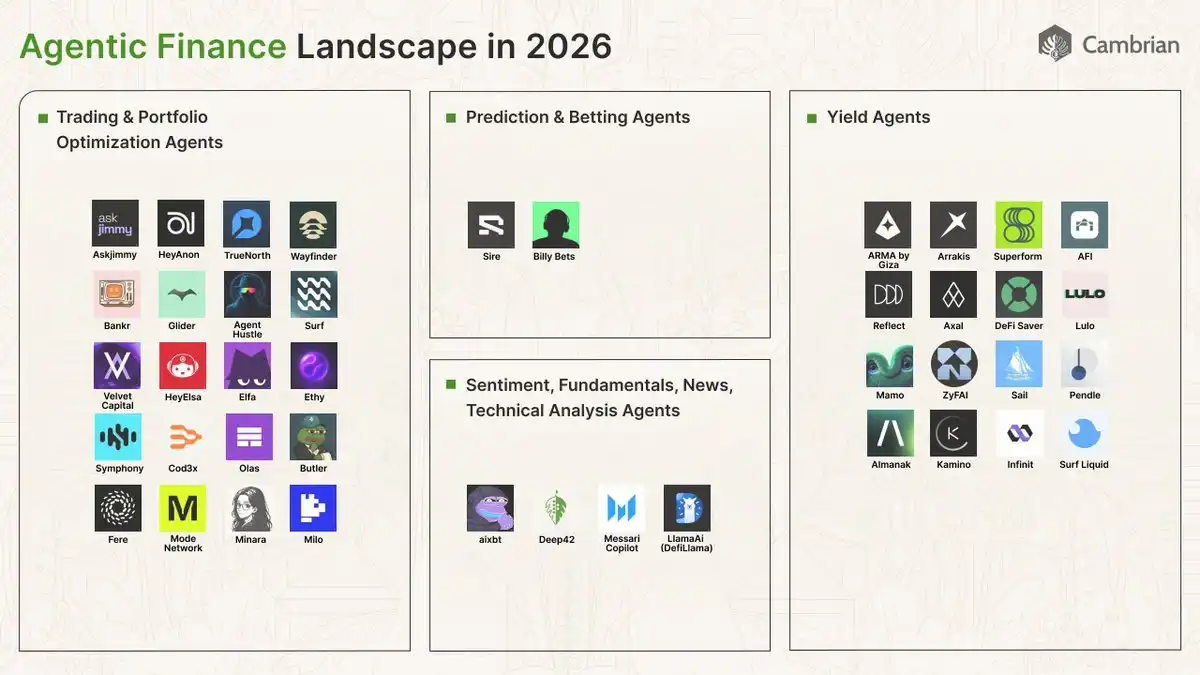
This report surveys the panorama of autonomous products supporting retail users' participation in decentralized finance (DeFi). As before, we have set strict inclusion criteria: selected projects must be active and publicly available, with real users and actual operating funds. Agents are categorized by product type.
Note: In this report, products previously classified as "Liquidity Providing Agents" and "Lending Agents" have been merged into the broader "Yield" category, reflecting the increasingly diverse ways agents earn yield.
What is Agentic Finance?
Agentic Finance is an emerging market segment where products use automation technology to actively manage user funds or provide financial advice. Inspired by ChatGPT, Claude Code, and emerging open-source agent tools like OpenClaw and Moltbot, some products use LLMs, while others employ hard-coded rules or traditional machine learning. Regardless of the underlying technology, many describe themselves as "agentic".
The early form of Agentic Finance was simple automated trading bots. The DeFi summer of 2020-2021 brought yield farming bots and Vault protocols like Yearn that could automatically harvest and compound yields, but the logic was still deterministic: if X is true, execute Y. By 2022-2023, automation expanded cross-protocol and cross-chain (bots managing collateral ratios, rebalancing LP positions, chasing yield in lending markets), but users still held the keys and set every parameter.
The first real shift occurred in 2024 when LLMs entered the tech stack, and we began to see natural language interfaces, AI-powered analytical agents, and conversational trading. The decisive breakthrough happened in 2025—the first closed-loop agents that acted according to strict rules without human approval. Today, Agentic Finance is an acknowledged market category, and the Cambrian team is proud to have pioneered the terms "agentic finance" and "AgentFi" to describe this segment. The products covered in this report represent the next major step in AgentFi's development: software capable of making decisions, managing capital, and paying for its own operations.
Autonomy and Intelligence in Agentic Finance
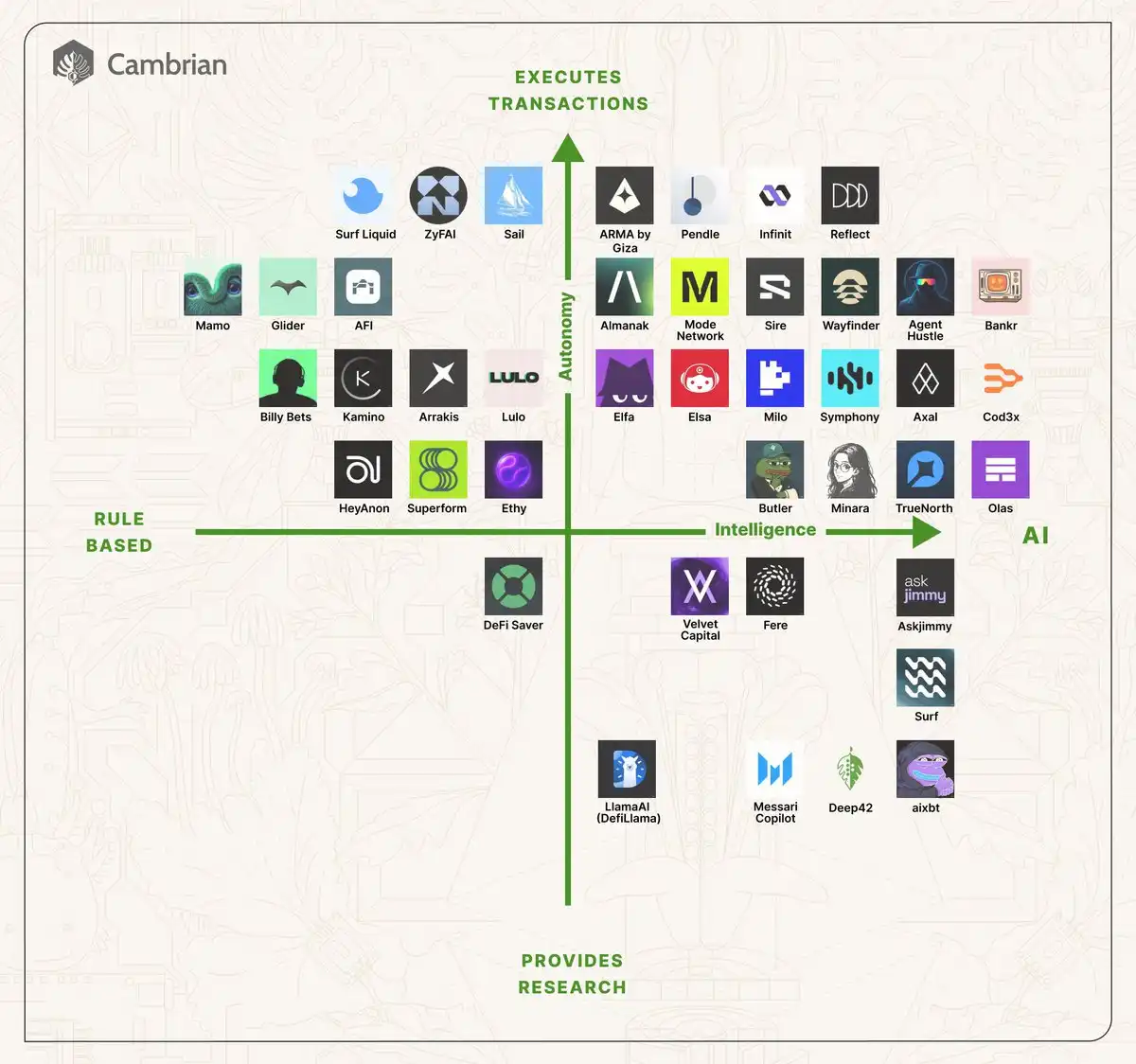
Agentic Finance projects span multiple specialized use cases, but each can be placed on a simple coordinate system. The horizontal axis represents the degree of intelligence: left for rule-based systems relying on math and statistics, right for systems based on LLMs (which many now call "AI Agents"). The vertical axis represents the degree of autonomy: bottom for informational tools, middle for systems requiring human intervention, top for systems that execute autonomously within a strategy's scope without requiring approval.
Since the first issue of this report, the market's center of gravity has shifted upwards towards higher autonomy, while the products with the largest assets under management (AUM) remain on the rule-based side for capital allocation decisions. LLMs have shown their strength in interfaces, information retrieval, and analysis, but when it comes to fund flows, algorithm-based rule agents are still mainstream because reliability and auditability are crucial.
AgentFi Market Growth 2025-2026
Growth Data
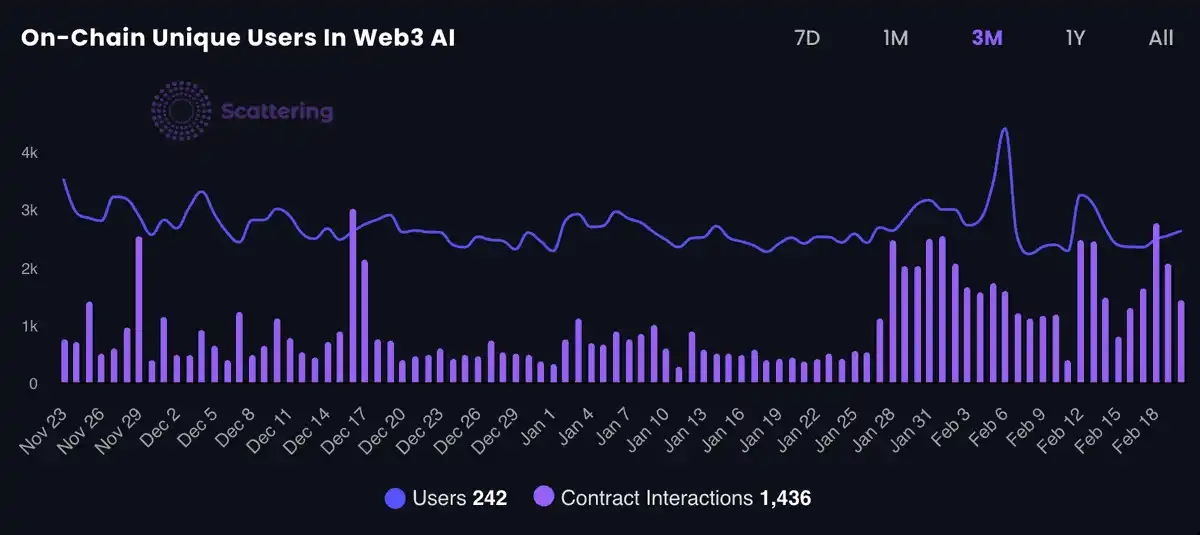
Since the last report, the ecosystem has continued to expand. The number of unique users of on-chain AgentFi products continues to climb. In the past 30 days, Bankr and Giza led in user deposits, each with 900+ deposits.
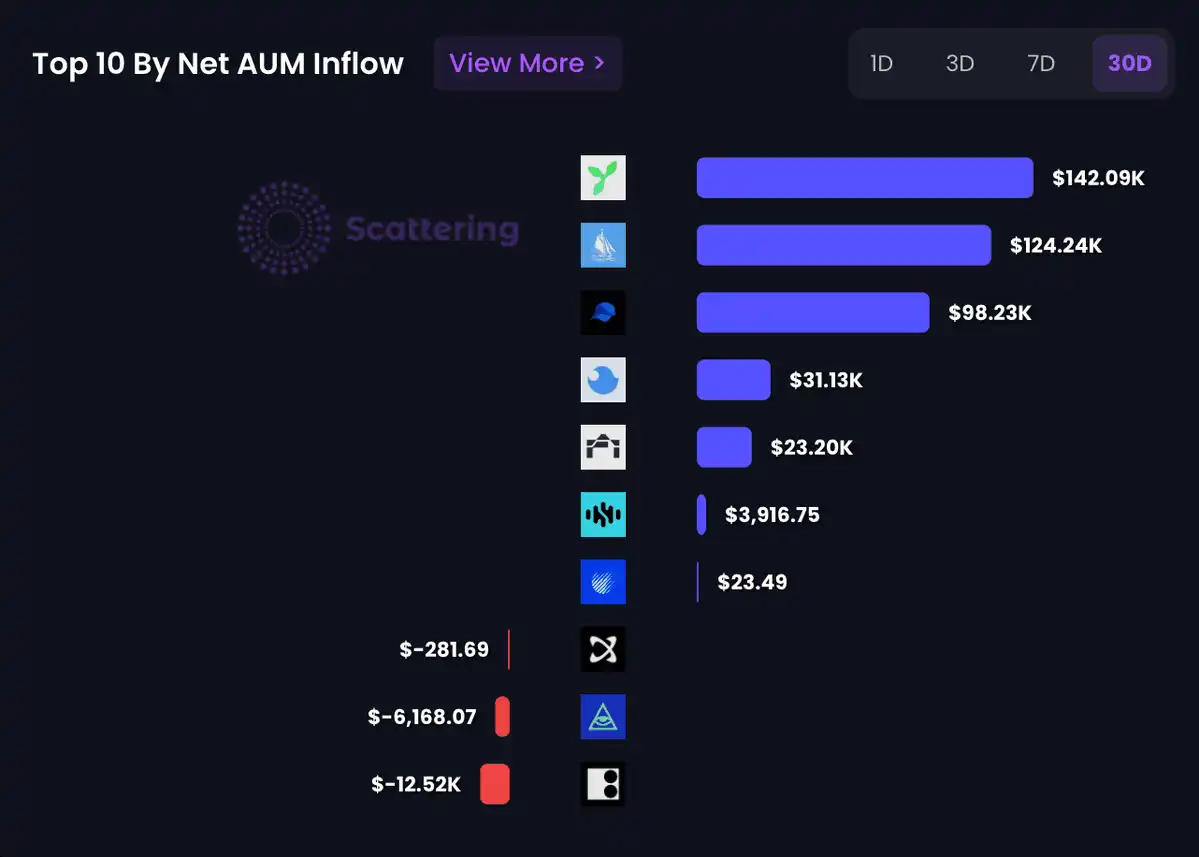
Among the agent projects dominating the field, yield-seeking agents are at the center of discussion alongside trading and portfolio optimization agents.
We are also seeing increasing institutional interest and active investment in building the infrastructure needed for the exponential growth of Agentic Finance. Examples include: Grayscale's launch of a decentralized AI fund in late 2025, Robinhood's release of the Cortex assistant for retail users, and Visa's launch of the Trusted Agent Protocol, designed based on Coinbase's x402 payment standard, for AI commerce scenarios.
x402 continues to expand to new chains, now supporting BSC and Polygon in addition to the already supported Base and Solana. Although slowed by recent market conditions, agent payment volume remains strong, with cumulative x402 transaction volume exceeding $50 million. In the past 30 days, most x402 transaction volume was processed by Virtuals.
Emerging Trends
If you are active on X, you may have noticed your timeline recently flooded with OpenClaw-style agents built on the OpenClaw core framework, such as clawdbotatg. These agents can autonomously complete payments, mint tokens, execute AI-driven crypto trades, and participate in prediction markets.
Bankr has become a widely used execution layer for these OpenClaw agents, offering programmable wallets and automatic fee redirection to help cover operating costs. It's not just Bankr—over 80+ projects are building Agentic infrastructure for OpenClaw-style agents on Base, enabling them to participate in Agentic Finance.
Various emerging agents are also actively utilizing the recently launched ERC-8004, registering their identities as NFTs and building reputation histories to prove their legitimacy. Since ERC-8004 went live on January 29th, over 24,000 agents have registered.
With the叠加 (stacking) of all the standards mentioned in previous reports (ERC-8004, x402, AP2, ACP), crypto infrastructure is proving to be the most powerful underlying layer for AI agents to hold, transfer, and create monetary value, without any gatekeepers. A recent case is Coinbase's newly launched Agentic Wallets.
Agentic Finance Panorama Q1 2026
In early 2026, retail users are the early adopters of Agentic Finance, institutions are watching but still far from full adoption. Below is a list of the most representative retail-oriented AgentFi products.
Cambrian has strict screening criteria for inclusion in the Agentic Finance Panorama: We do not include projects still in development or internal testing phases, nor do we include projects that only provide an LLM interface but require humans to make "critical" decisions. This excludes many projects.
Trading & Portfolio Optimization Agents
Trading agents are the products most people think of first when they hear "agentic finance." These agents manage user funds by rebalancing portfolios or choosing assets to buy and sell. Trading decisions require access to exchanges, tradable assets, budgets, trading guidelines or rules, and high-quality data. The following tools support one or more of these aspects.
@askjimmy_ai: AI signal terminal with win rate/P&L, supports one-click execution
@HeyAnonai: Spot and leveraged trading configurable via natural language prompts
@get_truenorth: Trading functionality supported by advanced discovery and research engine
@AIWayfinder: Utilizes on-chain agents for autonomous cross-chain trading
@bankrbot: All-in-one DeFi terminal supporting cross-chain swaps and automated strategies
@glider_fi: Automated, customizable portfolio management
@AgentHustleAI: DeFi personal assistant, covering basic swaps to custom automated strategies
@Velvet_Capital: DeFi app equipped with information assistant, can perform basic operations (e.g., swaps)
@SurfAI: DeFi research and execution assistant combining deep market analysis with automated trading workflows
@HeyElsaAI: AI assistant for managing crypto assets, executing DeFi trades, and providing real-time cross-chain data
@elfa_ai: Trading assistant with analytical core, blending social signals and smart wallet tracking
@ethy_agent: Autonomous trading assistant, directly executes trades, staking, yield, and transfers from user's smart wallet
@symphonyio: Cross-chain DeFi execution terminal with AI trading assistance
@Cod3xOrg: Event-driven trading engine with terminal supporting updatable algorithmic trading strategies
@autonolas: Autonomous portfolio management agent deployed via desktop, supporting adaptive DeFi strategies
@Butler_Agent: Orchestration agent executing trades, yield farming, and DeFi automation via Virtuals Protocol Agent
@fere_ai: AI assistant supporting cross-chain, meme coin, prediction market, and DeFi protocol trading
@modenetwork: Perpetual DEX with LLM-driven trading agent executing 24/7 based on user-configured strategies
@minara: AI trading assistant with perpetual contract assistant and customizable agent workflows
@MiloOnChains: Solana trading agent supporting natural language execution and optional 24-hour automatic trading
Yield Agents
Earning yield in AgentFi takes many forms; currently, the most popular is through lending protocols (borrowers pay interest, lenders earn yield). Users can also provide liquidity in DEX (decentralized exchange) liquidity pools to earn trading fees, or deposit funds into curated vaults that allocate capital across multiple venues. The following agents help users find the best risk-adjusted returns in these strategies.
Note: In previous versions of the report, we split LP Agents and Yield Agents into separate categories. Over time, we've found more and more projects integrating multiple yield generation strategies, including but not limited to lending, LP, and spot trading.
@afiprotocol_xyz: Yield optimization through non-custodial algorithmic agents managing liquidity and derivative strategies
@almanak: Multi-strategy yield optimization utilizing AI-generated strategies
ARMA by @gizatechxyz: Stablecoin yield agent
@ArrakisFinance: Automated market making strategies
@getaxal: Finds optimal lending protocols, liquidity pools, and delta-neutral yield strategies
@DeFiSaver: Lending across all major protocols, provides automatic anti-liquidation protection
@Infinit_Labs: DeFi abstraction layer offering one-click preset agents and promptable DeFi strategies
@kamino: Automated lending protocol on Solana, offering optimized yield, leveraged positions, and modular credit markets
@uselulo: Generates yield by depositing funds into over-collateralized lending pools
@mamo: Financial assistant aimed at simplifying personal finance management
@pendle_fi: Autonomous yield optimization across lending protocols, vaults, and delta-neutral strategies
@SaildotMoney: Automatically rotates funds between lending pools, vaults, and AMMs
@superformxyz: Non-custodial on-chain digital bank, aggregating yield from cross-chain lending protocols, supports cross-chain deposits
@Surf_Liquid: On-chain DeFi agent, autonomously manages stablecoin yield with verifiable rebalancing history
@RFLnow: Autonomous agent on Base, end-to-end management of LP yield farming, including deploying liquidity, harvesting, rebalancing, and optimizing returns
@Zyfai_: Lending yield management
Prediction & Gaming Agents
Prediction markets are platforms where users can trade on the outcome of future events (e.g., election results or sports matches). These markets often require tracking news and other real-time changing real-world information. Prediction markets are one of the most exciting emerging categories in AgentFi. Agents can ingest and track real-world event information from a wider range of data sources than humans can handle manually, making them ideal participants for prediction markets.
We expect this segment to continue growing in 2026. Academic research (like this study from the Federal Reserve) suggests prediction markets can provide valuable insights for decision-makers. Meanwhile, the CFTC is asserting its authority to legitimize prediction markets, overriding state objections.
@AskBillyBets: Active in crypto-based sports betting and prediction markets
@sire_agent: Collective autonomous sports betting fund driven by AI strategy execution
Sentiment, Fundamental, News & Technical Analysis Agents
Investors typically use market analysis to decide what to buy and sentiment analysis to decide when to buy and sell. LLMs have significantly changed market and sentiment analysis by expanding the volume of data analyzed, speeding up analysis, and forming deeper contextual understanding by identifying connections between data sources. The key distinction of analytical agents from those above is that they do not take direct action but provide informational guidance. There are many analytical agents; below is a partial list.
@aixbt_agent: Crypto market intelligence, narrative detection, alpha analysis, KOL tracking
@DeepFortyTwo: Alpha-finding agent monitoring high-signal tweets on X, scoring and analyzing on-chain and off-chain information
LlamaAI by @DefiLlama: DeFi data assistant querying the DefiLlama database for TVL, yields, fees, and token analysis
Messari Copilot by @MessariCrypto: Powered by Messari research and real-time data, provides answers with citations
Next Steps for Agentic Finance in 2026
The first quarter of 2026 has been testing crypto infrastructure under pressure. The total crypto market cap corrected amid macroeconomic uncertainty after peaking above $4 trillion. However, BlackRock's IBIT (iShares Bitcoin Trust) recorded a historic single-day volume of $10 billion in early February; tokenized RWAs have surpassed $20 billion (tokenized treasuries alone are $8-10 billion, up from $5.5 billion in Q3 2025); stablecoin supply has climbed to $3.1 trillion.
Regulatory Clarity & The Convergence of DeFi, TradFi, and AI
The regulatory landscape continues to evolve towards providing clear rules for the sustained growth of the crypto economy. We see this as significant progress, as regulatory clarity is key for TradFi to bring more capital into crypto轨道 (tracks/orbits). For example, the SEC under Chairman Paul Atkins announced an "Innovation Exemption" and upcoming "Crypto Regulation" rulemaking, while the passage of the CLARITY Act (clarifying CFTC/SEC jurisdiction) before the November 2026 midterm elections is a realistic possibility. Meanwhile, Hong Kong is preparing to issue its first stablecoin licenses in March 2026; the UK FCA (Financial Conduct Authority) has opened a regulatory sandbox supporting UK stablecoin issuance; the full MiCA CASP (Crypto Asset Service Provider) compliance deadline will arrive in July 2026—following the delisting of USDT by several EU exchanges last year, Circle's EURC has become the dominant compliant Euro stablecoin.
Regulatory clarity combined with battle-tested crypto infrastructure is laying the foundation for institutional capital on-chain and the maturation of Agentic Finance at scale. In the coming months, we expect both institutional adoption and Agentic Finance to continue growing, but along parallel tracks. Agentic Finance must first establish a credible track record for retail users before institutions allocate meaningful capital; only then will these two trajectories converge.
We also expect stablecoin usage and agent payments to continue growing as new autonomous agent trends (like OpenClaw) emerge and require programmatic access to APIs, computing power, and third-party services. Stablecoins, as the native settlement layer for machine-to-machine transactions, are poised to be a key catalyst for Agentic Finance going mainstream.







