After Two Consecutive Years of Independent Verification, Matrixdock Turns Reserve Transparency into On-Chain Financial Infrastructure

marsbitPublicado em 2026-07-28Última atualização em 2026-07-28

Resumo

The article discusses the importance of sustained transparency and independent verification for tokenized real-world assets (RWA), moving beyond a one-time proof of reserves. It highlights Matrixdock, a platform under BIT, which has completed its fourth consecutive semi-annual independent reserve audit conducted by Bureau Veritas. This marks two years of consistent verification, now extending to include its tokenized silver product (XAGm) alongside gold. The audit confirmed the full backing of all circulating tokens with physical bullion stored in institutional vaults. The piece argues that as RWAs like tokenized gold and treasuries become integral to on-chain finance—used in lending, payments, and institutional treasury management—trust must be built through continuous mechanisms, not single audits. Matrixdock’s approach, termed a "Reserve Transparency Stack," combines periodic third-party audits, monthly reserve reports, on-chain proofs, and asset lookup tools. This shift reflects an industry evolution where competitive advantage lies not just in asset tokenization, but in establishing reliable, long-term transparency infrastructure that supports ongoing participation in decentralized finance.

For tokenized assets, market trust is not built on the day of issuance.

A single audit can prove the existence of assets at a specific point in time, but when these assets begin to enter on-chain financial scenarios such as lending, payments, and fund management, the market's focus shifts to whether the underlying reserves still genuinely exist and continue to undergo independent verification months or even a year later.

As more and more RWA products enter on-chain financial scenarios, the industry's focus is gradually extending from asset issuance itself to the ongoing transparency and verification mechanisms post-issuance, shifting from "proving asset existence" to "continuously proving asset credibility." Reserve transparency is therefore no longer just an information disclosure requirement during the product issuance stage, but is beginning to become a fundamental capability supporting the sustained participation of RWAs in on-chain finance.

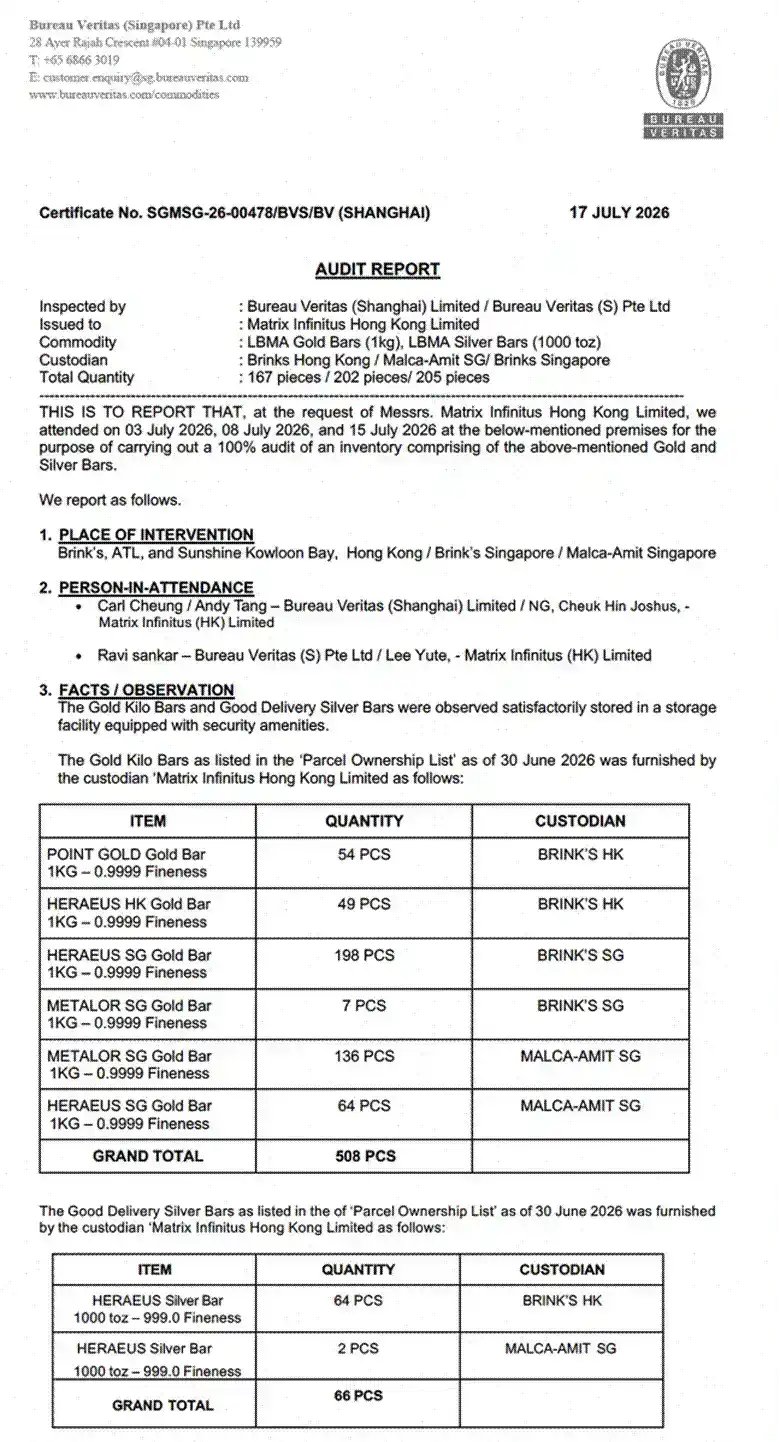
Recently, Matrixdock, the RWA tokenization platform under BIT (formerly Matrixport), completed its fourth consecutive six-month independent reserve audit. The independent reserve verification was again conducted by the international inspection and certification body Bureau Veritas, and for the first time included the tokenized silver product XAGm within the audit scope. This audit covered a total of 574 gold and silver bars from LBMA (London Bullion Market Association)-certified refineries, stored across three institutional-grade vaults in Singapore and Hong Kong.
Compared to a single audit result, two consecutive years of independent verification also reflect that reserve transparency is gradually evolving from a one-time proof of assets towards a continuously operating transparent mechanism.

From One-Time Verification to a Continuously Operating Transparent Mechanism

In traditional financial markets, whether for ETFs, funds, or custodial assets, market trust is not built on a single audit, but relies on continuous information disclosure, third-party verification, and long-term operational mechanisms. For financial products, market trust stems more from a continuous, stable, and transparent mechanism than from a one-time verification result.

As RWAs begin to assume more on-chain financial functions, this type of continuously operating transparent mechanism is gradually becoming a fundamental industry capability, rather than a mere compliance requirement.

According to information released by Matrixdock, this marks the platform's fourth consecutive completion of a six-month independent reserve audit, and the second consecutive year of independent reserve verification performed by Bureau Veritas. This means Matrixdock has maintained a consistent and continuous independent reserve verification mechanism for two consecutive years.

Compared to a one-time asset verification, continuous verification by the same international third-party institution can not only maintain consistency in verification standards but also means that reserve assets can be tracked long-term under a unified methodology. For financial markets, what matters is not the audit result at a single point in time, but whether the verification mechanism can operate long-term and stably. For Matrixdock, reserve transparency does not come from a single audit, but is continuously built through ongoing operation. Two consecutive years of independent verification is precisely a manifestation of this continuous transparent mechanism.

In this audit, Bureau Veritas completed physical verification of all metal bars across the three institutional-grade vaults, including weighing, dimension measurement, and item-by-item cross-checking with vault records. The audit results show that the underlying gold reserves for XAUm are consistent with the circulating token quantity; after applying the corresponding ozPerToken value, the reserve assets for XAGm are also consistent with the circulating token quantity, with no discrepancies found.

Meanwhile, the inclusion of XAGm in the independent reserve audit for the first time signifies that the same set of reserve verification standards is beginning to cover more tokenized precious metal products, rather than being applicable only to a single asset.

Transparency: More Than Just Proving Asset Existence

If reserve transparency in the past primarily meant "proving the genuine existence of assets," then as RWAs enter the on-chain finance stage, it is beginning to take on another, more important function—continuously supporting market trust.

In addition to the semi-annual independent reserve verification, Matrixdock also continuously discloses monthly reserve reports, on-chain Proof of Reserves, and the Gold Allocation Lookup tool among other transparency mechanisms. This provides the market with continuously updated reserve information, rather than relying solely on periodic audit results.

Matrixdock refers to this system as the "Reserve Transparency Stack." This system does not rely on a single proof but combines multiple components—independent third-party verification, on-chain data verification, and continuous information disclosure—to jointly build reserve transparency capability.

Behind this change is also a reflection of the industry's evolving needs. For lending protocols, payment networks, and institutional fund management, what truly matters is not just whether there is sufficient reserve backing on the day of asset issuance, but whether the assets can continuously maintain transparency, verifiability, and traceability throughout their entire lifecycle. Transparency is evolving from a one-time "proof" into an essential trust foundation supporting the continuous operation of on-chain finance.

When Reserve Transparency Begins to Impact On-Chain Finance

In recent years, tokenized gold, U.S. Treasury bonds, and other RWA products are gradually entering more on-chain financial applications such as lending, liquidity management, payments, and institutional reserve management. Real-world assets are shifting from being mere "on-chain representations" to becoming "on-chain financial assets."

This change signifies that the role of the underlying reserve is also transforming. In the past, it primarily supported asset issuance; now, it is beginning to support the continuous circulation, collateralization, settlement, and institutional allocation of assets on-chain. For institutions, assets not only need to be tokenized but also require the capability for continuous verification, continuous disclosure, and continuous operation.

According to information disclosed by Matrixdock, continuous reserve verification helps tokenized assets further enter lending, institutional fund management, and more on-chain financial scenarios. From this perspective, what reserve transparency supports is no longer a single product, but the trust foundation required for assets to enter the on-chain financial ecosystem.

If the competitive focus in the RWA industry over the past few years has been "how to bring real-world assets onto the chain," then as the industry gradually enters a new developmental stage, competition is beginning to shift towards "how to enable these assets to participate in on-chain finance long-term." With asset issuance becoming increasingly mature, continuous verification, continuous disclosure, and long-term operational mechanisms are becoming new focal points for institutions.

For the entire RWA industry, what may truly differentiate players in the future is perhaps no longer just the scale of assets, but who can continuously verify reserves, continuously disclose information, continuously build market trust, and consolidate these capabilities into a long-term, stable, and operating transparent system. As more and more real-world assets enter on-chain financial scenarios like lending, payments, and institutional fund management, reserve transparency is also evolving from a product capability into an important trust infrastructure connecting real-world assets with on-chain finance.

This article is contributed and does not necessarily represent the views of BlockBeats.

Perguntas relacionadas

QWhat is the core evolution of reserve transparency for RWA platforms as discussed in the article?

AThe article highlights that reserve transparency is evolving from a one-time proof of assets at issuance into a continuous operating mechanism. It is shifting from merely 'proving assets exist' to 'continuously proving assets are trustworthy,' becoming a fundamental trust infrastructure for RWA to participate in on-chain finance over their lifecycle.

QWhat significant milestone did Matrixdock achieve in its recent audit according to the text?

AMatrixdock completed its fourth consecutive semi-annual independent reserve audit conducted by Bureau Veritas. This marks two consecutive years of consistent independent verification for its gold product (XAUm) and, for the first time, included its silver product (XAGm) within the audit scope.

QHow does Matrixdock's 'Reserve Transparency Stack' provide ongoing transparency beyond periodic audits?

ABeyond the semi-annual independent audits, Matrixdock's 'Reserve Transparency Stack' includes continuous disclosures such as monthly reserve reports, on-chain Proof of Reserves, and a Gold Allocation Lookup tool. This multi-layered system provides persistent, updated information rather than relying solely on periodic audit results.

QWhy is a consistent, long-term verification mechanism considered more important for financial markets than a single audit?

AFor financial markets, trust is built on sustained, reliable transparency mechanisms and long-term operational stability, not a snapshot audit result. Consistent verification by the same independent third-party (like Bureau Veritas for Matrixdock) ensures methodological consistency and allows for long-term tracking of reserve assets, which is crucial for institutional confidence in on-chain finance applications.

QWhat broader industry shift does the article suggest is happening in the RWA sector regarding competition?

AThe article suggests the RWA industry's focus is shifting from competition on 'how to bring real-world assets on-chain' to 'how to enable these assets to participate in on-chain finance long-term.' Future differentiation will depend less on asset scale and more on which platforms can build sustained trust through continuous verification, disclosure, and operation of a robust transparency framework.

Leituras Relacionadas

In Conversation with Ray Dalio: We Are Currently in an AI Bubble, with 1% of My Portfolio in Bitcoin

Ray Dalio, founder of Bridgewater Associates, warns in an interview that the current AI boom shows classic bubble characteristics, which could lead to significant economic downturns as seen in past cycles like 1929 or 2000. He explains that speculative enthusiasm, fueled by debt and overvaluation, often precedes a crash when rising rates or taxation force asset sales, causing widespread losses and recession. Dalio also outlines his "Big Cycle" theory, describing an approximate 80-year pattern where widening wealth gaps, massive government deficits, and shifting geopolitical power (like China's rise) create internal conflict and global instability. He emphasizes that we are in a late-cycle, transitional phase where traditional powers like the US and UK face decline. For personal wealth protection, Dalio advises diversification beyond cash into assets like stocks, bonds, real estate, and particularly gold, which he prefers over Bitcoin. While he holds about 1% of his portfolio in Bitcoin as a non-printable hard asset, he views gold as more secure from technological or governmental threats. Regarding AI's impact, Dalio believes it will disproportionately benefit capital owners, worsening inequality by replacing both physical and cognitive labor. He suggests that human intuition and emotional intelligence, combined with AI, will be key for future workers. On taxation, Dalio argues that wealth taxes are impractical and risk triggering asset sell-offs, reducing productive investment. He points to the UK as a cautionary example of debt, low productivity, and political strife. Geopolitically, Dalio foresees a more regionalized world, with the US showing weakness in prolonged conflicts like with Iran, akin to past imperial declines. The ideal outcome, he suggests, is coexisting powerful blocs (e.g., Americas, China-Asia Pacific) without major war.

marsbitHá 3h

In Conversation with Ray Dalio: We Are Currently in an AI Bubble, with 1% of My Portfolio in Bitcoin

marsbitHá 3h

Daily 7.2 Trillion KRW: Foreign Capital's Record Net Buying on Friday! Wall Street Says Headwinds for Korean Stock Fund Flows Have Subsided

South Korean stock market sees a dramatic shift in fund flows. On July 31, foreign investors made a record net purchase of approximately KRW 7.2 trillion in KOSPI stocks, marking a fundamental reversal from the persistent large-scale net outflows seen in previous months. This contributed to a significant narrowing of foreign net selling in July to KRW 9.8 trillion, down sharply from KRW 48.4 trillion in June and KRW 44.5 trillion in May. Simultaneously, domestic institutional pressure eased. South Korean pension funds and asset managers turned to a net buying position in July, purchasing KRW 1.0 trillion worth of KOSPI shares, contrasting with net sales in May and June. Market volatility is expected to be dampened by new financial regulations. Effective July 31, the Financial Services Commission tightened access for retail investors to single-stock leveraged ETFs by raising the minimum cash deposit requirement. Trading volumes for these products subsequently dropped to about 50% of their monthly average. Citigroup Research maintains its year-end KOSPI target of 10,000 points. The firm cites several supportive factors: the substantial easing of headwinds from capital outflows, a robust fundamental outlook for the semiconductor sector, historically low market valuations, strong economic fundamentals, and the potential for policy support from financial authorities if needed.

marsbitHá 3h

Daily 7.2 Trillion KRW: Foreign Capital's Record Net Buying on Friday! Wall Street Says Headwinds for Korean Stock Fund Flows Have Subsided

marsbitHá 3h

Thanks to Dice Rolls, Bitcoin Keys Are Stored Offline, But Not Everyone Will Do It

The article discusses using dice rolls to generate secure Bitcoin wallet seeds, providing entropy independent of potentially flawed hardware random number generators. It explains that each fair dice roll offers about 2.585 bits of entropy, with around 50 rolls needed for a standard 12-word seed phrase and 99+ recommended for higher security. This method gained attention after a vulnerability was revealed in some Coldcard hardware wallets, where a faulty firmware RNG (dating back to 2021) compromised generated keys. The analysis notes that while a dice-generated main seed was safe from this specific flaw, other Coldcard functions (like creating paper wallets, backup keys, or passwords) could still be vulnerable if they used the defective RNG. The piece argues that while dice-based entropy is technically robust, the manual process is error-prone, tedious, and unrealistic for most new users, who might make mistakes in recording or inputting rolls. It concludes that while manual entropy generation should remain an option for advanced users, the long-term goal is to develop reliable, user-friendly hardware and software that securely generates randomness without requiring specialized knowledge. Coldcard users are advised to check their firmware version and replace any secondary secrets (like paper wallet keys) created with vulnerable devices, while also considering multi-signature setups with devices from different manufacturers for added security.

cryptonews.ruHá 8h

Thanks to Dice Rolls, Bitcoin Keys Are Stored Offline, But Not Everyone Will Do It

cryptonews.ruHá 8h

Trading

Spot
活动图片





